
Disclaimer: This article may contain inaccuracies and is for entertainment purposes only. Please do your own research. Feedback and corrections are welcome.
Stablecoins usually represent real-world currencies on blockchains. They are digital assets that are pegged to a fiat currency. A peg means there is a fixed exchange rate between the stablecoin and the currency (e.g. 1 unit of stablecoin for 1 USD, vice versa).
Fiat is Latin for ‘so be it’ and is used to characterise currencies given value by government decree. They are not backed by commodities like gold. The USD is an example. Being fiat, the Fed purchased nearly US$6 trillion (that is more than Australia, India, Indonesia and the Netherlands’ 2020 nominal GDP combined) worth of bonds and mortgage-backed securities from Mar 2020 – Mar 2022 with money magicked into existence with a few keystrokes (i.e. the Fed ‘printing money’).

Note: The Fed is the central bank of the US. It conducts US monetary policy in three ways – one way is buying securities to increase the total money supply, which is part of its ‘open market operations’.
Look at how the US M2 money supply increased between Mar 2020 – Mar 2022 compared to historical trends. Crazy.
I digress.
Stablecoins exist because you can’t just transfer the cash in your bank account to a cryptocurrency wallet, and a wallet is the only way to interact with apps and other users on a blockchain like Ethereum or Solana.
On blockchains, users can:
trade stablecoins for cryptocurrencies
transfer/receive stablecoins to/from other users
hold stablecoins (instead of holding the currency)
provide stablecoins as liquidity to automated market makers (decentralised exchanges) to benefit from commissions when others trade
lend their stablecoins to others to earn a yield (also called yield farming)
Founded in 2014, the most popular stablecoin is USDT, with over US$65b in circulation (27/6/22). It is designed to be pegged 1-to-1 with USD. USDT is a ‘centralised’ stablecoin, which means its supply and reserves are controlled by a single entity, which is Tether.
The company issues USDT like this:
A KYC-ed Tether user (individual, exchange, trading firm, etc) deposits USD into Tether’s bank account
Tether issues an equivalent amount of USDT to the user’s cryptocurrency wallet
e.g. Bob deposits 100,000 USD into Tether’s bank account and receives 100,000 USDT into his cryptocurrency wallet – assuming the peg remains at 1:1
If Bob wants to redeem his USDT for USD, he will deposit his USDT tokens into his account on Tether’s website (technically Tether’s crypto wallet). Then, Tether will remove his deposited USDT from the total USDT supply and send USD to his bank account. Simple, right? This is how most centralised issuers mint (create) and burn (remove from supply) stablecoins.
It is important to note this is not how most acquire USDT (and most other centralised stablecoins). Tether requires a minimum deposit/withdrawal of US$100k, charges a 0.1% fee for deposits and a US$1,000/0.1% (the greater of two) fee on withdrawals. Because of this, many obtain USDT like they would bitcoins – by buying through a centralised exchange (like Binance) or a decentralised exchange (like Uniswap).
Stablecoins should only hold their value when their issuers’ reserves match the value of total stablecoins issued. For example, you would not want to exchange your 1 USD for 1 USDT if Tether issued 2 USDT for every 1 USD they had in deposits. If Tether did that and if everyone opted to withdraw their USDT to USD at the same time, Tether would lack sufficient funds to fulfil the withdrawals.
However, because of opaque reserves reporting, the 1:1 reserves-to-supply rarely holds for certain centralised stablecoins.

Tether claims that all USDT tokens are pegged 1-to-1 with USD and are 100% backed by their reserves. However, its reserves aren’t sitting in a bank account waiting to be redeemed. As of 31 March 2022, cash and bank deposits are near only five percent of their total reserves. What about the other 95%?
According to the diagram above, Tether has over six percent of its reserves in ‘other investments’, which it does not catalogue beyond ‘digital tokens’ (like Bitcoin and Ether? One can only speculate).
This is irresponsible because it is not prudent to gamble reserves that are meant to maintain a 1-to-1 peg with the USD on volatile digital tokens.
The majority of the reserves however, are kept in short-term debt securities like commercial paper and US T-Bills. While T-Bills are bulletproof as they are issued by the US Treasury (i.e. the US govt), commercial paper risk depends on the issuer (e.g. Apple). Tether does not disclose which companies’ commercial papers it holds, only the credit ratings of the papers. What are they hiding?
This, and storing nearly 15% of its treasury in riskier assets does not instil confidence. For comparison, Circle, the issuer of the second-largest stablecoin, USDC, keeps >25% of its reserves in USD and the rest in short-term T-Bills. How is Tether still ahead of Circle?!
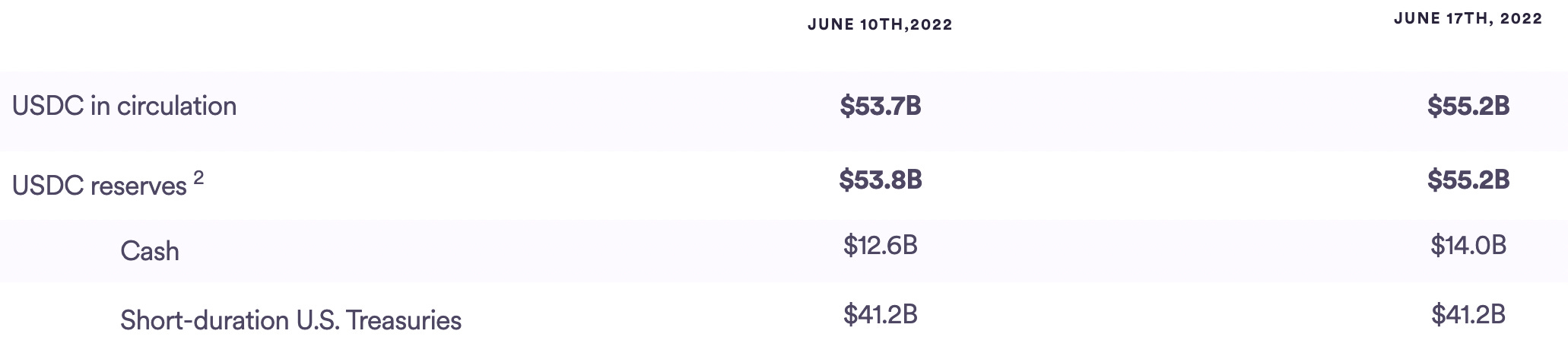
Additionally, while Circle reports on their reserves breakdown weekly, Tether last disclosed its quarterly reserve breakdown on 31 March 2022 (shown above). It claims on its ‘Transparency’ page that the value of its reserves is published daily. In reality, it shows a daily update of the total USDT issued on each blockchain, with two lines at the bottom of the page outlining total assets and total liabilities.
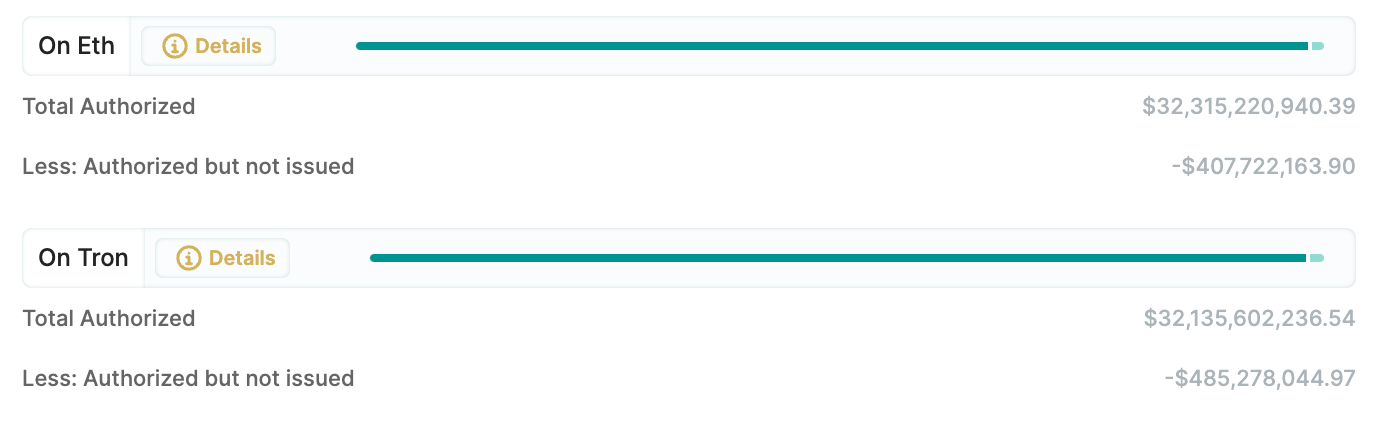

Compared to Circle’s weekly breakdown, its ‘daily reporting’ is laughable. Without a regularly-published, detailed breakdown, there is no way to tell if ‘Total Assets’ is made up mainly of low-risk, short-term debt or if Tether is betting the farm on Dogecoin with 100x leverage.
In April ‘22, Tether CTO Ardoino claimed Tether would continue to reduce its commercial paper holdings in favour of T-Bills. This follows from speculation that Tether held Evergrande’s commercial paper, which Tether denied. However, you’ll have to take Tether at their word because they only report their reserves breakdown once a quarter, with little detail.
If it were Tether’s choice, it would not report a breakdown at all. It is only because of a requirement included in their settlement (see clause 57) with the New York Attorney General (NYAG) in February 2021 that they publish quarterly breakdowns.
Tether’s reserves have also been the subject of multiple controversies throughout history (non-exhaustive list):
May 2019: Tether’s general counsel admits that only ~74% of USDT in circulation is backed by reserves
Feb 2021: Bitfinex (Tether’s owner) pays US$18.5m over mixing client and corporate funds to cover missing US$850m
Apr 2019: NYAG Press Release – ‘The filings explain how Bitfinex no longer has access to over $850 million dollars of co-mingled client and corporate funds that it handed over, without any written contract or assurance, to a Panamanian entity called “Crypto Capital Corp.,” a loss Bitfinex never disclosed to investors. In order to fill the gap, executives of Bitfinex and Tether engaged in a series of conflicted corporate transactions whereby Bitfinex gave itself access to up to $900 million of Tether’s cash reserves, which Tether for years repeatedly told investors fully backed the tether virtual currency “1-to-1.”’
Oct 2021: Tether ordered by CFTC (US government regulator) to pay a US$41m fine for misrepresenting to customers that it maintained sufficient reserves to back every USDT in circulation (i.e. USDT not ‘fully backed’)
Amidst the most recent cryptocurrency crash (which coincided with the 2022 stock market drawdown), Tether issued a statement last month where it bragged about honouring redemptions of >10% of circulating USDT within 48 hours (>US$10b). In the same statement, it also condemned critics, rhetorically asking ‘Which bank is able to process withdrawals for 10% of their total assets within 48hrs?’.
Tether not only embraced false equivalence but praised themselves for being a hen that lays eggs.
However, I do note that Tether is right in stating that USDT has never lost its peg. While multiple outlets have reported various times that USDT has ‘lost its peg’, it has not. USDT losing its peg would only happen when 1 USDT cannot be redeemed for 1 USD. Tether’s market price on exchanges fluctuates due to liquidity changes and regular supply and demand.
Despite this, who’s to say there won’t be a first? Two weeks ago, Celsius, a cryptocurrency exchange with >1m users and >US$11b in deposits froze withdrawals, swaps and transfers for all users. It has still not resumed yet. If Tether continues to play fast and loose in extremely volatile markets, they could be next.
Stablecoins Part 2 will cover UST’s US$45b collapse, other centralised stablecoins, decentralised stablecoins and regulation. If you would like me to cover a topic not mentioned, shoot me an email at arthurwongjh (at) gmail (dot) com.
No posts
Comments
Nothing yet. Say the first thing.
Sign in to join the conversation.