
Hello, I’m Junghyun Kim (a.k.a. Colin), CEO of BaeRae. Building wallets and on-chain payment infrastructure, I’m continuing this series to offer a different perspective on the stablecoin conversation.
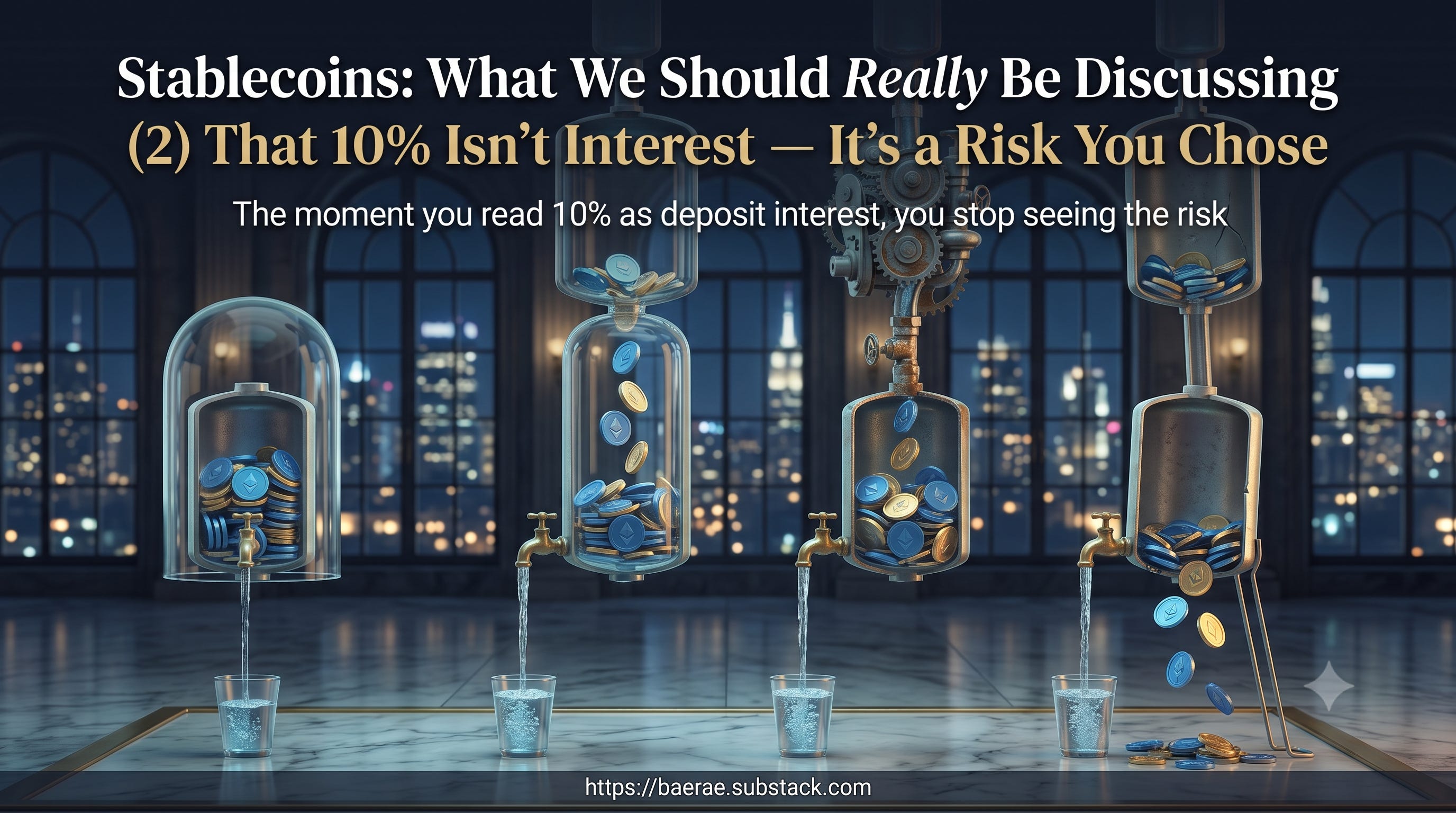
This post is about “yield.” Some stablecoin services advertise 5% a year; some advertise more than 10%. In an era when bank deposits pay 2–3%, that sounds extremely attractive. But I think the moment we call that number “interest,” we miss something important.
Let me be clear about one thing first: a stablecoin itself generates no interest. Hold a stablecoin in your wallet and the interest is zero. This is actually obvious — it’s exactly the same as cash in your wallet earning no interest. Holding a stablecoin is, in essence, holding a digital form of cash.
Interest arises only when you “put money somewhere or set it to work.” Just as depositing cash in a bank earns interest: if I deposit a million won, the bank lends that money out to generate returns and passes some of it back to me as interest. And that deposit is protected, up to a limit, by deposit insurance. Interest is a right embedded in the “deposit” contract.
A stablecoin’s “yield,” likewise, doesn’t come from merely holding it — it comes from lending it out or putting it to work somewhere. Up to this point the structure is the same as a bank deposit. In fact, bank interest is also, when you get down to it, compensation for risk: the bank bears the risk of the money it lends out going bad, except that deposit insurance absorbs much of that risk on the depositor’s behalf. Stablecoin yield is, at bottom, the same compensation for risk — but with a decisive difference: the risk is far larger, and there’s no safety net to absorb it. On the surface both look similar — “put money in, receive a return” — but one is interest whose risk is hidden behind a safety net, while the other is a larger payment with that risk left fully exposed.
So the sentence “stablecoin interest rates are higher than the bank’s” is a bit like setting an apple next to an orange and comparing them. Since the two are different in nature, it’s hard to line them up and measure them by the same yardstick.
So where does the yield actually come from? Stablecoin yield traces back to roughly five sources. Unpack each and its true nature shows.
First, T-bill interest pass-through. The issuer holds short-term U.S. Treasuries in reserve and passes some of that interest to holders. With 3-month Treasuries yielding about 3.65% as of 2026, products based on this typically return around 3.5–4.6%. This is the safest and most intelligible source — essentially a “tokenized money market fund.”
Second, lending interest. Deposit your stablecoin into a lending protocol, and the interest paid by borrowers flows back to you. But go one step deeper and the question becomes: who borrows stablecoins, and why?
One major source is the arbitrageur. Crypto is fragmented across hundreds of exchanges, so the same coin trades at slightly different prices from venue to venue. Arbitrageurs buy where it’s cheap and sell where it’s expensive, closing that gap (and, in the process, keeping prices aligned across the market). The catch is that these opportunities vanish in an instant, so they have to pre-fund accounts on many exchanges with capital they can deploy immediately. When their own assets are tied up in crypto (ETH, BTC, and the like), they need liquidity in stablecoin form that they can put to work right away without selling those holdings — so they post crypto as collateral and borrow stablecoins. Traders looking to add leverage, and holders who want cash-like funds without selling their crypto, pile onto the borrowing side too.
What’s interesting is that what people want to borrow is mostly not BTC or ETH but stablecoins. In practice, the bulk of on-chain lending takes the form of “posting crypto as collateral to borrow stablecoins.” As a result, even within the same lending market, borrow rates for stablecoins tend to run higher than the rates for borrowing BTC or ETH — because demand is concentrated on the stablecoin side. The more this borrowing demand crowds in, the higher the lending rate climbs — typically 3.5–7% a year.
But there’s a common misconception here. People worry “what if the borrower doesn’t repay?” — yet because blockchain loans are mostly over-collateralized, that worry is smaller than it seems. A borrower must post collateral worth more than the amount borrowed, and if the collateral’s value falls below a set threshold, the system automatically sells it to recover the loan (liquidation). This is different in nature from the “getting stiffed” default of traditional finance. The real risk lies elsewhere: when the collateral’s price crashes so fast that liquidation can’t execute in time or at a fair price, or when the mechanism that reads the collateral price (the oracle) malfunctions. In those cases, selling the collateral may not fully cover the loan, leaving a loss. In other words, the risk in lending yield isn’t “the risk of not being repaid” but “the risk that liquidation fails to work properly.”
Third, liquidity-provision fees. On a decentralized exchange (DEX), instead of a middleman like a bank, a pool of funds that people have deposited in advance (a liquidity pool) acts as the counterparty to trades. If I place stablecoins like USDC or USDT into such a pool, I earn a proportional share of the fee charged each time someone buys or sells in that pool. The more active the trading, the greater the return. Pools that pair stablecoins together (e.g., USDC-USDT) are relatively safe among these yield types, since both sides hover around one dollar and rarely diverge much in value. But it’s not risk-free: during the Silicon Valley Bank episode in 2023, USDC briefly fell to $0.87, and when one side’s peg breaks like that, providers can take a loss. Yield from trading fees alone typically runs 2–5% a year.
Fourth, the basis trade. This is the engine of high-yield stablecoins: hold spot and futures in opposite directions at the same time, capturing the funding that comes from the price gap between futures and spot. Whether futures trade above spot (the common case) or the reverse, the wider that gap, the larger the funding — and the larger the yield. Gaps tend to widen when the market runs hot. Products like sUSDe posted 10–20% a year this way at times. But this yield depends entirely on the gap between futures and spot, and that gap can collapse in an instant when conditions change. The classic case is a sharp market drop. In a downturn, when everyone piles into shorts, funding flips negative — and the income you were receiving turns into a cost you have to pay. At the same time, if the price whipsaws upward, the futures leg held as a hedge can face liquidation, forcing a hurried unwind. In the second half of 2024, exactly this combination played out during selloffs: a leading product saw large outflows, and the coin at one point traded well below its target. It looks like a stable high yield, but it’s a yield that can flip negative the moment the market changes direction.
Fifth, a marketing subsidy. This one differs in nature from the previous four. It isn’t earned from economic activity; it’s a promotional cost the service burns from its own pocket to attract users. The newer the protocol, the more it tends to hand out its own governance token or pile on extra rewards to draw in deposits early — and this inflates the headline yield considerably. The problem is that the subsidy isn’t sustainable, for two reasons. One: the budget for handing out tokens is finite, so over time the protocol reduces the number of tokens it distributes or ends the incentive program altogether. Two: the price of the token being handed out falls. Early on, expectations keep the token price high, so even a single token is worth a lot; but as more supply is released and the hype cools, the token price declines, and the same number of tokens is worth far less. When these two combine, it’s not rare for a product advertising “15% a year” to see its real yield collapse to 3% six months later. So when you see a high yield, you have to separate how much comes from genuine economic activity and how much is a temporary promotion.
What matters here is that these five carry completely different risks. The difference between T-bill interest (3.5–4.6%) and the basis trade (10–20%) is precisely a difference in risk. Just as volatile stocks demand a higher expected return than safe Treasuries in the equity market, this yield gap is not a bonus handed out for free but compensation for taking on greater risk. Extra yield does exist — but so does the variance.
So if you see a stablecoin yield of 10% a year, the question isn’t “the interest is high” but “what risk am I taking, and how much of it?” And here’s a common misconception: thinking that the sources above are all stacked, layer upon layer, into every product. They’re not. Which source a product draws its yield from differs completely from one product to the next.
A few examples. Hold USDC or USDT in your wallet and the yield is zero — the T-bill interest from the reserves goes to the issuer (Circle, Tether), not passed on to holders. But zero yield doesn’t mean zero risk. Even just holding, if the issuer goes bankrupt or the reserves turn out to be unsound, the peg can break and you can take a loss; and if your wallet or a smart contract is hacked, the coins themselves can be stolen. In other words, holding carries no yield but still carries principal risk. Deposit into a lending platform like Aave, and the yield comes mainly from the borrowing demand we saw earlier, along with the risk that collateral liquidation fails to work properly. A product like sUSDe derives most of its yield from the basis trade, and so it bears the risk of funding flipping. There are also products like sUSDS and sDAI that weave together Treasuries (RWA) and collateralized-lending fees and redistribute the proceeds. And the high yields of newer protocols often have a temporary marketing subsidy layered on top of all this.
In other words, the same number “10% a year” carries an entirely different kind of risk depending on whether it came from T-bill interest, the basis trade, or a subsidy. So when you look at a yield, the real thing to ask is “exactly which source does this come from, and what risk does that entail?”
And whatever the source, there’s a decisive difference from a bank deposit: there is no deposit insurance here. If a bank fails, deposit insurance returns a certain amount; but if something goes wrong in a stablecoin yield product — the issuer goes bankrupt, the protocol is hacked, the peg breaks — there’s no guarantee. Looking at past cases, recoveries have ranged from “total loss” to “full restoration.” So whatever the product, its yield also contains compensation for this uninsured risk.
Once you weigh the source and the risk this way, the number 10% stops looking like “high interest” and starts looking like “the price of taking on this much risk.” And that is the accurate view.
This isn’t just about using terms precisely. It’s because regulation is being drawn exactly along this line.
The U.S. GENIUS Act prohibits payment-stablecoin issuers from paying interest to holders. The aim is to box stablecoins in as a “means of payment” and stop them from spilling over into “investment products.” Yet interestingly, tokenized Treasury funds and separate yield products are classified as “investment products (securities)” and are allowed to pay yield. In other words, regulation is drawing a line: “if it pays interest, it’s not a means of payment but an investment product.”
This distinction is exactly the question that will apply to Korea’s won-stablecoin design. Will a won stablecoin bear yield, and if so, is it a means of payment or an investment product? How you answer this completely changes the product’s nature, which regulator supervises it, and how consumers are protected.
So the moment we casually say “stablecoin interest rate,” we smear over all of these distinctions — whether it’s interest or the price of risk, a means of payment or an investment product, protected or not.
So let’s return to the question we started with. When you see a stablecoin’s “high yield,” the real question isn’t “how much higher than the bank.”
When you put money in a bank, you don’t choose the risk. Whatever the bank does with that money, whichever loans go bad — that’s the bank’s risk to bear. The depositor only ever sees the result of it, as interest, and in the worst case deposit insurance stands behind them. Choosing the risk was never the depositor’s job.
Stablecoin yield products are different. Here you bear the risk yourself, and which product you pick determines which kind of risk you’re taking. Deposit into Aave and you take the risk that collateral liquidation fails to work properly. Choose sUSDe and you take the risk of funding flipping. Chase a new protocol’s high yield and you take the risk that the subsidy dries up. And in every case, there’s nothing standing behind you when something goes wrong.
Which means the very nature of the choice is different. At a bank, what we choose is a yield; with a stablecoin, what we choose is a kind of risk. The yield is merely what follows from that choice. This is the real reason two seemingly comparable numbers can’t be lined up side by side — and the reason that yield shouldn’t be called “interest.” Interest is something you receive; risk is something you choose.
So when you see 10% a year, the question to ask is this: which risk is this 10% the price of? If you can’t say what that risk is, you haven’t chosen it yet. You’ve simply taken it on.
In the next post, I’ll take on the “deposit token” the Bank of Korea is pursuing. This deposit token, which looks like a safe digital won, is structurally a “closed currency” — much like KakaoPay Money. I’ll look again, along the axis of openness, at what is gained and what is lost.
You can find my other writing on the structural shifts in blockchain, wallets, and digital assets — including the topics covered here — at BaeRae’s Substack. If you’d like to go deeper on any of these subjects or explore working together, feel free to reach out for a coffee chat anytime. Find me on X, Telegram, or LinkedIn.
This post reflects a personal view against the backdrop of the market and regulatory situation in the first half of 2026, and is not specific investment advice. Yield figures vary significantly by time and protocol. References: analyses of stablecoin yield sources and risk tiers (2026), the interest-payment prohibition in the U.S. GENIUS Act, Circle’s S-1 (reserve interest was 95–99% of revenue), and BIS analysis of stablecoin reserves.
No posts
Comments
Nothing yet. Say the first thing.
Sign in to join the conversation.