
I just finished Wind and Truth, a novel large enough that its physical form is classed as a deadly weapon in most jurisdictions and which, incidental to this intended use, finishes the first arc of Brandon Sanderson’s The Stormlight Archive. Overall, I thought it was an improvement on the last one. I liked it. The ending was interesting. But, time and again, I kept coming back to the same thought: why doesn’t this feel like a fantasy novel?
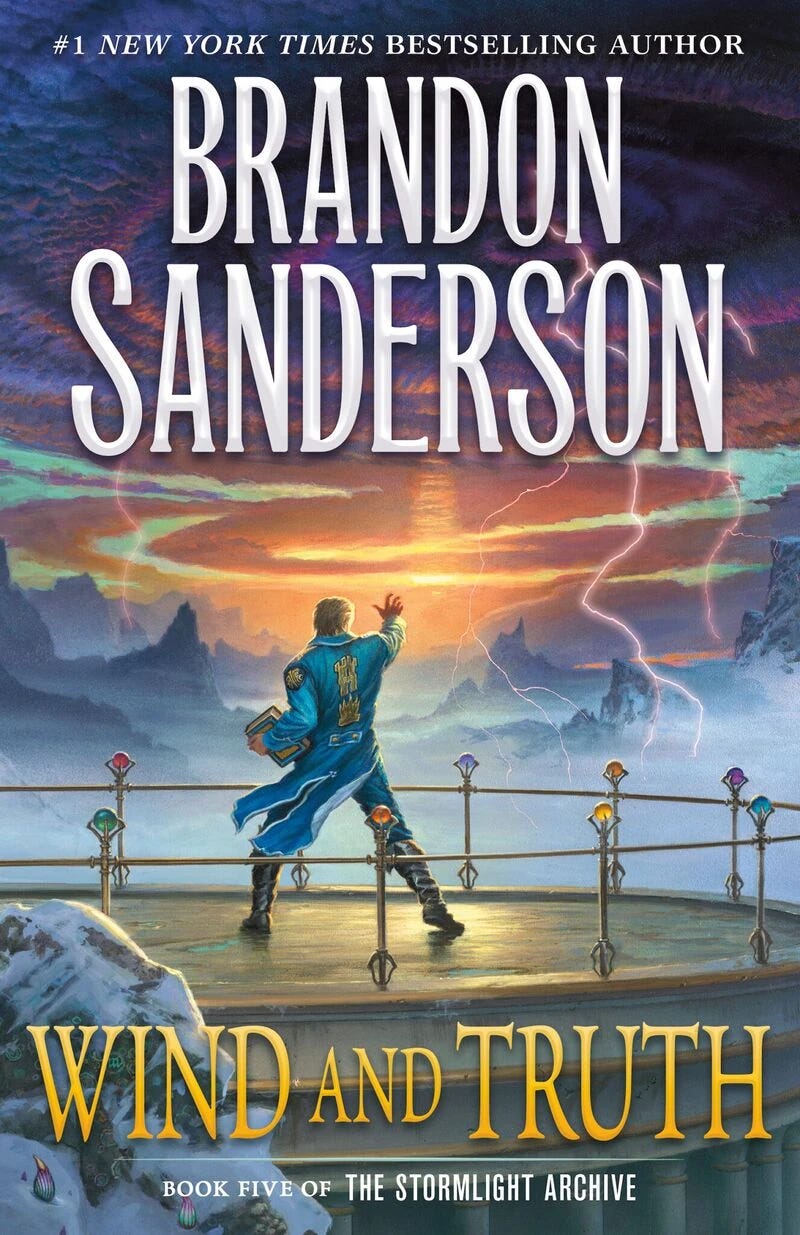
On the face of it, that’s an absurd thing to say. Sanderson is currently the biggest writer of adult epic fantasy1 and this is his biggest, most epic series. If any series of novels is the flagship of the fantasy genre right now — like The Wheel of Time was in its heyday — it is this one. Of course it’s fantasy!
And yes, it is. But, strangely, it doesn’t feel like fantasy. Not to me, at least. Something in the vibe, in the aesthetics, is discordant with the genre I know — something I can feel in my bones. Something that makes me look at an epic-length series based in a constructed world full of magic and gods and say, entirely seriously, that at some point it stopped feeling like this genre I know and love so deeply. So, let’s try to understand what and why that is.
But first: none of this is a criticism of this series or its writer. ‘Fantasy’ is a genre label. Literature isn’t good based on the degree to which it conforms to that label. So no, this isn’t in itself a criticism of the series. Instead, it’s an attempt to understand what we mean when we talk about fantasy, moving away from surface level boxes to tick (magic, secondary world, etc.) and towards what I’m broadly calling the ‘feel’ of the writing.
Beginning an interrogation into this intuition, the first and strangest thing to say is that this wasn’t always the case. The Way of Kings and Words of Radiance both felt very fantasy to me. It wasn’t until Oathbringer that this began to change, before I really identified the feeling while reading Rhythm of War.2 What’s up with that?
Something has changed as this series has progressed which fundamentally altered how it feels to read. No, not just something, but an overlapping cluster of somethings that are at times difficult to tease out and individually identify. Nonetheless, let’s attempt to do just that.
When talking about Sanderson, the first thing that gets brought up by critics is, usually, the prose. This is a starting point, and it’s a useful one. I have lots of thoughts on Sanderson’s prose most of which are best kept for another day, but a few are relevant here.
Sanderson talks about aiming for ‘clear’ prose. Prose that is unobtrusive and readable. To use his own metaphor, some prose is like a stained glass window, where the window itself is beautiful irrespective of what you can see through it, whereas he aims for a clear, clean, transparent window that exists only to show you what’s beyond. At its best, his prose falls away until you’re hardly even aware that you’re reading. Pages fly by, never fatiguing until your eyes start streaming and you realise it’s 3am and you’ve gotta be at work in six hours so you should probably try sleeping for a few of them.
However, Sanderson doesn’t always attain that ideal. Elantris, his first novel, has noticeably clunky and flabby prose. Reading it with any kind of eye towards editing will drive you up the wall. It’s a window with such shoddy craftsmanship that all you can see are the scratches. After Elantris, this changes. Mistborn era one, the early Stormlight books, and everything else he released during that period were the closest he ever came to achieving his ‘clear window’ ideal.
But then it changed again! Sanderson had always had a ‘problem’ — if I can use such a subjective term — with Whedon-esque banter, out-of-place terminology, and his particular brand of wordplay. It’s in all his books. Warbreaker suffers the most from it, but it’s heavily present from Shallan in Stormlight as well. At its best, it’s usually just not very funny (to me). At worst, it completely breaks emersion as a very modern turn of phrase shows up. The infamous ‘homicidal hattrick’ gag from Mistborn, for example. While this has always been present, it’s been getting more prevalent in his more recent novels.
Here’s the thing: this is the opposite of ‘clear window’ prose. It is a smudge on the window. Maybe you can see through it, but you have to squint, and all of a sudden you’re aware of the window in a way you weren’t before. Fantasy, in particular, carries prose expectations. The prose doesn’t have to be archaic or purple, but it does have to feel like you’re reading something fantastical. There needs to be something to it that carries the fantastical vibe. The Worm Ouroboros is written entirely in Jacobean English and, in sections where it quotes from letters using long abandoned spelling from before the Great Vowel Shift, is genuinely hard to parse. More modern fantasy tends to merely dop that which feels overtly of our particular time. Either way, if you could use the exact same prose in a contemporary thriller, it feels off. It begins to draw attention to itself, even though it’s not trying to.
I have thoughts on why I think this change occurred, but those thoughts are besides the point for today. The point is the effect this creates. When Kaladin is being referred to as a psychiatrist within the text of the book and the characters are talking like they’re in the MCU, it all starts to feel very different from fantasy as we have come to understand it.
Prose suffuses everything in a novel and this is a crucial element to the unfantasy feel, but it’s not the totality. All else, nonetheless, is compounded by the prose.
This was the realisation that started making everything else click into place. By the time of the fourth and fifth novels, most of our major characters are ‘Radiants’ — meaning they have access to two discrete magical abilities and effectively unlimited healing, along with greater speed, strength, and endurance, so long as they have access to enough mana. (Which, in this case, is called Stormlight and captured in gems semiregularly when a great storm passes over the world.)
Radiants don’t feel like fantasy adventurers to me. They’re not classic sword & sorcery barbarian heroes, or wizards, or rogues, or really anything the genre is used to. But do you not what they feel a lot like? Superheroes.
Superheroes pretty much across the board have broadly better physical characteristics than non-superheroes. Those things I just mentioned: superior speed, strength, endurance, and healing, they’re not all that common in fantasy but superheroes are all but guaranteed to have them, potentially along with a couple of other discrete abilities of their own. Spiderman has all that plus can shoot webs, climb walls, and sense danger. Superman has that stuff — just even more than most other superheroes — plus flight and laser eyes. Wolverine takes the healing to its absolute extreme and adds a metal skeleton and fist-blade-things on top of that same suite of stock abilities.
The Radiants’ two other abilities also feel more superhero than fantasy coded, in that they are specific, discrete, thematically relevant powers. Flight is the one we see most often, which is another stock superhero ability. (On the other hand, flight is relatively uncommon in fantasy, where characters more commonly fly by riding on something, like a dragon.) Many of the abilities are very explicitly manipulations of the Newtonian laws with semi-scientific explanations for how they work — the manipulation of gravity and friction and so on — which is again common in superhero media but much less so in fantasy. The result is Stormlight begins to feel less like a fantasy novel and more like someone took superheroes out of the comic book and into epic-length prose.
The earlier books, on the other hand, had far fewer Radiants. Those it did have — Kaladin and Shallan — were still figuring out their own powers and had to keep those powers hidden, rather than using them constantly as they do in the later books. Dalinar didn’t have these powers. Adolin didn’t know they existed. Before Stormlight was the story of the Radiants, it was the story of kings and princes and warriors whose only real use of magic was ancient magical weapons and armour. That all just felt much more typically fantasy.
Aside from the Radiants, the other primary use of magic in this world is the ‘fabrials’ — a form of technology usable by anyone which utilises the same principles as the Radiant powers.
From the beginning, fabrials were used for things like heating and instantaneous communication, with those same semi-scientific explanations for how they work, explicitly referencing Newtonian physics. However, over the course of the series, use of fabrials have increased, as has the series’ own interest in them. Rhythm of War included a whole subplot about them which someone somewhere presumably enjoyed reading. (I’m sorry — that one was just by far my least favourite of the series.) By Wind and Truth, they’re using fabrials in Urithuru for everything from lifts to running water. They’re taking showers using fabrial science.
Technologically, therefore, Stormlight doesn’t feel analogous to our past, which is very different to most epic fantasy. In fact, to me it feels more retro-futuristic. Retro-futurism, however, is not traditionally a fantasy thing. Instead, it usually feels more like sci-fi, in that the actual technology is beyond our present abilities and it’s only the set dressing around the technology that’s semi-historical.
Ever since the coining of ‘steampunk’ (itself coined from ‘cyberpunk’, which of course does not have that historical aesthetic), we’ve been using that ‘Xpunk’ construction for retro-futuristic settings, such as the ‘atompunk’ of the Fallout games. In this case, where the tech is being powered by a kind of magic, what might we call it? Magicpunk? No, I don’t think so. Because those genres lean into the aesthetics of the retro element whereas Stormlight decidedly doesn’t lean into the aesthetics traditionally associated with magic. What’s left is retro-futurism without the retro. It’s soft sci-fi where the tech happens to be called ‘magic’. It’s science fantasy of a sort. Even Star Wars — despite its otherwise far-future aesthetic — leans more into the mystical nature of its magic. (Midichlorians not withstanding.)
But that’s just hard magic, you shout at me.3 Well, it’s predicated on hard magic. But Sanderson has written hard magic systems that don’t end up feeling like another kind of technology. Elantris’s system, where magic is a writing system, isn’t used to replicate modern or futuristic technology. Mistborn’s, where the different magic systems involve using a particular metal to create a particular effect, is perhaps even harder than Stormlight’s (in part because it’s easier to understand and, where it relies on the laws of physics, keeps it all comparatively basic) but felt much more fantasy to me. This use of magic to broadly replicate technology, then, is not inevitable with Sanderson-esque hard magic but instead specific to this particular use of it. The result is a feeling closer to sci-fi than to fantasy.
Fantasy’s physical geography tends to be either broadly Earthlike — with magical additions — or some flavour of absurdist. Roshar is different. Its physical geography is, effectively, an alien biome. The weather, flora, and fauna are all entirely constructed, yet those elements have very little to do with the magic. Instead, the strange plants and animals are built up from evolutionary principles. The result is a world that feels like it could welcome Captain Kirk arriving to survey it on his five-year mission more than than it could Aragon on his quest to reclaim the throne.
And while Roshar’s physical geography fits at home with sci-fi, its human geography4 is positively modern. In the first two novels, we mostly hung out in the warcamps and in a political and social context that nodded towards the historic. Highprinces functioned like feudal grandees. Slavery was common and of crucial plot importance. Gender roles were constricting barriers. None of these individual elements are essential to fantasy, but overall they created a world that felt inspired by the historic and thereby at home with the fantasy that went before it.
But then everything changed. In Oathbringer, all the previously important intra-Alethi politics was abandoned. None of our characters are slaves any longer, so we can just free all the slaves off-page and assume that went fine. And now that women can be Radiants, we should probably just abandon misogyny whole cloth and, like with slavery, assume that no-one ever batted an eye about this.
Suddenly, we’re no longer living in a semi-historic, semi-feudal kingdom but instead in, well, it’s not entirely clear. Society is whatever Dalinar says it is, pretty much. If you don’t like it, the plot will find a way to kill you while Dalinar shakes his head so everyone knows he doesn’t approve of extrajudicial murder.
Now, that’s not to say that characters cannot hold broadly modern social or political views in fantasy media without abandoning a feel of fantasy. A lot of fantasy games, in particular, go that route, as it allows players to craft whatever characters they like without then suffering from discrimination and restrictions. D&D’s official worlds, Thedas from Dragon Age, and Tamriel from The Elder Scrolls all follow that logic and nonetheless immerse the player in a feeling of fantasy.
I also don’t think it’s a bad thing to do that. If a writer isn’t going to meaningfully engage with some social problem, including it merely for the sake of making their world look more historical isn’t in itself a good thing. It may even be distracting. What makes Stormlight feel ‘unfantasy’ isn’t that the characters hold those views but instead that transition, in which the previous social and political system was abandoned wholesale and largely off-page. The result of that is that we are reading about a very different, much more modern feeling world from Oathbringer onwards, which only highlights the lack of any real inspirations from the historic in any aspect of the worldbuilding.
Throughout all of this, I’ve been identifying the fantastical with the semi-historical. This is because I believe that, at a fundamental level, the fantasy genre is steeped in and broadly inspired by history. Without that, it stops feeling like fantasy.
The earliest fantasists writing for adults were attempting to replicate and put their own spin on fairytales, medieval romances, and the sagas — works of literature that explicitly coated themselves in the historical despite clearly divulging from it. With the creation of the modern fantasy genre, writers replicated the feel of these works while relocating them out of real history and into a constructed secondary world. The adventures of the Arthurian knights were, after all, not at all fundamentally affected by the actual historicity of the eponymous king. At its heart, this early fantasy was rooted in a love of history and a love of these works of literature.
Most important to this tradition is, obviously, Tolkien. Yet on it continued. Fundamentally, the fantasy genre is rooted in a love of real history and a feeling of semi-historicity. It’s there even as recently as George RR Martin’s ASOIAF books, with their acknowledged Wars of the Roses inspiration.
But we’ve had a few generations of fantasy writers since Tolkien codified the genre. Each of those generations have been inspired less by the writing that inspired earlier generations and more by what those earlier generations themselves wrote. Where writers have continued to reach into the historical to supplement their fantastical inspirations, they have continued to reach new heights.5 Where they have merely constrained themselves to already well-trodden ground within the genre, they’ve developed a notable Habsburg chin from all that inbreeding.6
And then there’s Sanderson, who is reaching for new inspirations not from history but from a) his own boundless creativity and b) non-fantasy genre fiction. The result feels new and exciting, but it doesn’t necessarily feel like our genre. Instead, as we’ve seen, it feels like a mishmash of fantasy, sci-fi, and superhero aesthetics.
Just to drive that home. I think it’s fascinating that the biggest fantasy series today doesn’t feel much at all like the fantasy genre we know and love. That doesn’t mean the series is bad. If anything, it probably indicates the trajectory of epic fantasy moving forwards. Or, at least, one trajectory that one part of the genre is heading in.
Digestible prose to lower the barrier to entry. Playing with archetypes and ideas from other genres. Moving away from what’s expected; from what’s been done. All of that is intuitive if you want to write fantasy with a mass appeal today. It’s only a short skip and a jump from there into the litRPG and progression fantasy that’s so beloved online, some of which appears to be breaking into the mainstream. If you want to write commercially viable fantasy fiction, there are lessons to be learnt here, even if you personally plan not to embrace these trends. In a decade’s time, this feel/vibe/aesthetic may well have become the norm in mainstream fantasy.
As an obsessive with the historical — for whom the whole appeal of fantasy is the ability to play with the historical without the restrictions of actual history — I’m perhaps less poised to embrace these ideas in my writing or preferred reading, and yet even for me it’s clearly not a dealbreaker. I generally enjoy reading Brandon Sanderson books! So no, to repeat again, not a criticism, even if I clearly have problems with some of Sanderson’s prose and worldbuilding choices.
What this all really means, I think, is that we’re in a moment of transition. The fantasy genre is expanding, encompassing more, and I don’t see that as a bad thing. There’s still more than enough room for fantasy inspired closely by history and the fantasy that has gone before it. At least, I hope there is, given I’m out here writing it.
And, at a more fundamental level, this all raises the question of what genre even is anyway. If it’s mere marketing copy or a convenient way to slice up a shop, then who cares about any of this? If genre is a set of criteria to tick, then perhaps we should exorcise this new turn from fantasy and declare it a distinct genre, but I think that would be rather silly.
As I understand it, genre is a conversation. All literature is, with genres as circles of discussion. Writing that appears to cross genre, then, is merely writing that engages with more than one discussion. It’s the socialite moving between conversations, keeping them in contact with one another.
Stormlight walks up to the fantasy discussion and it talks differently to what’s already there. It stands out. Perhaps it’s not entirely engaging with the rest of the conversation. But that doesn’t mean it doesn’t have anything interesting to say.
This interstitial article, posted on my off-week, was supposed to be a note. Then it was supposed to be under 2,000 words. Oh well. I’ll be back in one week with another article and, two weeks after that, my next short story. If you missed my last one, look no further:
A True Bastard
·
Mar 5
The king’s bastard sibling is caught between his love for his brother and his love for the queen.
And yes, I am officially working on a longer article about the man himself, Brandon Sanderson, which will focus on much more than merely his writing.
A weaseling phrase I’m using to avoid pitting him against the YA and romantasy writers who equal or exceed his sales.
‘Rhythm’ is one of those words that I’m surely can’t really be spelt like that until my word processor of choice stubbornly refuses to underline it in squiggly red. But are you sure, though? That really doesn’t look like any English word I’d ever seen. Where are the vowels!?!
You know I can’t hear you, right?
Well, ‘sentient geography’, given the sentient non-humans in the series.
This is my millionth call for everyone to pick up the closest Guy Gavriel Kay novel — even if they do not yet technically own it — and not stop reading until they shed a tear.
See: anything that plays D&D-ified tropes straight, rather than making a joke out of them. There’s a reason why non-satirical original fantasy with orcs and dwarves and elves just doesn’t get published today.
Comments
Nothing yet. Say the first thing.
Sign in to join the conversation.