
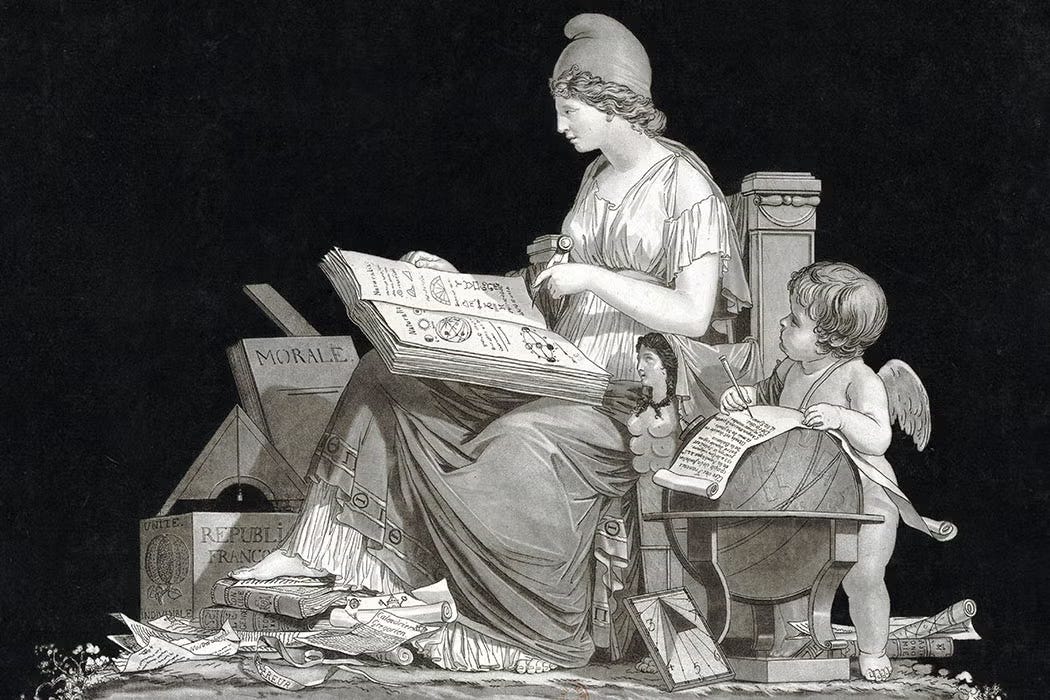
I’m fascinated by ‘revolution’, and in particular by the first French Revolution, the one that gets to be called the French Revolution, generally dated to have begun in 1789.
What is revolution? Literally, it is a turning. It is a period outside of ‘normal’ politics; of rapid political and social change. A period in which we abandon how things are done in favour of how they could be.
Revolutions are, of course, dangerous. Stable societies are stable for a reason: whatever that is, they work. Maybe not justly, or even particularly well, but nonetheless definitionally they stop societal collapse. If they didn’t, they would not be stable.
Outside of revolutionary periods, societies change slowly. They evolve, cautiously grasping their way forwards. Revolution is, on the other hand, a leap into the unknown. One in which the old is brushed aside and a new system built up from nothing. At the end of that leap, the society might land safely, or might fall into a hidden chasm.
‘Path dependency’ is the concept that, once we start doing something a certain way, we will keep doing it that way. Our societies, in effect, suffer from inertia: they keep going as they are, even long after they have become irrational, until a large enough force comes along to change them. Revolution is that force; its change absolute.
The French Revolution was a time of political change, of course. But it was also a time where everything — all of society, all of culture — was subject to the revolutionary principle. How freeing would it have been to live in such a time? A time when all can be questioned, when people were looking for new, better approaches to every aspect of the social system. And how terrifying, when the old order collapsed like sand and a new one was built on the whims of a few people who happened to have taken hold of the reins of revolution for a year, a month, a week, a day.
It was in this climate that the old measurement systems were thrown out in favour of the metric system. The currency system, Carolingian in its origin, was decimalised. These are innovations that didn’t just survive in France, they spread to most of the rest of the world.
The first great climax of the revolutionary spirit came on the night of 4th August 1789. When a nobleman moved to abolish feudal privileges in an evening session of the National Assembly, it set off a flurry of delegates stepping forward to renounce every part of the feudal regime. Titles, tithes, feudal dues, the privileged position of the nobility, all swept aside in a single night. Though parts of the programme were quietly dropped in the post-coital clarity of the following morning, the vast majority were implemented.
Yet, the Revolution didn’t stop there. It couldn’t. Did you know that the French revolutionaries effectively nationalised the Catholic Church? Under the Civil Constitution of the Clergy, the Church’s lands were brough under public management, all monasteries were closed, priests were turned into salaried employees of the state, and appointment to clerical positions — from parish priest to bishop — were subject to election by their parishioners. Even God could not escape the revolution.
Nor was time itself safe. I’m talking, of course, about the French Republican calendar.
The French Republican Calendar
Often erroneously called the French Revolutionary calendar, the French Republican calendar was introduced in 1793, during Year II of the Republic according to the calendar itself.
The Revolution had been playing with the concept of time since the very beginning. After all, a calendar in which the ‘year one’ was a fairly random date that had previously been incorrectly guessed to have been the year of Jesus’ birth just wasn’t very revolutionary or rational. Instead, revolutionaries began playing around with calling 1789 the Year I of the Age of Liberty. However, this was just a renaming of the years, not a wholesale new calendar.
Yet the Gregorian year itself was offensive to the revolutionary spirit in its irrationality. Seven-day weeks are strange: why pick a prime number, and one that doesn’t divide well into months or years? And the months are a complete disaster: why is February like that? Why are September, October, and November named after the wrong numbers? Why are other months named mostly after Roman gods and rulers?1 Let’s just throw this all away and start again from scratch!
So, after the Republic was declared on 21st September 1792, a committee was formed to create an entirely new calendar for Republican France, which was formally adopted a little over a year later. This is the story of that calendar.
Designing the French Republican Calendar
The main problem with designing a calendar is that calendars attempt to align two things that cannot be aligned: mathematical divisibility and observable natural phenomena.
It makes sense to base your calendar around the natural phenomena all around us. The day-night cycle. The lunar cycle. The seasonal cycle. The movement of the stars. Before formal calendars, this is presumably how humans tracked time. But, if you’re going to do that, you might want to start quantifying. How many days in a lunar cycle? How many lunar cycles in a seasonal cycle? That is, fundamentally, what a calendar is.
And what you swiftly conclude is that none of these things divide neatly into each other. Rounding to a single decimal, there are 29.5 days in a lunar month. 12.4 lunar months in a solar year. Also, the year as defined by the stars and as defined by the seasons is subtly different in length. It’s maddening.
So, compromise must be reached. Solar calendars throw out tracking the months by the lunar cycle and just divide the year into 12 arbitrary lumps of time (assuming they don’t abandon months entirely) — though they still have to decide what a year is, and deal with the fact that 365 doesn’t divide by 12. Lunar calendars define a year as 12 lunar cycles and abandon any connection to consistent seasons or the movement of the stars. Lunisolar calendars are lunar calendars that add a 13th month (a kind of ‘leap month’) to some years (specifically, about seven out of every 19 years) so the seasons don’t get too off kilter, creating years of wildly differing lengths. None of these are perfect solutions but instead different sets of compromises.
The Gregorian calendar is a fairly standard solar calendar, but still suffers from that weirdness that is the seven-day week and the stupidity that is goddamn February2. So, how did the revolutionaries try to fix it?
The Republican year was split into 12 months of 30 equal days. 30 days isn’t too far off the 29.5 days of a lunar cycle (it’s certainly closer than Gregorian months, which are on average too long — most of them having 31 days — hence why stupid February has to be like that) and allows each month to be perfectly divided into three 10-day weeks.
Oh yes, that’s right: three 10-day weeks. (Though they were officially called ‘décades’, not weeks, I’m going to call them weeks because decade means something else in English.) And within each week, the old days based on the names of Roman gods (in French, that is: the English days are instead named for equivalent Germanic deities) were replaced with a simple, if boring, numbered system based on Latin numbers. (Specifically, the names were: primidi, duodi, tridi, quartidi, quintidi, sextidi, septidi, octidi, nonidi, and décadi.)
But hang on, you’re probably thinking, 12 30-day months adds up to 360 days, not 365. So, what did the Republican calendar do with those last five days? Or with leap years? Well, this is where I have to introduce the concept of intercalary days, which the Gregorian calendar doesn’t have. Intercalary days are a feature of certain calendars: days that fall outside of the usual structure, being outside of any week or month. The French Republican calendar put those last five days at the end of the year to form a kind of half-week long festival to the nation and republic. Every four years, a sixth day would be added — the calendar’s leap day.
Because this was to be a republican calendar, Year I began with the declaration of the Republic in 1792 rather than the beginning of the revolution in 1789. (Meaning that they were celebrating the revolution’s more republican-radical turn rather than its more constitutional-reformist beginnings.) Also, the revolutionaries noticed a fun coincidence: that the republic had been declared on 21st September 1792, and the September equinox in 1792 was on 22nd September. So, it was decided that the year would begin with the autumnal equinox as observed by the Paris observatory — meaning that the Republican calendar began the year at a completely different time to the Gregorian calendar. (And that the first day of the new calendar was technically the day after the republic was declared, which to be fair does make it the first full day in which France was a republic.)
So that’s the system. New Year is the autumnal equinox, after which there are 12 months each made up of three 10-day weeks. At the end of the year are five intercalary days, with a sixth added every fourth year. But that’s all quite boring so, next, the system was handed over to a poet.
Naming the Republican Calendar
Fabre d’Églantine was a poet and playwright and is one of those revolutionaries who’s never quite notable enough to have become widely famous. However, if you know your French Revolutionary history, then you know the two things he is known for.
First, he invented the ‘Foreign Plot’ to accuse his enemies (people who knew how corrupt he was) of being anti-revolutionary traitors. When this act of fiction was uncovered, along with d’Églantine’s general corruption, it ended up convincing Robespierre that d’Églantine and all his allies — in particular his great patron Georges Danton and my best boy Camille Desmoulins — were traitors. This led pretty much directly to the trial and execution of the Dantonists in April 1794 which was itself the beginning of the Great Terror — those terrible final months of the Reign of Terror.
But second, it was to him that the task of naming everything in the new calendar was given. Not only did d’Églantine come up with a name for every month, he even named every individual day. (Inspired by and attempting to supplant how the Catholic calendar had a saint for each day of the year.) The day names were mostly basic rural items, like the names of animals and foodstuffs and tools, with the idea being that these basic, simple things should be celebrated and reflected upon on their respective days.

d’Églantine came up with the month names mostly by making French terms sound more Latin or Latin/Greek terms sound more French, creating made-up terms that usually reflected whatever was happening in that particular month. They are, along with what they were supposed to mean, as follows:
Vendémiaire (September/October) — grape harvest
Brumaire (October/November) — mist
Frimaire (November/December) — frost
Nivôse (December/January) — snow
Pluviôse (January/February) — rain
Ventôse (February/March) — wind
Germinal (March/April) — germination
Floréal (April/May) — flower
Prairial (May/June) — meadow
Messidor (June/July) — harvest
Thermidor (July/August) — heat
Fructidor (August/September) — fruit
So, as you can see — and as with the individual day names — the calendar honoured the natural world and agriculture, rather than individuals or deities. They also grouped the months by season: each set of three months having the same ending. (‘ire’ for autumn, ‘ôse’ for winter, ‘al’ for spring, and ‘idor’ for summer.)
The great struggle for anyone interested in the revolution is that, after the calendar was adopted, all the big events got named after the months they took place in under the Republican calendar rather than the Gregorian calendar. Before the Republican calendar, we talk about the 14th July Insurrection (AKA the Storming of the Bastille) or the 10th August Insurrection (AKA the fall of the monarchy). After the calendar, however, history instead uses names like the Thermidorean Reaction (AKA the downfall of Robespierre) and the Coup of 18 Brumaire (AKA Napoleon’s coup).
The other big struggle with the calendar, besides the names of the months, is of course that the year doesn’t align at all with the Gregorian year. Year I of the Republic began on 22nd September 1792, meaning that most of Year I actually took place in 1793. And this is also true of the months themselves, which don’t neatly align with Gregorian months.
But, while these are problems for us today, they weren’t the biggest problems with the calendar at the time. So, what were?
You Had One Job And You Screwed It Up
You might think, what with the new calendar project being all about rationally fixing the old calendar, that they would actually make sure it worked. Except, if you’re eagle-eyed, you might have already spotted something that doesn’t make sense. More specifically, two things I’ve said about the calendar that are not compatible.
First, I mentioned that a sixth intercalary day would be added every four years, like Gregorian leap years. Second, I said that the year began with the autumnal equinox. Here’s the thing: these are two incompatible ways of changing the length of the year.
Now, these are usually compatible and the French Republican calendar had a leap year in Year III, Year VIII, and Year XI — all the standard four years apart without any problem. Though the calendar was abolished in Year XIV, another leap year was planned for Year XV, four years after the last one. However, to keep the first day of the year on the autumnal equinox, the next leap year after that was planned for Year XX, five years after its predecessor.
So, to keep the autumnal equinox as the first day of the year, leap years would occasionally have to fall outside of the standard four year cycle, which was just needlessly confusing.
Furthermore, if the autumnal equinox (as observed over Paris) was really going to be the start of every year then, in order to plan what the calendar would look like in the future, you’ve got to work out when all future autumnal equinoxes will occur. Now, already in the 1790s, we were pretty good at working this stuff out, but by no means perfect. They did, for example, work out when the calendar would start for its first five centuries of use, which is no mean feat. Still, imagine trying to work out exactly what day the year will begin in, say, ten-thousand years. This is the inherent problem with any calendar based around observable phenomena. The Gregorian calendar, on the other hand, for all its faults, is entirely detached from any observable phenomena and so, with a little maths, we can plan out exactly what the calendar will look like for all future years. Billions of years in the future, at the heat death of the universe, we could work out precisely the day, month, and year.
(Proposals to correct this, abandon the autumnal equinox as a new year, and just move to the Gregorian leap year system, were frequently made but never adopted.)
The related problem is how France-centric the calendar was. The calendar begins with the autumnal equinox as observed over Paris because of course the equinox can fall on different days depending on where in the world you are. But that means that everywhere else has to consult Paris to work out when the year starts. Also, do you know what they call the autumnal equinox as observed over Paris in the southern hemisphere? That’s right: the spring equinox, because the seasons are reversed down there.
Which brings up another issue: the months. Those wonderful poetic months that d’Églantine came up with? They all reference what’s going on during that period in France, a temperate country in the northern hemisphere. Imagine telling people in, say, Australia, that they’re supposed to celebrate the month of ‘frost’ in the middle of their summer. And of course only a Frenchman could’ve come up with a calendar where a whole month is named after the grape harvest. Are you really that eager to get your hands on this year’s vintage?
So, though conceived of as a rationalisation of the calendar that would produce something universal to all humanity, the calendar became both confusing to use over the long-run and clearly centred on France itself. Not, shall we say, what was needed for a new universal calendar for the age of liberty and rationality.
A Step Back For… Worker Rights?
That can’t be right, can it? But take a second to think about it. During the 18th century, France allowed workers a single day off per week, on Sunday. The Republican calendar also allowed a single full day off per week, except now the week was 10-days long rather than seven.
Now, to make up for this, the fifth day of the Republican week was designated as a half-day. (The full day off being the tenth and final day of the week.) There were 36 weeks in the Republican calendar (12 months multiplied by three weeks per month), so 36 full days off and 36 half days off, which kinda works out to 54 days off. (36x(36/2)=54.) That’s technically more than the 52-53 Sundays in a Gregorian year. Except, well, half days are stupid. You still have to go into work, you can’t lie in, and your boss probably has some reason why you have to stay late: it’s just nowhere near as good as a full day off. So, as it turned out, most people preferred their 52-53 full days off to 36 full days and 36 half days.
This was also — quite intentionally — a problem for practicing Catholics. After all, the new day off would only align with Gregorian Sunday once in every seven Republican weeks. (So, only about five times per year.) Hence, you were supposed to be at work during mass for the other six out of seven times. This was part of a general effort to de-Christianise the country which frankly deserves its own discussion, but let’s just say that it was a big gripe for those who wanted to maintain Sunday as their day of rest.
Even the Day can be Rationalised
Along with the calendar, a new timekeeping system was introduced. Under this system, a day was 10 hours, an hour 100 minutes, and a minute 100 seconds. There are some advantages to this system, as it massively eases maths using time3, but nonetheless it never really took off.
A few clocks and watches were produced using the new decimal timekeeping system, but it was officially dropped long before the calendar was. If you’ve lived your whole life with one system, and it works well enough, then it’s hard to change it. Even during revolution, sometimes path dependency — social inertia — is too strong a force to overcome.
The End of the French Republican Calendar
After Napoleon came to power in 1799 Year VIII, he slowly began to dismantle many of the more controversial innovations of the earlier revolutionaries. The calendar, however, survived longer than you might otherwise have thought: all the way until, as I mentioned earlier, Year XIV.
The decree abolishing it was promulgated on 22 Fructidor Year XIII, which is 9th September 1805 to the rest of us, but nonetheless the calendar was not immediately taken out of use. Instead, the decree kept the Republican calendar in use until the Gregorian calendar was brought back on 1st January 1806, or 11 Nivose Year XIV. Interestingly, this means that the Republican calendar survived almost two years longer than the republic itself, which was turned into Napoleon’s empire on 18th May 1804, or 28 Floréal Year XII.
Even that wasn’t quite the end of the Republican calendar, as it was briefly brought back for some purposes during the Paris Commune’s uprising in 1871, known under the calendar as Year LXXIX. (Or Year 79: though Roman numerals are the most common way to represent the calendar, and what I’ve used here, actually Arabic numerals were also in use in a less official capacity. If it had caught on, you can imagine that Arabic numerals would have become the standard once the Roman ones became unwieldly.)
And for my fellow fantasy fans, did you know that Tolkien’s Numinorean months have a striking resemblance to the names of the Republican calendar’s months, when translated from Quenya? Wind, flower, heat, fruit, mist, cold: all are translations of both Numinorean months and French Republican months. (The Numinoreans apparently weren’t as obsessed with wine as the French revolutionaries, though, so that equivalent month is called ‘sun fading’ when translated. This proves that Tolkien was much better at naming months than d’Églantine.) The Numinorean calendar also cares about the equinoxes and solstices, so the start and end of the months roughly line up too, though it begins with the winter solstice rather than the autumnal equinox. Coincidence? Well it’s possible that he just came up with similar ‘things happening to a temperate northern hemisphere country during that period’ but also more than possible that he took some inspiration.
What We’ve Learnt
The French Republican calendar was the whole revolution in microcosm. A bold attempt to throw out the old and come up with a whole new system, which turned out to be flawed in a whole host of ways no-one initially realised.
As I said in my introduction, nothing scares me so much as revolution. And yet nothing inspires me like it either. For better or worse — and, by the time the calendar was introduced, mostly worse — the revolutionaries were willing to throw out everything they saw as unjust, backwards, and irrational, and make what they hoped would be a better world. That went for things as large as the position of the monarchy and Church and as seemingly small as how we measure distance and the passage of time.
In our rather politically uninspired period, perhaps we could do with just an iota of that revolutionary spirit of radical renewal. And then, perhaps, we could finally fix goddamn February.
Thank you for reading. If you found this interesting and would like to read more like it, or even if you didn’t, feel more than welcome to subscribe.
My post will be the short story Four-And-A-Half Engagements, which I’m pitching as a ‘romantic comedy of manners’. My attempt to channel Austen, basically. Going by my usual schedule, that would go up on New Year’s Day. Instead, I think I’ll put it up on 2nd January.
After that, on 15th January, my next non-fiction article is most likely to be an explainer of early modern British politics and government, to accompany the similar article I wrote last month about the aristocracy of the period.
The answer to all these questions is obviously the calendar’s Roman origins. Under the original Roman calendar, the year began in March and didn’t have a set number of days in a year. With March as month one, September, October, November, and December were month 7, 8, 9, and 10. And February, the last month, just got however many days were left before the new year started, as decided by the Pontifex Maximus. (A lifelong elected position; the head priest of Rome.) It was Julius Caesar who as Pontifex Maximus established the current length of February and the concept of regular leap years, creating the Julian Calendar. By that point, the year already began in January with the election of that year’s new officials. (Consuls and aediles and the like.) Before Julius Caesar’s regularisation of the calendar, the Pontifex Maximus’ ability to shorten or extend the year at will was of huge political importance because all political offices were held for a single year.
This is my formal declaration of war against the month of February. My proposal: we remove the 31st day of three random 31-day months, give those days to February, then rename it something easier to spell. Clarke, perhaps.
Quick: how many seconds are in two hours and fourteen minutes? Quick! Quick! Multiply by 60 faster!!! Now, express 23 minutes and 12 seconds as a fraction of one hour. Quicker! Under the decimalised clock, you just have to add zeroes or move the decimal point. 2.14 hours is 214 minutes which is 21,400 seconds. 23 minutes 12 seconds is 23.12 minutes which is 0.2312 hours.
Comments
Nothing yet. Say the first thing.
Sign in to join the conversation.