
For those reading in email: Once again, I hit the email length limit and therefore some email clients may cut off this article or format it strangely. If you run into this problem, the full article is available through substack’s app and website, a link to which can be found at the top of the email.
Well, not every French Revolutionary constitution, I suppose, because today we’re talking specifically about the first French Revolution (1789-17991), and thereby excluding all those later revolutions — 1830, 1848, 1870, to mention merely the ones that led to new constitutional arrangements.
Now, that’s merely a ten year period. How many constitutions could the French have possibly have gone through in just a decade? Four! Four entirely distinct constitutions, which is presumably some kind of world record. (And that’s only talking about the ones that were actually voted into law.)
In brief, we have the constitutional monarchist constitution of 1791, the never implemented radical Jacobin constitution of 1793 (AKA Constitution of the Year I, for reasons I’ve discussed before), the more conservative Thermidorean constitution of 1795 (AKA Constitution of the Year III), and the dictatorial Napoleonic constitution of 1799 (AKA Constitution of the Year VIII), which ended the revolutionary period. Each has a fascinating history and is a snapshot of the revolution at the moment it was implemented, yet each was discarded as the revolution moved past it and the people who created it. So, let’s get started.
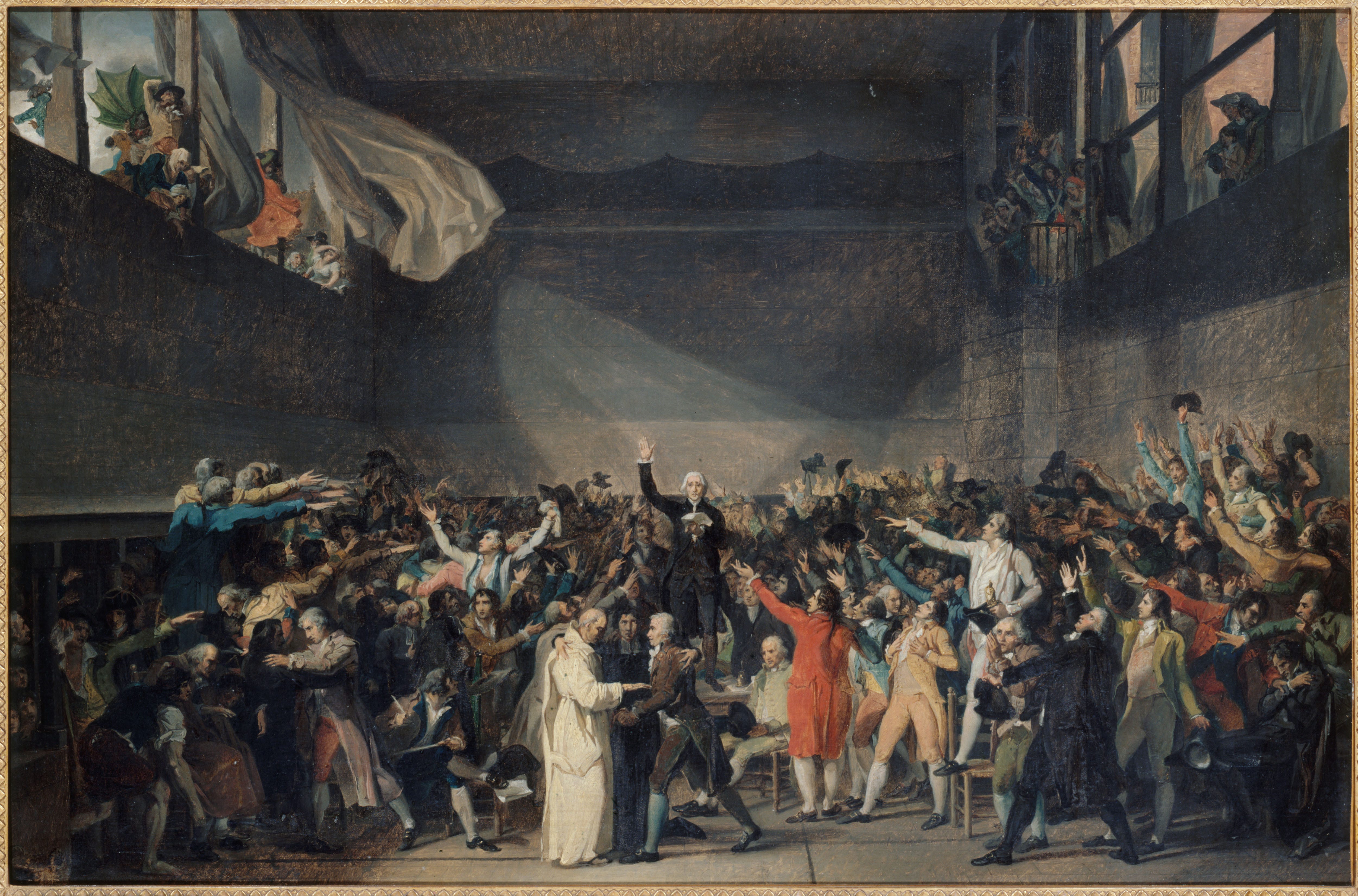
After the revolution asserted and then cemented itself over the Spring-Autumn of 1789 (Tennis Court Oath, Storming of the Bastille, Women’s March on Versailles), its first revolutionary phase was over. Louis XVI was in Paris, away from the army, with little choice but to go along with the flow of events. Feeling secure in their position, and that the revolution was already effectively over, the delegates of the National Assembly turned themselves to what they saw as their most important task: drafting a new constitution for France. Turning the absolutism of the ancien régime into a constitutional monarchist regime, chiefly inspired by that of Britain.
However, there were disagreements between the deputies, centered principally on three issues: the status of the legislature, the authority of the king, and the political rights of the citizenry.
On the legislature, the more conservative and constitutional-liberal deputies favoured a two-tiered legislature, such as that already found in Britain (House of Commons and House of Lords) and the United States (House of Representatives and Senate) — whose own constitution was only a few years old. They believed that a stable political system needed an upper house of older, more aristocratic men to temper the radical tendencies of a more democratic lower house.
The more radical representatives, on the other hand, believed that such an upper house would be an intolerable anti-democratic imposition and the last vestige of feudal aristocratic power. They were students of Rousseau, who only allows for a single legislative body acting according to the general will. There is only one nation with one general will, democratically determined, so an upper house could exist only to serve the sectarian interest of a class seeking to separate themselves from the national fraternity.
With royal power, the same fight was fought. How far should the king be active in politics? How much power should he have over his ministers, the government formed in his name? Should he have a veto over legislation? The conservatives believed that the king should have an unlimited veto and full executive power. The radicals believed the king should be a figurehead, with ministers effectively appointed by the legislature, and no say over legislation. (The model that Britain was moving towards.)
And finally, those citizens rights. The 1789 Declaration of the Rights of Man and the Citizen said that ‘Men are born and remain free and equal in rights.’ (Article I). It also said (Article VI) that ‘The law is the expression of the general will. All the citizens have the right of contributing personally or through their representatives to its formation.’. At the same time, Article I also allows social distinctions, so long as they are ‘founded only upon the general good’.
Radicals argued that, following these articles, the constitution should embrace universal male suffrage, allowing all to both vote and hold office. Conservatives were horrified by this and used Article I’s ‘social distinctions’ clause to argue that, for the general good, only educated, affluent citizens should be allowed to actively participate in the political process.
All of these debates were slowed down by the king’s hostility to allowing a constitution that would force him to cede additional powers. At that point, all he had allowed was the existence of the National Assembly. For him and his advisors, the best bet seemed to be a delaying action, until situations might change and they could reassert control. Hence, negotiations were protracted, taking the rest of 1789, all of 1790, and into 1791, the hardliners on both sides getting more and more fed up.
The turning point was the king’s Flight to Varennes on the 20th-21st June 1791. A royalist plot was hatched, for the king to flee Paris, rally the army, and perhaps that of Austria too, and march on Paris to suppress the revolution. The plan failed; Louis was recognised at the small town of Varennes, not far from the border, and prevented from going further. He was brought back to Paris, moderate revolutionary leaders pretending that the king had been abducted against his will, but no-one was fooled.
Radicals met at the Champs de Mars on 17th July, protesting and signing a petition that asked the National Assembly to force the king to abdicate, for conspiring against the people and the revolution. The moderates in charge of the city and guard attempted to suppress the protest, which escalated to firing upon the crowds, leaving some dead and more wounded. The Champs de Mars Massacre cleft a split between the more radical and moderate revolutionaries and forced the conservatives — including the king and his advisors — to recognise that they needed to agree to the draft constitution now, before the revolution turned any more radical.
The resultant constitution was a compromise on the three most contentious issues.
The legislature would be a single chamber called the Legislative Assembly with 745 members, a victory for the radicals. Yet, this assembly would not be elected by universal manhood suffrage. Instead, in a victory for the conservatives and moderates, the constitution created a two-tiered citizenship. Passive citizens, the majority, would be bound and protected by the law but have no role in creating it. Only active citizens — those over 25 who met a certain tax threshold and other smaller qualifications — were given the vote. Radicals hated this, believing that such an assembly could never represent the nation’s general will.
Elections would take place every two years under a multi-layered system. First, active citizens would meet at the local level in primary assemblies, where they would elect delegates from amongst themselves to go to a second election, at the departmental level. At that second election, those delegates would elect the department’s representatives, though they could only choose active citizens from the department, and no citizen could be elected to three assemblies in a row.
The king remained at the head of the executive, with full powers to appoint his own ministers, who were not in any meaningful way responsible to the Legislative Assembly. Furthermore, as a compromise on the veto issue, the king was given a ‘suspensive’ veto. That is, a time limited one. The king could veto a law but, if the same law were presented to him by the following two legislatures, on the third instance it would pass automatically. Finally, while foreign policy was the domain of the king and his foreign minister, the Legislative Assembly would furthermore have to ratify declarations of war and the signing of treaties.
Before the National Assembly dissolved itself, to be replaced by the new Legislative Assembly, it voted on one final measure, believed today to be of critical importance to the next stage of the revolution. It was, in fact, the first notable intervention in the revolution’s course by a thus far unimportant deputy from Normandy: Maximilien Robespierre.
The measure was called the self-denying ordinance, and it stated that no member of the National Assembly could sit in the first Legislative Assembly. After all, they’d already been in session for over two years, and the new constitution only allowed a given deputy to sit in the Legislative for four years (two elections in a row) before they were ineligible, and had to wait a term before being elected again. If any of them sat in the first Legislative Assembly, therefore, they would’ve been legislators for slightly longer than those four years by its end.
In hindsight, this created a huge problem. Veterans of the National Assembly might’ve been able to use their national fame to be elected en mass, allowing them to shepherd the first years of the constitution they had just created. With the self-denying ordinance, none could. The new deputies were instead very different men. Half of the National Assembly had been drawn from the nobility and priests (because it was the result of the amalgamation of the Three Estates), whereas the new Legislative Assembly was overwhelmingly drawn from the professional classes. They were, therefore, on average more radical than the men they were replacing.
Furthermore, the outgoing deputies of the National Assembly had sat through agonising years of compromise to develop their constitution. None of them were happy with it, per se, but the majority were proud of their achievements and were used to working with each other, even across political lines. The new corps of deputies, by contrast, had no such collegial feelings and many had effectively ‘campaigned’ on all the ways they disagreed with the constitution. Very few, be they radical or the smaller faction of conservatives, wished to see it succeed. To take a prominent example, Brissot, the journalist and slavery abolitionist who would become the most prominent member of the assembly, had been present at the Champs de Mars Massacre; he had written one of the anti-Louis petitions circulated there.
During the single year in which the constitution of 1791 was France’s supreme law, from September 1791 to September 1792, French politics was dominated by fights between the radical majority of the Legislative Assembly and the king. Louis used his suspensive veto liberally to block the assembly’s measures. The king argued that he was perfectly within his constitutional rights to do so and, in the meantime, appointed men loyal to himself to the ministries. The Legislative Assembly’s deputies found their legislative programme blocked at every turn and, simultaneously, that there was nothing they could do but loudly complain about Louis’s conservative ministers.
Louis, of course, hated the constitution; hated the idea of limits on his power. The radicals hated the constitution too; hated how much power it gave Louis to frustrate their agenda. Neither wished to work with the other, and Louis in particular was completely unwilling to compromise, instead using every power he was granted to its absolute limit.
Frustrated domestically, Brissot and his supporters turned their attention externally, in particular to Austria. The Austrian government had already issued declarations that they would intervene militarily in France to restore absolutist rule if Louis was harmed. Drawing on France’s natural Austrophobia, they began to call for preemptive war. On this, and this alone, the Louis and his advisors agreed with the radicals. If France won the war, which they viewed as unlikely, surely the people would flock to their victorious king. If France lost, the victorious Austrians could march on Paris, put an end to the revolution, and restore the king’s authority. A win-win. In preparation, a new set of ministers, made up of Brissot’s allies, were appointed.
According to the constitutional procedure, Louis officially proposed war to the assembly, which voted in favour on 20th April 1792. Unbeknownst to all, they had just unleashed a period of near continual warfare that would last a generation, until it was ended on the field of Waterloo in 1815. Belgium, then under Austrian rule, would be both the first and the last front of these wars.
Louis and his advisors had failed to consider the third option, between a quick victory and quick defeat. The French were pushed back but held on. The Assembly proposed ever more radical measures, which the king continued to veto. In June, Louis dismissed his Brissotin ministers and appointed more conservative ones. The people turned on their king, accused (correctly, as it turned out) of collaboration with the enemy. And, on 10th August 1792, Georges Danton convened the Insurrectionary Commune, organising a force that stormed the palace. The king, lacking any other options, sought refuge with the Legislative Assembly. They granted it, but also provisionally stripped him of all powers and announced elections to a new National Convention, which would determine the status of the king and constitution. The constitutional monarchy, and thereby the Constitution of 1791, was dead.
In all measurable respects, the Constitution of 1791 failed. But did it have to?
In my opinion, the constitution had a primary, inescapable flaw. It set up, in effect, two diametrically opposed camps and gave them no reason to compromise.
On the one hand, we have the Legislative Assembly. As a single body, with no upper house, the majority opinion of the Legislative Assembly was the opinion of the entire legislature. A more conservative upper house might have forced it to compromise to pass laws, for example. In the end, even with the franchise restricted by the active/passive citizenship distinction, the Legislative Assembly was all but guaranteed to be a radical body and the mouthpiece of the revolution, with no natural break on that radicalism or constitutional incentive towards compromise.
On the other hand, all executive power was granted to the monarch, meaning to Louis XVI. Here we have the biggest flaw, in my opinion, but a difficult one to overcome. A constitutional monarchy requires a constitutional monarch. Louis had no desire to become one, and so no willingness to act in the spirit of that job. The assembly’s deputies were not his partners but his enemies, and his first task was, as he saw it, to defeat them at every turn.
Changing this, however, would have required changing the monarch, most likely forcing Louis to abdicate in favour of his son or his distant cousin the Duc d’Orléans (going by the name Philippe Égalité since the abolition of feudal titles). The monarchists hated this idea, the radicals would’ve preferred abolition to abdication, and the moderates — who had held political power at that critical moment before the constitution was implemented — had all convinced themselves that Louis and his queen could be trusted. That they had learnt their lesson and would now be good constitutionalists after the Flight to Varennes. Gullible idiots, all of them.
One way this might’ve been mitigated would’ve been to allow the Legislative Assembly the ability to dismiss royal ministries through a vote of no confidence, like the British system. This would’ve forced compromise between the king and assembly, to find a government, and stopped the king from surrounding himself purely with conservative yes-men. It also would’ve prevented the king’s dismissal of Brissot’s allies, one of the direct triggers of the 10th August insurrection.
The other issue, naturally, was the suspensive veto. During ‘normal’ politics, waiting a few years to implement a reform, ensuring that successive elections endorsed it, doesn’t seem too absurd. The British House of Lords retains what is effectively a suspensive veto, for example, though a much more time limited one, and we have yet to rise up against them for it. But France was not in a period of ‘normal’ politics at this time; it was in the grip of revolution, where a delay even of days seemed intolerable. That the king could delay critical reforms for years, in a revolution that had only started two years earlier, was unacceptable.
Better, in my opinion, might’ve been to instead give the king a veto closer to that of the American President, which can instantly be bypassed given enough support (a 2/3 supermajority). This would’ve allowed the assembly’s reforms to pass, and likely in a watered-down form that less radical deputies could agree to, while still allowing the king to register his rebuke. Something like this may have fostered compromise rather than conflict, and prevented future divisions.
In the end, then, the constitution created two diametrically opposed bodies. A (semi-)democratic, unicameral legislature of radicals, hoping to further the revolution. And a reactionary king, hoping to reverse it. The king was, at least in the short term (and the constitution never got past the short term), given an veto over all legislative acts and complete executive authority. The assembly could only use its parliamentary immunity to shout ever louder about the king’s excesses. It is an irony that one of the few things that required compromise between the two — going to war — was one of the few things they accomplished together, and directly led to the end of the constitution as the war only further radicalised both sides.
The constitution had failed. Constitutional monarchy had failed. The revolution had slipped its leash.
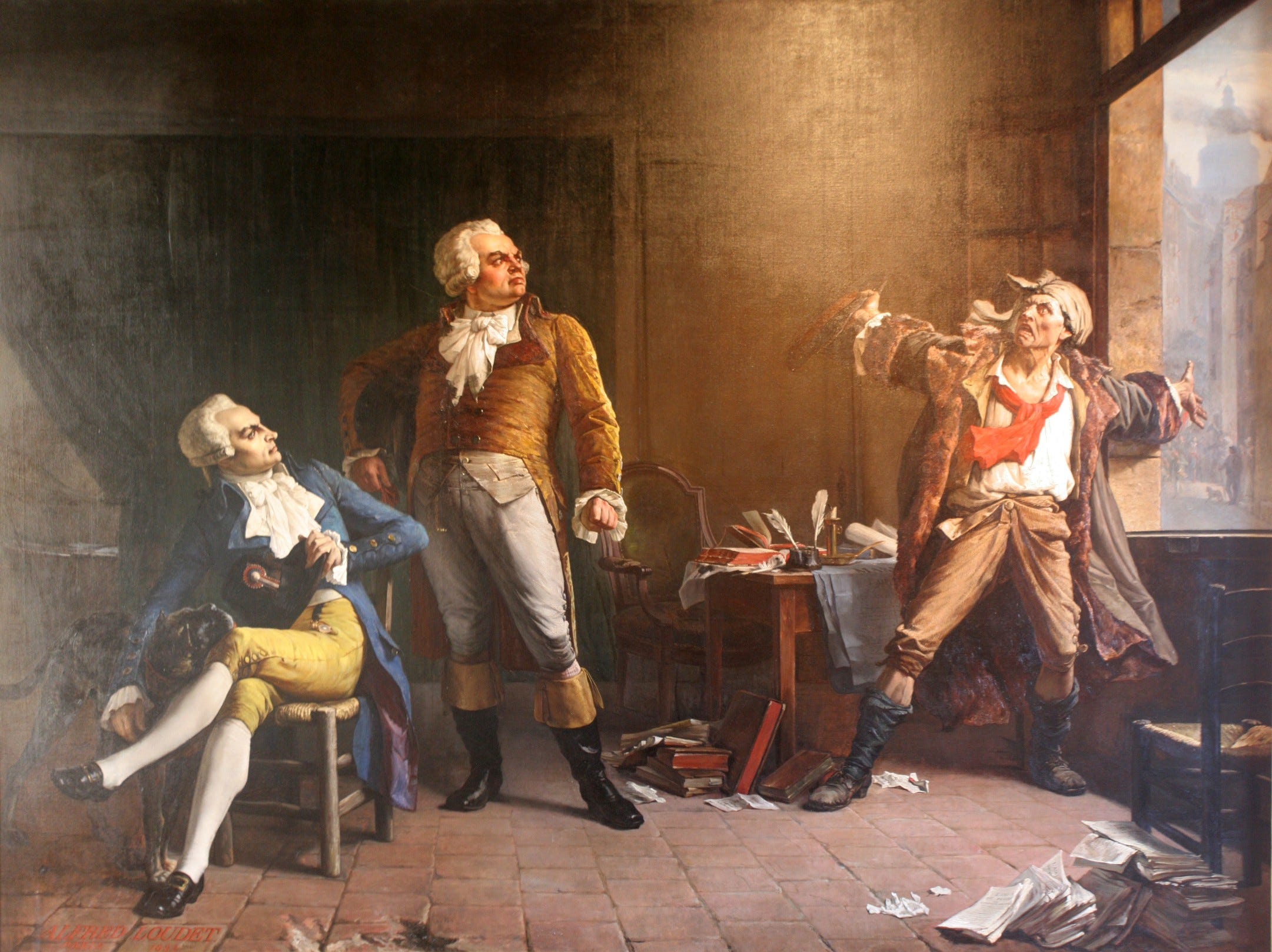
In calling for elections to the National Convention — to be elected by universal manhood suffrage — the Legislative Assembly had already completely bypassed the constitution, which allowed for no such body. When the Convention assembled for the first time, on 20th September 1792, all recognised that the previous constitution was already dead. The next day, they declared France a republic. Soon, they would put the king on trial and vote for his execution.
The Convention took upon itself all sovereign power. It would pass all laws and appoint all ministers and judges. Soon, for efficiency, it would create committees to exercise delegated powers, of which the most notable were the Committee of General Security and the notorious Committee of Public Safety. It would sit, without any new elections, slowly hemorrhaging members to coups and purges, for the next three years, without any constitutional limits on its authority. When it took power, France was on the brink of defeat and civil war. When it relinquished it, the French were storming to victory on all fronts and all open rebellion had been stamped out.
From the beginning, the deputies of the National Convention wished to draft a new, republican constitution for France. Most of them were the prominent radical leaders of the past year. Brissot, the leading voice of the Legislative Assembly and architect of the war. Danton, the man who had overthrown the king. Robespierre, a veteran of the National Assembly, returning to correct the flaws in the constitution it had drafted. Marat, whose fiery calls for death to the revolution’s enemies were distasteful even to his radical allies.
However, their first and greatest problem was factionalism, as a direct result of the September Massacres. In the weeks before the Convention first met, the streets had Paris had been flooded with blood, as the masses broke into the prisons and summarily executed over a thousand people. The motivation was the belief that these were counter-revolutionary traitors who would rise up once the good revolutionaries left for the front, and had to be killed before they could do so. Most were petty thieves, debtors, and the like. Some were children.
Most radical leaders — Marat excepted — were horrified. Brissot and his allies, grouped as the Brissotins or Girondins, accused Danton — minister of justice since his 10th August insurrection — of being complicit or worse. Danton and his allies, in particular Robespierre, denied this and called the massacres unfortunate but perhaps understandable, and certainly not something to focus on in a moment of crisis. Robespierre famously asked the Convention, ‘Citizens, did you want a revolution without a revolution?’.
It was Brissot’s allies who first drafted a constitution, called the Girondin Constitutional Project. It proposed universal manhood suffrage, a single legislative chamber elected each year, and an executive council made up of ministers who would be directly elected every two years. Amongst its drafters, the polymath and early feminist Nicolas de Condorcet and the American Founding Father Thomas Paine.
Their opponents, grouped as the Montagnards, voted down the draft despite agreeing with almost all of it. Later in the year, the Girondins were purged from the Convention and arrested through a popular insurrection led by the ultra-radical Enragés, a group that even most Montagnards held at arm’s length. Soon after, most of the identified Girondins were put on trial and sent to the guillotine, one of the first actions of the Reign of Terror. Almost immediately after the expulsion of the Girondins, the Montagnards set about drafting their own constitution, which they presented in a matter of days, a slapdash job, and one substantially similar to the one they’d rejected.
As with the proposed Girondin constitution, the legislature was to be a single chamber Legislative Body elected every year by universal manhood suffrage.
Presiding over the executive would be an executive council of 24 members. Unlike the Girondin proposal, these men would not be ministers themselves, but instead would appoint and oversee the ministers, making them a kind of collective presidency, not dissimilar from the 12-man Committee of Public Safety that had effectively already taken up that role. The primary assemblies (where voters met to elect their legislative deputies) would propose members, and the Legislative Body would select from that list. This process would happen for half the executive council’s seats each year, so each would be elected to a two-year term. No term limits are mentioned either for this council or for the Legislative Body itself.
Perhaps more interesting than the constitution itself is its preamble. Every French constitution since the first revolution has, like the 1791 constitution, been preceded by the Declaration of the Rights of Man and the Citizen, unchanged since first drafted in 1789. The Constitution of the Year I and the revolution’s later constitutions are different, as they amended the Declaration, altering and adding to it. Many of this constitution’s changes are also found in the Girondin Constitutional Project, and include the right to either work or, for those unable to work, ‘a means of existence’ provided by society (Article 21) and a right to education (Article 22). Its final, 35th Article, provides for the right of insurrection against tyranny.
Finally, the constitution retroactively justified the National Convention’s existence, after it had already sat for almost a year without any constitutional basis, in having an article allowing the formation of such a Convention, without specifying its powers but implying that they include the revision of the constitution. (The Girondin Constitutional Project also had a National Convention article, with far more details, which is presumably what the drafters of the Year I constitution were imprecisely trying to get at.)
However, all of this is irrelevant for practical purposes. The deputies of the National Convention agreed to the constitution, put it to a referendum (where it was overwhelmingly supported), but then voted to suspend it indefinitely before it could ever actually be put into effect, due to the crisis of war and rebellion. Over the following months, they would develop a doctrine that France first required a revolutionary (unlimited, unconstitutional) government to defeat the enemies of the republic both externally and internally. Only once liberty was assured could the republic transition into constitutional government, with regular elections, a division of powers, and full rights for all citizens. In the end, the most important thing about the Constitution of the Year I is that it was never implemented, even though it was France’s official, if suspended, constitution from 1793-1795.
Or, rather, lack thereof. With the constitution ratified, France had a supreme law waiting in the wings and its leaders were adamant that it would be put into effect as soon as the crises besetting the infant republic were pacified.
So began a centralisation and expansion of authority under the Committee of Public Safety. The levée en masse flooded the army with new recruits, giving France the first citizen-army in Europe, with almost a million men under arms. Rebellions, the pro-royalist uprising in the Vendée and pro-Girondin Federalist Revolts, were brutally suppressed. The Law of Suspects allowed anyone to be arrested for suspected counter-revolutionary activity (activity which included opposing the war and hoarding food) and, after the prisons filled up, the suspects were put on trial, with death the prescribed punishment for the guilty.
Over the winter of 1793-4, the revolution entered its most radical phase. On the left, Jacques Hébert and his supporters (the Hérbertists, or Exagérés) took up the mantle of the assassinated Marat, arguing for the Reign of Terror to go even further, and beginning the aggressive de-Christianising of the country, favouring a new state religion of their own invention, the atheistic Cult of Reason. On the more moderate side, Georges Danton and his supporters (the Dantonists, or Indulgents) argued that the Reign of Terror should be reined in as it had already achieved its aims and the crises were now abating, and that aggressive de-Christianisation was a mistake. Between them, ‘The Incorruptible’ Maximilien Robespierre, who had emerged as the principal leader of the Committee of Public Safety.
As winter turned to spring, Robespierre tightened his grip. He could see the narrow path towards utopia, his ‘Republic of Virtue’. Any who opposed him, he came to believe, were counter-revolutionaries in league with France’s foreign enemies. In March, he had the Hébertists sent to the guillotine. In April, the Dantonists followed them. He suppressed the Cult of Reason, replacing it with his own Cult of the Supreme Being, a deistic religious system, within which he presented himself as something like a messiah. A law the previous December had centralised the terror under the committee’s rule; another of June expanded it into the Great Terror, those final awful months.
These measures turned more and more people against Robespierre — those who had been close to the purged factions, but not close enough to be executed with them; those who had previously been staunch allies of Robespierre, but feared they might nonetheless be next; those who began to recoil from the revolution’s insatiable appetite for her own children.
On the 27th of July, or 9 Thermidor, Robespierre and his closest allies were themselves overthrown and executed in the Thermidorean Reaction, and the Thermidoreans began to disassemble the apparatus of the terror. The revolution’s most radical phase was over. All of its great leaders lay dead. Others would have to pick up the pieces and carry the revolutionary project forwards.
Obviously, with the constitution never going into effect, it’s a little hard to assess. However, I think that very issue should be our starting point.
The Montagnards developed what they saw as a perfect democratic constitution, but one which, in their own views, could only stand during ‘ordinary’ politics. They saw it as too perfect to exist in an imperfect world, or at least in one in which the French Republic was under attack from foreign states and domestic opponents. This is surely, in itself, a failing.
Liberty and democracy merely when it’s convenient isn’t worthy of the name. A constitution that cannot exist under imperfect conditions is useless. Constitutions need to be able to adapt to changing circumstances, including the stress of crises. And, if they exist to do anything — beyond defining the apparatus of the state — it is to bind that state in its interactions with its people. Crises, then, are when constitutions are most needed, as they are when states are most likely to attempt to stretch their power as the expense of the citizens’ liberty.
Taking on absolute power during the crises of war and rebellion, the Convention was incredibly effective at bringing France back from the brink of defeat and unleashing her potential. By the end of the Reign of Terror, a major argument against it was that it had already been successful, and so had outlasted its usefulness.
The cost, however, was almost 17,000 officially executed by the Revolutionary Tribunal and representatives on mission (members of the Convention sent out to the provinces with near dictatorial powers) over the roughly 10 months of the terror2. Nothing compared to the mass repressions of the 20th century, we might say. For French political violence, it pales when placed against the Bloody Week, the suppression of the Paris Commune in 1871, in which thousands were killed every day, localised to a single city. All true, all true. And so? Does that mean those deaths were inevitable, or excusable? Might a constitution have given them some protection?
We should also assess the constitution in itself. If it ever had been implemented, would it have been any good?
Here I have to admit that I don’t believe the Constitution of the Year I was ever supposed to be implemented. Its basic outline, certainly. But that specific document? I don’t think so. As mentioned, it was a slapdash job, rushed out in days, though similar in concept to other mainstream radical thoughts (in favouring universal manhood sufferage, a single legislative chamber, and an elected executive of some type).
I think the Montagnards recognised they needed to set out their constitutional intents after the Girondins were purged, and did so with this one, but also knew they were going to suspend it and, if ever it had come time to actually implement it, they probably recognised that it needed some work. I’ve already mentioned that the National Convention clause is imprecise to the point of being useless. The same is true of primary assemblies, which are supposed to represent 39-41,000 citizens, but the constitution has no mechanism for how these assemblies will be formed. It mentions that municipal officials should be elected by communal assemblies, but gives no indications as to what a communal assembly even is or how they should be organised.
To drive the difference in detail between it and the more considered Girondin Constitutional Project home, the Constitution of the Year I comes to only a little over 1,000 words in total. The Girondin Constitutional Project is well over 10,000 words long. (For comparison, the original text of the US Constitution is a little over 4,000 words.)
And, of course, the constitution itself implied that a National Convention (like the one currently sitting) could alter the constitution. In effect, then, the deputies had granted themselves the power to completely rewrite the constitution into an actually useful document whenever they needed to and had the time to do so.
Putting its more obvious flaws aside then, what about the basic system it lays out? How yearly elections to the legislature might’ve worked we can only guess. I think we can be a little more sure that the 24-member executive council would’ve been an unwieldly nightmare, though it does align with the constitution’s aims to diffusing power such that no individual could rise to absolute authority.
Another interesting element is that, as far as I’m aware, it’s the first modern constitution to define runoff voting as the election method. (That is, that if no candidate reaches a majority of the votes, a second round of voting occurs between the top two candidates of the first round.) This is actually France’s modern voting system. So, at least one idea first proposed in this constitution actually had some legs on it.
I do also think it bears mentioning that this was the first modern constitution to grant universal manhood suffrage. The next French constitution to grant such a wide franchise was that of 1848, over half a century after this one. My native United Kingdom wouldn’t give all adult men the vote until 1918! (Which was also when the first women were granted the vote, with the franchise restricted to those over the age of 30.)
Over the following year, opposition to the Thermidoreans grew. They were a rump assembly, after the various purges of the past two years, (though they had let back in a number of members who had been stripped of their seats but not executed during the terror) and one attempting to walk a very tight line between radicalism and royalism, suffering attacks from both those wings.
The radicals took up the cry of Bread and the Constitution! and, if the Thermidoreans agreed that the major crises were over, and hence the terror was no longer needed, then surely they had to agree to constitutional government. But the Thermidoreans were terrified of finally implementing the Constitution of the Year I. Would its democratic nature not just bring back the worst excesses of the terror? Would they not, in that case, be next to meet Madame la Guillotine?
France needed an implemented constitution, they agreed, for ideological reasons, and to cement the republic, and to head-off criticisms of their rule. Just not that constitution. So, they set about drafting a new one.
Here, it helped that the Thermidorean Convention was reasonably unified, lacking the intense factionalism of the National Assembly and Jacobin Convention. For the remaining members of the Convention, it was not them against each other, but instead them against the radicals and royalists baying for their blood. Their task, then, was to draft a constitution that could keep those elements out of politics and solidify their own hold on the republic, preventing either another terror or a royalist reaction, while still aligning with their basic belief in republicanism and democracy.
Initially, the primary opposition to the Thermidoreans came from the left. Because of this, they tacitly relied on elements of the right for support, such as the Muscadins — gangs of young conservatives who wore ostentatious pre-revolutionary fashions and engaged the neo-Jacobins in street brawls. They also closed the Jacobin Club and abolished Paris’s central government, which had been a hotbed of radicalism throughout the revolution. In short, as the constitution was being drafted, the Thermidoreans were more concerned about keeping out the left than the right, though both were recognised as threats.
First, the constitution brought back the two-tiered election system of 1791. All citizens could participate in primary assemblies, which elected men to go to the electoral assemblies. However, to be eligible for this election, a citizen had to be at least 25 and possess property that met a certain threshold in value. It was these electoral assemblies which would actually elect the deputies of the legislature.
So, what was that legislature? For the first time, the Constitution of the Year III split the legislature (collectively called the Legislative Body) into two chambers, with the Council of Five Hundred as the lower chamber and the Council of Ancients as the upper chamber. The Council of Five Hundred had, surprisingly, 500 members, who had to be at least 30 years old (though, for the first four years of the constitution, that was lowered to 25 years, reflecting that many of the Convention’s members were quite young and wanted to be eligible for the council). The Council of Ancients had 250 members, who had to be at least 40 years old (and married or widowed, and domiciled in France for at least the last 15 years).
All legislative terms lasted three years, with a third of each council being elected each year. After anyone had been a member of the legislature for two terms (i.e. six years), a term limit kicked in that made them ineligible for the next two years, after which they could be elected to the legislature again.
The Council of Five Hundred proposed and debated laws. Once it voted to enact them, the proposed law was turned over to the Council of Ancients, which did not have the power to amend the law, only to accept or veto it. The Ancients were intended as guardians of the constitution and a bulwark against the younger, presumably more radical Five Hundred.
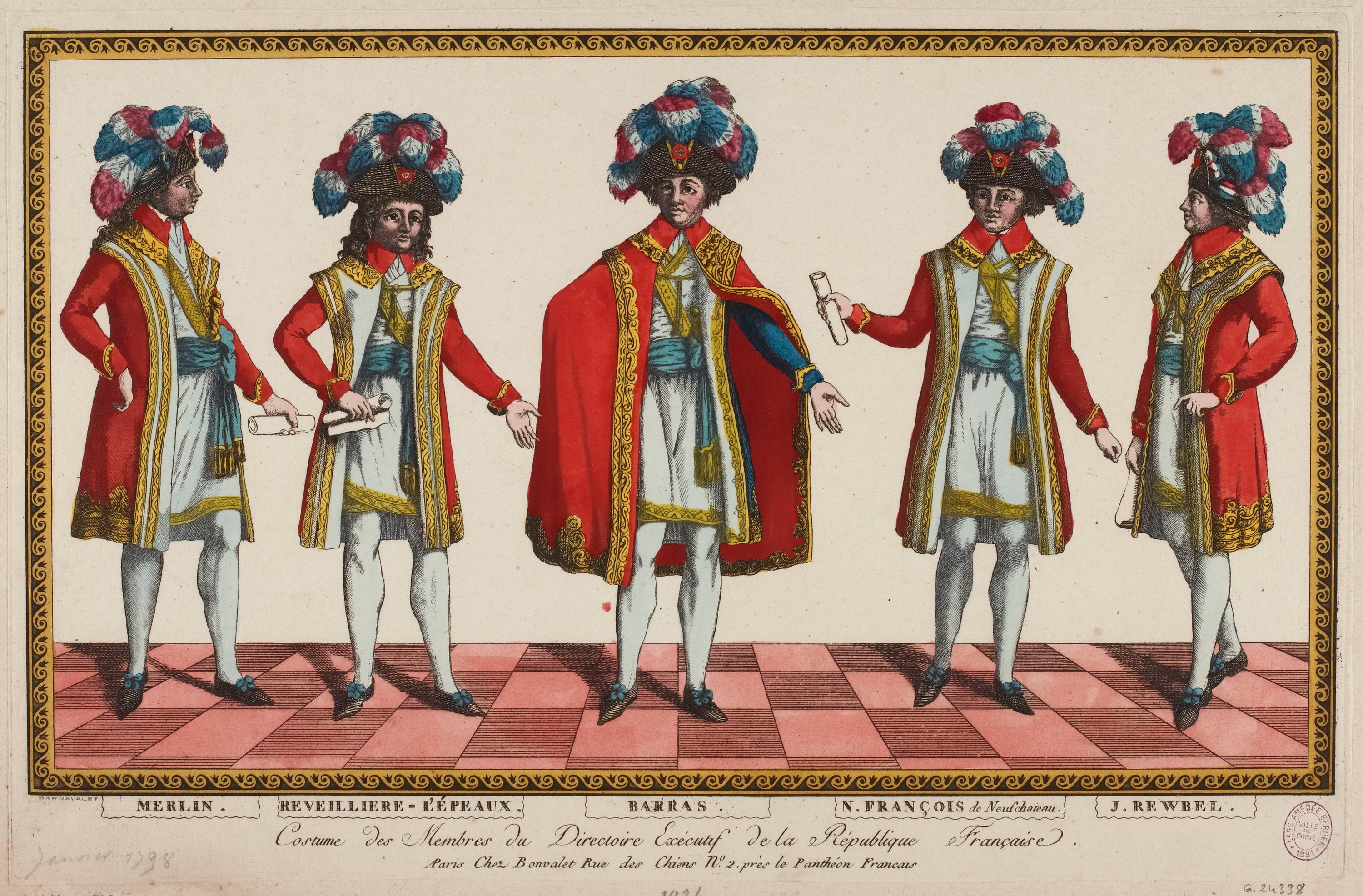
Heading the executive was the Directory, the body which gives these constitutional arrangements their name. There were five directors, each serving a five year term with one elected each other. For the first four years, which of the initial five directors would be replaced each year was decided by lot. The directors had to be at least 40 and had to have served either in the legislature or as a minister. They were elected by the Council of Ancients, from a shortlist drawn up by the Council of Five Hundred. Their terms could not be immediately renewed: a retired director had to wait at least five years (i.e. one full term) before they could be elected to the Directory again.
The Directory itself acted, like the executive council of the previous proposed constitutions, as a kind of collective presidency. It appointed the chief officials of the republic, most notably the ministers but also the generals and governors, and could dismiss them at will. Day-to-day, its job was to make the highest level decisions and set the direction of policy.
One particular part of the new constitution’s implementation was incredibly controversial, and bears discussing before anything else. When the constitution was voted on, the Convention agreed another measure to go along with it, the Two Thirds Decree. This stated that two thirds of the members of the first Council of Five Hundred and Council of Ancients had to be drawn from the members of the Convention currently sitting. This guaranteed a seat in the new legislatures for most of the outgoing deputies of the Convention.
Why they did this is obvious, given what we’ve already said about the Constitution of 1791, namely that by baring its drafters from sitting in its first legislature through the Self-Denying Ordinance, it had effectively turned over the new constitutional arrangements to a body of men actively hostile to them. This measure, however, was incredibly undemocratic, a swing wildly in the other direction, and one that looked a lot like the Thermidorean deputies not wanting to give up power. Which is true, they didn’t! Many of them were terrified that, if they handed power over to a new group, that group would eventually seek to purge them, as all previously powerful revolutionary groups had been purged over the past six years of the revolutionary experiment.
The constitution’s first test came even before it came into effect. Realising that, thanks to the Two Thirds Decree, they would be unable to flood the new legislature, the constitution’s enemies — particularly of a royalist persuasion — turned to insurrection. On 5th October 1795, or 13 Vendémiaire Year IV, they launched an uprising in Paris.
The insurrection was suppressed, but it set the tone for the Directory, where political fights were most commonly of an extra-constitutional character. It also led to the rise of the two men who organised the defence of Paris, one who dominated the Directory, and another who ended it. First, Paul Barras, who was elected a director and quickly emerged as its leading member. Secondly, young General Napoleon Bonaparte, who was eventually rewarded with command of the Army of Italy.
Thanks to the Two Thirds Decree, the legislature was packed with loyal Thermidoreans. However, distressingly, almost half of the remaining third of newly elected members were avowed royalists. The royalists did even better in the next elections, of 1797, the ultimate result of which was a struggle for power and eventually a self-coup by Barras, nakedly anti-constitutional, in which the army took control of Paris and the royalists were thrown out of the councils. Their leaders were even sent to the penal colony in French Guiana.
The coup is traditionally used by historians to periodise the Directory into two phases, with the period after it called the Second Directory. Continuing the Thermidoreans’ wobbling from right to left and back again in response to wherever the greatest threat was at that moment, the Second Directory was notably friendlier to the neo-Jacobins and cracked down heavily on royalist activity. It also saw Barras consolidate power and the directors routinely manipulate the constitution in their favour. The 1798 elections were a victory for the neo-Jacobins, until the directors nullified most of the election results they didn’t like to keep their grip on power.
The Directory’s major achievement was the end of the war in 1797, after five long years, thanks to Bonaparte. His Italian theatre was supposed to be a distraction to the main action in Germany, but the German front stalled, while Bonaparte unexpectedly swept aside all opposition in Italy until he was threatening Vienna from the south, forcing the Austrians (France’s last remaining enemy on the continent) to sue for peace.
France was still at war with Britain, but that was a purely naval conflict, meaning the French armies could finally get some rest. The army was, by this point, a behemoth, the greatest fighting force in Europe, as well as an important political instrument. France had also, in the end, done well out of the war. Captured loot had stabilised government finances, the republic had directly annexed Belgium and the German lands west of the Rhine, and ‘sister republics’ (allied states with Directory-inspired constitutions) had been set up in the Netherlands and northern Italy.
Wanting to end the war for good, the directors tapped Bonaparte to lead an expedition to Ireland, hoping to link up with Irish patriots and take the war to Britain, forcing them to the negotiating table. However, a previous Irish expedition had been a disaster and Bonaparte had his own ideas. He convinced Barras to instead send him to Egypt, with the idea being that this would threaten Britain’s routes to its expanding empire in India, while also enriching France. The directors agreed, and off Bonaparte went. The campaign was a disaster — Bonaparte could win every battle but not the war — and the expedition led to the Ottomans and Russians joining the war, soon joined by the Austrians again, who could see which way the wind was turning.
In Europe, the renewed war went predictably badly, with France’s best troops and generals abroad, which turned popular opinion against the Directory. The 1799 election was another victory for the neo-Jacobin, and one the Directory couldn’t do much about as the army was required on the front and any support they had was fading fast.
A man named Sieyès, who had refused a seat in the Directory because he believed its constitution was too democratic, saw an opportunity. He began to plot a conspiracy, along with other figures such as foreign minister Talleyrand, to remove Barras from power. Sieyès saw himself as the brains of the operation, but needed some muscle (or, as he put it, a sword) to carry off his planned coup. As with every yearly election, one of the five directors stepped down and another was elected to replace him. This time, Sieyès accepted the position, putting himself in a position to take down the Directory from the inside.
Bonaparte returned from Egypt at the perfect moment. Though the expedition was falling apart, Bonaparte could spin his own version of it, casting himself as the returning conquering hero. Remembered as the man who had won the war last time, he was an incredibly popular figure, as well as a highly ambitious one. Sieyès had found his sword. On 18 Brumaire (9th November), Bonaparte led a military coup against the Directory, backed by Sieyès, as well as by Bonaparte’s brother Lucien, who was a prominent radical in the Council of Five Hundred. Bonaparte dismissed the Directory and announced the formation of a new government and the drafting of a new constitution.
Well, at least it was implemented, unlike the Constitution of the Year I, and survived longer than a year, unlike the Constitution of 1791. Indeed, having been France’s supreme law for four years by the time of Bonaparte’s coup, during a period that saw victory in war and the opening up of the political sphere, the Constitution of the Year III looks downright stable.
Except, of course, that it also proved that constitutions aren’t worth the paper they’re written on if no-one who matters wants to enforce them. The Directory was the first regime during which France had regular elections — it wouldn’t get them again until the Bourbon Restoration — but those elections were routinely manipulated by the directors if they disliked the results and, when push came to shove, the directors were happy to use the army to solidify their control. The constitution itself made provision for this, banning the army from approaching Paris without the invitation of the councils, but that clause too was meaningless if the military commanders were more loyal to the directors than the constitution.
We have to wonder what would have happened if the directors had only acted within the constitution. Without the 1797 coup that purged the royalists, what might have occurred? Could the royalists have just announced the return of the monarchy, themselves ripping up the constitution? I don’t think they would’ve been able to do so immediately, no. Might they have slowly packed the Directory with royalists, who then appointed royalists to the army and ministries, before they could successfully pull off a royalist coup? That’s more likely, and perhaps the ministry really did have to act against that threat, or perhaps the constitution itself should have had greater protections against the election of people innately hostile to it.
Overall, I’d say the constitution’s main problem was innate to the whole Thermidorean faction: they were a narrow group between the neo-Jacobins and monarchists, lacking popular support, clinging on to power out of a fear of what might happen otherwise. So the electoral system was designed to keep out the radicals, which predictably shifted the make-up of the councils to the right, until the only way to keep the right down was the return of political repression.
The Thermidoreans genuinely did want some level of democracy, but democracy requires a loyal opposition: those who oppose the government but support the constitution. In revolutionary France, at that moment, there could be no such thing. During the revolution, power was gained through violence. And so, as it turned out, it could only be maintained through violence.
Looking at the content of the constitution itself, I’ve always wondered about the two councils. Normally, if you have a lower and upper house, they’re elected differently to do different things. The lower house is your more democratic and responsive house, while the upper house represents the regions, or expertise, or some other thing. The Constitution of the Year III has two houses, but they’re both elected the exact same way, with the difference between their members only being a higher age requirement for the Council of Ancients.
The difference between them is their powers, where the Council of Five Hundred had more legislative power, while the Ancients had the final say on who joins the executive. Maybe there’s a utility there, in diffusing powers between two groups, even if they elected the same way, but it seems to me like they just wanted two chambers, without really thinking about why or what those two different chambers could do.
Having said all that, there are some interesting features of the constitution that I’m quite partial to. Renewing the legislative in parts each year, rather than through a full election every however-many-years, seems on the one hand like quite a faff, but on the other allows the legislature to be responsive to changing attitudes among the electorate, and prevents the legislature from being a snapshot of the electorate’s feelings in one moment, frozen for years until the next full election. I think it’s an interesting idea.3
I also quite like the executive council concept. A president, vested with all the powers of the executive, like an elected king, may concentrate too much power into a single set of hands, allowing one person to dominate a government, which becomes merely an instrument of their personal whims. Similarly with the modern, more presidential prime ministers. Today, Switzerland is the only country I’m aware of to still have a council rather than an individual as the head of the executive, a system they were first introduced to when they became a French sister-republic in 1798 and were given a Directory-inspired constitution. If democracy is anything, surely it is government by discussion, by debate, an idea that should be reflected at all levels of its institutions, up to the highest level of its executive. At least, that’s one guy’s opinion. (Though, as the Directory proved, such councils can become dominated by a single member, undermining the very point of them.)
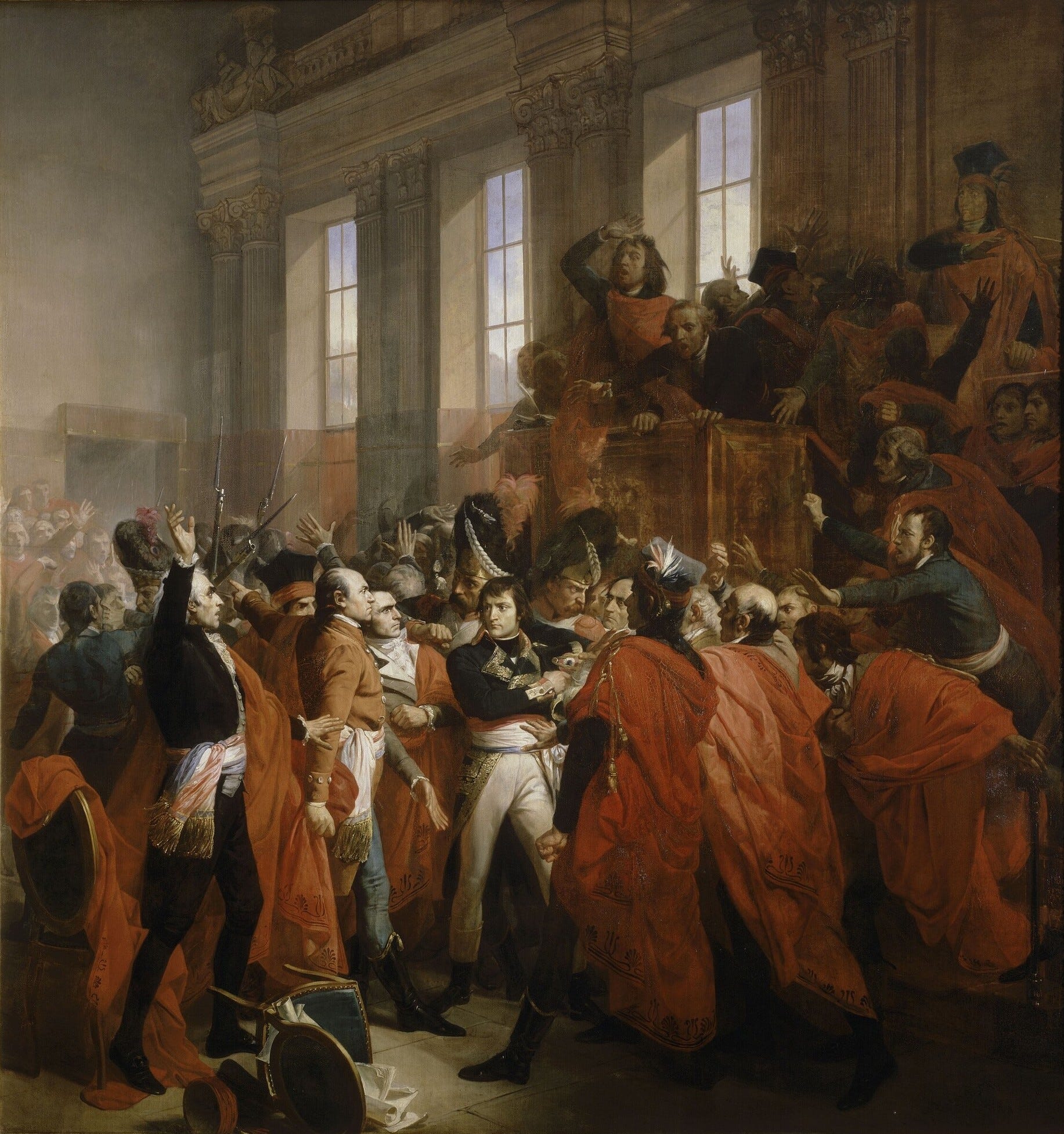
Today, we think of 18 Brumaire as Bonaparte’s coup but, at the time, Sieyès firmly believed that it was in fact his coup, with Bonaparte as nothing more than the muscle. His plan for the executive was to have two figures referred to as consuls actually governing the country. A third figure, the Grand Elector, would be appointed for life but have the single power of selecting the consuls. Sieyès intended for Bonaparte to take this largely ceremonial position, which would effectively politically neuter him, giving him a lifelong office with no direct political authority.
Sieyès furthermore aimed at a kind of aristocratic republic, modelled firmly on that of Rome, though without any pesky elections. There would be a clear separation of powers and lots of checks-and-balances to prevent the kind of tyranny he identified with both the old order and the Reign of Terror.
Bonaparte, of course, was having none of this. He had risked his life to overthrow the Directory so that he could rule France, not to meekly turn it over to some constitutional meddler. Sieyès had been useful, but now had to be carefully pushed out into the cold.
So, Bonaparte announced that three provisional consuls would take power while the constitution was drafted, reflecting Sieyès’s eventual plan for two consuls and the Grand Elector, with the positions filled by the two of them plus Ducos, an ex-director. Which, of course, doesn’t make any sense: what do you mean three consuls! Consul means two! But it was all a bit of linguistic play to make Sieyès think he was still on the inside.
Taking Sieyès’s idea as a base, Bonaparte had the proposed constitution aggressively modified, replacing the Grand Elector with a First Consul who held all the actual power. This rendered the other two consuls, who Sieyès had planned to be the co-equal heads of the executive, impotent, and cemented the linguistic ridiculousness of three individuals with the title of consul.
The Constitution of the Year VIII was quickly adopted, solidifying the coup plotters’ hold on power. Predictably, Bonaparte had himself appointed to the near-dictatorial position of First Consul. Sieyès was completely outplayed, and wasn’t even offered a seat as one of the two junior consuls. Instead, he was appointed to the new Conservative Senate which, thanks to his own constitutional proposals, was a remarkably powerless institution. None could doubt it: whatever the constitutional arrangements, France’s final law was now the every command of Napoleon Bonaparte.
The core of the new constitution, one of Sieyès’s ideas, was the lists of notables. All citizens (most men over 21) could participate at the very lowest level, at the commune. However, their only job was to draw up a list, equal to one-tenth their number, of good, trustworthy men they believed could serve in public office, called the communal list. The men so named could be appointed by the government to local office, but also gathered in each department (region) to draw up a similar list equal to one-tenth of their number, the departmental lists. And then all the so named would gather to draw up a list equal to one-tenth of their number, which was the national list. This would therefore have on it the names of 0.1% of the citizenry, those who had passed through the previous three weeding-out processes, and it was from this list that people could be selected for national office.
At the heart of the system sat the Conservative Senate (yes, that’s its actual name, the direct translation of the French Sénat conservateur, though I’ll mostly just be calling it the Senate), whose job was to select men for national office and protect the constitution. When new people had to be appointed to the other national institutions (Legislative Body, Tribunate, Consulate, and highest court), it was the Senate who picked them from the national list. When there were questions over the constitutionality of a law or action, the Senate had the last word on judging that.
The Senate had 80 members who sat for life and could not be appointed to any other office. Hence, appointment to the Senate was a way of completely politically neutering someone. Sieyès had hoped to do that to Bonaparte, so Bonaparte turned the tables on him. When a senator died, the First Consul, Tribunate, and Legislative Body would each propose a name from the national list and the Senate itself would pick its new member from that shortlist. If all three proposed the same name, the Senate had no choice but to pick that person.
The Tribunate and Legislative Body were the two legislative institutions, though they didn’t function like ordinary upper and lower houses. Instead, they used a strange system, one of Sieyès’s odder ideas, whereby the Tribunate would debate government proposals and then send three of its members to present their argument (for or against) to the Legislative Body. The Legislative Body, without any debate of their own, but only after hearing the speeches of three tribunes and three government representatives, would vote on the proposal, using a secret ballot. If the Tribunate agreed with the government, all the Legislative Body would hear before voting was six pro-government speeches. The Tribunate was also the body that could ask the Senate to rule on the constitutionality of a given proposal. Neither had any right to make proposals of their own or amendments to the government’s proposals.
As mentioned, all members of the Tribunate and Legislative Body were selected by the Senate. The former had 150 members, at least 25-year old. The latter had 300 members, at least 30-years old. Both had five-year terms with a fifth of each being appointed each year. Also, the Legislative Body only sat for four months each year, unless the government decided to convene it for special sessions.
So far, the system was broadly as Sieyès had intended. But then there’s the consuls.
The provisional system of three consuls was made permanent, as mentioned, but not all consuls were created equal. Instead, all power was invested in the First Consul, AKA Bonaparte, who appointed all government officials and had full executive power. The second and third consuls only had the right to consult the First Consul, making them utterly powerless except insofar as the First Consul wished to delegate responsibility to them.4 Bonaparte even gave himself a salary over three times higher than the other two consuls. All three consuls were appointed by the Senate for ten-year terms, without term limits, except that the First Consul was always given a seat in the Senate after he resigned or his term was up. As a senator, he was therefore ineligible for life from being appointed to any further office, including re-election as First Consul.
The Constitution of the Year VIII gave Bonaparte effectively dictatorial powers, with the only checks on his authority being the Senate’s ability to rule measures unconstitutional and the Legislative Body’s ability to veto his legislative proposals. Of course, as already discussed, the Legislative Body wasn’t even allowed to debate before it voted and would always hear at least three pro-government speeches before doing so, and potentially six, and couldn’t even propose amendments.
All of which is irrelevant anyway, because Bonaparte made sure to pack all these institutions with loyal yes-men who would do what they were told. Loyalty of the Senate meant the ability to pick who was appointed to the Senate, Tribunate, and Legislative Body, and at no point were the citizens directly consulted about anything. In effect, it was a dictatorship with a thin veneer of republicanism.
But, of course, there was one major check on the First Consul’s powers, one final idea of Sieyès’s that Bonaparte felt he had to concede to, to avoid accusations of tyranny: the fact that the First Consul was limited to a single 10-year term. Bonaparte didn’t entertain this theoretical limit on his time as France’s ruler for longer than three of those ten years: in 1802, he had the Senate pass an amended version of the constitution (the Constitution of the Year X, though it’s largely identical to the one it replaced) which changed the length of office for the consuls from 10 years to life.
Furthermore, the constitutional amendment put even more power in the hands of the First Consul. He was given more power over appointments, including the exclusive power to propose replacement consuls, even his own successor, to the Senate, and made president of the Senate, making the Senate itself even more subservient to the First Consul. This very amendment was a mockery of the constitution, which allowed the Senate no such authority to amend it, and indeed charged to Senate with its maintenance against just this type of unconstitutionality.
And then, of course, two years after that, another amendment was made to the constitution. Most institutions were kept intact, but the consuls were removed and their powers (the First Consul’s power, given the other two never had any) re-invested in Bonaparte as Emperor Napoleon I of the French. After 11 years of republican government, France was a monarchy once more.
Well, you can’t deny that the Constitution of the Year VIII did what Napoleon wanted it to, namely allow him total power, with only the facade of any checks on that authority.
And, by that same stroke, it was an utter failure for Sieyès, who had hoped to craft a system whereby no-one was given enough power to become a dictator. All Napoleon had to do was keep all the other institutions as individually powerless as Sieyès had intended, while concentrating all remaining authority in his own hands. A remarkably simple bait-and-switch, but then Napoleon was, whatever else he was, a very direct man, even in his subterfuge.
But as a constitution, it’s a joke. The hiding of dictatorship behind the smallest possible trappings of a balance-of-powers. Frankly, it existed only to placate Sieyès into thinking he was getting what he wanted, and convince a few fence-sitters that Napoleon would govern as more than merely a tyrant. Even Napoleon himself thought the Tribunate and Legislative Body system — with one debating and the other voting — was silly, which is part of why he decided to just give more powers to the Senate after 1802, so he wouldn’t have to deal with them as much anymore.
The main innovation, if it deserves such a name, was the system of lists: the idea that the people could play a role in politics without direct elections by being responsible for drawing up successive lists of people eligible for public office. That way, someone couldn’t be appointed for public office unless he was approved by three different layers of selection by his fellow citizens. But the flaws to this should be immediately obvious.
At the end of the day, it was ultimately the Senate who selected names from this list, and less than 600 people (300 legislators, 150 tribunes, 80 senators, three consuls) would actually be chosen from it at any one time. The list was of over 6,000 names. Finding regime loyalists to appoint was trivially easy, and would have been even if a disgruntled citizenship had ever decided to try to pack the national list with regime opponents. Less than 10% of the eventual list had to support the regime for the Senate to be able to only pick loyalists to all institutions!
Also, while there were no formal property or wealth requirements, those selected for the lists had to take time to travel to their department capitals and, eventually, the national capital, to take part in the further trimming down of the lists. Merely being on a list wasn’t a public office and didn’t entitle the holder to any kind of salary or renumeration, so in practice you needed enough wealth to take that time out of your job and travel. You also, to put yourself forward for selection to a list, had to be willing to actually be selected for public office, which of course meant leaving your previous employment.
The last deathblow for the lists as anything other than a sham, and I was saving this nugget ‘til last, is the fact that they weren’t even created until the second year of the regime. Before that, the Senate had free rein to appoint whoever it wanted, and whoever it did appoint was then automatically added to the first lists, and could only be removed from them by majority vote by the citizens responsible for drawing up that list.
So, the Constitution of the Year VIII: a sham, but quite an interesting one, reflecting the competing visions of Bonaparte and Sieyès, and in particular the victory of the one over the other.
We should remember that France was the second country to really get a constitution in the modern sense — a written down document laying out the basic laws — after the US. It was, at that point, a radical new idea, and one that wouldn’t become widespread in Europe until the Revolutions of 1848.
Ideas that we take for granted, and systems that have become standardised models, were unheard of or entirely new back then, which partially explains why these constitutions look so weird to us now. Ideas that seemed normal to them, like elections every one to two years, seem radical to us5, at a time where most countries only have elections every four to five years. Ideas that seem normal to us, like universal adult suffrage, without any restrictions of property or gender, were unbelievably radical to them. Systems like presidentialism and parliamentarianism, now the primary two models of democratic governance, weren’t even considered.
The result was some quite strange ideas, some quite stupid ideas, but also some interesting ones, the product of a time when constitutionalism was still a new idea and there were no conventions or norms to follow.
And there’s that question: if these constitutions had been different, might they have sent the revolution in another direction? Maybe, in small ways. But on the whole, I don’t think so. 1791 was doomed by the fact that Louis XVI and revolution were irreconcilable, by his own choice. All later constitutions, by the fact that no-one in power was willing to actually submit themselves to a constitution when they butted up against its limits.
At the end of the day, maybe the Montagnards had it right: revolutions and constitutions are just incompatible. Revolution is the sweeping away of the old order, by violence if needed. They are periods of intense, powerful political fights, so difficult to control. Those who oppose the revolution will naturally oppose its new constitution, and a constitution cannot stand without a general consensus of its special authority. For a revolution to create a stable constitution, then, the revolutionaries must be completely successful, brushing aside all opposition and keeping that opposition firmly away from power until they accept the constitution — an anti-constitutional concept by its very nature.
So, constitutions. So robust in principle, but ultimately just a piece of paper, given authority by our own imaginations, so easily made fragile and meagre. And what a strange, modern idea they are. What a precious one. We should try to remember that, I think, and remember what can happen when they fall apart.
Or, to use the French, Vive la Constitution! Which constitution? Well, I suppose that’s up to us all.
Well, that was another long one. As always, I’ve got a lot to say about the French Revolution, especially when I can approach it from some novel angle. I try not to indulge in the revolution too often around here, but I’ve still got a lot to say about it. Religion and the revolution is a topic I’d like to tackle, and ideally some more about the Directory, that so often unjustly overlooked period.
In two weeks, I’ll be posting my next short story. It’ll probably be the second in the loosely connected adventures of Daniele A’Themi, now a privateer and hunting for prizes, entitled Fortunes of War. Two weeks after that, it’s cooked long enough, I’ll finally be releasing an essay on Terry Pratchett and Immanuel Kant; I think it’s the best non-fiction I’ve written.
To read the first Daniele adventure in time for the second, check out:
(Yes, I am running out of ‘fortune’ puns after only two stories, thank you for asking.)
And for further perusal, this might help:
Yes I know other people define the revolution differently, but they’re all wrong and anyway I’m using the most widely accepted dates.
Which isn’t to count those who died in battle, including during the rebellions, or those summarily killed or lynched in mob violence, or those who died indirectly as a result of lack of food or shelter caused by the turmolt of the civil war, intentional or otherwise.
Yes, I’m aware the US Senate does this.
Second Consul Cambacérès, a criminally underdiscussed figure of the Napoleonic period, was basically Bonaparte’s prime minister, governing the country day-to-day and in particular when Bonaparte was off fighting his wars. He was also the main architect of the Napoleonic Code and, after the Consulate became the Empire, was made Archchancellor of the Empire, basically continuing in the same role.
Yes I’m aware of the US House of Representatives, but of course that institution itself is a product of this period.
Comments
Nothing yet. Say the first thing.
Sign in to join the conversation.