
Note to subscribers:
My apologies for missing last week’s post. Alas, life keeps intervening and the writing of these missives grows intermittent. I lost a paid subscriber who said I don’t post often enough anymore. I can’t blame her.
I hope you’ll bear with me as I try to get back on track. If I think there’s no hope of delivering consistently in future, I will pull the plug on paid subscriptions.
In the past year, I read a number of books about trees or that touched upon trees, from Richard Powers’s fictional but informative The Overstory to Robin Wall Kimmerer’s Braiding Sweetgrass, Peter Wohlleben’s The Hidden Life of Trees, and others.
From these readings and my own observations over the years, I’ve gained some personal insights into the nature of trees. Here are a few of these observations and the ways they have been informing our practices at Puddock Hill:
Left to their own devices and absent excessive deer pressure, trees assert themselves. Around here it’s primarily sassafras (Sassafras albidum), sweetgum (Liquidambar styraciflua), black walnut (Juglans nigra), tuliptree (Liriodendron spp.), black cherry (Prunus serotina), oaks (Quercus spp.), and maples (Acer spp.), but there are many others. Not counting invasive trees, we also see hickory (Carya spp.), box elder (Acer negundo, a variety of maple), black tupelo (Nyssa sylvatica), black birch (Betula lenta), ash (Fraxinus spp.), and hackberry (Celtis spp.).
I think our practice of using tree volunteers in planting beds as a nursery for transplanting is coming to an end. Now—after years of benign neglect inside deer fencing—we are beginning to see saplings arising in better quantities where we want them. With precious few exceptions, trees popping up in planting beds will henceforth be treated as weeds. Likewise most trees in meadows.
Sometimes, however, nature suggests an expansion of the woods from the old mow pattern. Remarkably, a pair of river birches (Betula nigra) cropped up on the low side of the slope to the wet woods. These were the progeny of river birches we’d planted years ago. I decided to leave them, letting the woods creep out a bit. I also decided to let a volunteer maple sapling stay on the higher side of the path along that slope.
Similarly, we have been mowing a wide path from the lawn to the big pond and leaving no-mow areas on either side only to be cut once a year. But at the edge of a small wooded area that I’ve been encouraging along, several sweetgums and oaks popped up. I’ve decided to leave them, too.
In the east woods near the small pond, a stand of pawpaw trees (Carica papaya) continues to spread. They flower but won’t fruit, and no one I’ve asked seems to know why. It could be they need to cross pollinate or it could be lack of sun. Yet they thrive in other ways. I look forward to watching them compete with taller trees. The pawpaws will likely lose the battle on the slope toward the fence, but they may win by the small pond, where they grow densely.
Where we planted a few redbuds (Cercis canadensis) at the edge of the black walnut woods, dozens of saplings sprung up last year. We’ll be careful not to cut them down when fighting invasive plants in that area.
The redbuds’ success leads me to another observation…
We are told that black walnuts suppress other plants by releasing biochemicals into the soil. While I’m sure there’s some truth to this, other plants seem to thrive under black walnuts, in particular the aforementioned redbuds but also perennials such as Solomon’s seal (Polygonatum spp.) and white avens (Geum canadense). Oak saplings are also growing in our walnut woods.
There is no question that our region has seen its ash trees devastated by the emerald ash borer. Here at Puddock Hill, we’ve made the rare exception to our no-chemicals commitment by treating our ashes (also the few remaining hemlocks). As these hang on and set seed, in the past couple years many young ash trees have sprouted, although whether they can make it to full maturity without treatment remains to be seen.
There is a theory that the emerald ash borers will burn themselves out before the last ash dies, but it’s been thirty years and the bugs remain. Also, I’ve been told that these pests concentrate on older trees, so the future, as always, is hard to predict. Still, although great forests of old ashes have largely disappeared, the ash tree species hangs on.
The American beech (Fagus grandifolia) is under new threat from a nematode that can kill rapidly if left unaddressed, and I fear for the old trees in the forest. Here at Puddock Hill we’ve started fortifying our few beeches with ground-injected fertilizer, which is said to help.
Five or six years ago, we planted a variety of trees in our effort to reforest outside the deer fence along the road. It’s been hit and miss. By far, the most successful trees there have been the beeches, so far outgrowing the oaks in height and spread. They seem to want to be there, no surprise given their longstanding presence in nearby forests.
Some trees that we’ve planted are thriving on their own but don’t yet seem to be seeding new trees despite the fact they are native. In particular, I think of the dogwoods (Cornus spp.) and magnolias in this regard. It’s entirely possible they would never have found their way here without human help, perhaps due to some characteristics in the soil. On the other hand, they may be biding their time for certain conditions to arise. Various species do seem to come in waves.
Perhaps I am stating the obvious when I observe that forest trees are often starved for light. Young trees can struggle along, stunted for years until some disruption exposes them to more sunlight. Then they shoot up.
When we shop for trees, the sales pictures inevitably show specimens—trees growing to maturity without competition. But that is not a common condition outside gardens. In the forest, trees reach for the sun, often at the expense of their lower branches. This is a natural phenomenon.
When we planted hundreds of whips and saplings to accelerate our reforestation efforts, we intentionally planted them with random spacing, sometimes almost on top of other trees, which is how nature does it. Now I watch volunteers competing to stake out the same territory, sometimes several species in a 10-square-foot plot. I leave them alone to let natural competition sort them out.
Trees growing in lawns and gardens can be stronger than any individual tree in the forest because they are coddled—given good light, careful pruning, water beyond rainfall, and sometimes fertilizer (though we don’t do that here). But they are not necessarily stronger in the long run.
Forest trees better absorb harsh winds when the intermingled canopy limits the sway of their crowns. Their roots entangle, sharing any stress on their footing. They benefit from a thriving underground environment of mycorrhizal fungi. And apparently they send chemical signals to one another to fight off threats.
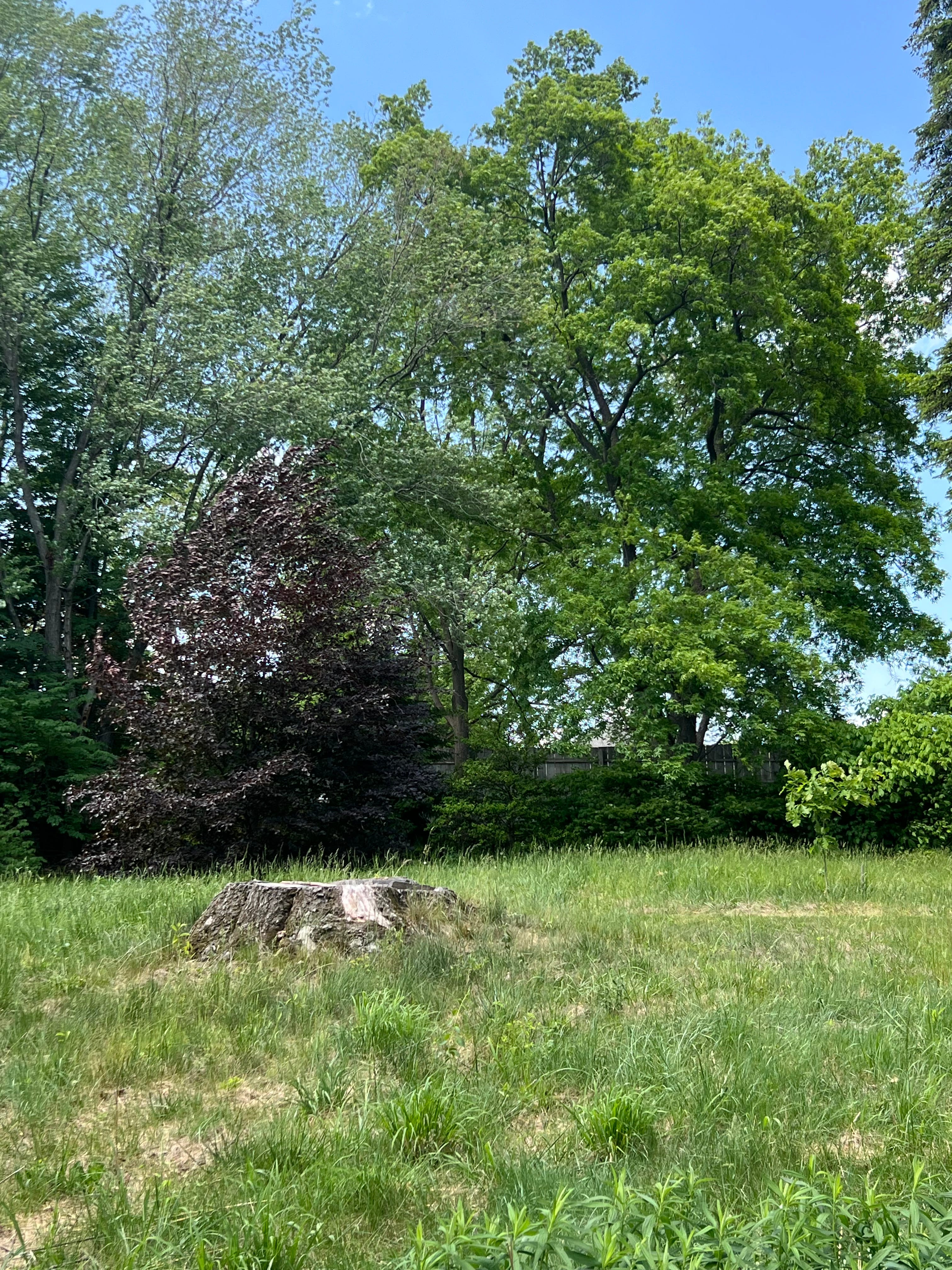
Two years ago we lost an old red oak (Quercus rubra) that grew in the no-mow area north of the house. We left the giant stump and transplanted another (probably its child) that had taken root in one of the planting beds fifty yards away. The young tree stands ten feet from the old and seems to be thriving, probably helped by remaining soil elements that fed the old timer. My only worry is whether it will withstand the wind, as it grows unprotected.
In nature, when it comes to trees and so many other things, chance may be the ultimate arbiter.
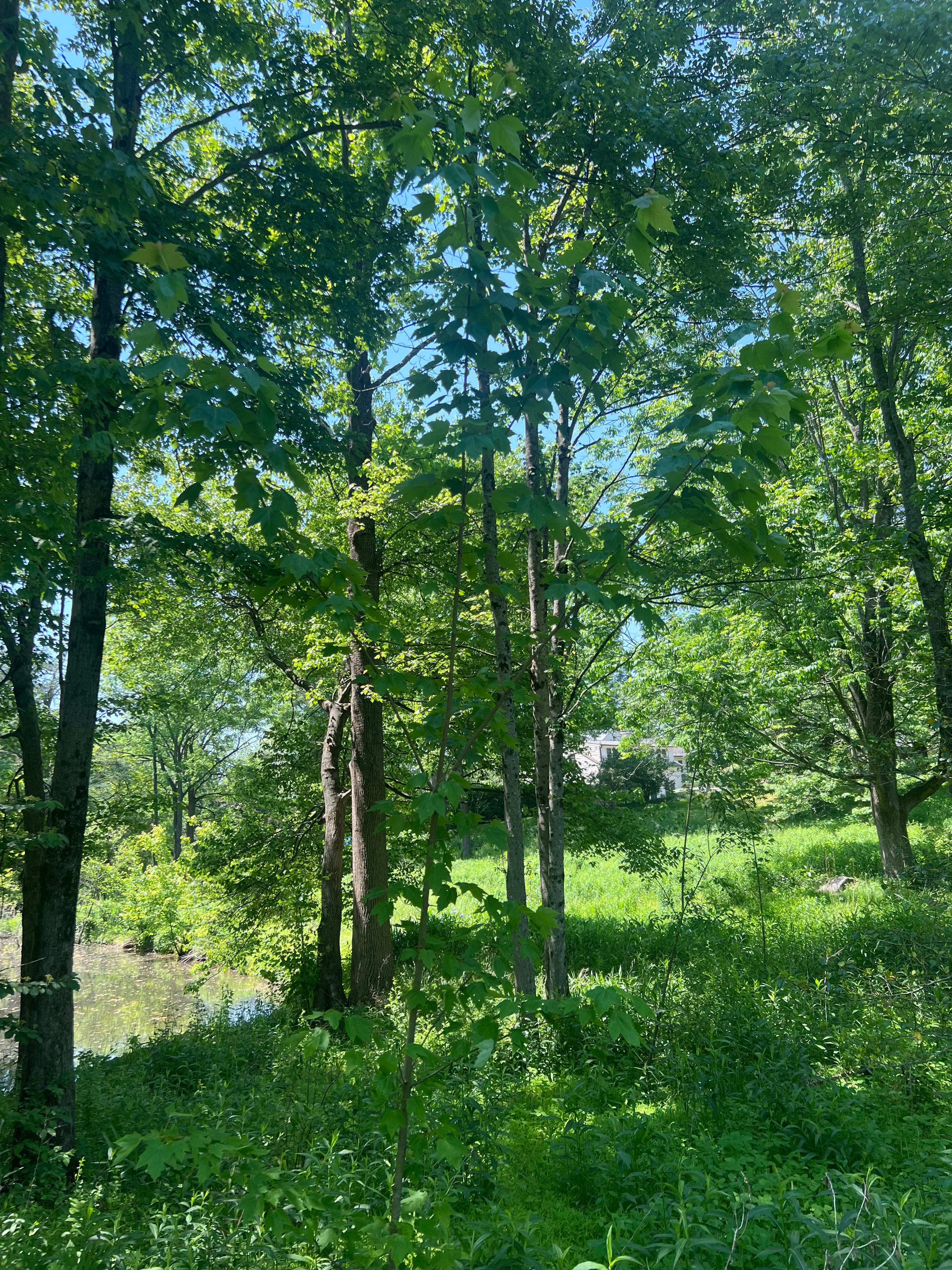
The thin tree in the foreground is a native red maple (Acer rubrum) planted six or seven years ago in the east woods. Now twelve feet tall, it’s doing what a forest tree does, going straight for the canopy:
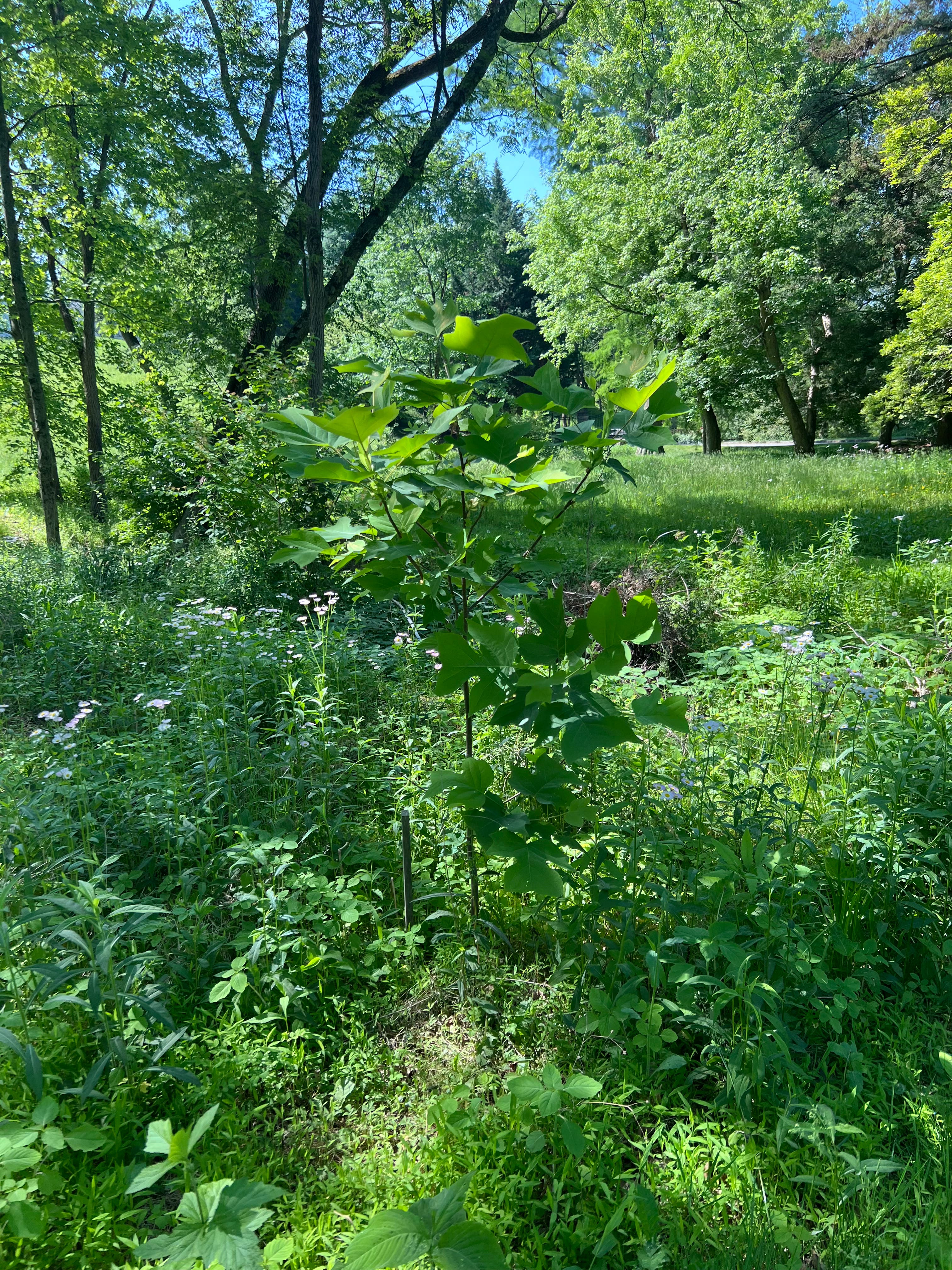
A young volunteer tuliptree (in its third or fourth year) grows at the edge of the east woods. As it gets more light than the maples, it’s growing fuller:
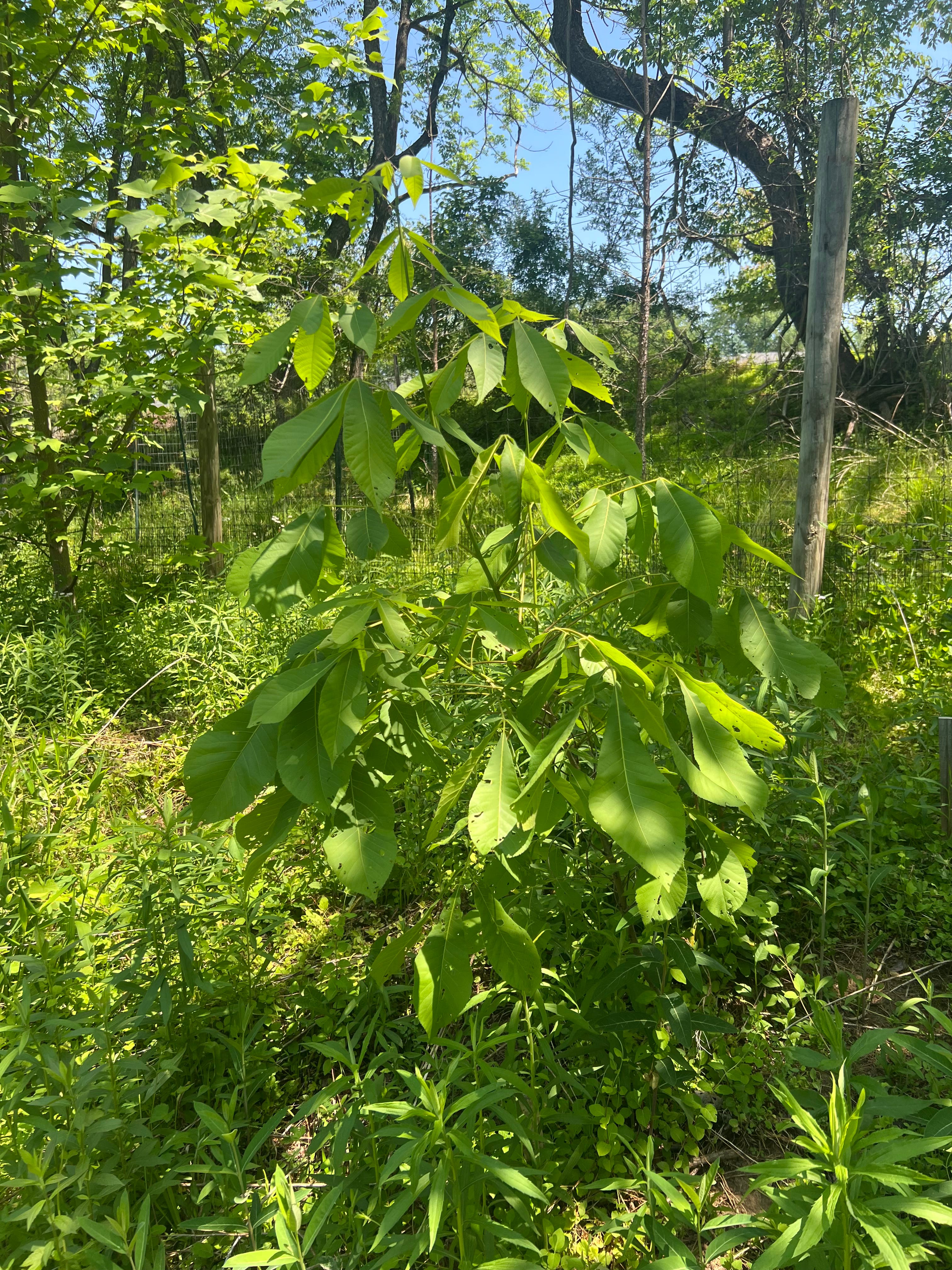
This seven-foot-tall shagbark hickory (Carya ovata), planted in good sun by the east woods, seemed to struggle along for five years (probably working on its root system), but shot up this spring, adding three feet of growth in one unusually dry month and establishing a leader:
This copper beech (Fagus sylvatica), a native of Europe and the last exotic tree we planted, has come into its own after eight years:
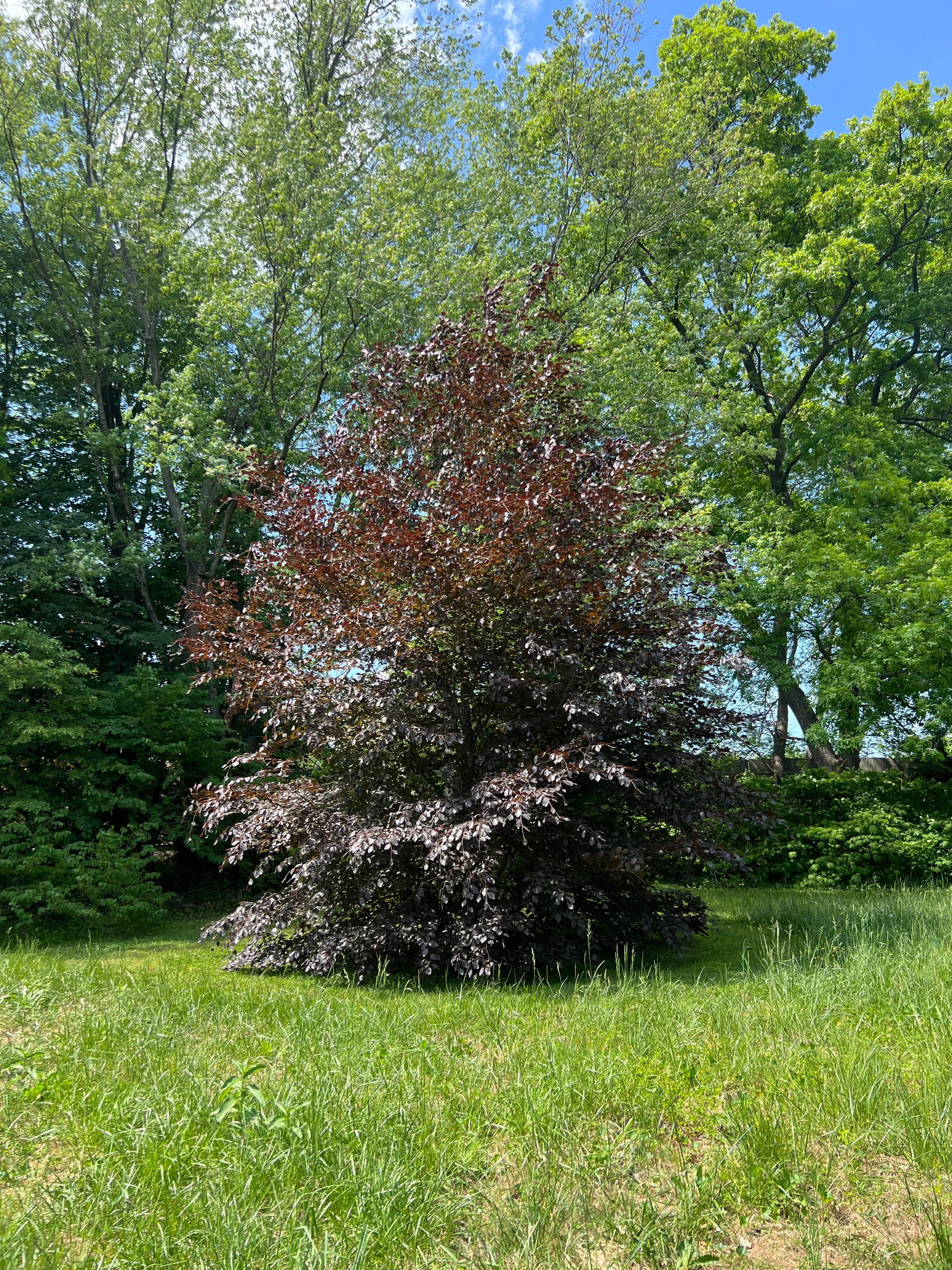
Red oak stump, copper beech, small red oak (far right):
Comments
Nothing yet. Say the first thing.
Sign in to join the conversation.