
NOTE: Regularly scheduled Backyard Stewardship programming resumes some time in April.
A few weeks ago, a friend who was visiting the Coachella Valley told me a story he’d heard from a tour guide. It had to do with a man walking parched and starving through the desert centuries ago who came upon an oasis in the nick of time and feasted off the fruit of the date palms growing there.
The problem with this story is that only one palm tree is native to the western United States and the northern Sonoran desert: the California fan palm (Washingtonia filifera). Date palms (Phoenix dactylifera), although heavily cultivated here in modern times, are native to the Middle East and North Africa.
Yet, one certainly does find oases in the Sonoran Desert, and no doubt people who lived more in touch with the land have sought them out over the centuries.
In my last post, I shared pictures of wildflowers growing in the hills above Palm Desert, California. Standing on the ridge looking back towards the road, one sees this:
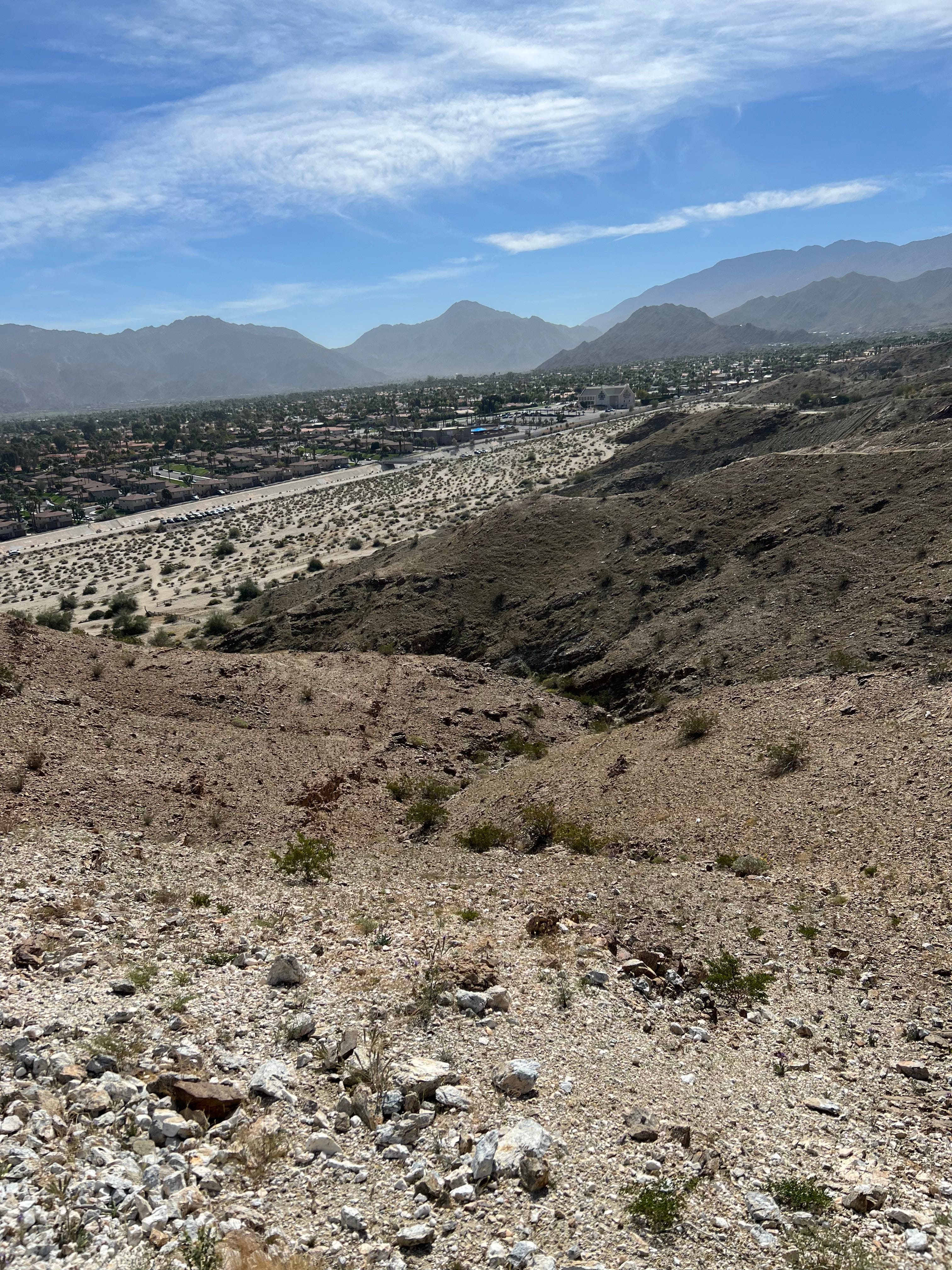
If you look closely, you will discern (from bottom to top) first the dry foothills of the Santa Rosa Mountains, which connect to the San Jacinto Mountains. These are part of the Peninsular Mountain chain that runs south into Baja California.
Second, you see a desert wash on the floor of the blow-sand desert, its material relatively paler than the hills and its flora relatively more abundant in this location. The sand comes from erosion over millennia, and the plants grow at a low point where water gathers— when there is water. Their deep roots follow the water down into the ground.
Just past the sandy area you see a large drainage canal, built to carry stormwater to the Whitewater River, which flows down the valley into the Salton Sea. The Salton Sea is the most polluted body of water in California because toxins leach from the soil and agricultural runoff from the nearby Imperial Valley also drains into it. Since it’s a terminal lake (meaning no water flows out of it), over time the lake water evaporates but the toxins never leave. Not coincidentally, water in the Salton Sea is twice as saline as ocean water.
Beyond the drainage canal lies a portion of the city of Palm Desert. You can see the houses just past the canal and lots of green. The developed floor of the desert is irrigated with water from the ancient aquifer plus some Colorado River water brought by canal.
In the distance are the mountains themselves, the wetter peaks of which support alpine forests.
Walking roughly in the direction where the camera is pointing, we descended from our hike (the first part of which I wrote about here) and came upon a small oasis:
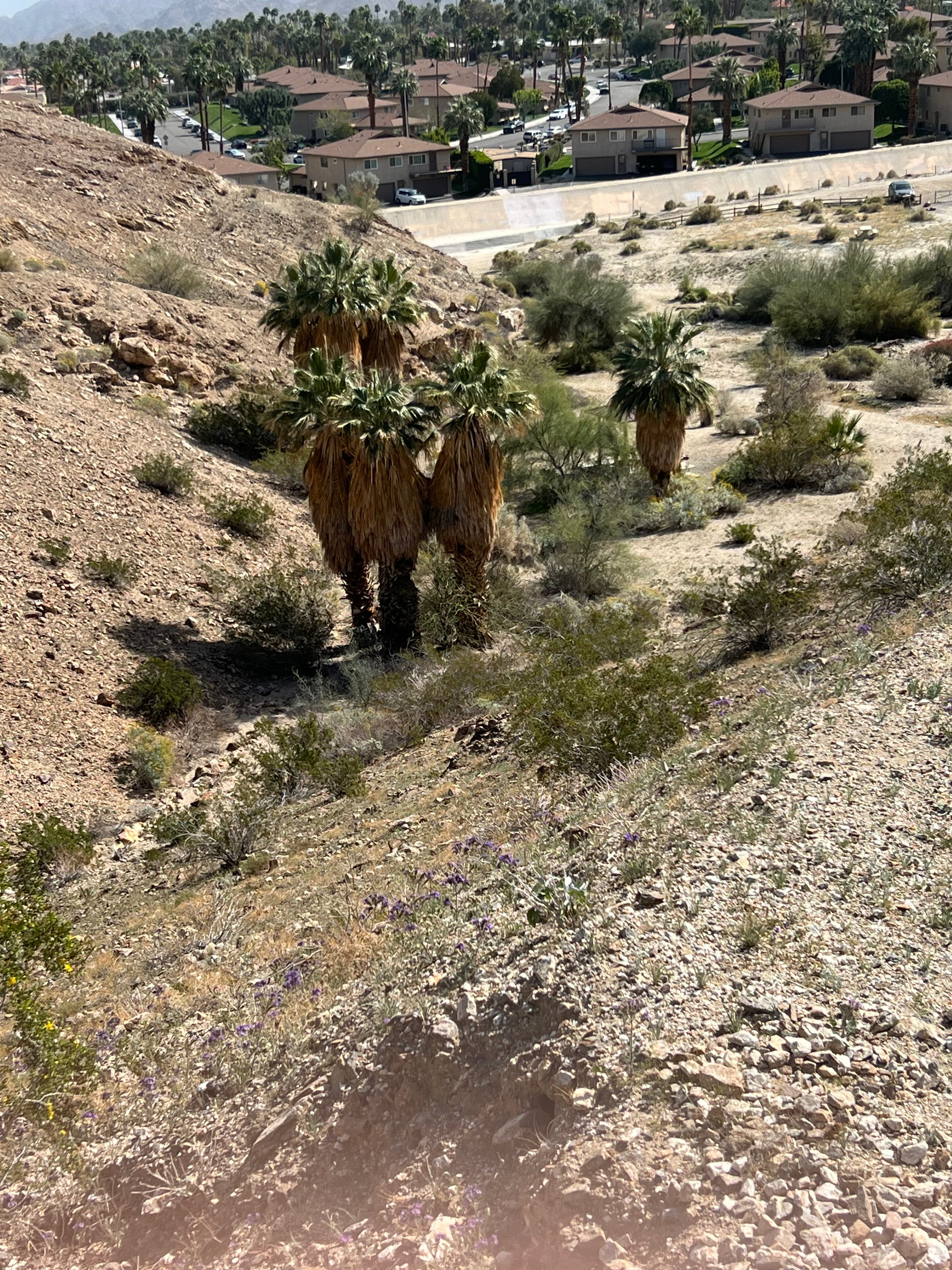
The taller trees are California fan palms being fed by a spring that originates from precipitation high in the mountains. It also probably benefits from direct rainwater channeling in that direction from the nearby slopes.
Several other native trees grow in the oasis. The taller plant in this picture is a blue palo verde (Parkinsonia florida):
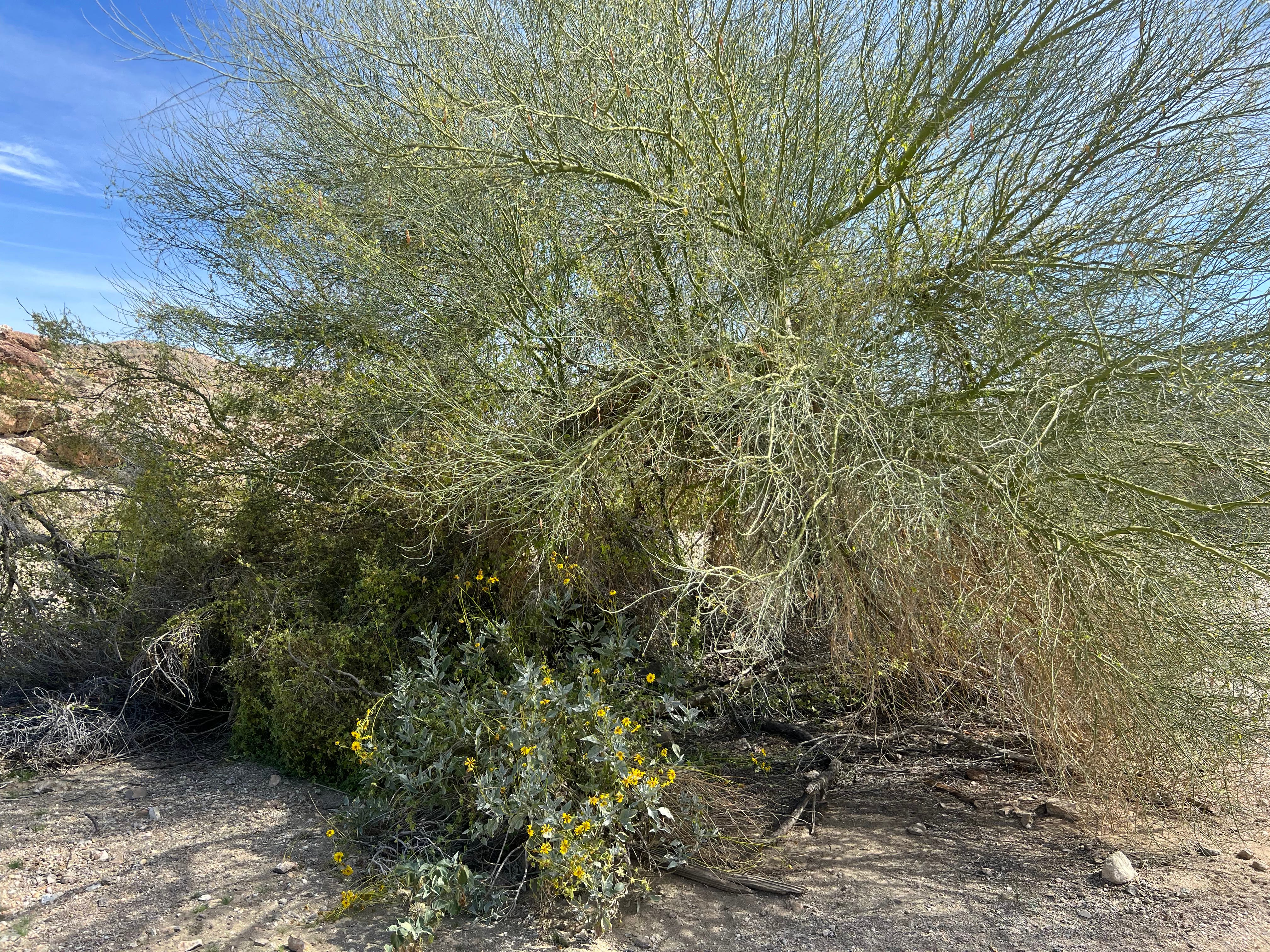
It is a keystone species in the Sonoran desert, serving as larval host to a number of moth species. The tree also hosts mistletoe, which feeds the Great Purple Hairstreak (Atlides halesus) butterfly. Many pollinators feed on its yellow flowers, and birds nest in its branches and eat its seeds.
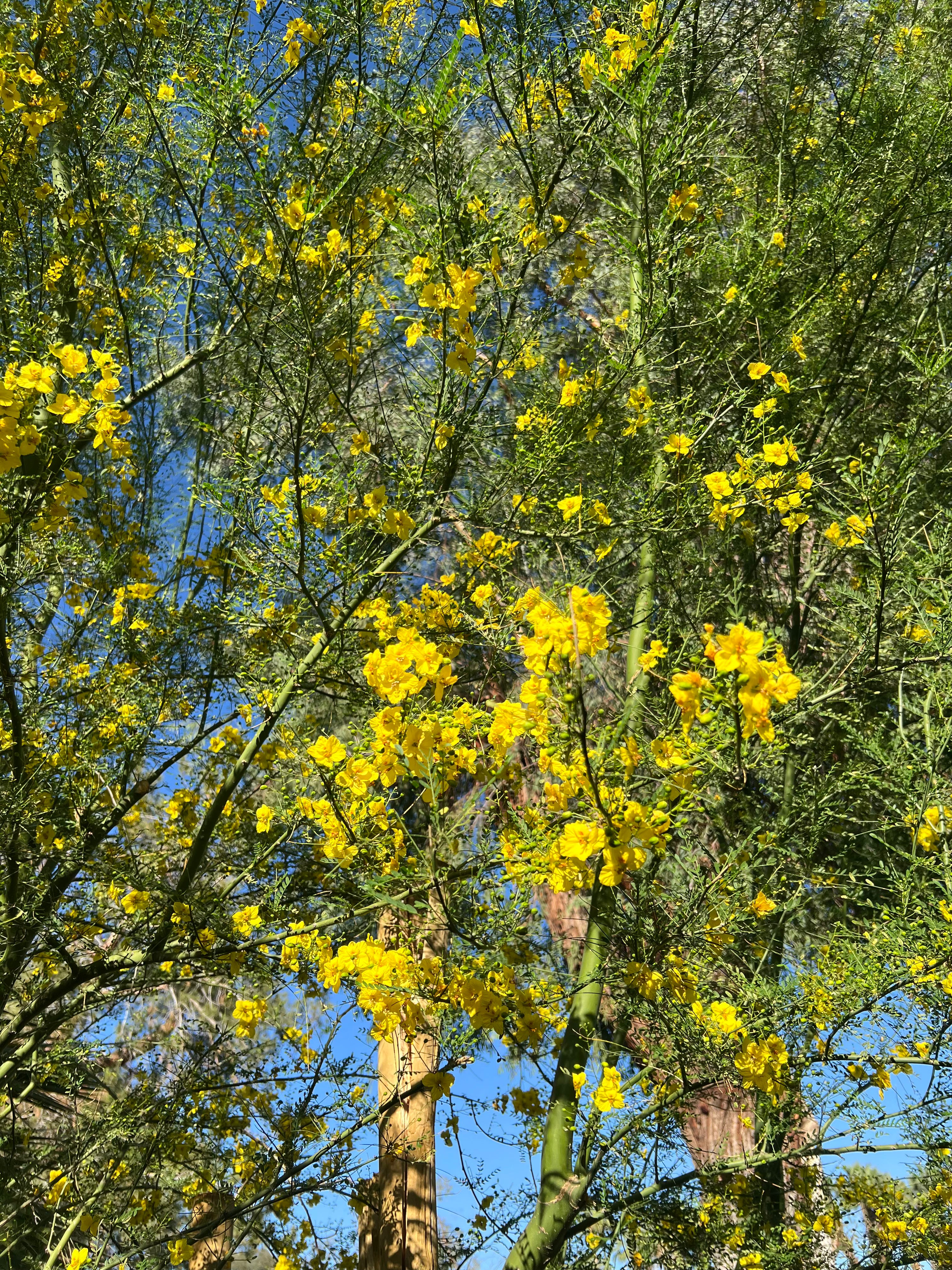
Here are the flowers of a blue palo verde tree growing in our desert yard:
Growing nearby the wild blue palo verde we found the deciduous shrub chuparosa (Justicia californica):
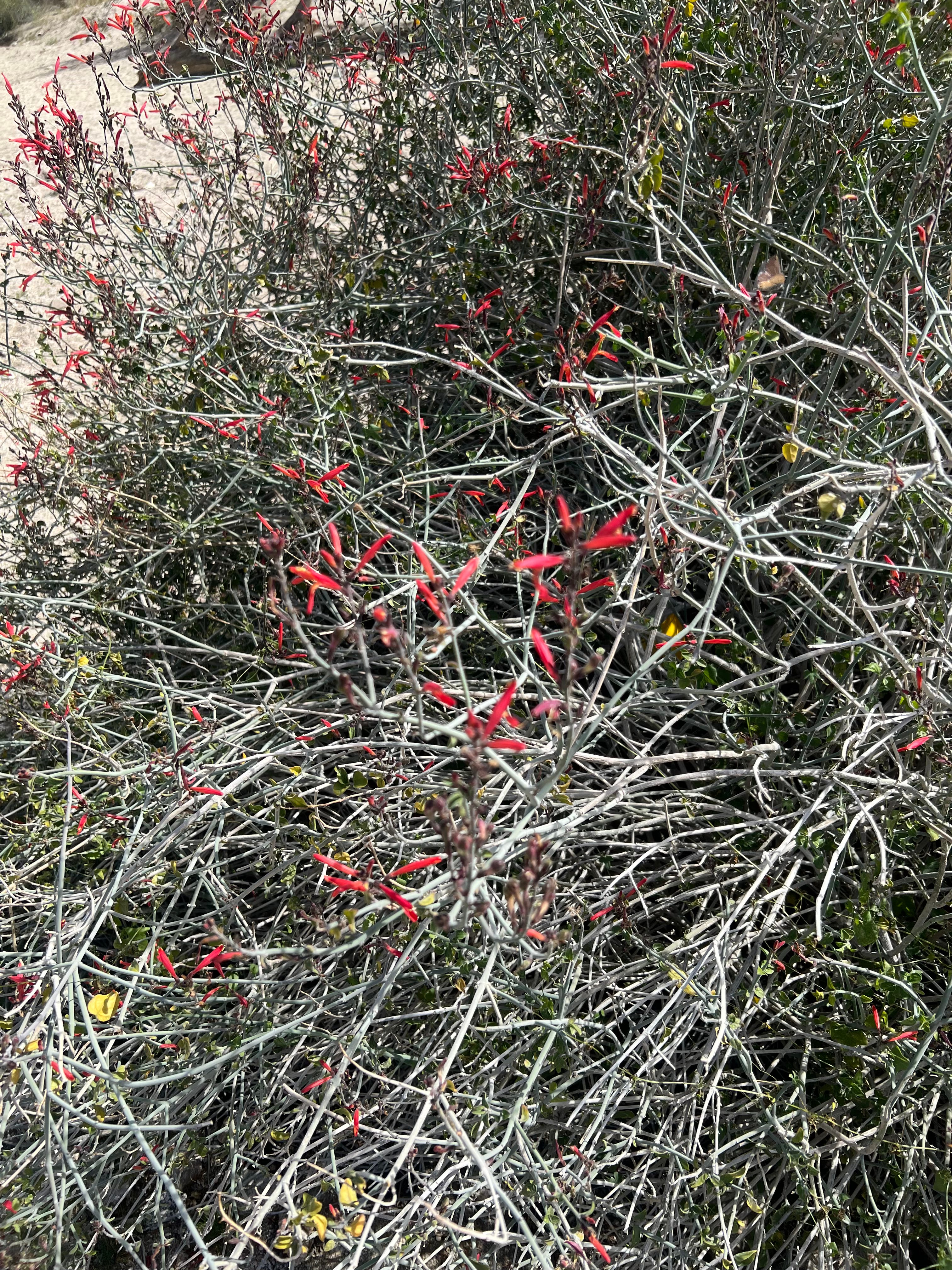
This plant is larval host to several species of butterflies, and its red flowers feed hummingbirds (one of its common names is hummingbird bush).
Before the drainage canal and the wells that tap the aquifer and the houses and the roads, one can imagine a member of the Santa Rosa Indian tribe finding his way to an oasis such as this, stopping to rest in the shade, and digging for water to quench his thirst. He might even have eaten the California fan palm berries.
For millennia, oases have supported the wildlife of the Coachella Valley. In an area that receives three to four inches of rainfall per year, their presence means life itself.
Even in the absence of dates.
Comments
Nothing yet. Say the first thing.
Sign in to join the conversation.