Does memorizing "chunks of language" make you more fluent?
More failures of rote memorization

Commentary on research in language acquisition and language education
Subscribe:.rss.atom.json.md.m3u.pls
Live Last read · last published · next check
More failures of rote memorization
Teaching adults a second language, or developing a good teaching app/program, requires both a solid grounding in the “why” (theory/research) as well as the “how.” If you don’t understand the why, you have no way of knowing if the how is working, or how to fix it when it doesn’t.
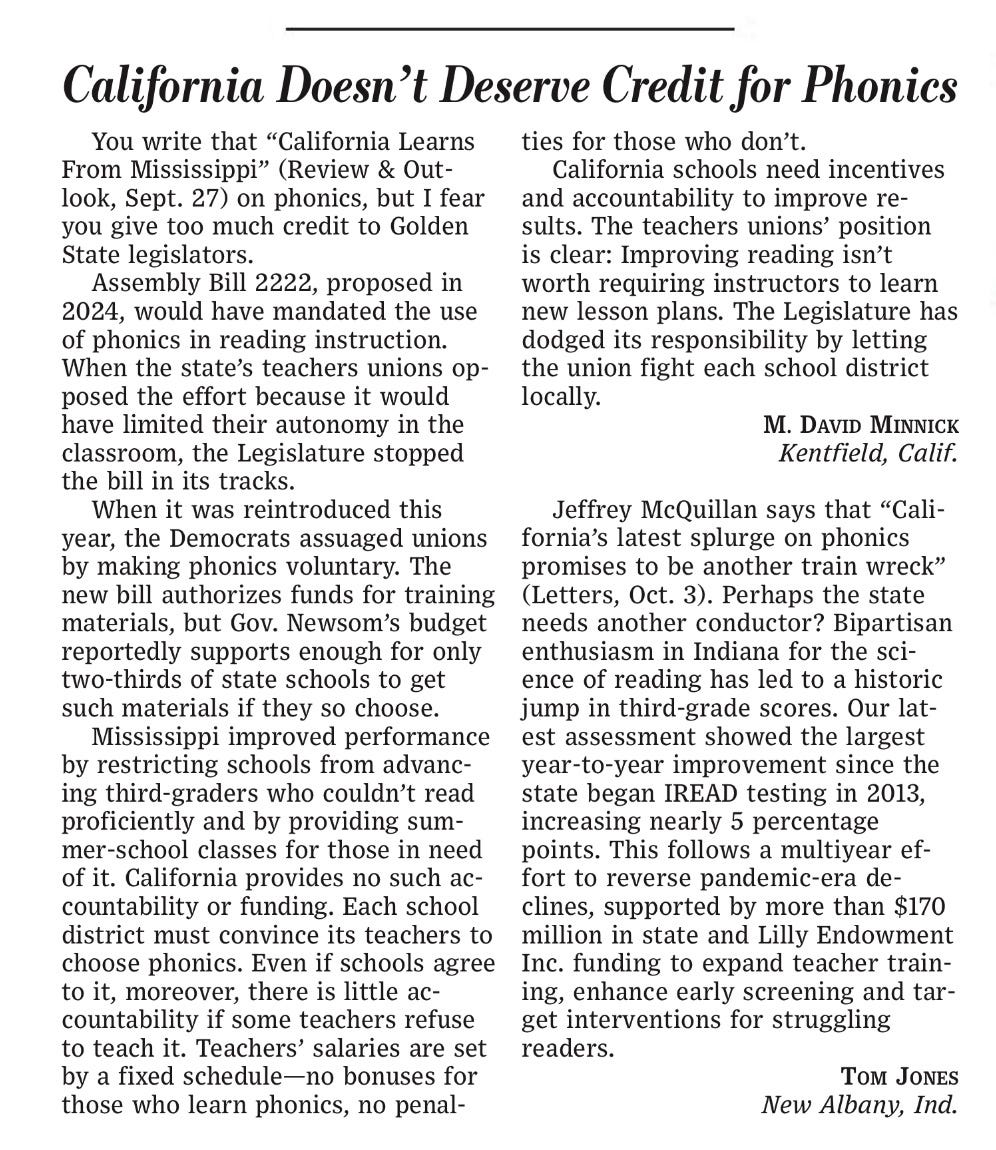
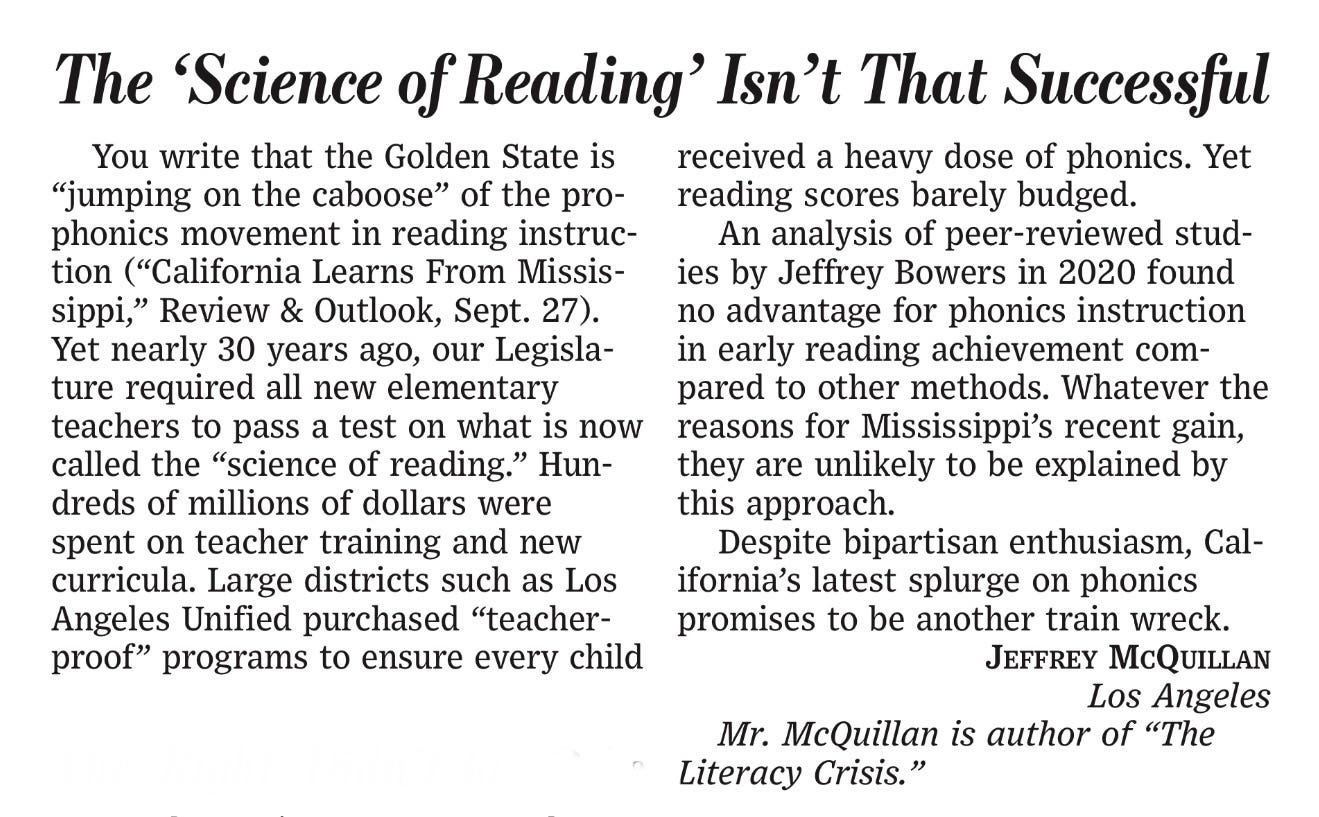
Two more letters appeared in the 10/12/25 print edition of The Wall Street Journal on the topic of phonics and California.
The Wall Street Journal recently published a letter by Tim Shanahan in response to my earlier letter on phonics instruction in California.
More false claims about California, Mississippi, and phonics
"Do not focus on language learning!"
The research shows the popular approach is in fact not supported by the evidence.
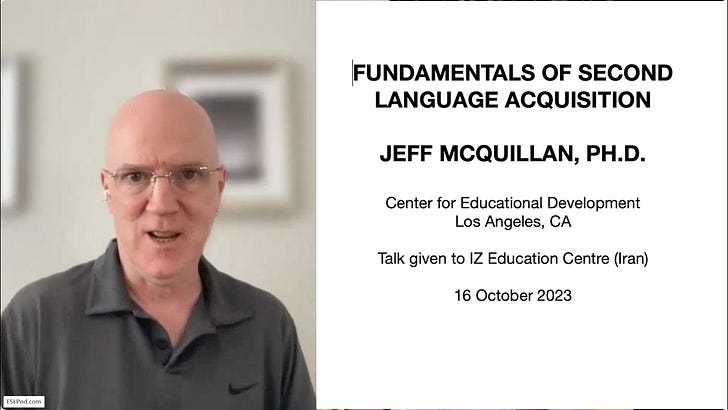
I gave two one-hour talks to the IZ Education Centre for beginning teachers over the past six months or so.
Popular YouTuber Matt Brooks-Green interviewed me recently on some key concepts in acquiring a second language.
Stephen Krashen and I published a very short paper, “The Case for Acquired Phonics,” which argues that the “acquisition/learning” distinction applies to phonics.
I was recently interviewed by Álvaro from Natural Languages about using comprehensible input in language teaching.
A video lecture
I’m giving short talk as part of a panel presentation on heritage languages for the National Association for Bilingual Education (NABE) this week.
One of the first collections of papers on heritage language acquisition and education was , published in 1998 and edited by Stephen Krashen, Lucy Tse, and me.
I gave a talk to a group of students and scholars at the IZ Education Center (Iran) via Skype on May 15, 2020.
Gallagher, Taboada Barker, Beck, and Buehl (2019) evaluated yet another academic vocabulary intervention for middle school students.
“Decodable texts” are books written so that the words that appear in them conform to the phonics rules children are taught.
The title Vocabulary, Grammar, Sex, and Aging is from a paper published a few years ago in the journal Cognitive Science, not what’s been on my mind lately.
The National Assessment of Educational Progress (NAEP) – “the Nation’s Report Card” – has released results from their latest round of reading tests.
The education writer at Forbes, Natalie Wexler, argued last week that reading fiction isn’t the “only” thing needed to boost academic achievement.