
Uniontown is a struggling community in the heart of Alabama’s Black Belt, and among its struggles is a failed sewer system that has been failing for more than 40 years. Various attempts have been made to fix the system, which has often spewed untreated sewage into Uniontown residents’ yards from the open cesspools supposedly treating sewage. The technical term for the cesspools is lagoons, a euphemism that masks the true awfulness of this open sewer system.
But a fix is supposedly in the works – and has been for several years. Ben Eaton, formerly the high school shop teacher, and a former county commissioner, has been interested for many years in learning more about the fix, including whether it is the best design for the problems, where the money has gone and for what, and whether the state and federal governments, which are funding the fix, have examined various possibilities before settling on a plan. And he has also wondered about this: why the corporations and the prison in the small city, which are big users of the local water and sewer systems, aren’t contributing to the cost of the fix. But Ben has repeatedly been stonewalled by his own city government and the federal government about a high-dollar contract touted as the way the impoverished community would finally see its decades of problems resolved.
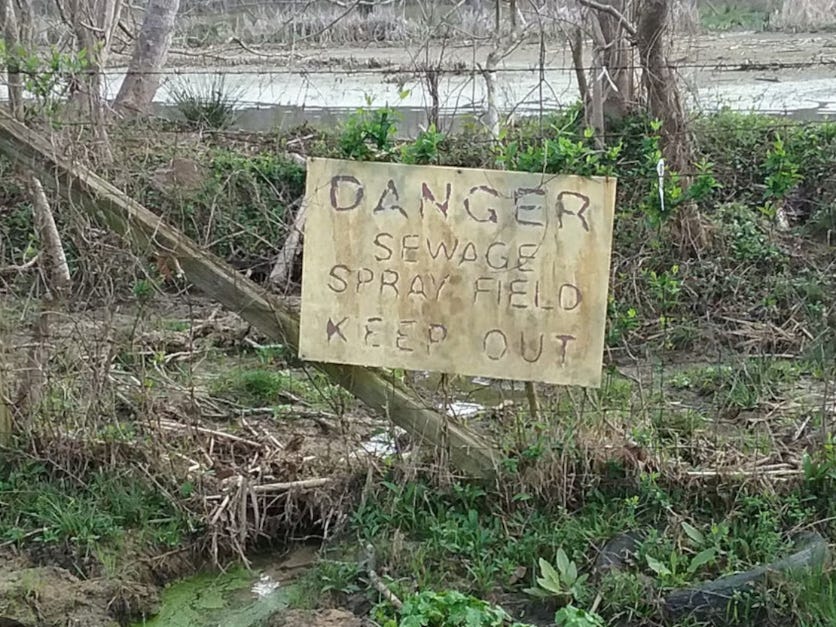
Spoiler alert: after the expenditure of more than $30 million in mostly federal funds for this community of about 2,000 people, the sewer system is still failing. Do the per capita calculation on what has been spent per person in Uniontown. And of course, like me, you can continue to puzzle over where the money has been going and why the problems persist in Uniontown.
I began researching the situation in Uniontown in early 2020 as I was embarking on my book, Backroom Deals in Our Backyards: How Government Secrecy Harms Our Communities and the Local Heroes Fighting Back. There was and continues to be a lot of government and corporate secrecy in Uniontown, including over the sewer system.
I visited the community in 2022 and 2023, and also spoke extensively with Ben and with Portia Shepherd. Both have been active in the community and deeply concerned about longstanding environmental injustice in Uniontown. Ben in particular had been an early proponent of finding out what was going on. In the course of his own research, he led a push to try to get various documents from the local water and sewer board, the Alabama Department of Environmental Management, and the U.S. Department of Agriculture. USDA has played a significant, and often secretive role in the effort to fix the sewer system.
The first time I visited Uniontown in 2022, I met with Ben for several hours. He drove me around in his van to give me a tour of gushing sewage. I also attended a meeting of the Uniontown Waterworks and Sewer Board. The local five-member board meets in the city hall, has written agendas and produces minutes. Having not attended previous meetings, I wanted to get some past copies of agendas and minutes, which the board was not routinely handing out, nor posting online. (There is still no public website for the board).
After the meeting, I went to the board’s office, a small store front adjacent to a stockyard -which, like the lagoons, is another contributor to various unpleasant smells that waft over the community. At the office, I filled out a form, said who I was, gave my address in Maryland, and paid a few dollars for copies of recent agendas and minutes. No problem, even though Alabama at the time was one of a handful of states that allows but does not require public agencies to limit public records requests to citizens of the state. (There has been a tiny bit of progress. Alabama now limits public records requests to residents of the state, so you don’t need to show proof of citizenship any more).
A year later, when many people in the community including the water and sewer board members were aware that I was watching the sewer project and trying to get information about it, I visited Uniontown again. and again attended a water and sewer board meeting. Again, no copies of the agenda and minutes were handed out to the public in the audience, so I returned to the board’s office.
This time, my request for documents was not filled on the spot, but instead was referred to the board’s lawyer, Prince Chestnut, a state representative who also has a robust legal practice advising water and sewer boards in many Alabama communities. When I asked why I could not get documents that I had easily obtained a year before, I was told that now Chestnut was reviewing all public records requests. And so a long wait ensued, as I sought documents that clearly were in the public domain, and which in other communities in the United States are routinely available online or at the very least on the city hall bulletin board, and on the bulletin board in the water and sewer board’s office. Not in Uniontown.
What’s the big secret about information that – if you had attended water and sewer board meetings – you already would know? Chestnut told me in a letter about a month after my request that he was unable to provide the information because I wasn’t a citizen of Alabama. And this, even though I am a citizen of the United States, and my federal taxes are helping to pay for the U.S. Department of Agriculture’s spending on Uniontown and supporting the water and sewer board by offering substantial advice and guidance. And while Alabama law allows public agencies to deny documents to out-of-staters, it doesn’t require them to.
And why, exactly, is Alabama allowed to keep these items secret – at least from out-of-staters like me?
Here’s why, thanks to a unanimous U.S. Supreme Court ruling that is now 13 years old.
In a case from Virginia, McBurney v. Young (569 U.S. 221 (2013)), the court reviewed conflicting rulings to decide that it was just fine for states to withhold public information from members of the public who were not citizens of those states. Here’s what the decision by Justice Samuel Alito said, in part:
“The state FOIA essentially represents a mechanism by which those who ultimately hold sovereign power (i.e., the citizens of the Commonwealth) may obtain an accounting from the public officials to whom they delegate the exercise of that power. See Va. Const., Art. I, §2; Va. Code Ann. §2.2–3700(B). In addition, the provision limiting the use of the state FOIA to Virginia citizens recognizes that Virginia taxpayers foot the bill for the fixed costs underlying recordkeeping in the Commonwealth.” In 2013, here’s who was on the Supreme Court and agreed with Alito: Stephen Breyer, Anthony Kennedy, Elena Kagan, Ruth Bader Ginsburg, John Roberts, Antonin Scalia, Sonia Sotomayor, Clarence Thomas (who wrote his own concurrence).
Well, in Uniontown lots of other people are footing the bill for the “underlying recordkeeping” that Alito mentions and that the Uniontown water and sewer board is undertaking.
That would be you, me and everyone else who pays federal taxes.
The Uniontown board is closely monitored by representatives of the U.S. Department of Agriculture, who attend nearly every meeting that the board holds. The USDA people, who compelled Uniontown to set up the board to begin with, have advised the board regularly about whom to contract with, how to handle questions from the public, and who can sit on the board and who cannot. (That’s a topic for another day).
At least $24 million in federal funds have been allocated to Uniontown and paid out to contractors; another $6 million and more coming has been directed by the state to Uniontown. Some of that money came from federal funds sent to the state. So one might argue that the Uniontown water and sewer board is actually, in addition to being part of the state and local governments, also an arm of the federal government. If so, it could be argued, that Uniontown’s water and sewer board should be responding to public records requests without insisting that citizenship (and now residency) is required for the board to fulfill a records request. That is the case with federal Freedom of Information Law. No citizenship or residency is required.
In any case, what’s the big hesitation about withholding your agendas and minutes? Unless, of course, you don’t want out-of-staters looking over your shoulder, and trying to unravel where the money has done and why the project still isn’t completed.
I did eventually, after a two-year-wait, get some documents from the U.S. Department of Agriculture, but only after Ben Eaton got help from two law clinics – at Yale and Vermont law schools – and a federal judge in Washington, D.C. ordered USDA to come up with the documents. And yes, some of those included agendas and minutes from – you guessed it – the Uniontown water and sewer board.
This process is a big waste of everyone’s time – and our tax money. Secret keeping generally is.
Roger Hurlburt, who was one of two plaintiffs in the McBurney case, that allows states to bar out-of-staters from obtaining public records, told me that despite the ruling, he isn’t having a lot of difficulty getting documents and data he needs from across the country, and even in Virginia where he asks for electronic copies of each county’s property tax rolls.
“I get almost 80 percent compliance,” he told me in a phone call from his office in Jefferson City, Missouri the other day. “I don’t use the word FOIA request in Virginia. It would tempt an uncooperative bureaucrat to say ‘you aren’t one of us.’”
In other states with similar restrictions to Alabama and Virginia, he said, some government employees quickly offer up the information he is seeking “may have come to the realization that it is really stupid to deny out of state requestors.”
He said a denial makes more work for the government employee.
They need to write back, he told me and say something along the lines of ‘no you can’t have the information because you are from out of state.’
“Then they have to take my letter and at least throw it in the waste basket. That takes a few more steps,” he said.
It is sometimes easier just to send along the information, Hurlburt said.
In Alabama, for instance, you need to get someone in-state to make a public records request for you. That, too, can be something of a minefield for public employees handling the requests, Hurlburt said. It’s easier for the government employee “to deal with a sophisticated, experienced requestor than to deal with someone who makes inadvertently unreasonable demands.”
Several other states besides Alabama and Virginia – Arkansas, Delaware, Kentucky, Louisiana, and Tennessee - allow public agencies to require residency or citizenship of that state for public records requestors.
It’s time to rethink these laws, especially because the Internet knows no such boundaries, and because so much federal money is intermingled with state activities, and the feds don’t require citizenship or residency. At least, not yet.
If you want to read more about the environmental suffering that Uniontown residents have been experiencing for decades, an entire chapter of my book is devoted to that saga. You can get Backroom Deals in Our Backyards: How Government Secrecy is Harming Our Communities and the Local Heroes Fighting Back directly from my publisher, The New Press.
Click on this link and use the discount code Backroom30.
No posts
Comments
Nothing yet. Say the first thing.
Sign in to join the conversation.