
Hullo - we are in summer reruns. Not literal reruns yet, although I might still dig out a few old pieces that I think people have forgotten, but this is a part of some of the background work for the “next book but one” (ie, the one I’m working on now, while The Problem Factory is with its editor). It’s about a sort of visual metaphor which I think causes a lot of trouble in policy thinking. I first wrote about this on this ‘stack a year ago
There is a great danger of assuming that controls work in a predictable and consistent fashion. When you turn the steering wheel of a car, the wheels turn and the car moves in a consistent way. The steering doesn’t suddenly make a sharp turn in response to a small touch on the controls. And if you steer one way, then reversing your movements brings you back in exactly the same way – the steering doesn’t change its response depending on what direction you’re going in, or what you did previously.
Let’s describe this sort of stable and consistent relationship by saying that “the control surface is smooth”. The map which translates inputs from a steering wheel, or any other controller, is a map of a flat surface, or at least one of gradual and regular curves. Important properties of a smooth control surface are that fine-tuning is possible – you can home in as closely as you like to a desired position by making small adjustments to the controls. And the business of control is reversible – anything that you do, there is some sense in which you can undo it by moving the controls back to where you started from.
Smoothness of a control space is a very desirable situation to be in; there’s a reason that most machinery is designed in this way. For aircraft, smooth response is highly prized, and the extent to which reality approaches this ideal is a measure of how good the flying conditions are. In high winds, close to stall speed or with badly designed aerodynamics, the pilot might have to fight with discontinuous or volatile responses, but in a good aeroplane on a good day at cruising height and speed, the response to the stick should be pretty smooth.
Unfortunately, in social, political and management situations, if the “policy levers” exist at all, they operate on the basis of a very bad control surface.
[…]
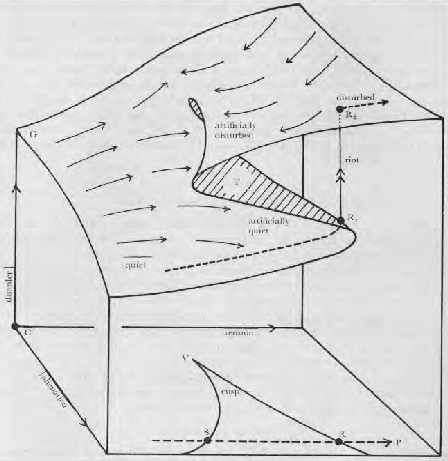
What Professor Zeeman and his colleagues found, though, was that when it came to prison riots, the control surface was warped and twisted. They decided to model it in two dimensions, declaring that there were two variables that could be influenced, which they called “tension” and “alienation”. The first of these was a measure of how discontented the prisoners were, which could be measured by things like the population of the number of requests to see the governor, the number of men in the sick bay and the number of welfare visits. The second was a measure of how bad the prisoners’ ability to communicate with authorities was, measured by the population of the disciplinary wing and the number of requests to go into segregation. And these were related to a third measure of “disorder” which included fights, work strikes and other elements of protest as well as riots themselves.
The control surface that they eventually drew, however, had to reflect the reality of prison riots. Which is to say that a prison riot doesn’t develop gradually as tension increases – you start off in a position that appears OK, then a small increase in tension results in a large and immediate step-change in the amount of disorder. Added to which, once you’ve moved from the “not riot” state to the “riot” state, you can’t just undo the actions which caused the riot and move back. The situation is not reversible in that way; getting to a truce requires much larger movements in the positive directions than the negative moves which started the riot. And things are path-dependent; the order in which they happen matters. If you know that an increase in tension is on the way, because of staffing problems or overcrowding or political issues in the outside world, then improving communication ahead of time makes it much less likely that this will lead to a riot.
And so the surface is folded – it has what Zeeman called, following the French mathematician Rene Thom, a “cusp catastrophe”. At some points, a small move in the direction of higher tension or alienation takes you off a cliff edge, with a sharp increase in disorder. When that happens, you’re on another part of the surface, and the path which brought you to the cliff edge is inaccessible. You need to navigate another way back, possibly moving through another catastrophe that might be labelled “truce”. In principle, you can map out the shape of the cusp and get an idea where the control surface might respond to your policy interventions in a reasonably consistent manner, and where you might be vulnerable to sudden jumps. Zeeman and Shapland started to plot their data on a three dimensional graph, noting where they found sudden and sharp changes in the level of disorder.
[and, various consequences ensued …]
No posts
Comments
Nothing yet. Say the first thing.
Sign in to join the conversation.