
Well, NYC’s Mayor recently announced that they will “replace the frigidity of rugged individualism with the warmth of collectivism”!1

And it reminded me of something I have puzzled over for a long time: Leftists love collectivism, but they appear to know little about it. They certainly don’t appear to realize that most research on collectivist societies shows that it is almost always completely opposed to everything they value.
If you enjoy my writing and want to support viewpoint diversity in academia, you can give me a tip! Or please simply, like, share comment, or subscribe:
The term "collectivism" conjures a warm image in popular leftist discourse, as indicated by Mamdani’s quote. It conjures images of equity, generosity, mutual aid, community solidarity, openness, and progressivism. Collectivism is thus presented as a viable antidote, for leftists, to individualism and capitalism, and as a path toward a more open and equitable society.
A closer look reveals that the forms it takes in the real world are often starkly different from, and even opposed to, the conceptions of collectivism held by leftists, and it’s often directly opposed to the ideals they champion.
This is not simply a “look at the mountain of bodies political collectivism leaves in its wake”2 argument, which has been rehashed over and over. Rather, I want to point out that even mushy notions of Eastern style cultural collectivism are in direct opposition to leftists ideals.
It might help here to differentiate between these two general levels or types of collectivism.
We could call the first type “political collectivism”, or “institutional collectivism”. This is criticized frequently, so I won’t give it much attention here.
This is the top-down, state-enforced system where the individual is legally subordinate to a larger, truly collective identity—the state, the party, or the nation. Historically, this is the collectivism of communism and fascism. It’s pretty well depicted in this tweet:

Alice Smith@TheAliceSmith
Picture of one rugged individualist standing against the warmth of collectivism on June 5, 1989.

5:32 PM · Jan 2, 2026 · 489K Views
548 Replies · 8.82K Reposts · 40.3K Likes
As political theory and history demonstrate, this form of collectivism is inherently authoritarian, violent, and coercive. Because of the diverging interests of individuals—and the inherent flaws of planned economies and societies—it cannot be achieved voluntarily on a mass scale. It requires the use of centralized raw power, military, and police to suppress individual property rights, autonomy, freedom, dissent, free speech, and so on.
The horror of this sort of collectivism is so well known, and it has been so thoroughly debunked that we don’t really need to deal with it.
Leftist skirt this issue anyway, by mostly denouncing this extreme form of collectivism, by dressing up their conceptions of collectivism in the flowery, warm language of the second broad type of collectivism:
This type of collectivism is less political, and more socio-cultural3. It includes relational collectivism (kin-based), network collectivism (tribal, village, etc.—based on strong ties but not necessarily familial), and attribute collectivism (broader again, collectivism based on particular attributes: ethnicity, religion).
This is the type of collectivism that appears so attractive to western leftists. It is easily dressed up in the language of kindness rather than power. It conjures images of communes and close-knit yet diverse communities in which everyone works for the good of everyone else, but everyone is also somehow free to be and do whatever they want. It is often studied in Eastern, Latin American, or African contexts, giving it the exotic air of non-western, magical, noble cultures that leftists love to falsely invoke so much.
However, here is where leftist notions collide with reality: data shows that even cultural collectivism is frequently entirely at odds with leftist values.
I am necessarily going to simplify and overlook nuances and distinctions here, but the general image I paint is true. Look at the annotated reference list at the end of this article for key findings supporting this argument.
Collectivist cultures face very similar practical constraints and flaws as collectivist political systems. That is to say, in order to function as a collective, and in order for the concepts and culture underpinning the collective to be maintained, freedom must be limited, power must be exercised, and rules and norms must be strongly enforced.
Leftists are obsessed with "diversity", yet if you look at collectivist cultures around the world, they are all highly conservative and they do not tolerate diversity, deviance, or dissent nearly as much as individualist cultures. By their very definition, collectivist cultures require everyone to follow the same program. This often means enforced gender roles, enforced respect for elders, strong hierarchy, a lack of social mobility, strict religious and cultural practices, commitment to tradition, and so on… Not things that leftists typically approve of (they generally hate norms and social roles, they hate their elders, they hate religion, they hate tradition, they want the freedom to abandon their family for minor inconveniences or political differences, etc.).
Leftists look at some collectivist cultures around the world and see, for example, that some may be accepting of particular forms of a “third gender” or “trans”-type personalities, and assume that this means these cultures must surely be paragons of openness and liberality. Well, they aren’t—and the fact that such small features are so powerfully blinding to leftists is simply evidence of their monomania around gender.
Collectivist cultures ruthlessly leverage potent social technologies for maintaining order: social shaming, social surveillance, threat of ostracism, coercion, obligation, enforced reciprocity, and Machiavellian manipulation are often shown to be more prevalent in collectivist cultures.
These strategies are used in collectivist cultures in order to suppress individuals’ desires, differences, and dissent in order to ensure people follow tradition, don’t deviate from (and thus undermine) the collective cultural models, and do what is “best” for the group (ironically, it’s often not actually what is best. If you look at various indicators of social, economic, and political wellbeing, collectivist cultures generally are worse off than individualist ones).
One of the most significant clashes with leftist morality is the issue of corruption4.
In collectivist cultures, your primary moral duty is to your family, your village, to your co-ethnics or co-religionists (depending on the type of collectivism)—not to some universal liberal ideals of openness, procedural fairness, or justice.
What an individualist society calls corruption, a collectivist society often views as one’s moral duty. What Westerners call "nepotism" (leftists in the West love to gripe online about nepo-babies in Hollywood, or rich people who buy their kids’ way into prestigious institutions, for example) is often viewed, in collectivist societies, as the fulfillment of ones moral obligation to use whatever strategies one can in order to help members of the in-group collective. And very often, shaming, punishment, manipulation, and gossip are used to ensure that people fulfill these obligations to in-group members, who are pressured to do what is necessary to not lose their standing as a good member who is committed to the in-group.
If you are a government official or bureaucrat in a collectivist culture, and a family member or tribe member needs a job, or say if one of your job applicants is a co-religionist, it is your obligation—and there is immense social pressure—to give that person the job, even if they may be underqualified or if doing so means violating principles of fairness. You see this kind of corruption everywhere in collectivist cultures.
An ugly side to this cultural collectivism is also that, due to the coevolution of in-group favoritism and out-group prejudice, intergroup hostility is actually often more pronounced in so-called collectivist cultures.
Remember, in collectivist cultures, loyalty is to the collective and it’s members first, and the collective is never humanity in general; humans did not evolve for that, and it is very hard to achieve while in the “hive” mode—only Western individualism gets close.
By loosening identity-based affiliations underlying so-called collectives, individualism gets closer to leftist notions of global collectivism because EVERYONE is an individual, but only some people are the same race/tribe/family as you. So if we are committed to respecting individuals and freedom, we come closer to a truly all-encompassing collectivism, in which everyone is a member of the group. It’s paradoxical and confusing, but its true.
Overall, leftists—if they don’t ascribe to a full-blown political collectivism—ascribe to a mythical form of cultural collectivism that doesn’t really exist. If any collectivist cultures do come close to the myth, it is only because their incredibly small scale and isolation allows them to avoid a number of collective problems that larger societies face. You can bet that if their numbers increased and they were frequently in touch with other groups, the “collectivism” would manifest as intergroup hostility, prejudice, and so on, all to protect their “collective”.
It’s ironic; if you look at the global data, the collectivism that leftists love so much is closer to old-school tribalism, traditionalism, religionism, and racialism. It requires qualities that leftists clearly demonstrate a hatred of—commitment to family, to tradition, fulfilment of social roles, self-denial, respect for elders. In collectivist cultures, you cant abandon your family because they’re too traditional or don’t share your politics. You can’t decide you don’t want to follow to social program. You will be pressured to have kids. You can’t take endless mental health days and decide you don’t want to work because of your anxiety—the collective requires you to be productive and work for the good of the group! It facilitates everything that leftists ostensibly oppose so strongly—nepotism, corruption, social conservatism, familial and religious and cultural prejudice, etc.
The irony is that the only culture that actually comes close to achieving the mythical leftist utopia in which people simultaneously thrive economically, are free to dissent and deviate, to sever and then and create new social ties, to care for their mental health and nurture their own desires even if it means becoming a burden to the collective, and to extend the cooperative instinct far beyond the usual human boundaries—is Western-style individualism and market-based societies.
It is plainly obvious from the available data; data on corruption, health data, wellbeing data, economic indicators, crime data (including crimes of violence, abuse, etc.), that “individualist” societies are more liberal, more progressive, are better at facilitating large-scale cooperation, and are better at bringing us close to leftist ideals of freedom and equality than any so-called collective ones.
But as with many economic concepts, leftists seem to have a mental block wherein they can’t fathom that actions which don’t bear kind-sounding names and which appear to be counterproductive to their goals on the surface, when applied to a large scale, actually bring about the desired productive and positive phenomena as emergent properties. This is true of market economies, it is also true of cultural individualism.
If leftists could avoid the nominal fallacy, they would realize that, despite its name, “collectivism” in practice usually actually stifles diversity, works against ideals of universalism and equality, and encourages tribalism, corruption, and intergroup prejudice.
Note: To avoid spending days writing this into a long-ass piece, which I couldn’t be bothered to do, I necessarily ignored some complexities around vertical vs horizontal collectivist cultures, tight and loose collectivism, etc. But it doesn’t really matter because the point stands: Individualist societies do better at facilitating the kind of social change that progressives ostensibly want, and collectivist cultures frequently display higher rates of all the things that progressives ostensibly stand against.
That hasn’t prevented leftists from activating for collectivism though. Maybe it’s because they are motivated more by an oikophobic instinct than an actual desire to achieve progressive outcomes. Go figure.
If you enjoy my writing and want to support viewpoint diversity in academia, you can give me a tip! Or please simply, like, share comment, or subscribe:
Here is a short list of articles with some data supporting the argument above, that I had Gemini help with:
Mazar, N., & Aggarwal, P. (2011). “Greasing the Palm: Can Collectivism Promote Bribery?”
Key Finding: Using cross-national data and experimental priming, the authors found that collectivist mindsets lead individuals to feel less personally responsible for their actions. This “shared responsibility” makes it psychologically easier to offer bribes compared to individualists, who feel the weight of personal moral agency.
“Together, these results suggest that collectivism promotes bribery through lower perceived responsibility for one’s actions.”
Triandis, H. C., et al. (2001). “Culture and deception in business negotiations”.
“cultural collectivism was positively related to reported use of deception in negotiations”
Jha, C. K., & Panda, B. (2017). “Individualism and Corruption: A Cross-Country Analysis.”
“We find that more individualistic countries have lower levels of corruption (perception). This relationship is robust to the inclusion of a rich set of control variables and to the use of alternative measures of corruption.”
Zheng, X., et al. (2013). “Collectivism and corruption in bank lending.”


Fessler, D. M. (2004). “Shame in Two Cultures: Implications for Evolutionary Approaches.” World Cultures, 15(1), 37–62.
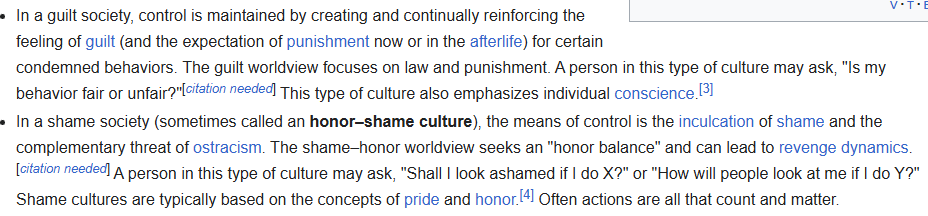
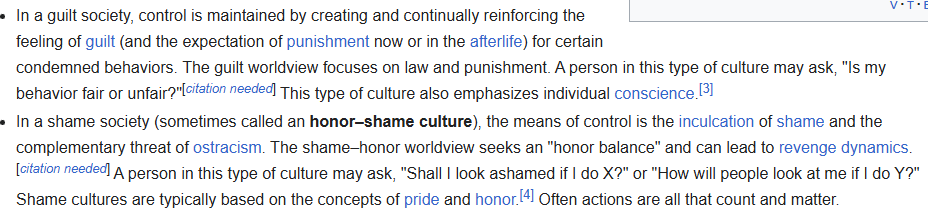
Key Finding: Contrasts “Guilt Cultures” with “Shame Cultures.” It finds that in collectivist settings, shame is a primary tool for social regulation used to maintain rank and subordinance.
Collectivists frequently feel shame, and show a major concern for how others perceive them, a strong desire to follow social norms, standards, and traditions to avoid shame, and so on.
Individualists more often discuss guilt, a feeling of “remorse or regret; Often stem from inflicting harm on another; Often involve a desire to compensate the victim, apologize, and/or punish the self; Little or no evidence of concern with others’ negative opinions of the actor; Little or no emphasis on public nature of failure, no evidence of a desire to avoid visibility, no reports of shrinking, feeling small, etc.”
On Shame vs Guilt cultures, one can see the dimension of collectivism vs individualism underlying these:
Sznycer, D., et al. (2018). “Cross-cultural differences and similarities in proneness to shame.”
Key Finding: Shows that the shame-threat (the degree to which you fear being shamed) is calibrated to the local social network. In collectivist societies, the valuation of an individual is entirely dependent on their standing in the group, making social shaming an existential threat.
Douarin, E., & Amini, C. (2020). “Individualism and attitudes towards reporting corruption: Evidence from post-communist economies.”
Key Finding: Found that individuals with higher individualist values are significantly more likely to blow the whistle on corruption. In collectivist settings, the “penalty of being ostracized” by the group prevents people from acting against corrupt leaders or kin.
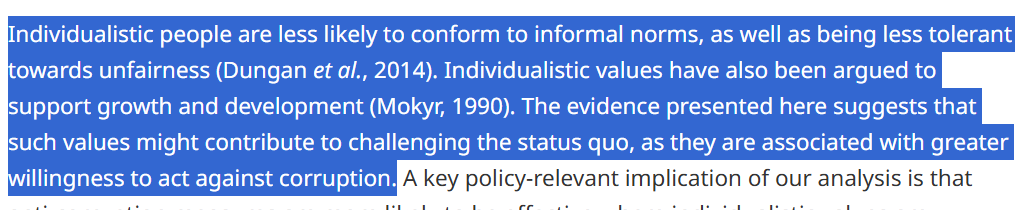
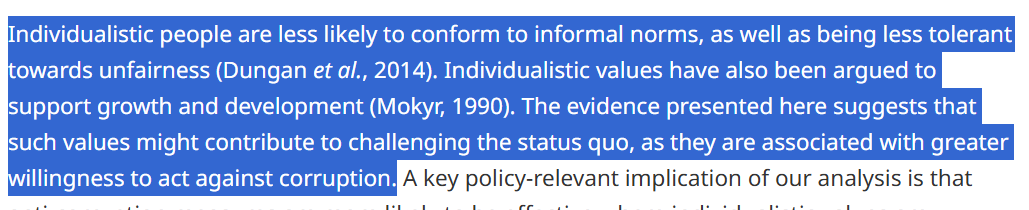
“Our findings indicate that individualism is associated with a greater likelihood to act against corruption. The effect estimated is small but highly significant and robust to changes in estimators and specifications. We also find evidence that institutional trust and individualism strengthen each other to generate greater willingness to report corruption.”
“We find a consistent positive association between individualism and the likelihood of reporting corruption, the belief that others will report it and the notion that ordinary citizens can do something to tackle corruption.”
“A key policy-relevant implication of our analysis is that anti-corruption measures are more likely to be effective where individualistic values are widespread”


Tu, Y., et al. (2020). “Collectivist traits and tolerance of public corruption.”
Key Finding: Explains that collectivism creates a moral decoupling. People can be highly “moral” and “loyal” within their family (relational collectivism) while being completely indifferent to corruption and the theft of public or state resources, because the state and other citizens are seen as a foreign “out-group.” Collectivism was positively related to corruption tolerance, engaging in corruption, and less willingness to engage in anti-corruption efforts.
Pillay, S., & Dorasamy, N. (2010). “Linking cultural dimensions with the nature of corruption: An institutional theory perspective”


Gorodnichenko, Y., & Roland, G. (2011). “Which Dimensions of Culture Matter for Long-Run Growth?” American Economic Review, 101(3), 492–498.
Key Finding: This is a major study showing that individualism is the strongest cultural predictor of long-run growth. The authors argue that collectivist cultures stifle “innovation-led growth” because they discourage individuals from standing out or challenging the status quo.
Klasing, M. J. (2013). “Cultural Dimensions, Collective Values and their Importance for Institutions”
Key Finding: In "horse race" regressions against other cultural variables like trust, religious adherence, and generalized morality, individualism remains the only robust predictor of institutional quality.
Individualistic societies lack the strong informal social networks used by collectivistic societies to enforce contracts. Consequently, they are more likely to establish formal institutions to protect individual property rights and facilitate anonymous market exchange.
These societies place a higher value on pursuing individual interests, leading them to create systems that reduce the abuse of governmental and bureaucratic power.
Davis & Williamson, 2016. Does individualism promote gender equality?
Key findings:

Davis & Dutta (2016). “Individualism and Economic Freedom”
Key Finding: “we provide evidence that individualism has a large, positive, robust relationship to the EFI. In our baseline regression, a one- standard deviation increase in individualism is associated with a 0.65 standard deviation increase in economic freedom. The relationship between individualism and economic freedom is robust to the use of alternative measures of individualism and to the introduction of a wide variety of controls related to geography, colonial and political history, social disparities, natural resource abundance, the level of economic development, formal legal and political institutions, and a wide range of cultural values and cultural aggregates.”
Diener, E., et al. (1995). “Factors Predicting the Subjective Well-Being of Nations.”
Key Finding: In a massive cross-national study, the authors found that Individualism is more strongly correlated with happiness than almost any other variable, including income. People in collectivist cultures report lower life satisfaction because their personal goals are constantly sacrificed for the group.
Hofstede, G. (2001). Culture’s Consequences: Comparing Values, Behaviors, Institutions, and Organizations Across Nations. (2nd ed.).
Key Finding: Hofstede notes that in collectivist societies, there is a lower press freedom and higher levels of state intervention. He explicitly links collectivism to lower per capita GDP.
Hofstede noted that Individualism is often inversely related to Power Distance. Cultures that emphasize individual autonomy (High Individualism) frequently reject large, unquestioned hierarchies (Low Power Distance), whereas collectivist societies are more likely to accept hierarchical structures as a means of maintaining group harmony.
Welzel, C. (2013). Freedom Rising: Human Empowerment and the Quest for Emancipation. Cambridge University Press.
Key Finding: Welzel’s research shows that as societies move from “Survival Values” (Collectivist) to “Self-Expression Values” (Individualist), human agency and objective life quality increase. He argues that collectivism is a “defensive” strategy for poor environments, but it eventually becomes a barrier to true human flourishing.
Social Science
Reign of Error: The failure of social science.
·
December 18, 2024

I include a lot of examples below, very often in the form of quotes and screenshots, to save time paraphrasing and rewriting. They go uncited, but there is a reference list at the end of the article. If you want to know which article a specific quote or screenshot came from, feel free to ask in the comments.
FYI, there is a reference list of key findings on collectivism presented at the end of this article.
Of which there are a couple-hundred million
Despite the fact that leftists try to appeal to warm images of cultural collectivism, instead of political collectivism, in practice, cultural collectivism usually entails political collectivism. As seen by the kind of policies Mamdani is beginning to advocate.
Although I guess recent events in the US might suggest that leftists aren’t so averse to corruption after all. It’s notable that the incredible corruption perpetrated in Minnesota was largely conducted by networks of people from one of the most fundamentally “collectivist” countries in the world.
No posts
Comments
Nothing yet. Say the first thing.
Sign in to join the conversation.