

If you enjoy my writing and want to support viewpoint diversity in academia, you can give me a tip! Or please simply, like, share comment, or subscribe:
Quite unbelievably, the need for viewpoint diversity in academia and higher ed is still being debated, with some asserting that the growing push for viewpoint diversity is a MAGA plot that is fundamentally opposed to the aims of the academy.

The people making such arguments clearly don’t have a grasp of psychology and the overwhelming evidence which shows that (at least in politicized fields) an ideologically homogeneous academy and truth-seeking apparatus is fatally flawed—just look at the state of modern social science.
I have written before about how ideology seeps into research, and how political-ideological frameworks get embedded into social science through biases in framing, measurement, interpretation, selective citation, exaggeration, and ignored alternative hypotheses. And how, because of the underdetermination of theory in social sciences, the generation and selection of theory in the social sciences essentially amounts to a popularity contest. The ideological skew in social sciences means that the theories and conclusions most socially and emotionally desirable to leftists are amplified and canonized.
Some of the biggest theories and programs in social science (like stereotype threat, implicit bias, learning styles, exploratory/student-led learning, and whole-word literacy) were hurriedly canonized and treated as gospel for years because of their amenability to a leftist, social-justice worldview, but then they fell apart and failed to meaningfully replicate or to bring about their noble aims. Meanwhile, highly replicable and durable findings (such as stereotype accuracy) are ignored.
Much of this is driven by the explicit hypocrisy of some of the fields biggest names, who use their influence explicitly for dogmatic, activist purposes—NOT principled truth seeking—and who have a history of conducting highly dubious research.
Cognitive Chicanery: politically motivated selective demands for rigor
A recent piece by philosopher expertly laid out the argument for academic reform. Do go and read the whole piece, but the following quote caught my attention:
Even those conservative faculty who manage to get hired face another form of ideological discrimination due to politically motivated selective demands for rigor. Academics employ selective demands for rigor when they lower their standards for research they like politically and then ratchet up the standards for work that they disagree with.
This mention of selective demands for rigor reminded me of an article recently published by Cory Clark and colleagues, entitled “Morally offensive scientific findings activate cognitive chicanery”.
In it, the authors “document a mutually reinforcing set of belief-system defenses—cognitive chicanery—that transform “morally wrong” scientific claims into “empirically wrong” claims.”
In a series of experiments they showed that, when participants were presented with scientific studies that they find socio-morally (their term) undesirable or offensive, they engaged in a host of strategies to undermine the conclusions of those studies and protect their own beliefs.
It’s the cognitive, rhetorical equivalent of dancing through lasers to avoid some counter-evidence which might otherwise weaken your commitment to a strongly held dogma.

Though the study investigated these phenomena in members of the public, anyone familiar with the academic social sciences, and the many controversies that have plagued these fields, will recognize these strategies from peer review experiences, debates in the field, conversations with coworkers, etc.
The strategies for Belief-System Defence
Clark et al. identified a host of strategies that people (and academics) use to defend their belief systems and to undermine scientific results that they find morally objectionable. It’s well known that when something offends or conflicts with our moral or political worldview, people usually don’t appraise it openly and rationally, we simply become more slippery; wriggling away from the uncomfortable awareness that our sacred principles and our worldview may be wrong.
The authors call this whole suite of avoidance behaviors cognitive chicanery. It’s the mental gymnastics people do to protect cherished beliefs without ever admitting that’s what they’re doing. It’s Ideological Neo, stopping any disconfirming or confronting evidence from slamming into his noggin.

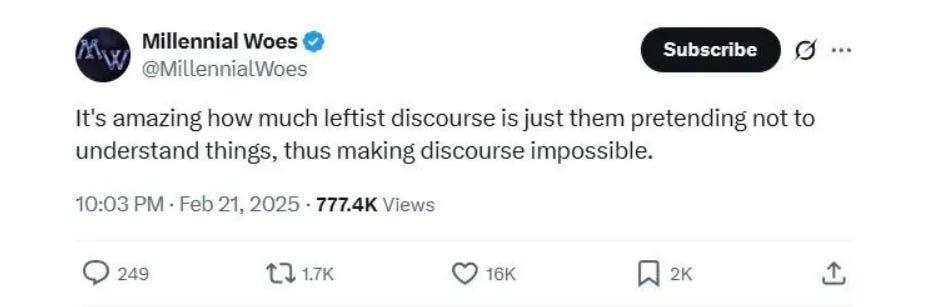
1. Motivated Confusion: “I can’t even understand this.”
This is the “strategic use of [feigned] ignorance”, also called dismissive incomprehension.
When findings challenge someone’s worldview, the writing magically becomes “unclear,” “confusing,” or “poorly explained”. The confusion likely isn’t genuine; its a feigned confusion. It’s a defense mechanism masquerading as a lack of comprehension.
From the paper:
Rather than reflecting a genuine lack of understanding or seeking clarification with the hope of fostering engagement, the aim of claiming incomprehension is the opposite: to publicly delegitimize speakers by alleging that the research is too incoherent to warrant serious consideration.
Almost 200 years ago, Schopenhauer proposed a similar idea: “If you know that you have no reply to the arguments which your opponent advances, you may, by a fine stroke of irony, declare yourself to be an incompetent judge: ‘What you now say passes my poor powers of comprehension; it may be all very true, but I can’t understand it, and I refrain from any expression of opinion on it.’ In this way you insinuate to the bystanders, with whom you are in good repute, that what your opponent says is nonsense.”
Relevant:
2. Motivated Postmodernism: “This question can’t even be studied.”
This is when a critic does not deny the conclusion, but the entire legitimacy of asking the question.
Suddenly they will claim that “The issue is too complex for science”, “You can’t quantify things like this”, or “Empirical data can’t capture lived experience”.
From the paper:
Critics may argue that certain lines of inquiry are conceptually misguided, that the phenomena in question are too subjective or socially constructed to be measured, or that the very act of reducing a morally charged issue to quantifiable data is ethically or politically objectionable. Our expectations rest on postmodern critiques of scientific knowledge, which question the assumption that phenomena can be meaningfully quantified or studied through positivist methodologies. Postmodernism, by its nature, challenges the assumption that objective reality can be captured through empirical methods, instead emphasizing the role of power, language, and social context in shaping knowledge…
By framing certain investigations as inherently flawed, oppressive, unanswerable, or not a matter for empirical research, individuals can justify the rejection of offensive scientific results seemingly on principle.
3. Contradictory Complaints
This is one of the funnier and more prolific set of strategies used by many people, (including academics). They carry a holster full of mutually contradictory critiques, leveraging whichever one is currently most useful, before switching to an entirely contradictory critique on the next issue if it serves them. They may even use many contradictory critiques at the same time.
The most obvious and common way this is done, by the intelligentsia especially, is to claim in one case that the sample size of a politically inconvenient study is too small, but then to turn around and dismiss large N studies because some anecdote, personal experience, or others’ “lived experience” says otherwise.
I remember seeing this done by many academics and pundits in New Zealand, when we had multiple reports about the dismal state of free speech and viewpoint diversity in our higher-ed institutions. Researchers who had no issue conducting and relying on studies with absolutely miniscule convenience samples (even samples of n=1… that one person literally being themselves—look up: autoethnography, and weep). These academics, who have spent years elevating tiny samples, anecdotes, and lived experience above data, suddenly found the modest convenience samples of the Free Speech surveys inadequate.
Clark et al. also found that the offensiveness of scientific findings were simultaneously associated with the contradictory claims that the scholars were unintelligent, but also that they are using their intelligence to manipulate people. Offensiveness was also associated with the claim that findings were “old news”, but also that the findings are preposterous. This is evidence that people will grasp for any and all strategies to undermine objectionable research even when those strategies are explicitly contradictory.
4. CIA Sabotage Tactics
Another funny one. For this aspect of the study, Clark et al. were inspired by the CIA’s Simple Sabotage Field Manual, which provides instruction on strategies which can be used to gum-up enemy organizations. These are strategies such as the weaponized demand for rigor, and weaponized ethical or procedural concerns.
One reading of this manual, after a long day of arduous meetings and review boards, battles with bureaucracy, and so on, will convince you that our institutions are actively being hamstrung by the deep-state or other bad actors.
Just read this from the Clark et al. study:
We test a small selection of strategies from their guidelines on interfering with organizations and production: “When possible, refer all matters to committees, for ‘further study and consideration’. Attempt to make the committees as large as possible. . . ”; “Haggle over precise wordings of communications, minutes, resolutions”; and “Be worried about the propriety of any decision—raise the question of whether such action as is contemplated lies within the jurisdiction of the group or whether it might conflict with the policy of some higher echelon.”
In peer review, ethical review, funding, and elsewhere, this kind of bureaucratic slow-walking and nitpicking is ubiquitous if your research is somewhat objectionable to the prevailing dogma.
Just look at ’s and other’s experiences with weaponized institutional review boards.
5. Schopenhauer’s Stratagems
Borrowed from Schopenhauer’s 19th-century manual on “being right even when you’re wrong,” these strategies for combating objectionable research include:
Extension: Exaggerating the claim to absurdity, or in Schop’s words: “carrying your opponent’s proposition beyond its natural limits. . . so as to exaggerate it”.
The obvious example here is taking some supposedly offensive claim about race/sex differences and say “but to assert that all members of one group are worse than all members of another group is patently false”.
This is extending the claim to absurdity in order to refute a claim that was never made (and also related to motivated ignorance: educated people pretending to not understand central tendency, distributions, and effect sizes).
Odious categorization: Labeling the research as extremist or dangerous, in Schop’s words: “If you are confronted with an assertion, there is a short way of getting rid of it… by putting it into some odious category; even though the connection is only apparent, or else of a loose character.”
This is to strategically label something “extremist”, “far right”, “…phobic”, and so on. This is a favored strategy of ideologues whose ideology rests on incredibly flimsy evidentiary bases. They instead rely on the slander and odious categorization, of opponents and their beliefs.
Ad personam: Pretty self-explanatory, related to odious categorization: “The authors of these findings are bigots.”
Viewpoint Diversity, Openness in Science
The authors conclude:
Across five studies, we found that when people were morally offended by scientific findings and experiencing desires to suppress those findings, they engaged in a host of cognitive evasion tactics. They were more likely to report that the writing was incomprehensible and that the question was beyond the purview of science. Later studies showed that moral offense and suppression desires also predicted endorsement of Schopenhauer’s stratagems for always being right, the Simple Sabotage Field Manual, and a potpourri of contradictory complaints (including the elevation of anecdotes above data and the sample size being too small, that the researchers are unintelligent and using their high intelligence to manipulate, and that the findings are both preposterous and old news). Experimental results, especially in later studies, suggest that all of these evaluations are likely motivated by desires to suppress morally offensive findings.
It’s how people turn a science into a pseudoscience, in order to prevent falsification of closely held dogmas.
These studies actually find that both right-wing people and left-wing people use such strategies. The authors say that “cognitive chicanery results from humans’ tendencies to justify the dismissal of dissonant claims with minimal effort”.
But the keyword there is human.
But proponents of viewpoint diversity like myself have never claimed that it’s only a left-wing phenomenon, or that a field composed entirely of conservatives would be any less biased.
We only assert that any field composed of humans who are universally leftists and who are all strongly ideologically aligned on a central set of dogmas, who wield institutional power, and who maintain a death grip on the academic and cultural Overton window, will be incredibly biased and unable to to produce valid research (at least on topics related to those central dogmas).
And it’s basically self-evident at this point that academia is composed “of people who share a deep interest in protecting cognitive and moral assets: including protecting them from inconvenient truths.”
Thus the reign of error will continue.
The evidence just keeps mounting.
If you enjoy my writing and want to support viewpoint diversity in academia, you can give me a tip! Or please simply, like, share comment, or subscribe:
Comments
Nothing yet. Say the first thing.
Sign in to join the conversation.