
By Michael Sheldrick
The world is entering what International Energy Agency (IEA) Executive Director Dr. Fatih Birol has called the “Age of Electricity.” Electricity demand is growing faster than overall energy demand as vehicles, buildings, industry, artificial intelligence, and data centers increasingly run on electricity rather than fossil fuels.
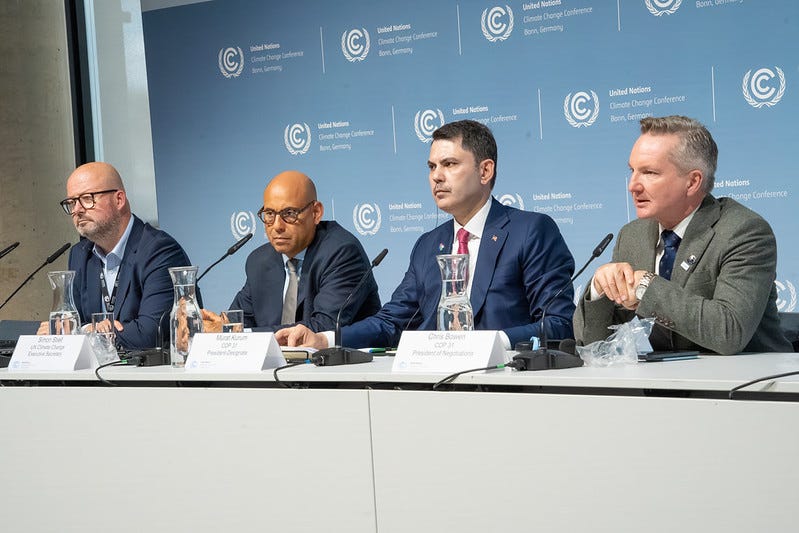
Against this backdrop, Australia and Türkiye’s COP31 Presidencies have put forward what could become one of the defining goals of the coming decade: increasing electricity’s share of final energy consumption to 35% by 2035.
At first glance, the target may sound technical. In reality, it is about economic competitiveness, energy security, public health, development, as well as emission reductions.
Breaking the 80-20 Rule
For decades, the global energy system has been stuck in an 80-20 trap. Despite dramatic advances in renewable energy, fossil fuels still provide roughly 80% of global primary energy.
Electrification is one of the few strategies capable of breaking that pattern. Every diesel truck replaced by an electric vehicle, every gas boiler replaced by a heat pump, and every industrial process powered by clean electricity weakens the grip of fossil fuels on the global economy.
As electricity increasingly comes from cheap, renewable, and low-emission sources, electrification becomes one of the most powerful tools available for reducing emissions across sectors. This is no longer a theoretical proposition. Renewable energy is now driving most of the growth in global electricity generation.
Beyond Emissions
The benefits extend well beyond climate action, however. Millions of people still rely on polluting fuels such as wood and charcoal for cooking, contributing to poor health outcomes and avoidable deaths. Electrification can help deliver cleaner cooking, healthier homes, and improved quality of life.
It also strengthens both energy security and access in an age of unpredictable geopolitical shocks. Electricity generated from domestic renewable resources cannot be disrupted in the same way as imported fossil fuels. In Pakistan, households, businesses, and farmers have embraced solar power at an extraordinary speed, reducing exposure to volatile fuel markets.
For hundreds of millions of people elsewhere, however, the challenge is not energy security but energy access. Across Africa, nearly 600 million people still lack reliable electricity. Mission 300, launched by the World Bank and African Development Bank, aims to connect 300 million people to electricity by 2030, expanding opportunity while accelerating economic development.
In an increasingly fragmented world, electrification is also becoming a source of industrial advantage and the strategic value of energy independence. Every megawatt generated from domestic renewable resources reduces exposure to volatile fossil fuel markets and geopolitical shocks. Companies such as Fortescue are pursuing ambitious plans to eliminate diesel use across mining operations, while countries with abundant, reliable, low-cost electricity will be better positioned to attract investment in advanced manufacturing, critical minerals processing, artificial intelligence infrastructure, and green industry.
The Missing Ingredient: Investment
The biggest obstacle is no longer technology. It is finance, as electrification at the scale envisioned by Australia and Türkiye will require unprecedented investment in transmission networks, modernized grids, battery storage, renewable energy generation, electric transport, and new industrial infrastructure. Yet many governments, developed and developing, face growing fiscal constraints and competing priorities, making public funding alone insufficient.
This is why the debate about electrification is ultimately a debate about investment.
What matters is whether governments, development banks, investors, utilities, philanthropies, and businesses can work together to turn ambition into bankable projects and investment pipelines.
This challenge is increasingly moving to the centre of international discussions. One example where this will be the case will be Global Citizen NOW: Perth in October 2026, which will focus on how governments, investors and businesses can mobilise the capital and partnerships needed for the Age of Electricity.
Western Australia itself offers a glimpse of what this transition could look like. Rich in critical minerals, renewable resources and industrial expertise, it is attempting to move from exporting raw materials to building the clean-energy industries of the future based on electrification.
The question is no longer whether the world will become more electric. It already is.
The real question is whether governments, investors and institutions can move fast enough to ensure that the benefits of electrification are broadly shared. Australia and Türkiye have helped put that challenge on the global agenda. COP31 should now become the moment when the world starts acting on it.
Michael Sheldrick is a co-founder of Global Citizen and also author of the book, From Ideas to Impact: A Playbook for Influencing and Implementing Change in a Divided World.
No posts
Comments
Nothing yet. Say the first thing.
Sign in to join the conversation.