
The month of May is typically hectic for me as a children’s librarian in a public library.
Summer Reading starts, rain or shine, on June 1. The list of what needs to be completed feels never-ending. There are decorations to finish, programs to plan, and calendars to correct. As well as the never-ending task of reminding a whole community that yes, Summer Reading is happening again.
But there is another part of May that keeps me busy.
My library has wonderful policies supporting our local schools. Every August, I send out flyers, emails, and even make phone calls to let local schools know that I would happily collaborate with them during the school year. I can help facilitate book clubs, do a special storytime on a classroom theme, or bring in a cool library resource like STEM kits.
And every year, I am met with silence until the month of May.
By late May, I have very little doubt about why I am there. I am usually brought in to keep students preoccupied while the classroom teacher completes the final mad dash of paperwork and grading needed to wind the year down. This is my fourth year doing late-May school visits, so I know my fate and try to make the best of it.
Mostly, I try to imagine new ways to make books and reading seem cool to elementary school children who have already mentally left the building. Their bodies may still be in the classroom, but their minds are at the pool. I have done reader’s theater with them. I have done Battle of the Books, where we vote on favorites across twenty titles until only one book is left standing. Recently, because candy seemed like it might be necessary, I tried book trivia.
Unfortunately, the fourth-grade class I visited did not seem to know about the spider who made webs to save a pig. They did not know about the boy named Auggie who left us all wondering what he looked like. They did not even seem to know about a superhero who famously wears underpants.
As I asked my twelfth trivia question, something about what country or imaginary land was found on the inside of a wardrobe in The Lion, the Witch and the Wardrobe, and was met with a classroom full of blank stares, I decided to pivot.
I am not in the classroom to wring my hands about “kids these days” or lament that “no one is reading the classics anymore.” I am there to make reading feel as cool and approachable as possible.
So I scanned the room for common ground. My eyes settled on a chapter book propped up behind the teacher’s desk. Carefully displayed. Easily accessible. Clearly in use.
I put my trivia questions down and walked over to pick it up.
“Hey, is this your class book?” I asked, hoping my instinct was right.
Half the class sighed with relief that the trivia they did not know was over. The other half eagerly raised their hands or blurted out, “Yeah, it is! We started it last week.”
I nearly sighed with my own relief. Finally, there was some engagement.
“Well, is it any good?” I asked. “I haven’t heard of this one before.”
I was not disappointed.
“Oh, you have to read it!” one boy said. He had been so uninterested in trivia that he had tried to derail the game multiple times. “It’s so good. It’s a crazy story.”
My heart leapt.
“Well, what’s so crazy about it?” I asked. “The cover looks normal enough.”
So many hands shot up at once that the classroom teacher intervened and called on a student who, I suspect, she knew would give a succinct and accurate answer.
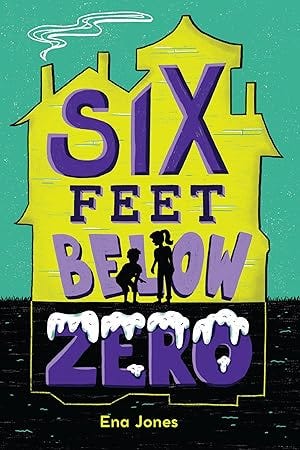
“You totally have to read it and tell everyone about it,” the student said. “It’s about these kids who have to put their grandma in the freezer so their evil aunt doesn’t get them.”
I did not even have time to react before another child interjected.
“I know it sounds bad,” one little girl said. “But the grandma told them to do it! And now both the kids have to sneak around so nobody finds out.”
Trivia was long forgotten by this point.
I asked if I could read the next chapter aloud. The teacher agreed. Everyone in the room listened attentively. It was the quietest class I had visited that week, and I had been in twenty other classrooms. Every child in this room was dying to know what would happen next.
I finished my hour-long visit, passed out candy, and took a picture of the cover: Six Feet Below Zero by Ena Jones.
My head was spinning with new information.
If I had stayed the course with my trivia game, I might have walked away saying that none of those children were readers. I might have said they did not know anything about “good” books. I might have let my own nostalgia and frustration do the thinking for me.
But that would not have been true.
What might be true instead is that today’s children are craving a different kind of book.
They do not necessarily want books that flatter them. They want books that trust them.
A book with stakes is not the same thing as a book that is bleak. Children do not need every story to be grim, violent, or traumatic. But many of the books catching on with upper elementary and middle grade readers right now have a certain shape to them. Something is genuinely wrong. The adults are absent, overwhelmed, unreliable, or sometimes part of the problem. The child protagonist has to make choices that matter. The danger is not symbolic. The consequences are not pretend.
This is why Alan Gratz makes so much sense to me in this moment.
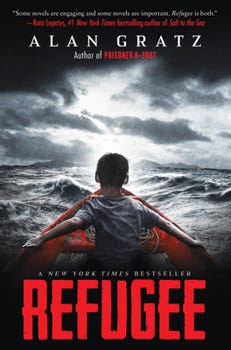
His books are often the ones adults describe with a faint look of alarm. Refugee. Ground Zero. Grenade. Prisoner B-3087. Allies. They are not gentle little stories about learning to share or believing in yourself before the spelling bee. They are books about war, displacement, survival, moral courage, and children caught inside danger much larger than themselves.
And yet children read them.
Not all children, of course. Not every child wants the emotional equivalent of being dropped into history with one canteen and a moral dilemma. But enough of them do that it seems worth paying attention to.
Alan Gratz’s popularity is not an accident. He writes books where the child reader is allowed to look directly at danger and ask, “What would I do?” He gives them fear, but also agency. He gives them chaos, but also narrative shape. He gives them the world at its worst, but not without courage.
That may be part of what children are hungry for.
Because the strange thing about modern childhood is that it is both intensely supervised and wildly unsupervised.
Children are watched in parking lots, fenced into playgrounds, tracked by apps, and warned away from strangers. They are told not to climb too high, run too far, bike too freely, or walk anywhere alone. Their physical lives are often organized around safety.
But then many of those same children are handed a device that opens onto the entire adult world.
They may not be trusted to cross the street, but they can wander through YouTube comments. They may not be allowed to climb a tree, but they can stumble into manipulative advertising, online bullying, or a chat box where nobody is quite who they say they are. They are protected from splinters and left alone with algorithms.
This is the peculiar state so many children are being raised in, overprotected in real life and underprotected online.
No single man can stroll past a Play in the Park event without a concerned caregiver pointing him out to me. Hands are firmly held in parking lots. Feet should always stay on the ground. Risk is treated like a contaminant.
But these same careful caregivers are sometimes the ones passing children phones and tablets they “think have parental controls” without checking whether a grown man has entered the Roblox chat.
Children notice the disconnect.
They may not be able to explain it the way adults would. They may not have the language for it. But they know something is strange about being told the world is too dangerous for a little independence, while also being allowed to wander through digital spaces full of people, images, ideas, and dangers no child is equipped to sort through alone.
So when a child reaches for a book about survival, danger, or children solving problems adults failed to solve, I am less inclined than I used to be to say, “Isn’t that a little dark?”
I am more inclined to wonder whether it feels honest.
That was true even before the fourth graders introduced me to the grandma-in-the-freezer book.
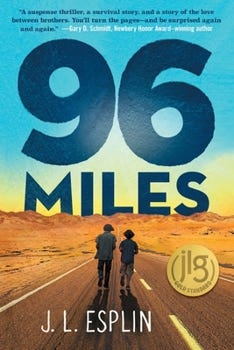
For a while now, I have had surprisingly good luck handing reluctant readers 96 Miles by J. L. Esplin. On paper, it does not sound like the easiest sell. It is not goofy. It is not especially soft. It is a survival story about two brothers trying to make a ninety-six-mile journey across the Nevada desert after their supplies are stolen during a massive blackout.
And somehow, that is exactly the appeal.
The reluctant readers I have handed it to do not always want a book that asks them to admire beautiful language or patiently wait for a theme to unfold. They want a problem. A real one. They want the water to run out. They want the road to be long. They want the adults to be gone or wrong or too far away to fix it.
They want the question underneath the plot to be urgent enough to matter:
Would I make it?
That question has power.
It lets a child imagine competence. Not the polished, “soon-to-be-college-ready” kind of competence adults are always trying to cultivate. But the older, wilder kind, of competence. Could I keep going? Could I protect my brother? Could I make a plan? Could I tell the difference between someone who wants to help me and someone who wants to hurt me? Could I survive if the world stopped behaving?
For children whose real lives are often managed down to the minute, that kind of story offers a different form of freedom. It gives them danger inside a cover. It gives them fear with an ending. It gives them a place to practice bravery without having to be brave in real life.
And that, I think, is the part adults sometimes miss.
We worry that books with real stakes will frighten children. Sometimes they do. A child’s age, temperament, history, and sensitivity matter. I am not arguing that every child needs Alan Gratz pressed into their hands at nine years old while an adult whispers, “This will build character.” Please do not do that.
Some children need dragons. Some need jokes. Some need guinea pigs. Some need books where absolutely nothing worse happens than a misunderstanding at summer camp.
But many children are already frightened.
They are frightened by things adults do not always know they have seen. They are frightened by news overheard in kitchens and drills at school. They are frightened by older siblings’ phones, comment sections, and playground rumors. They are frightened by the nature of a world that no longer keeps its adult anxieties very far from them.
A book with stakes does not introduce children to the idea that the world can be dangerous.
They already know.
What the book does is it provides a map to the danger.
It gives danger a beginning, middle, and end. It puts fear into a container. It lets children watch someone young face something enormous and keep moving anyway. That is not the same as traumatizing them. Done well, it is a sign of the utmost respect.
Maybe that is why the fourth graders came alive for Six Feet Below Zero. Not because they were drawn to something gruesome, but because they recognized a story that took danger seriously. They came alive because the premise did not condescend to them. It did not ask them to pretend the world was always tidy, safe, and adult-supervised.
It gave them a secret, a danger, a problem, and two children trying to survive a situation no child should have to manage.
That is a different kind of reading invitation than asking them to remember the name of the magical land inside the wardrobe. Not better, necessarily. Different.
Narnia still matters. Charlotte still matters. Auggie still matters. The old books are not dead just because one tired librarian had a bad trivia day in May.
But children are telling us something when the room goes quiet for the book with a body in the freezer.
They are telling us that danger does not feel as far away from childhood as adults sometimes pretend it does. They are telling us that they know grown-ups are not always competent, kind, or in control. They are telling us that stories do not have to be safe in order to be good for them.
Maybe they do not want darkness for darkness’s sake.
Maybe they want books that admit the world can be frightening and still insist that children can be brave inside it.
Maybe the real question is not why children are drawn to books with stakes.
Maybe the question is why adults keep pretending children do not already recognize them.
Author’s note: The children’s excited summary of Six Feet Below Zero gets a few of the book’s family relationships wrong. I have left the moment as I experienced it because the spirit of their response was genuine. The details they mixed up do not change what mattered in the room that day. They loved the book, they understood the stakes, and they were desperate to know what happened next.
No posts
Comments
Nothing yet. Say the first thing.
Sign in to join the conversation.