
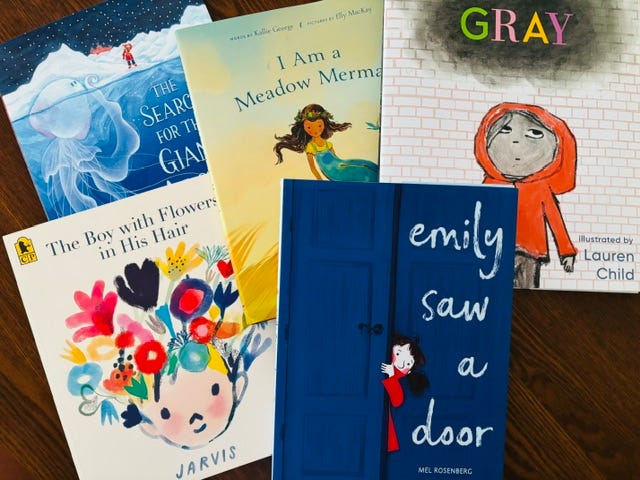
A few weeks ago, I had the pleasure of being interviewed by Mel Rosenberg, the author of Emily Saw a Door and host of the Children’s Literature Channel of the New Books Network. Afterward, he sent me a copy of his picture book, and I loved it immediately. It takes a certain kind of bravery to write about a difficult emotional subject like rejection and painful relationships for children. It takes a certain kind of genius to take those themes and turn them into a compelling story.
Yesterday, I finally read Emily Saw a Door to children, and they were completely engrossed. Some of the adults shifted nervously as I read. They could already tell what the closed and locked doors symbolized. But the children seemed to recognize the experience right away, asking someone for more and being told “no”. Any book that affirms and sees the complex emotional lives of children will always be a book I praise highly.
So few books are willing to address the sadder parts of childhood: loneliness, sorrow, grief, rejection. And yet these feelings are just as much a part of childhood as laughter and joy. With that in mind, here are five excellent books for highly sensitive children. Books that not only affirm their lived experiences but also tell them their feelings are real and worthy.
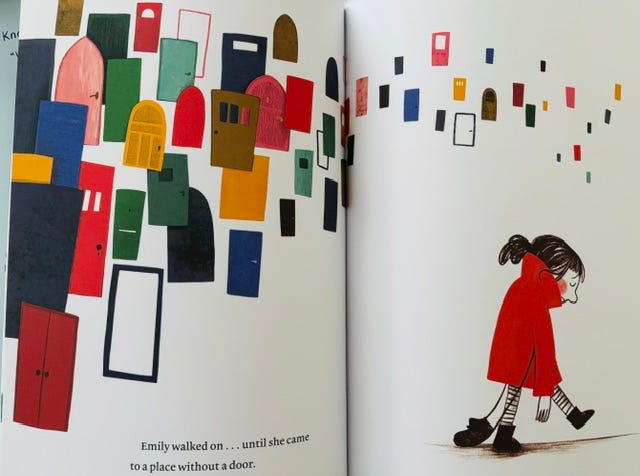
Emily Saw a Door by Mel Rosenberg, illustrated by Orit Magia, is a rare picture book willing to acknowledge one of the more painful emotional experiences of childhood. Wanting more from a relationship and the other person (or door) not reciprocating. Emily finds a series of locked doors and asks to be let in. Again and again, the doors refuse. The metaphor is simple enough for a child to understand, but emotionally rich enough for adults to feel the ache underneath it. This is a book about rejection, disappointment, and the bewildering experience of reaching toward someone or something with hope, only to be met with a closed door.
For sensitive children, this book does two important things. First, it affirms something many children know but adults are often reluctant to say aloud. Sometimes authority figures, caregivers, friends, or trusted people do let children down. Sometimes the door does not open. But the story does not leave the child helpless on the wrong side of rejection. Instead, it offers a framework for resilience. Emily keeps trying, keeps imagining, and eventually discovers that she can build a door of her own. She can create a world of her own. She can become part of the solution to the very problem she faces. That is a deeply hopeful message for children. Not every door will open, but that does not mean there is nowhere beautiful left to go.
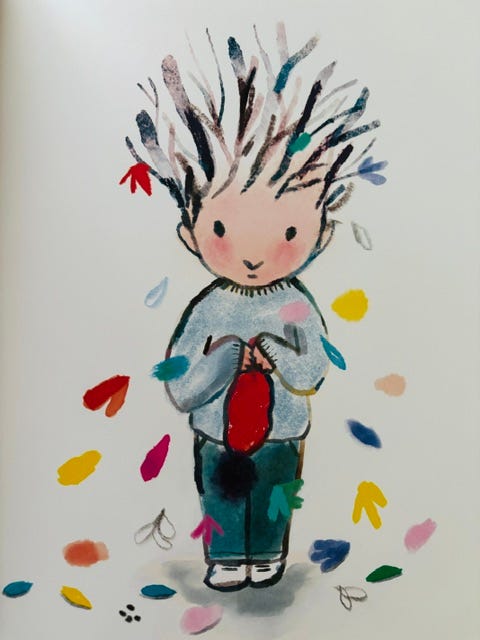
The Boy with Flowers in His Hair by Jarvis is one of the gentlest picture books I know about friendship, change, and loving someone through a difficult time. David’s best friend has flowers in his hair, and everyone loves him for his brightness, beauty, and joy. But one day, the flowers begin to fall out. Where there was once color and life, there are now bare, prickly branches. The metaphor is never overexplained, which is part of the book’s brilliance. Children are trusted to understand that sometimes people change. Sometimes sadness, illness, grief, fear, or hardship makes someone seem less like themselves.
This is a beautiful book for children because it honors both sides of care. It shows what it feels like to watch someone you love struggle, and it shows what steady friendship can look like when a person cannot be as bright as they used to be. David does not shame his friend for losing his flowers. He does not demand that he become cheerful again. Instead, he makes paper flowers and gently helps bring color back into his world. For sensitive children, this is a deeply reassuring story. Love does not disappear when someone is hurting. A good friend does not need you to bloom every day in order to stay.
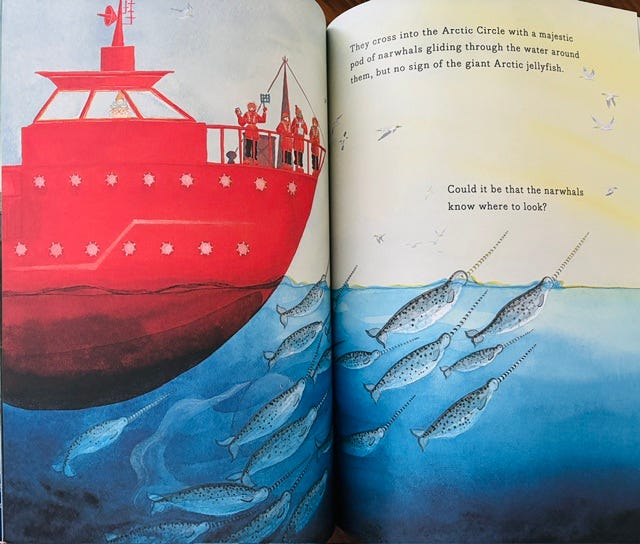
The Search for the Giant Arctic Jellyfish by Chloe Savage is a gorgeous book about wonder, patience, and the ache of looking for something you may not find. Dr. Morley and her crew set out on an expedition to find the elusive giant Arctic jellyfish. They search carefully. They prepare thoroughly. They notice so much beauty along the way. And still, the thing they most hope to see remains just out of sight. For children who are attuned to the world around them, this book captures the emotional experience of longing, wanting something deeply, watching closely, and learning to live inside the not-yet.
I love that this book does not treat disappointment as failure. The crew’s search is not wasted simply because the jellyfish is hard to find. Their attention matters. Their curiosity matters. The beautiful things they notice along the way matter. Sensitive children often live this way already. They are alert to small wonders, easily moved by beauty, and sometimes heartbroken when the world does not answer on command. The Search for the Giant Arctic Jellyfish offers them a gentle truth. Some wonders require patience, and even when what you are looking for stays hidden, the act of looking can still fill your world with meaning.
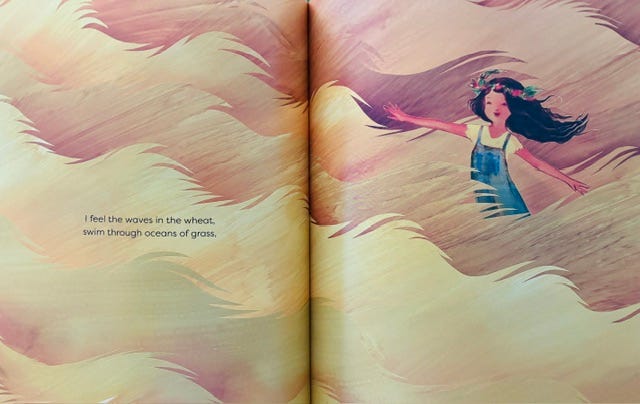
I Am a Meadow Mermaid by Kallie George, illustrated by Elly MacKay, is a dreamy celebration of imaginative play and the rich inner worlds children build for themselves. The child in this story may not live near the ocean, but that does not stop her from being a mermaid. Grass becomes waves. A meadow becomes the sea. The natural world is transformed through the power of pretend, and the book takes that transformation seriously. It understands that make-believe is not a lesser form of experience for children. It is one of the primary ways they explore longing, identity, beauty, and belonging.
Many adults forget how painful it can be when a grown-up minimizes a child’s intense imaginative play. In adulthood, we often forget how important our fantasy worlds were to us when we were very young. How real they felt, how protective they could be, how much they helped us understand ourselves. I Am a Meadow Mermaid not only acknowledges fantasy play. It celebrates it. Even better, it lets that fantasy open outward. The child’s imagination does not isolate her from the world. It leads her toward new friends, new adventures, and a deeper sense that the world around her is full of possibility.
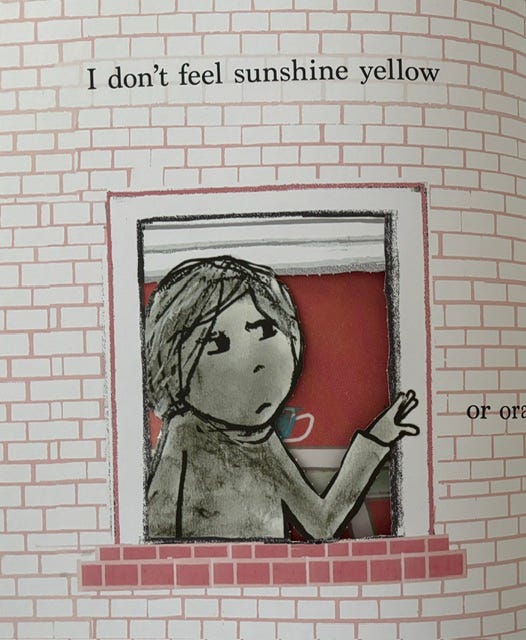
Gray by Laura Dockrill, illustrated by Lauren Child, is a tender and visually striking book about the days when a child does not feel bright, sunny, cheerful, or easy. Some books about sadness work very hard to rush children back toward happiness, but Gray allows the feeling to exist. It gives sadness color, texture, and weight without turning it into something frightening or shameful. The child in this story is not naughty, ungrateful, or difficult for feeling gray. They are simply having a gray day.
For children, this matters. Sensitive children are often aware when their feelings make adults uncomfortable. They may learn early to soften, hide, or explain away their sadness so the room can feel better. Gray offers something gentler. It reassures children that not every feeling has to be fixed immediately in order to be bearable. Sometimes the loving thing is not to argue a child out of their grayness, but to sit near them, make room for it, and trust that color can return without forcing it.
Children do not need books that pretend childhood is simple. They need books brave enough to admit that childhood can be beautiful, bewildering, lonely, imaginative, disappointing, and full of wonder. And sometimes all of those things in the same afternoon. The best picture books do not hand children easy answers. They sit beside them. They honor feelings children may not yet have words for. They remind them that sadness is not failure, sensitivity is not weakness, imagination is not silliness, and hope does not require every door to open. Sometimes a book is a place to be seen. Sometimes that is exactly what a child needs.
Link to my interview with Mel: https://newbooksnetwork.com/rachel-bachman-on-what-makes-an-excellent-picture-book
Join me on Thursday, July 16, at 7 PM Central for a video walkthrough of these wonderful books. I’ll share how I would use them in storytime, along with ways to engage children in meaningful conversations about the emotions and themes each book explores. At the end of the livestream, one paid member will be selected by raffle to win a copy of Gray.
https://open.substack.com/live-stream/277027?utm_source=live-stream-scheduled-upsell
No posts
Comments
Nothing yet. Say the first thing.
Sign in to join the conversation.