
Welcome to our 6th event editorial, written with 🖤 by Sarah Luna Mongin, edited by Annika Bautista and Aris Sevastianos.
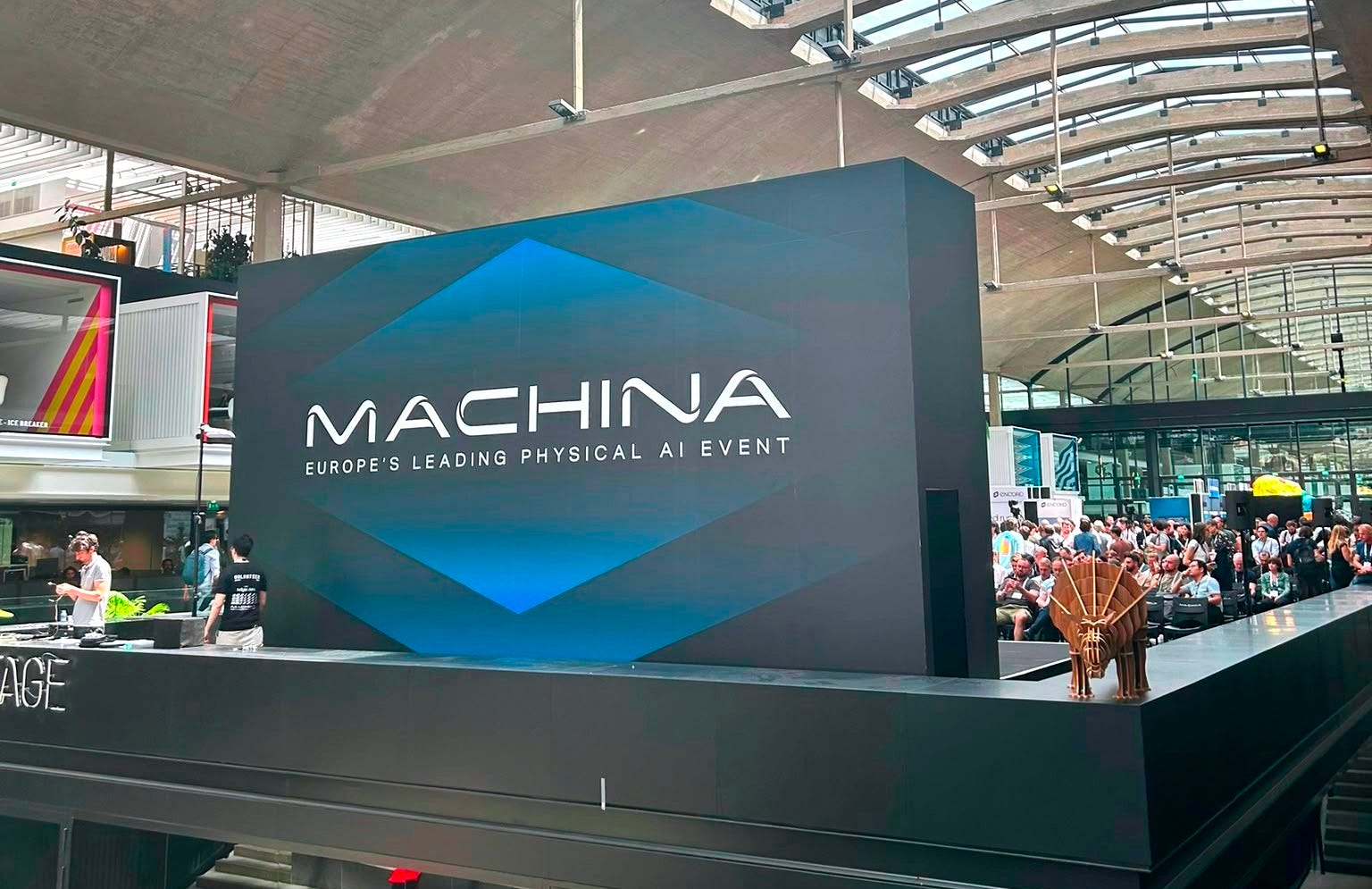
The Machina Summit is Europe’s leading Physical AI event. Early July 2026, it was held in Station F, Paris. Sarah Luna, one of our lead editors, shares her perspective on the event and what it means for the Physical AI space in Europe below.
We hope you enjoy the read! 💛
A panelist would make a confident claim about where robotics is headed, then immediately explain why we’re not quite there yet.
Not as a caveat, as the actual point.
The gap between the demo and the deployment is where the whole industry lives right now. Here’s what it looks like up close.
Teleoperation, operating a machine from a distance, is not a path to scale. Everyone in the room seemed to agree on that much.
You can build a robot that dances. Pre-programmed choreography and smooth motion? Great for a trade show floor (hello Unitree). It gets the crowd going. But, what you can’t yet build reliably is a robot that climbs a staircase, or grabs a tomato from a vine without destroying it. 🍅
The gap between the two is where the industry sits right now.
You might be wondering: what could be that last hardware bottleneck keeping robots from actually operating in unstructured environments?
Robots are simply out of touch.
They need the ability to estimate weight, apply precise force, and handle the variance that comes with interacting with a physical world that basically wasn’t built for them. To do that, robots need reliable tactile sensors. And the name of the game now is building the first open model for all tactile sensors and features.
Nobody has cracked it quite yet, but watch out for Dr. Zaki Hussein, Founder & CEO of Touchlab. 👀
If terrestrial robotics is hard, Patricia Apostol, CTO of Bubble Robotics reminds us that for ocean robotics, “hard” is relative.
In ocean robotics, there are three separate operating environments, each with its own set of constraints.
At the surface, the basic principles are:
never capsize,
handle system restarts, and
survive. 🛟
In shallow water (50 to 100 meters) high currents demand bulky, expensive, energy-hungry systems. Camera data helps but only when paired with sonar.
In the deep, pressure and light become the problem. Additionally, most of the assets being built right now are designed for shallow water cases and don’t scale down.
The robotics industry tends to benchmark against the easy version of its own problem. Ocean robotics is a humbling reminder that the real world constantly plays in hard mode.
Only 6% of US companies have robots deployed at scale. That number is striking, because technology isn’t the problem to adoption. It actually signals that deploying robots is as much an internal organisational challenge as a technical one. 🤔
Who fixes the robot when it breaks, and is the right person actually on shift?
How do you manage a workforce through the transition?
What does the business case look like when the investment horizon is long and the ROI requires flexibility?
That last point matters more than it sounds. The robots work in production environments where you can go back to manual when needed. Flexibility is what makes the return on investment work, especially with the speed of innovation coming from different players.
China and Europe are approaching building in the space differently.
China is all about speed. Get a proof of concept done, deploy at scale, collect real-world feedback from the field. 50 companies are doing an IPO in China this year in humanoid robotics alone.
Europe is moving on compliance: treating certification and regulation as a product feature, not a barrier, and anticipating what customers will need before they know they need it.
Neither approach is wrong. They’re just building for different markets and different timescales.
The shared bottleneck is quality control.
When you scale from 10,000 units, one tolerance issue floods your pipeline. China has 200 companies entering the humanoid market simultaneously. That’s a quality control problem waiting to happen at scale.
The Factory Deployment Gap panel with Yves Albers-Schoenberg, Sviat Dulianinov, Brennand Pierce, Edwin Yap and Vincent Despatin was direct about what the headline narrative gets wrong.
Myth #1: Production is a solved problem once you have a lab video. → It isn’t. Real production environments are complex in ways that controlled demos are not. The gap between the two is where most deployments stall.
Myth #2: More data solves everything. → It doesn’t. Data quality and provenance matter as much as volume. The real challenge isn’t having a bank of free images. It’s how you train your models, and specifically the techniques for self-supervised training that leverage what’s already been done on other modalities and 3D data.
Myth #3: (and the most important one) The companies that win have the best lab results → They won’t. Physical AI is the headline, but deployment will be the actual story. The winners will be the ones that figured out the data flywheel in production: getting data off the line, indexing it, making it searchable, enriching it, and triaging errors in a way that feeds back into the model.
The quieter thread from Machina, the one that won’t make a product roadmap, was about how humans actually relate to robots once they’re in the room.
If you’ve ever read “Klara and the Sun” by Kazuo Ishiguro, you’ll know that people form attachments fast. Faster than engineers expect. Faster than the robots can support.
A robot that visits sick children in hospital can reduce loneliness in rooms parents can’t enter. That’s real and genuinely good. But people also trust robots too quickly in environments where they shouldn’t, particularly with elderly care. Robots can’t help with dementia. That gap between what the robot can do and what a person assumes it can do is a design problem nobody has fully solved.
There are ways to shape how people interact with machines, and how they decide whether to treat a robot as an intentional agent or a tool. The field knows this, but it’s not yet designing for it consistently.
The conference didn’t aim to resolve that question. Instead, it added nuances to what makes it difficult to answer.
Every player has its own special sauce, preparing for a different version of the future.
Europe competes on compliance, on depth of industrial supply chain, on the precision manufacturing stack that Germany’s automotive sector built over decades.
China competes on speed and real-world feedback loops at scale.
The US competes on capital and model development.
What Europe has that the others don’t is the industrial base to make embedded AI in physical systems actually work at the quality standard enterprise customers require. That’s not a consolation prize. It’s a moat, if anyone finishes digging it.
The simulation-to-real pipeline is getting faster.
World models are starting to make plug-and-play simulation tools possible.
No posts
Comments
Nothing yet. Say the first thing.
Sign in to join the conversation.