
Hi there! I don’t really have an update on my Swedish progress — this week, I didn’t do anything special. Frankly, I did the bare minimum.

So, instead of a progress update, I’m going to share a little review I wrote a while ago. It was published on my old ‘stack and has been inaccessible for a while. As the topic fully fits the idea of Babel Babble, I’m happy to resurface it here.
Multilingualism in film/TV is becoming increasingly more common, as we get more diverse characters. Although, at times, it seems that screenwriters just insert a few words like “mi hijo” in conversations between family members, rather than have them converse in several languages throughout the film/series. A good example of a more realistic and nuanced depiction of multilingualism in film are the works of Fatih Akın – a Turkish-German director, whose films I really enjoyed during my university years. His movies focus on the way cultures mix and blend and, unsurprisingly, his characters seamlessly switch between languages.
So, I decided to rewatch Gegen die Wand (aka Head-on), a 2004 drama about Cahit and Sibel - an unlikely Turkish couple, who meet in the psychiatric ward after unsuccessful suicide attempts. Sibel, wanting to escape her traditionalist family, asks Cahit to marry her. Cahit, who has erected a wall between himself and anything reminding him of his origins, reluctantly agrees.
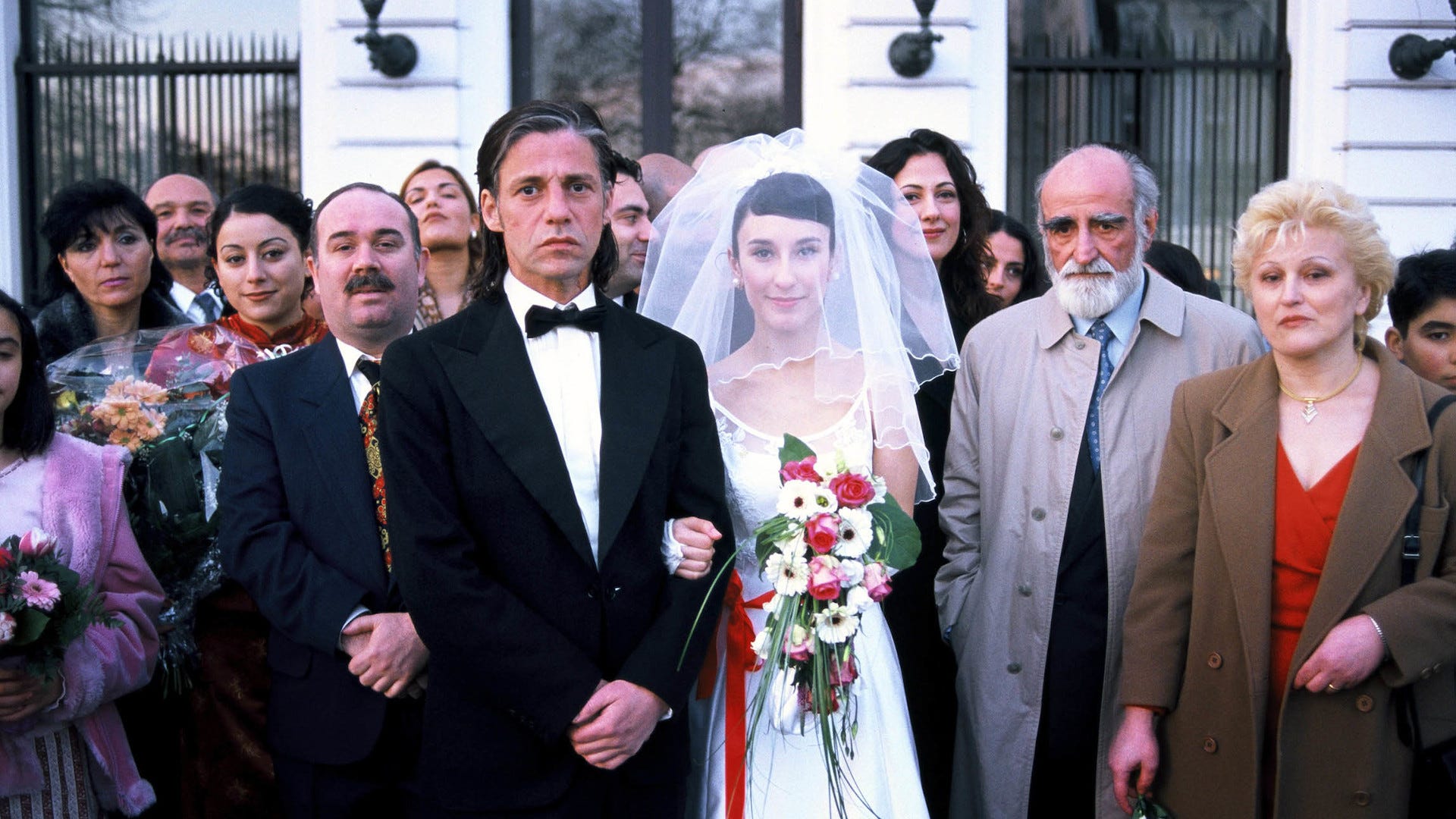
Watching the movie, I marveled at the deliberate choices the characters make when it comes to language. For example, when a Turkish bus driver tries to kick Cahit off the bus, he responds in German. The bus driver screams “Get off my bus”, only to hear “It’s not even your bus, it belongs to the municipality” back. In this case, the official state language serves as a way of putting the driver back in his place.
In the movie, we never get to see Cahit’s family, as he probably renounced them (or was renounced by them) a long time ago. When he goes to ask for Sibel’s hand, he brings along a friend who pretends to be his older relative. They barely have a backstory rehearsed and mix up everything - where they’re from, how many siblings they have, and so on. Cahit isn’t too articulate in Turkish, up to the point that Sibel’s brother asks him (in German) why his Turkish is so “shitty”. Cahit then retorts that he threw his Turkish away.
Rejecting one’s language isn’t too uncommon. In multi-cultural/post-colonial societies choosing not to speak a particular language is as political as choosing to speak one. While technically bilingual, I would often consciously downplay my knowledge of Russian when traveling abroad, as I didn’t want to be seen as Russian. I had nothing against speaking Russian (especially with people with whom I didn’t share another language) but I’d often assume an accent just in case. Soon I realized I didn’t really have to try. As Lithuanian became my language of choice in my teens, my Russian lost some of its natural fluidity. I certainly didn’t throw it away, like Cahit, but I do understand first-hand how one can partially lose a language they grew up speaking.
I’ve also met second-generation immigrants whose parents made the decision to not transfer the language to them. Some would have an awakening at the age of 20 and sign up for a beginners’ course. Others would just accept that the language their parents spoke was not going to be a part of their identity. I’ve even met people who seemed proud of not speaking a language they deemed second-class.
But let’s get back to Gegen die Wand. Aside from the sociolinguistic angle, the movie can be analyzed in many different ways. Tradition vs. personal choice. Community vs. self-identity. And ultimately, there’s the element of LAR. After sleeping with Cahit for the first time (it took them 6 months to become intimate), the libertine Sibel, tries to play the role of a Turkish housewife, even if for a few hours. Afterward, separated from Cahit (who’s in jail for a crime of passion) and alone in Istanbul, she starts LARPing as Cahit, becoming a female version of the hopeless drunkard. After the LARP makes her hit rock bottom, she gets redeemed.
When Cahit arrives in Istanbul (perhaps, for the first time in his life), he is relieved to discover that his cab driver shares a similar fate. He’s also a double exile from Munich. The two instantly switch to German and share stories of living in what many Turks call the gurbet - a foreign, inhospitable land. Only to them, Germany isn’t gurbet, it’s all they’ve ever known.
The final interesting choice of language I’d like to mention happens when Cahit meets with Sibel’s sister in the third arc. She tells him the uncomfortable truth that Sibel doesn’t need him. Cahit then switches to English to deliver a few poignant yet powerful one-liners. It’s not the first language of either, but it serves as a neutral battleground, where truth is presented boldly, without the domestic veneer of one’s mother tongue. Or maybe it’s another form of LARP - using the language of Hollywood movies that have impacted the persona he adopted growing up.
The movie holds water even if you’re not interested in spotting code-switching patterns and deliberate language choices. Above all else, it has an amazing OST, including the gypsy tunes of Selim Sesler and the Sisters of Mercy’s iconic Temple of Love (featuring the beautiful voice of Ofra Haza):
Are there any interesting examples of multilingualism in film you’ve noticed?
Till next time!
Comments
Nothing yet. Say the first thing.
Sign in to join the conversation.