
“Pro-Ukraine” propagandists like to have it both ways when it comes to the Azov movement, which they’ve long distinguished from the (not really) “depoliticized” Azov Brigade in the National Guard of Ukraine (NGU). These entities get conflated again when whitewashing the broader neo-Nazi movement.
The western media’s favorite Ukraine “experts” all but claimed that those in NGU Azov ceased to be real “Azovites,” because the neo-Nazi “origins” of the 2014 Azov Battalion were ostensibly overcome in the National Guard, and the extremists left the unit at some point between 2014-22, either because they were purged, or simply retired from military service and joined the Azov veterans’ movement.
If people really believed this, alarm bells should have been going off as new Azov units formed outside the National Guard and consolidated under the fascistic leadership of Andriy Biletsky, the original Azov commander. After all, his core followers are “old” Azov veterans, the type who never bothered to clean up their image. The depoliticization experts apparently took an oath of silence as more openly neo-Nazi fighters began to receive the hero treatment in Ukraine and abroad.
By 2023, with one Azov brigade “clean,” and the other (Biletsky’s 3rd Assault) “dirty” —according to the experts’ forgotten logic — and both of them famous, it became inconvenient for the anointed truth-tellers to seriously distinguish one unit from the other. “Didn’t we already settle this issue?” some journalists must have wondered about Biletsky’s proudly extremist forces. “Russian propagandists never grow tired of the discredited ‘Ukrainian Nazi’ trope!”
Over three years into the full-scale Russo-Ukrainian war, the Azov movement, although fractured, leads an army within an army, from one regiment (2022) to a pair of brigades and other units (2023), and now two corps (2025), which suggests the Azovites will command tens of thousands of soldiers, comparable to the 1940s Ukrainian Insurgent Army that they valorize. Most important is the 3rd Assault Brigade in the Ground Forces of Ukraine, the foundation of Biletsky’s new 3rd Army Corps. By 2024, you could read about Azov’s Führer (“Vozhd”) in the western media as an effective and quotable military leader, without any reference to his neo-Nazi movement, which is the best armed and most powerful one in the world.
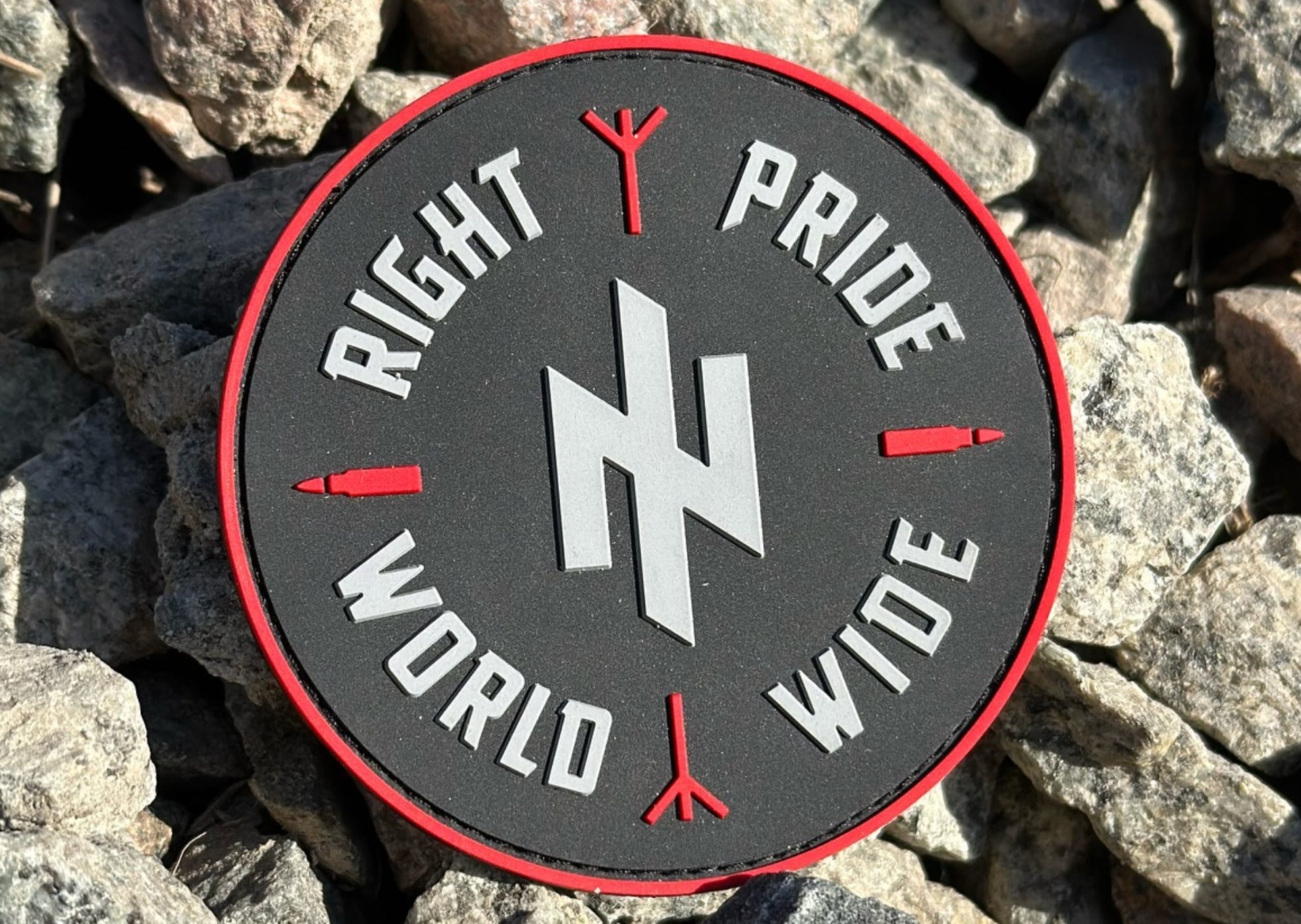
3rd Army Corps
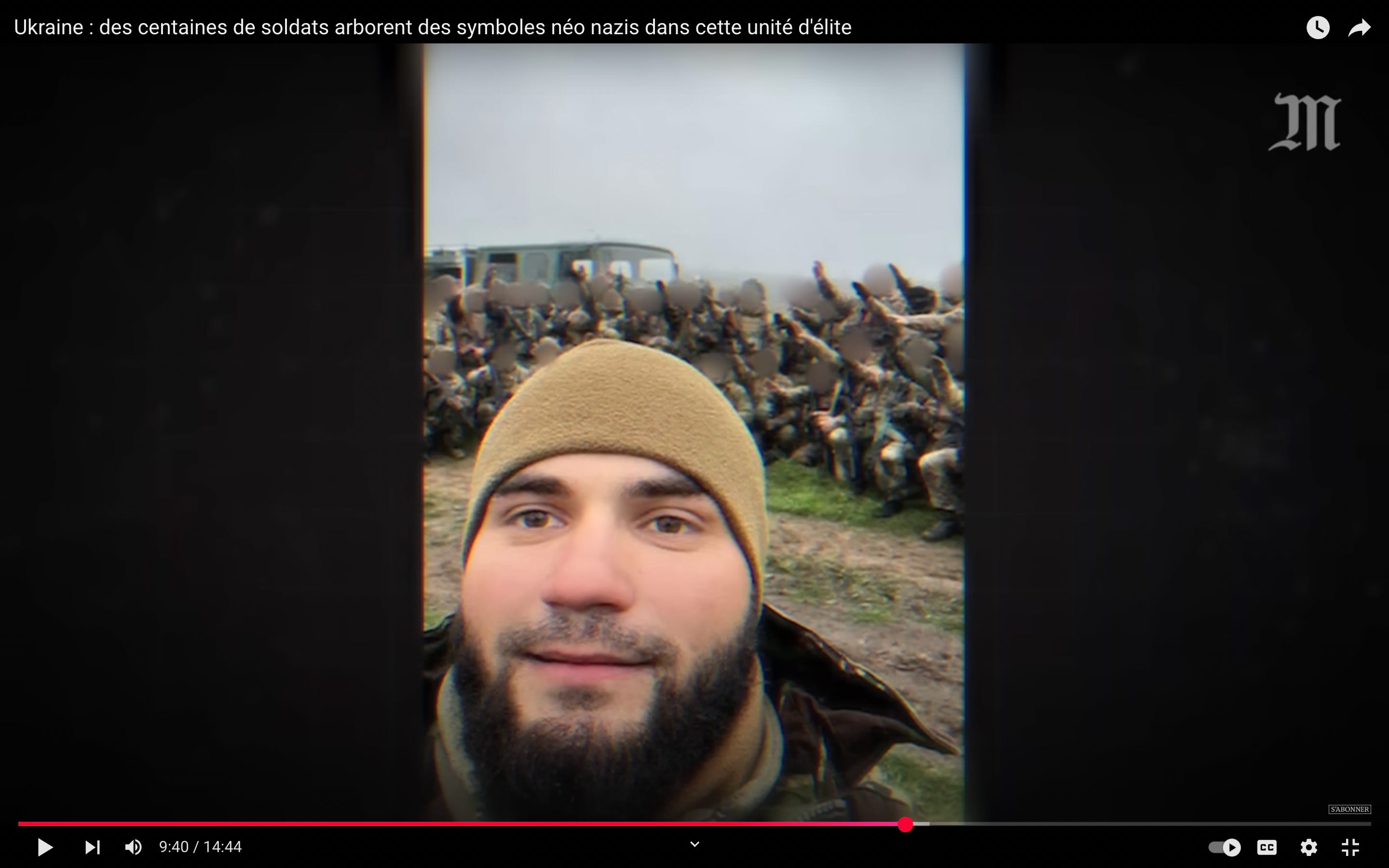
About a month ago, France’s premier newspaper, Le Monde, published a compelling investigation about neo-Nazis in the Ukrainian armed forces that inevitably zeroed in on the Azov movement’s 3rd Assault Brigade, which is often said to be one of the biggest and most effective in Ukraine. In just 10 days, French journalists identified more than 350 Ukrainian soldiers displaying neo-Nazi symbols on public Instagram accounts, with at least 200 of them linked to this one unit. Inspired by their investigation, I’ve begun compiling examples on my Twitter/X account, starting with artillerymen and the main battalions of the brigade.
It’s taken months for details to emerge about the composition of the new 3rd Army Corps since Andriy Biletsky announced its creation in March. “MilitaryLand,” a pro-Azov database of Ukrainian military units, recently backpedaled its breaking news that the Azovite military intelligence “Kraken” regiment would be joining the 3rd Army Corps. Apparently only “part” of the unit has sought the transfer, but “this move has not yet been approved by officials.” Meanwhile the 60th Mechanized Brigade has reportedly been reassigned, including its 97th Mechanized Battalion, another Azovite unit that “is closely aligned with Kraken.”
Le Monde and MilitaryLand note that Biletsky could command up to 50,000 troops if his forces are fully expanded. For now, let’s take a closer look at the origins of this corps, and the neo-Nazi backbone of the 3rd Assault Brigade.
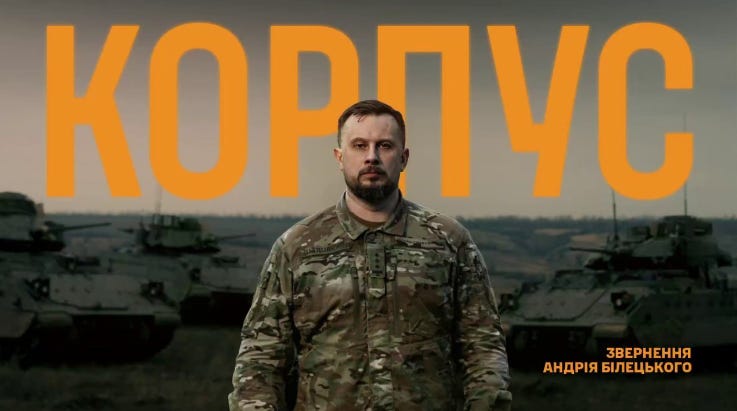
—The ‘Combat Wing’ of the ‘Civilian Part of the Regiment’
The Azov movement, as something bigger than the original Azov Battalion/Regiment in the National Guard, took shape by 2015-16 with the establishment of the “Civil Corps” NGO and later the “National Corps” political party, as well as Azovite youth camps. These and other structures (like the Azovite “ATEK” base in Kyiv), led by Biletsky and his cadre of neo-Nazi veterans, kept the movement intertwined with the NGU Azov Regiment, for example with recruitment, fundraising, ideological lectures, support for veterans, and the “Yevhen Konovalets Military School” for sergeants.
NGU Azov fighters supported the National Corps, and their commanders continued to refer to Biletsky as their leader, years after he formally left the unit in 2014 to become a member of parliament. Relations have strained since 2022, especially in recent weeks, but that is another story.
In 2017, Andriy Biletsky swore in Denys Prokopenko, the current NGU Azov commander. Also that year, under the leadership of Ihor Mykhailenko, another former Azov commander, the National Corps established a “combat wing” or “street branch” called the “National Militia.” Alexei Levkin, a prominent Russian neo-Nazi, is an important ideologist in this sector of the Azov movement that ultimately formed the backbone of the 3rd Assault Brigade. (He’s now affiliated with the Azov-linked “Russian Volunteer Corps,” which has a high concentration of neo-Nazis.) Levkin’s friend Danil Koval, another Nazi pagan ideologist from the National Corps and alleged expert on the “ancestral home of the Aryans,” at least used to oversee the brigade’s recruitment center in the Ukrainian capital.
The National Militia relaunched as “Centuria” in 2020, and could be described as a neo-Nazi street gang, at least before the Russian invasion. Since then, as the “newest Organization of Ukrainian Nationalists [OUN],” it’s become the premier group for young Azovites. Dmytro Krukovsky, the acting head of Centuria, is a veteran of the 3rd Assault Brigade, with a Hitler tattoo on his arm. If only under his leadership, the organization inaugurates the changing of the seasons with pagan cross-burnings. Last year he led an anti-LGBT march in Kyiv. With Krukovsky’s help, the Azov movement is reviving the OUN death cult alliance of radical war veterans and young extremists. It appears that he’s joining the ideological service of the 3rd Army Corps.
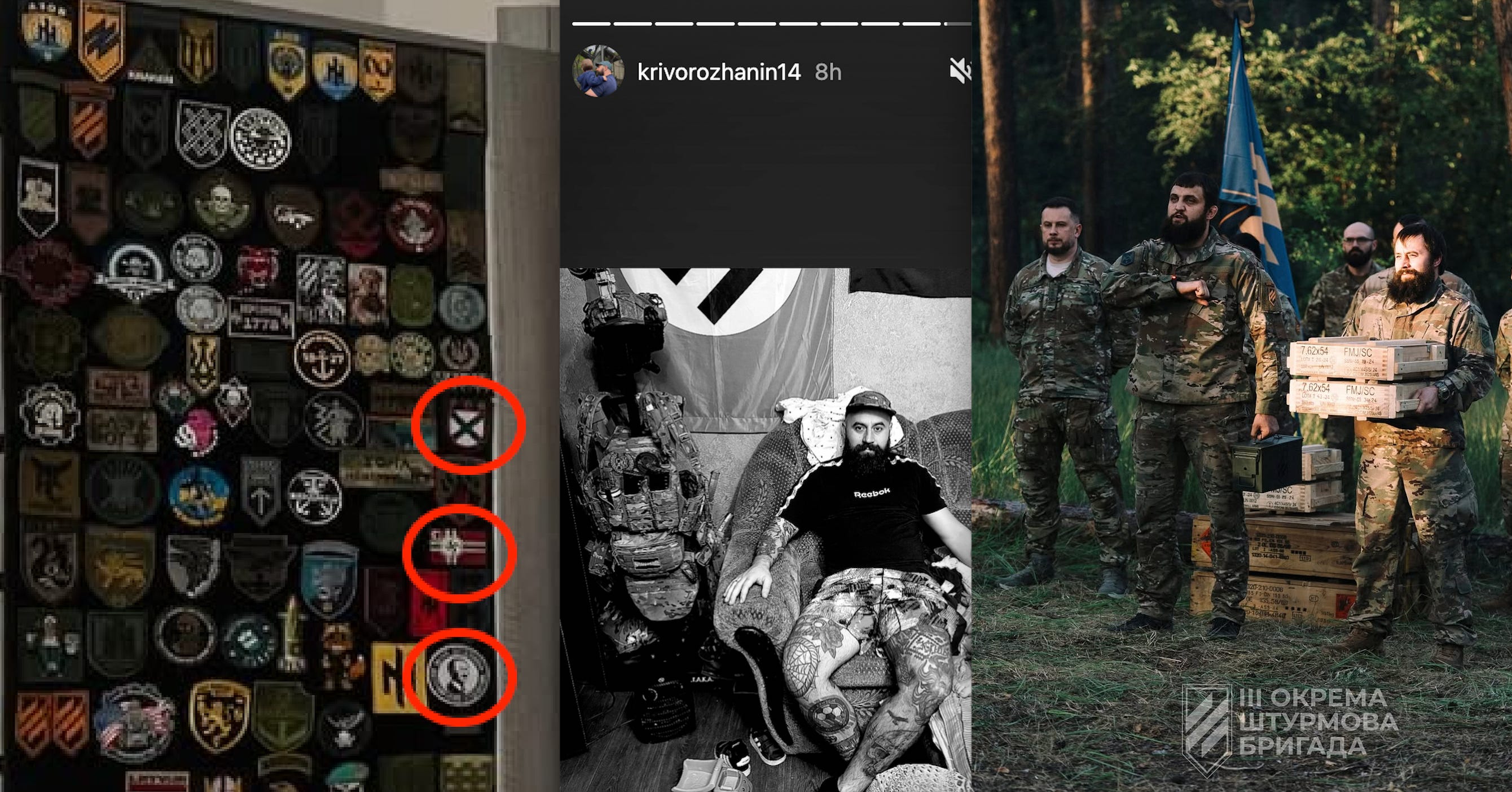
“Patriot of Ukraine,” the youthful Nazi pagan paramilitary group that largely formed the Azov Battalion in 2014, has a powerful spiritual successor. Take a look at any Centuria events today and you will probably see young people wearing merchandise from Alexei Levkin’s band “M8L8TH” (AKA “Hitler’s Hammer”), the most popular National Socialist Black Metal group in the Azov movement. The National Militia used the same Nazi-linked runic symbol as Levkin’s Azov-linked “Wotanjugend,” a Hitler-worshipping organization from Russia that’s connected to M8L8TH. “Nord Storm,” another Hitler-glorifying Azovite organization, sprung up in eastern Ukraine as a group within Centuria.
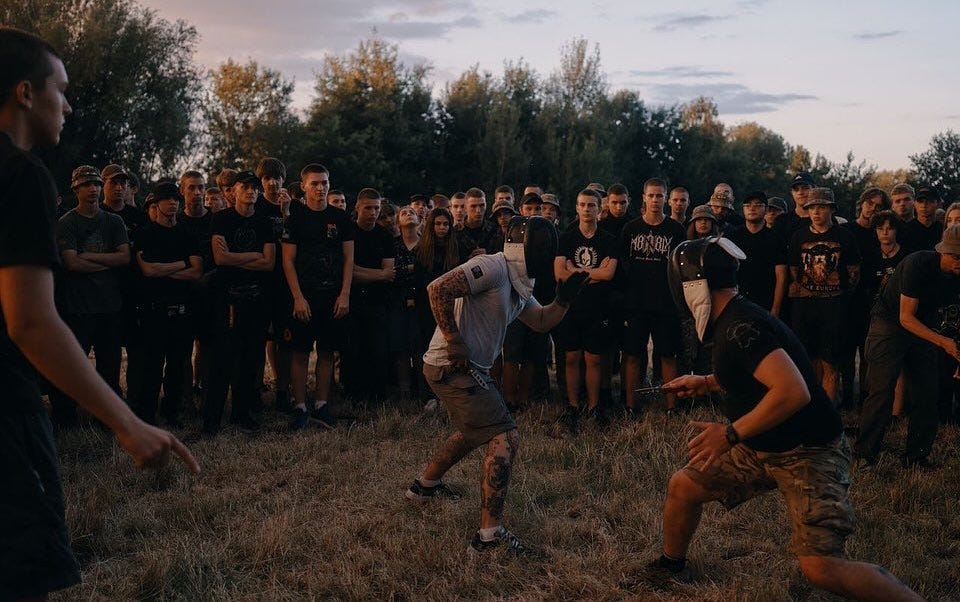
Last summer, Centuria held a knife-fighting (“Knife Cult”) tournament to honor a prominent fallen member, Oleg “Malysh” Fadeenko, who co-founded Nord Storm, the Knife Cult, and a special “Hatred” unit that migrated from Kraken to the 3rd Assault Brigade. Some of the event organizers wore shirts covered in swastikas. Mykhailenko was there—the founder of Centuria, a deputy commander of the 3rd Assault Brigade, and former deputy head of the Patriot of Ukraine. So was “Istok,” another former Patriot of Ukraine militant who ran the brigade’s “young fighter course.” Less than a year before the Russian invasion, “Malysh” and Nord Storm held a knife-fighting tournament to celebrate Adolf Hitler’s 132nd birthday, an event fondly remembered this year by the Hitler-tattooed leader of Centuria.
—Azov Special Forces: ‘Borderline Insane … Hyped-Up Warriors’
In 2022, the Azov movement created territorial defense units across the country, most of which joined Ukraine’s Special Operations Forces (SSO, Syly Spetsialnykh Operatsiy). That spring, while the NGU Azov Regiment was seemingly defeated in Mariupol but reborn in “pro-Ukraine” propaganda, the SSO Azov Regiment formed in Kyiv, spearheaded by the National Corps and Centuria.
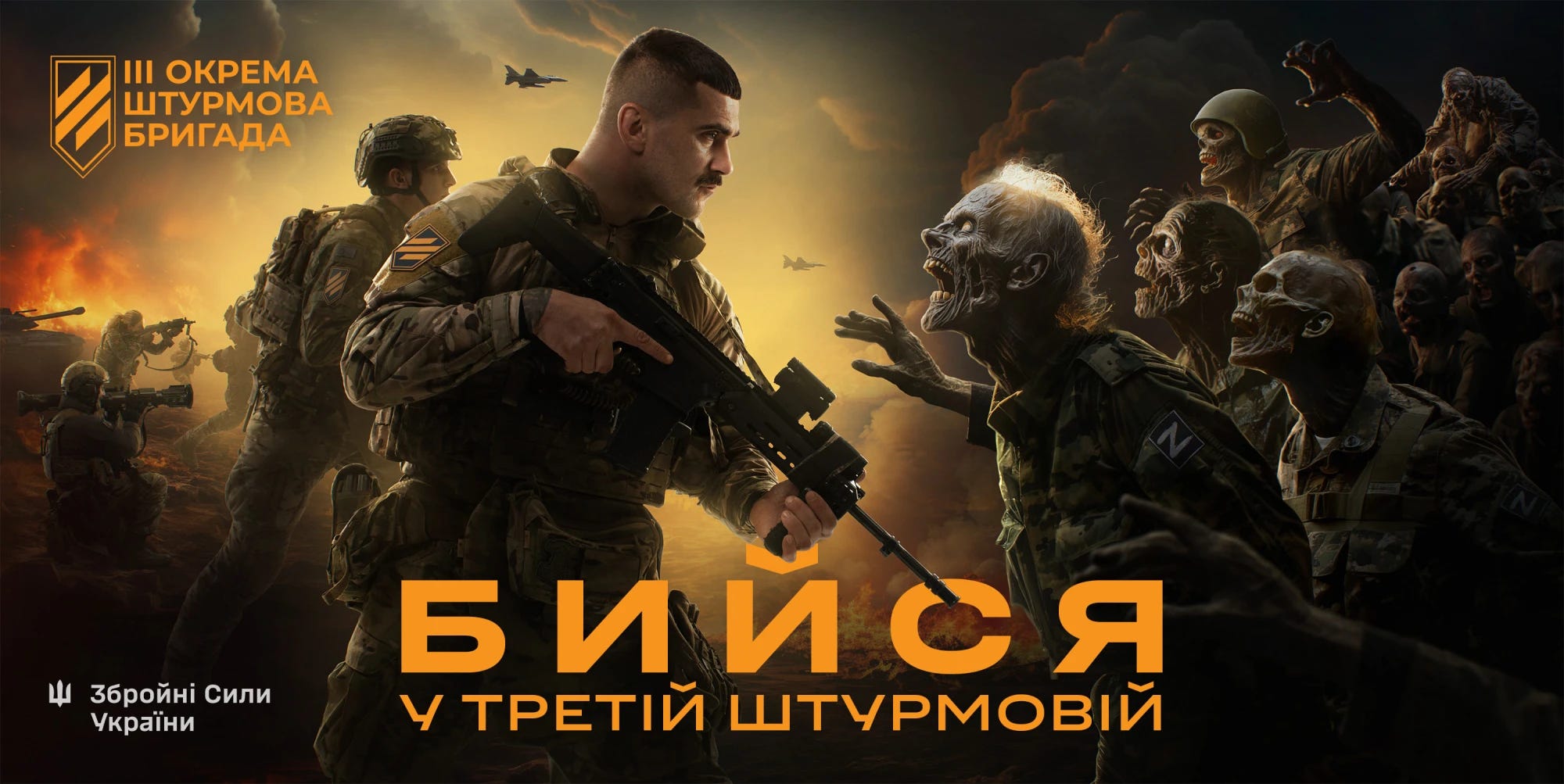
It behooved the new Azov units to merge in the 3rd Assault Brigade, and drop their favorite word from the name of the unit, if only to sidestep a Congressional ban on US weapons and training for the “Azov Battalion.” It also helped to muddy the waters for journalists who preferred to not think too hard about this stuff. The Azov movement needn’t be mentioned when writing about any of the Azovite units.
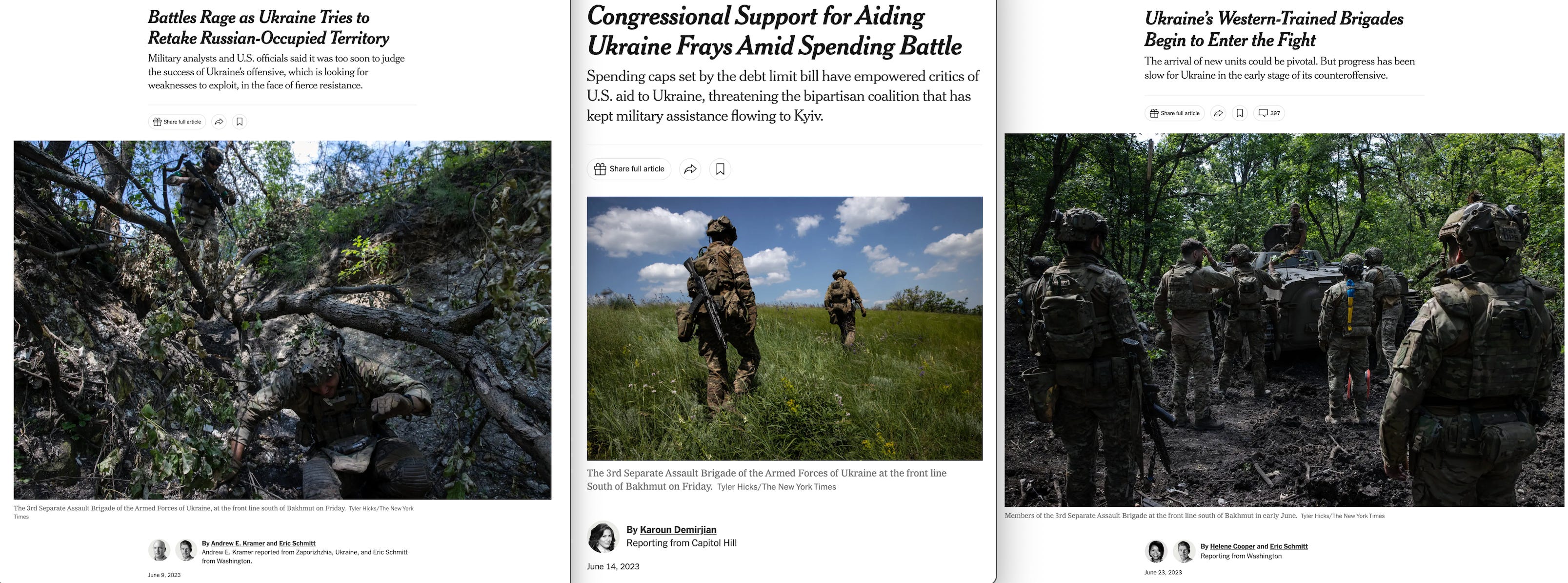
In the spring of 2023, the New York Times took notice of the 3rd Assault Brigade, but dithered about callings its fighters “Azov soldiers.” Andriy Biletsky was meekly identified as “a former far-right politician.” Some articles about the battle for Bakhmut mentioned Biletsky and his unit, but not “Azov.” In May, NYT reporter Marc Santora conducted “an extended interview with Colonel Biletsky near the front,” describing him as “a former ultranationalist politician and the founder of the [NGU] Azov regiment, a group that was part of Ukraine’s national guard before the war and is now integrated into the country’s military forces, with little or no political bent.” The Times implied by omission, in this article and the rest to come, that Biletsky’s openly neo-Nazi unit also has “little or no political bent.”
Later that year, the US “newspaper of record” referred to the 3rd Assault Brigade as “one of Ukraine’s most battle seasoned units,” once again without reference to Azov or its troubled “origins.” In June, the New York Times even started to use images from the 3rd Assault Brigade as artwork for articles about the war in Ukraine and the much-hyped 2023 “counteroffensive.” This was before the Azovites published a historical photo project, reaffirming that they see themselves as the spiritual successors of Ukraine’s Nazi collaborators. So it wasn’t really Azov that evolved, but their media coverage, in Ukraine and around the world.
When Centuria founder Ihor Mykhailenko handed out SSO Azov Regiment patches with a new design, the western media gave rise to a myth that the Azov movement abandoned Nazi symbolism. (Le Monde has decisively proved otherwise, and the issue is hardly just an Azov problem.) “It still has a lot of its neo-Nazi presence,” admitted Justin, an impressionable young American who wanted to defend Ukraine. He joined SSO Azov-Kyiv in the spring of 2022, not long after arriving in the capital. “You sort of just adapt to it, because these are your guys,” he explained.
Regardless of my battalion commander, my company commander being the Nazis that they were … I still get a kick out of this. I came in one day, and … you have to understand, these guys are hyper-fucking-masculine, these guys are almost borderline insane in terms of … they’re hyped-up warriors, you know, they’re these fucking gung-ho guys. So they kind of idolized the American Special Operations Forces, they wanted to be like them … so we watched these old History Channel Ranger School videos and stuff, and when my company commander opened his laptop on this huge fucking TV screen, he had a fucking desktop photo of fucking Adolf Hitler.
A short Azovite propaganda film, “Made in Ukraine,” captures the neo-Nazi essence of the SSO units behind the 3rd Assault Brigade, and in turn the 3rd Army Corps. It starts with “Martyn” shaving his head, which has “Made ꑭ Ukraine” tattooed on the back, so this becomes the title sequence. A couple minutes later, “Doc” is wearing an “88K” patch, the first sign of an openly neo-Nazi squad that stars in this project. The camera cuts to another group of “88K” fighters. Leading them is “Toten,” a platoon commander with the Nazi SS slogan tattooed on his arm in runic letters.
Then we see “Tokha,” with a tattoo of the 3rd SS Panzer Totenkopf Division emblem and the number 88 (“HH,” or “Heil Hitler”) on his shoulder. Moments later, a pouch with a hand-drawn swastika swings from a machine gun held by another soldier. Soon “Tokha” is back wearing the insignia of the 14th Waffen-SS Galicia Division, and “Doc” reveals a Black Sun tattoo and Patriot of Ukraine patch. We see Azov fighters laughing in the grass, next to a machine gun with an SS symbol. There are several more instances of Nazi imagery, including a Nord Storm patch at the end. The full video, including the opening sequence and credits, is less than 10 minutes.
The SSO Azov Regiment produced “Made in Ukraine” with “Neutrino Film,” an obscure venture based in London and Kyiv. Jack Hershman, the British co-founder, meanwhile worked as a Content Director for Google at Redwood BBDO in London, supposedly “the world’s leading content agency.” A longtime Azov photographer “Yara” went unrecognized in the credits, but the Ukrainian director confirmed her involvement. In the summer of 2023, “Yara” completed a photo project that saw Azov fighters from Andriy Biletsky’s brigade recreate historical images of the Waffen-SS Galicia Division and Ukrainian Insurgent Army, or the armed wing of the fascistic OUN’s “Banderite” faction that massacred Jews, Poles, and other “enemies of the nation.” As noted by the historian Marta Havryshko, the ideological service of the 3rd Assault Brigade produced this photo series, “In Storms of Steel,” which was exhibited at the Kyiv History Museum in September 2023.
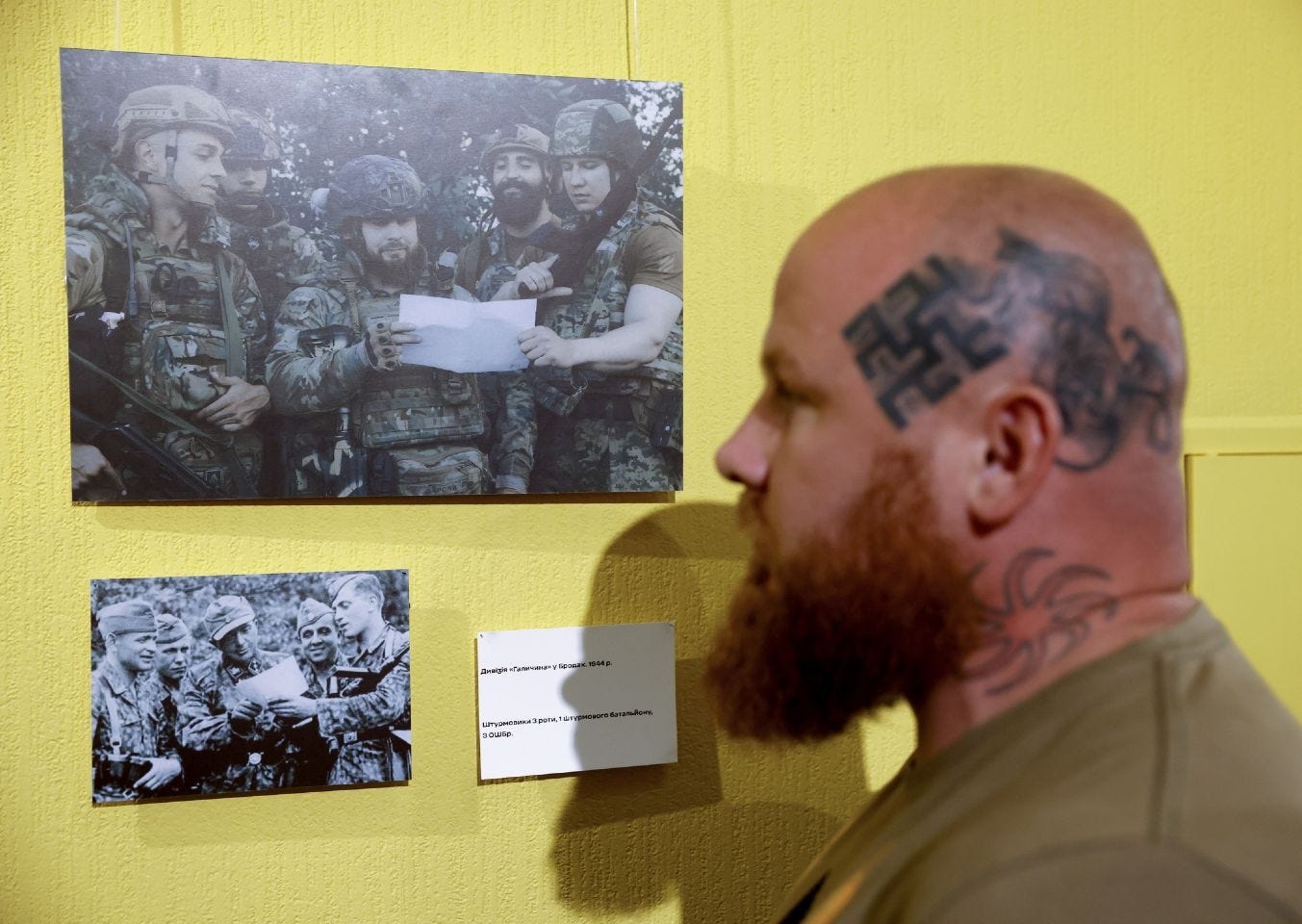
The 3rd Assault Brigade was established by early 2023. As far as I know, Andriy Biletsky wasn’t revealed to be its commander until his 44th birthday in August. Later that month, on Ukraine’s Independence Day, the brigade presented “In Storms of Steel” on social media. In the meantime, Volodymyr Zelensky and his team visited Biletsky’s command post in the Bakhmut sector, as if to rubber stamp his position. Recently, an ideologist from the 3rd Assault Brigade joined Zelensky’s government as the new head of the Ukrainian Institute of National Memory. (Stay tuned for more on the “Azovization” of the memory war…)
1st Azov Corps
Colonel Andriy Biletsky was the first brigade commander in Ukraine to announce the creation of a new corps under his leadership, but it seems that he did so prematurely, perhaps in order to upstage the NGU Azov commander, Lt. Col. Denys Prokopenko, whose fame surpassed Biletsky as a result of the 2022 siege of Mariupol.
About a month later, in April 2025, when Prokopenko became the second brigade commander to make such an announcement, he could also name the new units in the National Guard’s 1st Azov Corps. As for Biletsky, we still don’t know how many brigades will join the 3rd Army Corps or come from the Azov movement. With a feud apparently brewing between Biletsky and Prokopenko, the latter might be trying to start a new “Azov family” in the 1st Azov Corps, which consists of five brigades, including its namesake.
Until its recent expansion, the Lyubart brigade was the 5th battalion in the NGU Azov Brigade. In 2022-23, Lyubart was its own unit in Ukraine’s Special Operations Forces, “formed by Azov veterans and members of Centuria movement in Volyn Oblast on the day of [the] Russian full-scale invasion,” according to MilitaryLand.net. The first battalion is represented by “Dontsov’s beast,” a lion-wolf-hedgehog hybrid conjured in the twisted mind of the genocidal fascist ideologue who translated Mein Kampf into Ukrainian. The second battalion uses the aforementioned runic symbol favored by Wotanjugend and Azov’s former National Militia (now Centuria).
Just two of the five NGU Azov brigades are truly Azovite, and neither has purged the far-right. Certain “experts” and the many journalists who echoed them routinely claimed that Azov was long ago “integrated” in the National Guard, as if that implied depoliticization. Now three brigades are being integrated into the NGU’s 1st Azov Corps: “Bureviy,” “Chervona Kalyna,” and “Kara-Dag.” Perhaps that will not be too difficult. The 3rd battalion of the Chervona Kalyna brigade, for example, has an undeniable neo-Nazi symbol (Black Sun) in its emblem, and the reconnaissance company is represented by a patch shaped like several Waffen-SS divisions.
Arsen “Lemko” Dmytryk, the far-right chief of staff of the 1st Azov Corps, wrote an article for Forbes Ukraine this month about “why we cannot win the war without rethinking the essence of the army and state,” with “Azov as the bearer of a new management code.” According to Dmytryk, “When Ukraine enters the reconstruction phase after the war – not only of cities, but also of state institutions – this new type of leadership will be crucial. … Azov is not adjusting to the old Ukraine. It is preparing a new one. And this is its main victory. And our main hope.”

Thanks for reading. If you want to support my work, you can “Buy Me a Coffee,” pledge to become a paid subscriber, or share this blog with your friends.
Comments
Nothing yet. Say the first thing.
Sign in to join the conversation.