
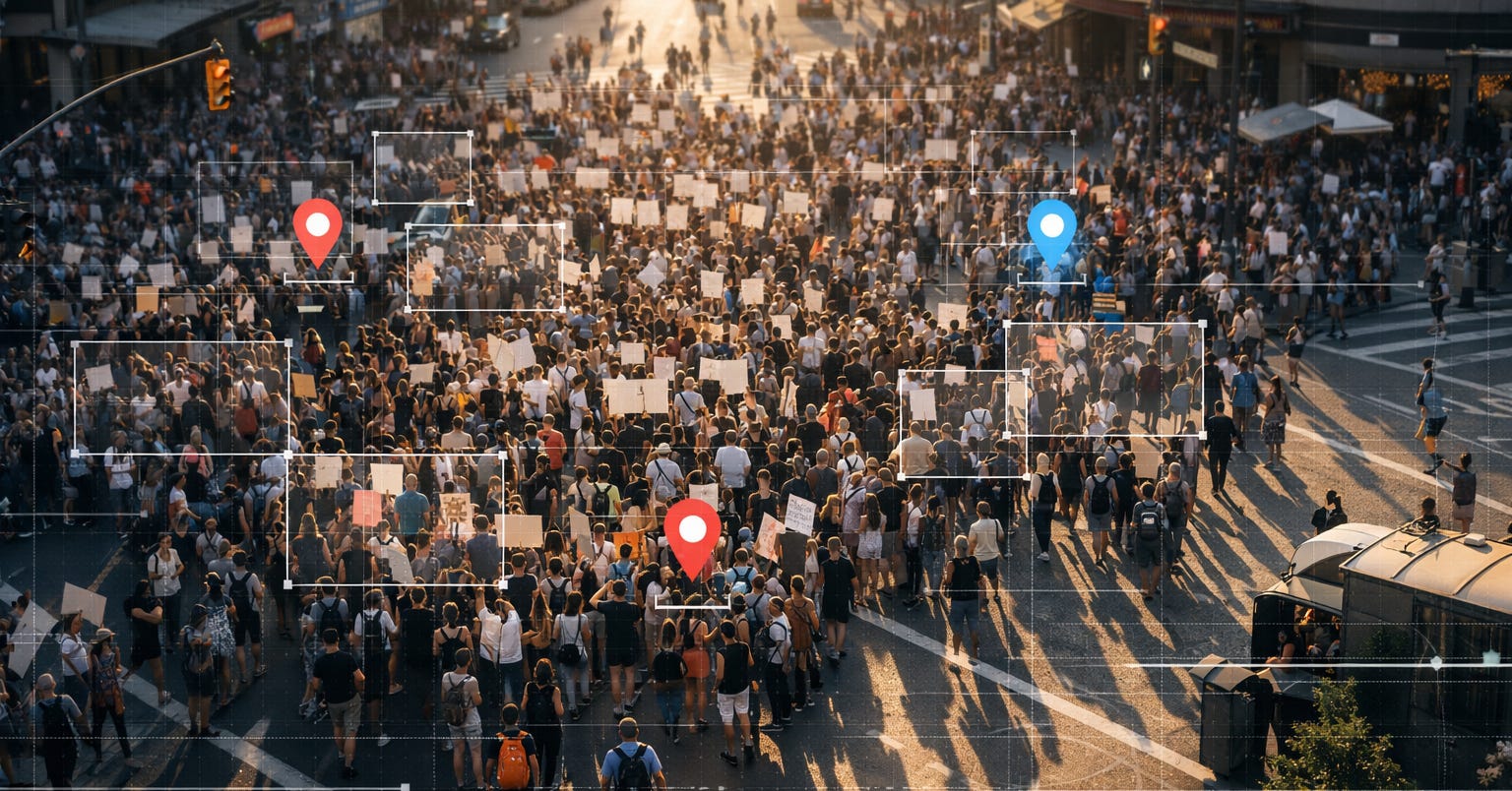
The Protest That Doesn’t End When the Crowd Goes Home
From the street, the protest looks familiar.
A crowd fills the intersection holding signs. People chant. Someone beats a drum while others stand on the sidewalk filming with their phones. Cars slow down as drivers lean out their windows to see what is happening.
Scenes like this have played out across American cities and towns for generations. Citizens gather in public, raise their voices, and demand change.
But today’s protests unfold in a very different environment than the ones that came before them.
A protest now leaves a digital record
Above the crowd, a small drone circles quietly. Traffic cameras capture faces as people cross the intersection. Smartphones in pockets and backpacks record location data with every step. Photos and videos begin appearing online within minutes.
None of this stops the protest from happening. The signs are still raised, the chants still echo down the street, and the constitutional right to assemble remains firmly protected.
What has changed is what happens after the crowd goes home.
A protest may last a few hours. The digital traces created during that time can last much longer.
Images, location data, and online posts create a record of the event that didn’t exist for most of American history. For people who participate in demonstrations today, understanding that digital environment has quietly become part of protest safety.
Activists have begun to describe this awareness with a simple phrase: digital hygiene.
It is not about fear or secrecy. It is about understanding the terrain.
A new part of protest preparation
Just as experienced organizers think about crowd safety, exit routes, and communication plans, many now think about the digital footprints people carry with them into public spaces.
In the age of smartphones, cameras, and constant connectivity, the modern protest does not end when the crowd disperses. The digital record continues long after the streets reopen.
And for citizens who choose to raise their voices in public, learning how that environment works has become part of the new protest playbook.
The Protest Environment Has Changed
For most of modern history, protests existed primarily in the moment.
People gathered in public spaces, raised signs, marched through streets, and spoke to anyone willing to listen. The audience was whoever happened to be there — the people in the crowd, the police standing nearby, and sometimes a few reporters documenting the event.
When the protest ended, much of it faded into memory.
Protests once faded quickly
A few photographs might appear in the next day’s newspaper. Local television might show brief footage during the evening news. But the event itself largely disappeared once the streets reopened and people went home.
That environment shaped how protest movements operated for generations.
Participants understood that their presence in a crowd provided a degree of anonymity. A demonstration could include hundreds or even thousands of people, and identifying every individual participant would have required enormous effort.
Today, the landscape is very different.
Public spaces are now digitally documented
Public spaces are now covered by layers of digital observation that simply did not exist even twenty years ago. Traffic cameras monitor intersections. Businesses install high-definition security systems. Smartphones record images and video from countless angles. Social media platforms allow those images to circulate instantly.
Even when no one intends to document an event, digital records are often created automatically.
Phones quietly record location data. Security cameras archive footage for later review. Images posted online can be stored indefinitely, long after the original event has ended.
None of this eliminates the right to protest. The constitutional protections for speech and assembly remain as strong as they have ever been.
Modern demonstrations now take place in an environment where public events often leave a digital footprint. Understanding that reality has become part of how experienced organizers and participants think about safety, preparation, and awareness.
In earlier generations, protest planning focused almost entirely on the physical world — crowd size, routes, permits, and communication between organizers.
Today, the planning often includes another dimension: the digital environment surrounding the protest itself.
Recognizing that shift is the first step toward understanding why many activists now talk about something that would have sounded unusual just a decade ago.
They call it digital hygiene.
What “Digital Hygiene” Means
The phrase digital hygiene might sound technical at first, but the idea behind it is straightforward.
Most people already practice some form of digital hygiene in their daily lives, even if they don’t use that term. They update passwords, adjust privacy settings, or think carefully before posting something online that might follow them for years.
Awareness of the digital footprint
At its core, digital hygiene simply means being aware of the digital footprint we create when we use modern technology.
That awareness becomes especially relevant in public spaces.
When people attend a protest today, they are not just bringing signs, water bottles, and comfortable shoes. Almost everyone also carries a smartphone — a device that functions as a camera, a communication tool, and a source of location data all at once.
None of that technology is inherently negative. Smartphones help people stay connected with friends, navigate unfamiliar cities, and document events as they happen.
But they also create digital traces that did not exist during earlier protest movements.
Technology creates automatic records
A phone may record location data as someone moves through a city. Photos taken by one participant may be shared by hundreds of others within minutes. Public cameras mounted on buildings or traffic lights may capture images of the same moment from entirely different angles.
Most of these systems operate automatically. They are simply part of the digital infrastructure that surrounds everyday life.
Digital hygiene is the practice of understanding that environment and making thoughtful decisions about how we move through it.
For experienced organizers, that awareness has gradually become part of modern protest preparation. Just as people think about weather conditions or safe exit routes from a crowded street, they may also think about the digital tools they bring with them and the information those tools might generate.
This does not mean withdrawing from public life or avoiding protest altogether. In many ways, it reflects the opposite.
Digital hygiene is about participating in civic life with clear eyes and practical awareness.
It recognizes that the right to assemble remains intact, while also acknowledging that the technological landscape surrounding public gatherings has evolved.
Understanding that landscape is the next step in learning how modern protests work.
The Digital Trail We All Carry
One of the easiest ways to understand the modern protest environment is to recognize a simple reality: most people now carry a small networked computer in their pocket.
A smartphone can take photos, send messages across the world instantly, and help someone navigate an unfamiliar neighborhood. It is an extraordinary tool for communication and coordination.
It is also a device that continuously interacts with the digital infrastructure around it.
Smartphones don’t just communicate — they interact with systems
When a phone connects to a cellular network, it communicates with nearby towers to maintain a signal. When someone checks directions on a map application, the device may use location data to determine where it is and how to reach the next destination. When a photo is taken and shared online, it can quickly spread across multiple platforms.
These functions are not unusual or suspicious. They are simply part of how modern technology works.
But together they create what could be described as a digital trail.
At a protest, that trail can take many forms.
A participant might take a photo of a sign and post it online. Another person might livestream part of the march to friends who could not attend. News organizations may capture footage for their coverage of the event. Nearby businesses may have security cameras recording the same street from a different angle.
Each of these actions produces a small piece of digital documentation.
Individually, they may seem insignificant. But collectively they create a record of the event that did not exist for most of American history.
Even systems people rarely think about can contribute to that record. Traffic cameras monitor intersections for safety and enforcement purposes. Building security systems often archive footage automatically. Public posts on social media can remain accessible long after the protest itself has ended.
None of these technologies were designed specifically for protests. They are simply part of the digital environment that now surrounds daily life.
Yet when large public gatherings occur, all of those systems can intersect in the same place at the same time.
Understanding that intersection is an important part of modern protest awareness. The digital trail most people carry with them is not inherently dangerous or malicious.
But it does mean that participation in public events can generate records that persist long after the crowd disperses.
Recognizing that reality helps explain why many experienced activists now treat digital awareness as another form of protest safety.
How Protesters Adapt
Protest movements have always evolved alongside the tools and pressures of their time.
During the civil rights era, organizers learned how to coordinate marches under the watch of government informants. Labor movements developed communication networks that allowed workers to organize across cities and industries. Antiwar demonstrations in the 1960s and 1970s relied on underground newspapers, campus networks, and word-of-mouth coordination.
Every generation of activists has had to learn the terrain it was operating in.
The digital age is no different.
As smartphones, cameras, and social media became part of everyday life, protest movements gradually began adapting their practices. Many organizers now think about communication, documentation, and digital exposure in ways that would have been unnecessary just a decade or two ago.
Movements adapt — so do habits
One example is how groups communicate before and during large demonstrations. Instead of relying entirely on public social media posts, some organizers coordinate through smaller trusted networks or encrypted messaging platforms. These tools allow groups to share information quickly while maintaining a degree of privacy within the organizing team.
Another shift involves how people think about documentation. Cameras and livestreams can provide an important public record of events, especially during moments of tension or conflict. At the same time, experienced organizers often encourage participants to think carefully about how images are shared and who might be visible in them.
In many protests today, volunteers also take on specific safety roles. Marshals help guide crowds along planned routes and watch for potential hazards. Legal observers document interactions between protesters and law enforcement. Street medics provide first aid if someone becomes injured or overwhelmed in a large crowd.
These roles reflect a broader principle: effective protests are rarely spontaneous gatherings alone. They often involve preparation, coordination, and people thinking ahead about potential risks.
Digital awareness has gradually become another part of that preparation.
Just as organizers plan routes and communication strategies, many now encourage participants to think about how their devices, online activity, and personal data interact with the surrounding environment.
This does not require complicated technical knowledge. In many cases, it simply means understanding how everyday technology functions and making thoughtful choices about how it is used during public events.
In that sense, digital hygiene is less about avoiding technology and more about using it intentionally.
And for many modern protest movements, that awareness has become another tool in the evolving playbook of civic participation.
Practicing Digital Hygiene Before a Protest
Preparation has always been part of responsible protest participation.
People check the weather, wear comfortable clothing, bring water, and plan how they will get home after the event ends. Experienced organizers also think about crowd safety, exit routes, and communication plans.
Digital hygiene simply adds another layer to that preparation.
Before attending a protest, many participants now take a few minutes to review how their devices handle privacy and location information. Smartphones are designed to share certain types of data automatically, often to support navigation, weather updates, or social media features.
Preparation isn’t paranoia — it’s intentional
Understanding those settings allows people to decide what level of information sharing they are comfortable with while attending a public event.
Some participants review which applications on their phone use location services and when those services are active. Others choose to limit automatic location sharing during the time they plan to attend a demonstration.
Communication planning is another common step. Many groups decide in advance how they will stay in contact during the event, especially if large crowds make it difficult to hear or see one another. Messaging platforms can help people coordinate meeting points, check on friends, or share updates about the route of a march.
Another simple practice involves thinking about the amount of personal information someone carries with them. Just as travelers sometimes reduce what they bring when attending large public events, some protesters prefer to limit unnecessary personal documents or data when entering a crowded environment.
None of these steps are complicated, and they are not about secrecy or hiding from public life.
They are simply examples of intentional preparation.
The goal of digital hygiene before a protest is the same as any other form of preparation: making thoughtful choices about how to move through the environment.
Just as experienced hikers check the terrain before heading onto a trail, experienced protesters increasingly check the digital landscape before stepping into the street.
Digital Awareness During a Protest
Once a protest begins, the environment can change quickly.
Crowds move, chants start and stop, and groups of people may shift direction as a march progresses through different streets. In the middle of that activity, most participants focus on the purpose of the demonstration itself — the message they want to share and the people around them.
Digital awareness does not require constant attention during those moments. But it does involve recognizing that modern protests often take place in spaces where documentation is common.
Participants frequently take photos or record video to capture the energy of the event. Journalists document demonstrations for news coverage. Bystanders watching from sidewalks may also record what they see.
These recordings can play an important role in public life. Images from protests often help inform broader conversations about social issues, and documentation can provide valuable context if disputes arise about what occurred.
Documentation matters — so does thoughtfulness
At the same time, experienced organizers often encourage participants to think carefully about how images and recordings are shared.
A photograph posted online may include people who did not realize they were being recorded. A livestream may capture faces or conversations that others expected to remain within the crowd. These moments are rarely malicious, but they can illustrate how easily digital documentation spreads once it enters the online world.
Digital awareness during a protest often comes down to simple habits.
Some participants pause before posting images publicly in real time. Others choose to frame photographs so that signs, speakers, or the larger crowd are visible without focusing closely on individual faces. In organized demonstrations, volunteers sometimes remind participants to think about how documentation affects everyone present, not just the person holding the camera.
Communication is another area where awareness matters. Large crowds can make phone service unreliable, and messages may take longer than expected to send or receive. For that reason, many groups establish simple meeting points or check-in plans ahead of time so that friends and organizers know how to reconnect if communication becomes difficult.
These habits are not about restricting participation or discouraging documentation. They are part of a broader culture of awareness that has developed as protests have moved deeper into the digital age.
In earlier decades, the main safety concerns at demonstrations were physical — crowd movement, weather, and interactions between different groups.
Today, those physical considerations still exist. But alongside them, many participants now think about the digital environment surrounding the event and how their actions contribute to the record that will remain afterward.
That awareness has become another quiet skill in the evolving practice of modern protest participation.
After the Protest: The Digital Footprint
When a protest ends, the physical signs of the event usually disappear quickly.
Crowds disperse. Streets reopen to traffic. Volunteers gather discarded signs and water bottles. Within a few hours, the same intersection that held hundreds of people may look almost exactly as it did earlier that day.
But the digital record of the protest often continues long after the last chant fades.
Photos taken during the event may begin circulating online through social media or messaging platforms. News organizations may publish galleries or video footage documenting the demonstration. Livestreams recorded earlier in the day can remain available for anyone to watch later.
Even systems that operate quietly in the background may preserve pieces of the moment. Security cameras mounted on nearby buildings often store footage for days or weeks. Public posts shared during the protest can be archived indefinitely on digital platforms.
None of this is unusual. It is simply part of how modern information systems work.
For many participants, reviewing that online record afterward has become another small step in practicing digital hygiene.
The protest ends — the record continues
Someone who posted photos during the protest might later look back at those images to see what details they contain. A quick review can reveal things that were not obvious in the moment — a visible address in the background, a clearly identifiable face, or personal information that someone did not intend to share publicly.
Some participants choose to adjust privacy settings on posts or limit who can view certain images. Others simply take note of what was shared and how widely it traveled across different platforms.
The goal is not to erase the event or hide participation in public life. Protests have always been visible expressions of civic engagement.
Instead, reviewing the digital record allows participants to understand how the documentation of the event continues to exist in the online world.
Just as organizers often debrief after a large demonstration to discuss what worked well and what could be improved, individuals can think about how their digital activity during the event shaped the record that followed.
Over time, these small habits form part of a larger pattern of awareness.
The protest may have ended in the streets, but the digital traces it produced often continue moving through networks, archives, and conversations long afterward.
Recognizing that ongoing life of an event is another step in understanding how protests function in the modern era.
Why Digital Awareness Matters for Democracy
Public protest has long been one of the most visible ways citizens participate in democracy.
From labor marches in the early twentieth century to civil rights demonstrations in the 1960s, Americans have repeatedly used public assembly to draw attention to issues they believe deserve national attention. The right to gather, speak, and advocate for change is protected as part of the First Amendment.
Those protections have not disappeared.
What has changed is the environment in which public demonstrations take place. The digital systems that shape modern life — cameras, smartphones, online platforms, and data networks — also shape how protests are documented and remembered.
Understanding that environment does not weaken the right to protest. If anything, it strengthens the ability of citizens to exercise that right thoughtfully.
When people recognize how the digital landscape works, they can make informed decisions about how they participate in public life. They can think ahead about communication, privacy, and documentation in the same way that earlier generations considered crowd routes or weather conditions.
In that sense, digital hygiene is not just about personal safety. It is also about civic awareness.
Awareness strengthens participation
A democracy functions best when citizens understand the systems that surround them. Whether those systems involve election procedures, public institutions, or digital technology, knowledge helps people participate more confidently and responsibly.
Public assembly has always required a degree of preparation. Organizers plan routes and speakers. Volunteers help guide crowds safely through busy streets. Participants bring signs, water, and comfortable shoes for a long afternoon of standing and marching.
In the digital age, preparation now includes another layer.
Understanding how information moves, how images circulate, and how personal data interacts with modern technology has become part of the broader landscape of civic participation.
The right to protest remains one of the most enduring features of democratic life.
Learning how to exercise that right in a world filled with digital tools and records is simply the latest chapter in a long tradition of citizens adapting to the terrain around them.
Conclusion — The Terrain Has Changed, but the Right Remains
Every generation of protesters learns the landscape it operates in.
In earlier decades that landscape was shaped by physical realities — the layout of city streets, the presence of law enforcement, and the challenge of coordinating large crowds without modern communication tools.
Today the terrain includes something new.
Cameras are common in public spaces. Smartphones create images and data with almost every interaction. Online platforms allow moments from a demonstration to travel far beyond the street where they first occurred.
None of this has eliminated the role of protest in democratic life.
Citizens still gather in public squares, march through city streets, and raise their voices when they believe something needs to change. That tradition remains deeply embedded in the civic culture of the United States.
But like any environment, the terrain has evolved.
Understanding the digital landscape surrounding public events has become part of modern protest awareness. Just as experienced participants think about crowd safety, communication plans, and exit routes, many now also think about the digital footprints they carry with them.
This awareness does not diminish the power of protest.
If anything, it reflects the same practical intelligence that has always helped civic movements endure. Successful movements learn how the world around them works and adjust their practices accordingly.
Digital hygiene is simply one expression of that tradition.
In a connected world, the modern protest may leave a record that lasts longer than the event itself. Learning how that record is created — and how to navigate it thoughtfully — has become part of the evolving craft of civic participation.
The terrain has changed.
The right to gather, speak, and advocate remains.
And for those who choose to step into the street, understanding both is part of the modern protest playbook.
Digital Hygiene Field Guide for Protesters
Public demonstrations remain one of the most visible forms of civic participation. In a world shaped by smartphones, cameras, and online networks, many experienced organizers now treat digital awareness as part of protest preparation.
This checklist reflects common practices people use to manage their digital footprint during public events.
Before the Protest
Review your phone’s location settings
Most smartphones allow apps to access location data automatically. Take a moment to review which apps have access to that information and when they use it. Many people choose to limit location access to only the apps that truly need it.
Update privacy settings on social platforms
Social media platforms often default to public sharing. Before attending a demonstration, it can be useful to review privacy settings and decide who can view posts, images, or live videos.
Plan communication with trusted contacts
Large demonstrations can make phone service unreliable. Decide ahead of time how you will reconnect with friends if you become separated. Simple plans — such as meeting points or scheduled check-ins — can make a large crowd easier to navigate.
Charge devices and bring backup power
Phones often become essential tools during protests for communication, navigation, and safety updates. A fully charged device and a small battery pack can prevent problems later in the day.
Limit unnecessary personal data
Many participants prefer to bring only what they need when attending large public events. Reducing unnecessary personal documents or sensitive information is a common precaution at crowded gatherings of any kind.
During the Protest
Assume cameras are present
Public demonstrations are often documented by participants, journalists, and bystanders. Being aware of cameras and recording devices helps people make thoughtful choices about what they share and how they appear in images.
Be thoughtful about real-time posting
Sharing photos or livestreams can help spread awareness about an event. At the same time, some participants pause before posting images that clearly identify other individuals without their consent.
Protect group communication
Messaging apps are often used to stay connected during demonstrations. Keeping communication within trusted groups can make coordination easier in large crowds.
Maintain situational awareness
Digital awareness should not replace physical awareness. Pay attention to the movement of the crowd, announcements from organizers, and safe routes through the area.
After the Protest
Review what was shared online
After the event, take a moment to review any photos or posts shared publicly. Sometimes images contain details that were not obvious at the time.
Adjust privacy settings if necessary
If a post spreads more widely than expected, many platforms allow users to update visibility settings or remove content.
Check in with your group
Large protests often involve long days and large crowds. Confirming that friends and fellow participants returned home safely is a simple but important step.
Reflect for the next event
Experienced organizers often review what worked well and what could be improved. Digital practices are part of that learning process.
Digital hygiene is not about avoiding civic participation. It is about understanding how modern technology interacts with public life and making informed decisions while exercising the right to assemble.
Sources
American Civil Liberties Union. “Stopping Face Recognition Surveillance.” Accessed March 2, 2026.
https://www.aclu.org/news/topic/stopping-face-recognition-surveillance
American Civil Liberties Union. “Trump on Surveillance, Protest, and Free Speech.” Accessed March 2, 2026.
https://www.aclu.org/trump-on-surveillance-protest-and-free-speech
American Civil Liberties Union of Washington. “Protester Guide: How to Defend Against Police Surveillance.” Accessed March 2, 2026.
https://www.aclu-wa.org/news/protestguide/
Electronic Frontier Foundation. “Attending a Protest.” Surveillance Self-Defense Project. Accessed March 2, 2026.
https://ssd.eff.org/module/attending-protest
Electronic Frontier Foundation. “Digital Security Tips for Protesters.” November 16, 2016.
https://www.eff.org/deeplinks/2016/11/digital-security-tips-for-protesters
Electronic Frontier Foundation. “Geofence Warrants and Reverse Keyword Warrants Are So Invasive Even Big Tech Wants to End Them.” May 13, 2022.
https://www.eff.org/deeplinks/2022/05/geofence-warrants-and-reverse-keyword-warrants-are-so-invasive-even-big-tech-wants
Electronic Frontier Foundation. “Federal Appeals Court Finds Geofence Warrants Are Categorically Unconstitutional.” August 12, 2024.
https://www.eff.org/deeplinks/2024/08/federal-appeals-court-finds-geofence-warrants-are-categorically-unconstitutional
Electronic Frontier Foundation. “Location Data Brokers.” Accessed March 2, 2026.
https://www.eff.org/issues/location-data-brokers
International Center for Not-for-Profit Law. “Protesting in an Age of Government Surveillance.” Accessed March 2, 2026.
https://www.icnl.org/post/analysis/protesting-in-an-age-of-government-surveillance
CalMatters. “How to Prepare Your Phone for a Protest.” May 6, 2024.
https://calmatters.org/economy/technology/2024/05/how-to-prepare-your-phone-for-a-protest/
Freedom of the Press Foundation. “How to Limit Exposing Your Location.” October 20, 2025.
https://freedom.press/digisec/blog/how-to-limit-exposing-your-location/
Wired. “How to Protest Safely in the Age of Surveillance.” January 8, 2026.
https://www.wired.com/story/how-to-protest-safely-surveillance-digital-privacy/
Wikipedia Contributors. “Geofence Warrant.” Last modified 2026.
https://en.wikipedia.org/wiki/Geofence_warrant
Comments
Nothing yet. Say the first thing.
Sign in to join the conversation.