
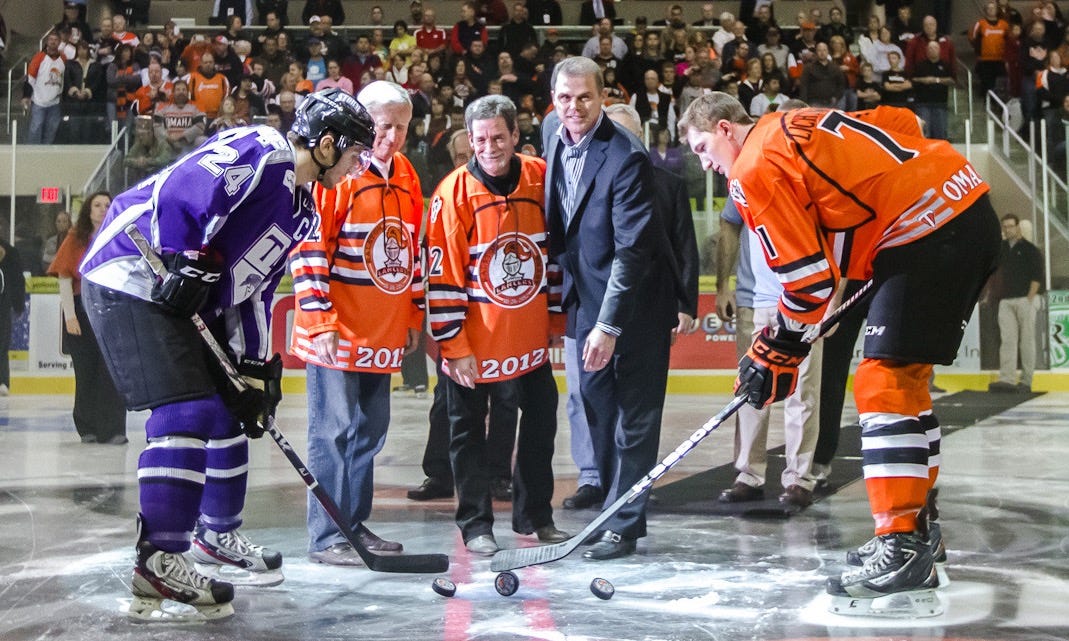
Ben Robert has already overseen the construction of two hockey arenas — the 18,000-plus seat Videotron Centre in Québec City and the 4,000-plus seat Ralston Arena near Omaha, Nebraska.
What’s one more?
The owner of the United States Hockey League’s expansion Phoenix franchise understands the challenge of getting an arena built in the Valley. That same challenge haunted the Coyotes for more than a decade before they relocated to Salt Lake City, but that is the task that will occupy all of Robert’s time for the next two months.
“I’m talking to various people to find a permanent location that does not exist,” Robert said Tuesday. “To me, to have a metropolitan area that is the (10th) largest in the country and only have one mid-sized arena is kind of mind-boggling. So I’m talking to various people to see if there would be an opportunity to build one.”
Robert said he has not zeroed in on a particular area of the city, preferring to keep his options open. Nor is he ready to identify those with whom he is talking.
“It’s going to take a lot of heavy lifting,” he said. “But we’re looking for a permanent solution, while all the while looking for a temporary solution to play in while it is being built.”
AZ Hockey Insider, LLC is a reader-supported publication. To receive new posts and support my work, consider becoming a free or paid subscriber.
The USHL announced in June that it will expand by six more franchises for the 2027-28 season. All of the teams will be located in the West, including two in Arizona — one in Prescott Valley and one in the Phoenix area.
The Phoenix announcement was a surprise because, with the exception of Chicago, the USHL has avoided large metropolitan areas where costs and competition make financial success more of a challenge. To Robert, however, Phoenix was a no-brainer, even with efforts underway to bring the NHL back to Valley, and even if some analysts think the league has put the cart before the horse with no arena yet in place.
“I would love the NHL to come back to Phoenix,” Robert said. “I think it would be awesome, but understand one thing: It’s not everybody that can afford NHL tickets. It’s not everybody that can even afford ASU tickets.
“When I look at our business model, I’m saying there’s a segment of the population that will get great entertainment and the value will be affordable. And in Phoenix, I think there’s enough people to support all three teams.”
Robert has an impressive resume. He served as the L.A. Kings’ vice president of business development under then-president of business operations Luc Robitaille. He bought the USHL’s Omaha Lancers in 2004 as part of an ownership group that included Mario Lemieux and Luc Robitaille, during which time he oversaw the construction of Ralston Arena before selling his majority stake in 2014. And he served as a senior executive in Québecor Media’s failed bid to bring an expansion NHL team to Québec City, during which time he oversaw the construction of the Videotron Centre.
“If anybody can get this done, it’s Ben Robert,” USHL President and Commissioner Glenn Hefferan said of Robert’s Valley venture.
Robert said he needs to have an arena solution by mid-October, with the goal of building a venue in the 4,000-seat range. Short of that, the USHL may have to look at another market for this franchise’s home.
The Tucson Roadrunners officially have two years remaining on their lease before an expected relocation to Reno where the Meruelo family is building an arena. Additionally, the Mosaic Quarter Iceplex in South Tucson is currently scheduled to open in the spring of 2027 near the Kino Sports Complex. The largest of the arens there will have a seating capacity of at least 3,000.
Even if Robert is successful in his Phoenix-area efforts, he still must secure a temporary home for the franchise because the new arena cannot be built in a year. Sources at Mullett Arena confirmed that Robert has not contacted them and there is significant doubt that the team would be viable and be able to afford using Mullett for a year or two.
In late June, a spokesperson for the Ice Den Scottsdale said the facility “was evaluated a while back and doesn’t have the ice availability or capacity needed to host the USHL team.”
With just 800 seats for the larger of its two NHL-style arenas, the new Fire 'n' Ice facility in north Phoenix does not meet the USHL’s minimum requirement of 3,000 seats either, but the league may be willing to bend the rules for a temporary facility.
Robert said that other logistics such as naming the team, finding billet families and roster construction will take a backseat until the arena component is in place.
“You cannot start at F,” Robert said. “You’ve got to start at A.”
Robert has been involved in USHL expansion talks for nearly a decade. COVID-19 put a crimp in the league plans, but the idea is sound, he said, if executed properly.
“Look at everything that’s happened on the West Coast,” he said. “The NHL has expanded out here and has done a tremendous job at promoting and growing youth hockey. Then you look at the AHL coming out west and the success that it has had — probably the most valuable division in the AHL is on the West Coast (the Pacific Division).
“Then look at how junior hockey is built in North America. You have 61 teams in the CHL, of which eight are American teams closer to the border. You’ve only got 16 teams at the Tier I level in the USHL and they’re all in the Midwest. The number of registered hockey players in this country now is higher than Canada, and it should be much greater than in Canada.
“There’s over 50 million people in California, Arizona, Nevada, and Utah (combined) so when you put all of this together, you say we have to provide more opportunities in this country for the game to continue to grow.”
Arizona State coach Greg Powers has noted the impact that the USHL’s expansion will have on the Sun Devils’ recruiting trips and costs with teams located out west in a league that produces more than 50 percent of Division I players. But he sees another valuable byproduct.
“I think it’s really smart of the USHL to expand their footprint and I’m pretty sure the NHL wanted to see them do that as well, but if you put six to eight teams out west and give American-born players at least an opportunity to stay closer to home and play high-level junior hockey, that’s a great benefit,” he said. “If it’s done right, I think it can develop into that, and I’m sure it will be done right with the people that are behind it.”
Until he shores up the arena question, Robert will retain a 100-percent ownership stake in Phoenix’s USHL franchise, but he hopes to bring in more investors at some point and has already had conversations with some of the many former NHL players who call the Valley home. If successful, Robert hopes to forge the same sort of connection with Valley fans, corporate sponsors and players that he forged in Omaha.
“I have always said that I work for the 99 percent,” he said. “One percent of players make it to the NHL and that’s awesome, but in that 99 percent, when the kids would come to my office and say, “’Hey, I’ve got my deal in North Dakota’ or “I’m going to Harvard’ or ‘I’m going to Michigan,’ I’ll admit, that feels pretty good.”
Comments
Nothing yet. Say the first thing.
Sign in to join the conversation.