
creative desk is where i’ll be documenting the side of creativity that usually stays behind the scenes. with support from microsoft surface, i’ll be sharing the habits, workflows, tools and business lessons i’ve picked up while building milk & cookies into a full-time writing career, with the hope that they’ll make creating feel a little more possible for you too.
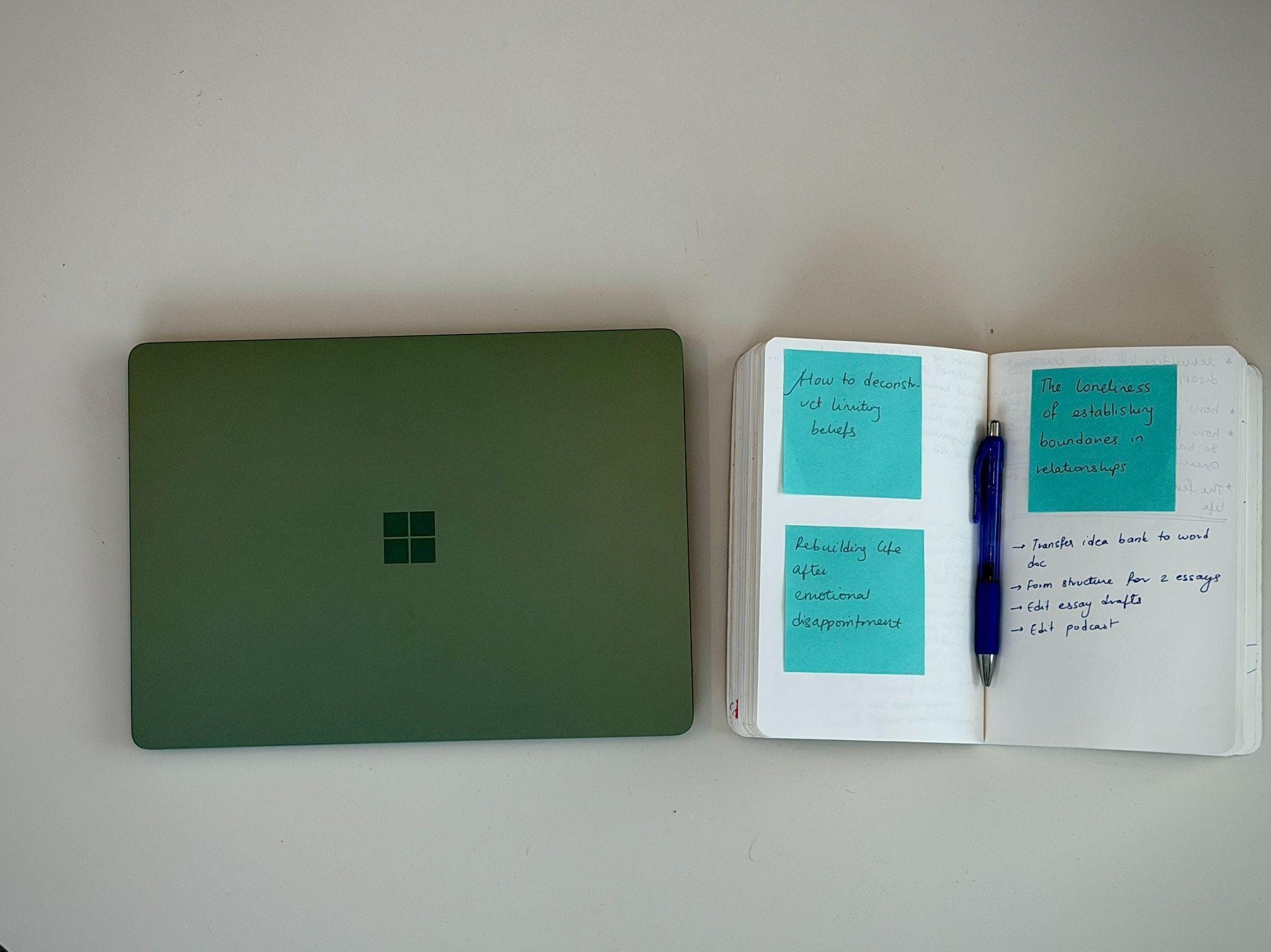
overwhelm often managed to make me feel productive without leaving behind much proof. the day would fill itself with messages, errands and decisions that seemed too small to deserve planning yet somehow large enough to consume every useful part of my attention. creative work kept being moved to the clean edge of the schedule, after the inbox had been answered and life had stopped producing minor administrative surprises, which meant it was usually assigned to an hour that did not exist. by evening, i had maintained my life with impressive dedication while making almost nothing that felt like mine.
the solution was not a more elaborate routine. elaborate routines were part of the problem. each new system became another object to maintain, another little government inside my life with its own forms and regulations. creation returned when i made the process smaller, less ceremonial and harder to postpone. these are the changes that helped:
1. i stopped treating every idea like a project
an idea can be exciting without immediately becoming a commitment. mine never really received that courtesy. the moment one appeared, i began imagining the finished essay, the response to it and everything required to make it worthwhile. a sentence had barely entered my mind before it was expected to justify several days of work. this made inspiration feel suspiciously similar to receiving an assignment.
letting an idea remain small removed much of its weight. a thought could become four lines in a document and wait there without demanding a title or a strategy. plenty of ideas improved during that period of neglect, while others revealed that they had only ever been attractive sentences wearing the costume of a larger argument. neither outcome required an emergency meeting.
the useful question became: what is the smallest visible version of this idea? sometimes it was a paragraph. sometimes it was a note explaining why the subject interested me. once the idea existed outside my head, it stopped occupying the mental space of something unfinished and became material i could return to.
2. i gave my attention a physical boundary
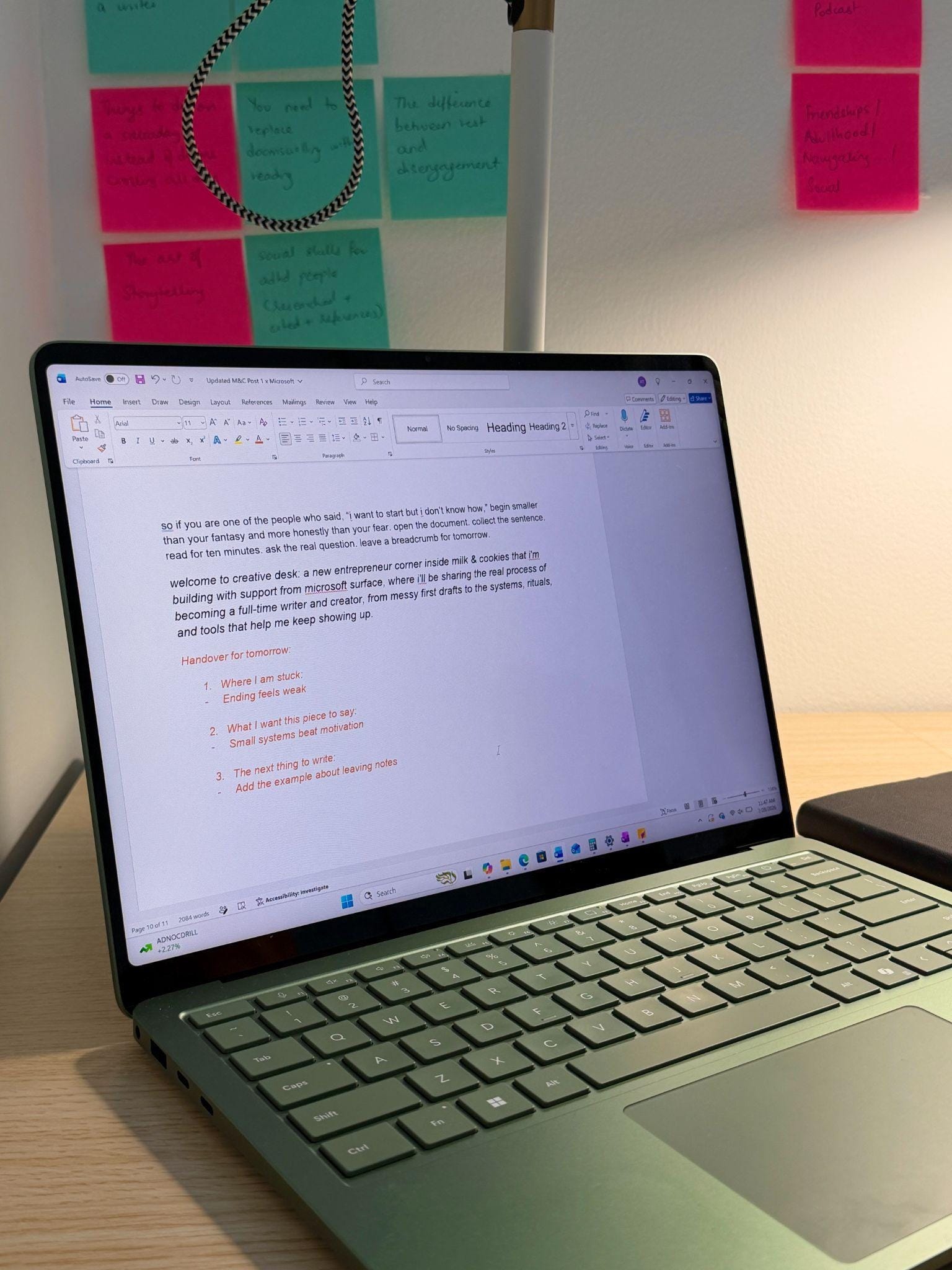
my laptop had gradually begun to resemble the state of my mind. windows overlapped, tabs multiplied and the draft i claimed to be working on kept disappearing beneath research that felt responsible enough to avoid questioning. an article led to another article. one useful reference opened a trail of loosely related ideas. by the time i returned to the page, my thoughts had become crowded with everyone else’s language.
using windows snap layouts on my surface laptop changed this in a surprisingly practical way. i began keeping my draft open in word on one side of the screen and the single source or note i needed on the other. because of the taller 3:2 display, both remained comfortably visible, which made it much easier to stay inside the writing instead of bouncing between windows and endless scrolling. the arrangement forced me to decide what belonged in the hour before the hour had the chance to dissolve. research had a boundary where writing remained visible. anything unrelated could wait without hovering at the edge of the work. the arrangement forced me to decide what belonged in the hour before the hour had the chance to dissolve. research had a boundary where writing remained visible. anything unrelated could wait without hovering at the edge of the work.
the feature itself is simple, which was precisely why it helped. overwhelm often makes life feel as though it requires a sophisticated rescue plan, while the actual problem may be that too many things have been granted simultaneous access to attention. once the screen stopped offering twelve possible directions, the next sentence became far easier to find.
3. i separated making from judging
creation became exhausting when every early sentence was expected to prove that the final piece would be good. the internal editor arrived before there was anything substantial to edit and began reviewing fragments as though they had been submitted for publication. a clumsy opening was treated like evidence that the idea lacked merit. an obvious paragraph seemed to confirm that i had nothing original to say. the draft barely had time to form before it was required to defend itself.
giving writing and judgement different appointments changed the atmosphere of the work. the first session became a place for discovering what i thought. revision could decide how well i had said it. this division sounds obvious until the number of unfinished projects created by premature judgement is considered.
a rough page is not a failed finished page. it is an entirely different object with a different purpose. allowing that page to be repetitive or slightly embarrassing gave the better version something to work with. editing cannot improve a sentence that pride refused to write.
4. i created before consuming
reading is essential to creative work, which makes it one of the most respectable ways to avoid creating. an hour spent gathering references feels serious and saving interviews feels adjacent to progress. the trouble begins when the mind becomes so saturated with polished thoughts that its own unfinished ones start to seem inadequate.
creating before consuming gave my ideas a brief period without comparison. even twenty minutes helped. i could follow the argument far enough to hear its natural voice before introducing it to somebody else’s conclusion. research became more useful because i approached it with a question rather than wandering through it in search of a reason to delay beginning.
this also revealed how little information many pieces actually needed. overwhelm had encouraged me to gather everything that could be relevant. the writing usually required one precise fact or an example that complicated my thinking. collecting indiscriminately turned out to be indecision with excellent browser history.
5. i left the work before exhausting it
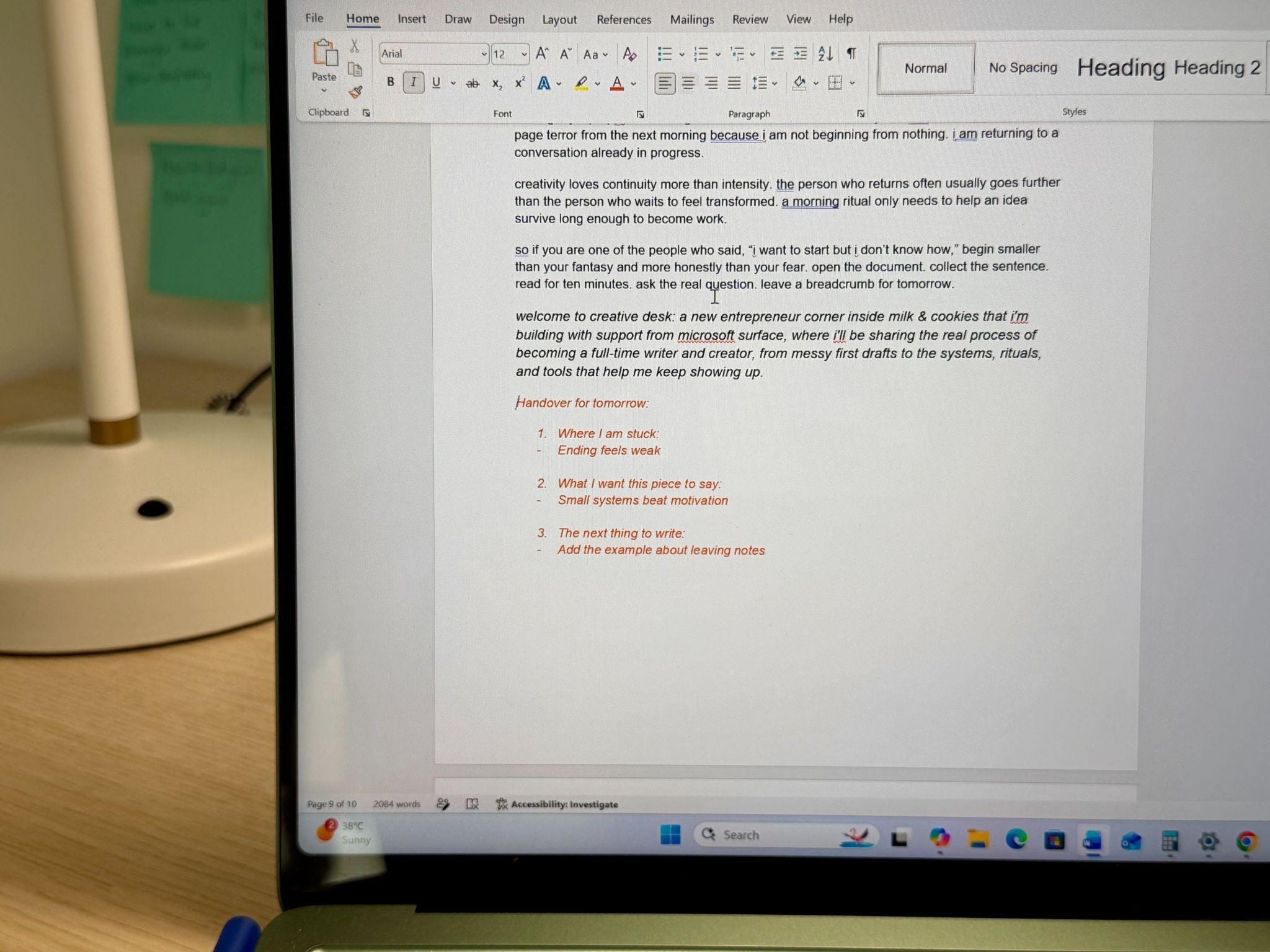
there was a tendency to remain at the desk until every usable thought had been extracted, partly because stopping while the work was going well felt irresponsible. the next session then began with nothing waiting for me except the vague instruction to continue. half the available time was spent trying to recover the mood and direction of a person i had been the day before. these days i stop much earlier, save a handover note for tomorrow and close the laptop while there’s still something left to say. by the end of the day my Surface Laptop still has plenty of battery left, so i’m ending the session because the work has reached a good stopping point, not because the computer has.
ending with a small note changed that. i would leave a sentence about the next paragraph or write the question the piece still needed to answer. the document stopped feeling abandoned and began feeling paused. tomorrow no longer had to begin by reconstructing yesterday.
this made shorter work sessions far more valuable. an hour only needed to move the piece into a position from which returning felt possible. consistency became easier once every session stopped demanding an impressive conclusion.
6. i counted outputs instead of occupied hours
overwhelm had taught me to measure effort by how tired i felt. a mentally crowded day seemed productive because so much had passed through my attention. the better measure was far less flattering: what exists now that did not exist this morning?
the answer could be: a page existed, an outline had shape, a difficult paragraph had become clearer. these small outputs restored a sense of authorship that maintenance work rarely provides. the kitchen would need cleaning again. the inbox would refill. a paragraph remained where i left it.
7. stopped deciding what to work on in the morning
mornings are terrible for making creative decisions because the first decision usually becomes ten more. instead, every evening before i close my laptop, i leave myself one instruction written in plain english. “rewrite the opening.” “find a better example.” “write 300 words before editing.” tomorrow’s version of me doesn’t have to think. she only has to continue. removing that first decision eliminated far more procrastination than trying to become more disciplined ever did.
8.i made every project ridiculously easy to reopen
there was a time when opening an unfinished project felt like walking into a room after everyone else had already started talking. i couldn’t remember what i was thinking or why i had written something a certain way. now every draft begins with three lines at the top:
where i’m stuck
what i want this piece to say
the next thing to write
it takes less than a minute to leave those notes before closing the document, but it saves twenty minutes of trying to remember where my brain had been.
9. i gave myself permission to write badly for fifteen minutes
some days i still don’t feel like writing. instead of waiting for enthusiasm, i tell myself i’m allowed to produce complete rubbish for the next fifteen minutes. almost every time, something useful appears around minute ten because the pressure to impress has already left the room. the hardest part of creating has rarely been writing. it’s surviving the first few minutes without judging myself.
10.i kept a running “next ideas” list instead of stopping my current work
halfway through every project, another exciting idea appears. i used to abandon whatever i was working on because the new idea felt fresher. now i write one sentence about it in a document called “next.” that’s all. the current project keeps moving and the new idea isn’t lost. surprisingly, if an idea still feels exciting a week later, it’s usually worth pursuing. if it doesn’t, i’ve saved myself from abandoning good work for temporary excitement.
creation changed my relationship with the day by giving some portion of my attention a destination. overwhelm had kept everything circulating internally until every thought felt urgent and none of them became real. making something allowed one idea to leave.
life never became orderly enough to grant me permission to create. the work became possible when i stopped requiring order as an entry condition.
i hope something in this list makes creating feel a little lighter this week.
creative desk is an ongoing series where i’ll be sharing the systems, tools and behind-the-scenes lessons i’ve learned while building a creative career. if there’s something you’ve always wanted to know about writing, publishing, entrepreneurship or the creative process, let me know in the comments. i’d love to explore it in a future edition.
for anyone building a creative practice of their own, you can explore the Surface Laptop i’ve been working on here
Comments
Nothing yet. Say the first thing.
Sign in to join the conversation.