
creative desk was built for a part of creativity where the systems beneath the finished piece, the tools that hold the mess and the small decisions that turn ideas into work people can actually read. more of these behind-the-scenes processes will live there, including the ways i plan essays, collect research and run milk & cookies from my microsoft surface using microsoft 365.
creative desk is a special series from milk & cookies, created in partnership with microsoft surface, exploring the systems and workflows behind my writing life.
building a newsletter for more than 200,000 people sounds, from the outside, like the result of a grand strategy involving dashboards, colour-coded calendars and a level of self-discipline that makes everyone else feel faintly inadequate. the truth is less appealing and far more useful. milk & cookies grew because i became increasingly good at protecting ideas from the chaos of ordinary life, then building small systems around the parts of writing that repeatedly exhausted me.
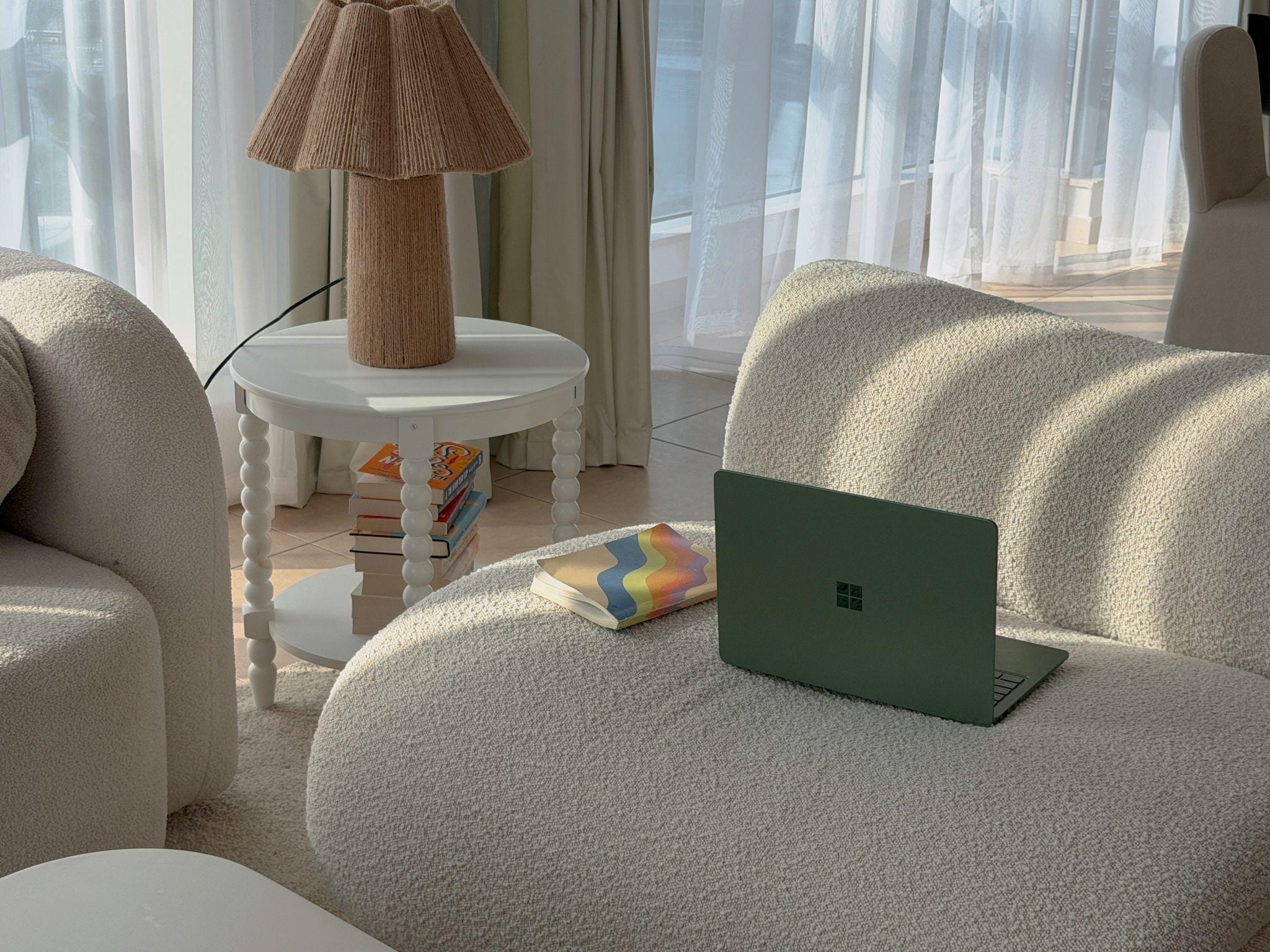
the real work happened between raising a toddler, replying to readers and managing the administrative debris that attaches itself to any creative business once people begin paying attention to it. inspiration mattered, although it was never reliable enough to run the company. the newsletter became sustainable when i stopped asking my brain to remember everything, decide everything and produce something brilliant on command. instead, i created a process that could carry me through days when my attention was split and the house was louder than my thoughts.
these are the systems behind that process, including the ones that rarely appear in advice about newsletters because they seem too small or unpolished to mention. most can be copied in less than an hour.
1. i search my own archive before researching the internet
before i search the internet, i usually open my surface laptop and search my own archive first. years of essays, notes and half-finished ideas often contain the seed of what i’m trying to write, and starting there usually leads to something more original than beginning with a blank search bar. the first place i look for a new essay is hardly ever the internet. i begin with my own archive.
if i want to write about confidence, friendship or ambition, i search the word across old drafts and published essays. this often reveals a sentence i wrote eighteen months ago and forgot, a question i raised without answering or an argument that belonged in a different piece. the search becomes a conversation with an earlier version of my mind, which is usually more interesting than beginning with everybody else’s conclusions.
the practical system is simple. every time a topic begins forming, i search three places before opening a browser: my published archive, my unfinished drafts and my reader comments. i copy anything useful into the new document under a heading called “already mine.” only after that do i research externally.
this has two benefits. the writing remains recognisably mine because it begins with my existing language, and older work becomes raw material rather than a graveyard of finished thoughts. one newsletter can contain the seed of five future newsletters if the archive is treated as a living resource.
2. every essay has three word documents
one document became too crowded for the way i actually think. research sat beside half-written paragraphs, deleted sections remained at the bottom and every attempt to find the current draft felt like rummaging through a handbag in the dark. and so, every essay on my surface laptop begins with three word docs open side by side, each serving a different purpose. now each essay has one folder in onedrive and three microsoft word documents inside it.
the first is called 01 source material. this is where i keep subscriber comments, book notes and links. anything that might support the essay goes here, including observations that are still too shapeless to use.
the second is called 02 working draft. this document contains only the essay itself. no research dump and no collection of abandoned introductions. opening it means entering the piece rather than sorting through its history.
the third is called 03 cutting room floor. every paragraph i remove goes there. deleting becomes much easier when the writing has somewhere to go, and old paragraphs often become the beginning of another essay later.
microsoft 365, which comes pre-installed on the Surface Laptop, makes this system particularly easy because the folder stays synced through onedrive and each document remains available across my surface and other devices. version history gives me the freedom to revise aggressively without creating files named “final,” “new final” and “final final 2,” which is the closest digital culture has come to a cry for help.
the useful hack is to create one blank folder with the three documents already named, then duplicate that folder whenever a new essay begins. organisation no longer requires thought because the structure already exists.
3. i keep a question bank instead of an idea bank
most writers collect topics. i collect questions.
“friendship” is a topic. “why do adult friendships often become less honest precisely when we need honesty most?” is the beginning of an essay.
the question gives the piece tension and tells me what the reader is hoping to understand. whenever a subscriber leaves a comment that contains confusion, frustration or a sentence beginning with “how do i,” i save it in a document called reader questions. i do the same with questions that appear in my own life.
each entry follows a simple format:
the question: why does resting make me feel guilty?
where it came from: a comment beneath the burnout essay.
the deeper tension: rest still feels like something that must be earned through exhaustion.
when several questions begin circling the same emotional problem, i know the subject has weight. this is far more dependable than waiting for inspiration because readers constantly reveal the language they use before they have found the answer.
the best newsletter ideas often sound familiar before they sound clever. recognition earns the click. insight earns the reader’s trust after it.
4. i write the title before the draft and keep rewriting it until the angle becomes clear
a weak title is often evidence of an unclear idea. when the headline sounds vague, the essay usually is too.
before writing paragraphs, i create at least ten title options. most are bad and several are embarrassing, which is exactly why the exercise works. the obvious versions have to be emptied out before the interesting angle appears.
for an essay about feeling behind in life, the first titles might be:
“why everyone feels behind”
“how to stop comparing your timeline”
“the emotional cost of feeling late”
the third version begins revealing an actual argument because it shifts the essay away from generic comparison advice and towards the cost of measuring life through imagined deadlines.
i keep a table at the top of the word document with three columns: title, promise and reader. beside each title, i write what the reader expects to receive and who is most likely to care. if the promise cannot be explained in one sentence, the title is probably carrying more charm than clarity.
the title remains provisional until the essay is finished, although writing it early gives the draft a destination. an essay without a working title tends to collect interesting paragraphs while avoiding the difficult work of deciding what it means.

5. i outline with proof before i outline with prose
most outlines contain headings but i prefer mine to contain evidence.
before drafting, i create a two-column table in word. the left side contains the claim i want to make. the right side contains the example, research or lived detail that proves it.
for example:
claim: adulthood creates more freedom while reducing the number of people who witness our lives closely.
proof: school once created daily contact automatically, while adult friendship requires scheduling around work and childcare.
this exposes weak sections before i spend an hour polishing them. any claim without proof is either too vague or not yet ready. any example without a claim is merely an anecdote waiting for employment.
the table usually contains six to eight rows. on the taller 3:2 display of my Surface Laptop, i can comfortably keep the two-column table in view without feeling cramped, which makes it much easier to compare ideas as they develop. once each row has enough substance, i delete the table and turn the material into paragraphs. the essay becomes easier to write because the thinking has already been tested.
the table usually contains six to eight rows. once each row has enough substance, i delete the table and turn the material into paragraphs. the essay becomes easier to write because the thinking has already been tested.
this system is especially helpful for personal essays. experience can make a piece intimate, although the reader still needs to understand why the experience matters beyond the person who lived it.
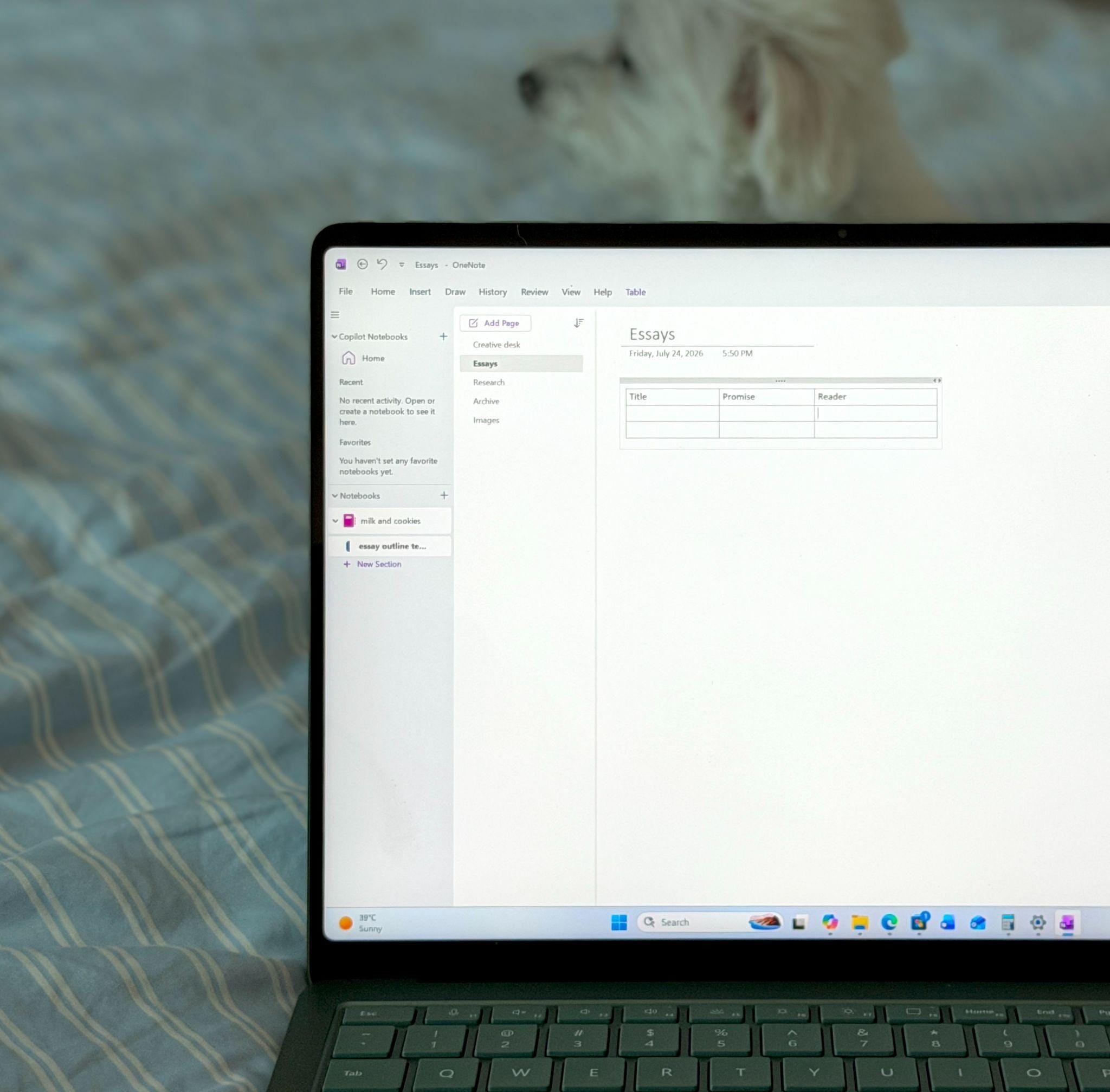
every essay starts messy. i use onenote as a place to collect ideas before they know what they’re trying to become. once enough pieces begin connecting, i move them into word and organise them into the claim-and-proof table you just read about. separating thinking from writing has made the entire process much lighter.
6. i research only after placing a blank inside the argument
research becomes overwhelming when it begins before the writer knows what is missing. an open browser can make every related fact feel necessary.
i draft the argument first and leave square brackets wherever the piece needs support.
[find a study on decision fatigue]
[add an example from a subscriber comment]
[check when this phrase became popular]
once the rough draft exists, i search only for those blanks. each research session has a shopping list instead of an invitation to wander. the process becomes faster and the final essay contains evidence that serves the argument rather than facts included because they were interesting at two in the afternoon.
my rule is that every source must earn its place by doing one of two things: confirming the point or complicating it. information that merely decorates the paragraph gets removed.
the same principle applies to book quotes. a beautiful quotation cannot rescue a section with no original thought beneath it. the quote should open the argument further, not stand there looking intelligent on my behalf.
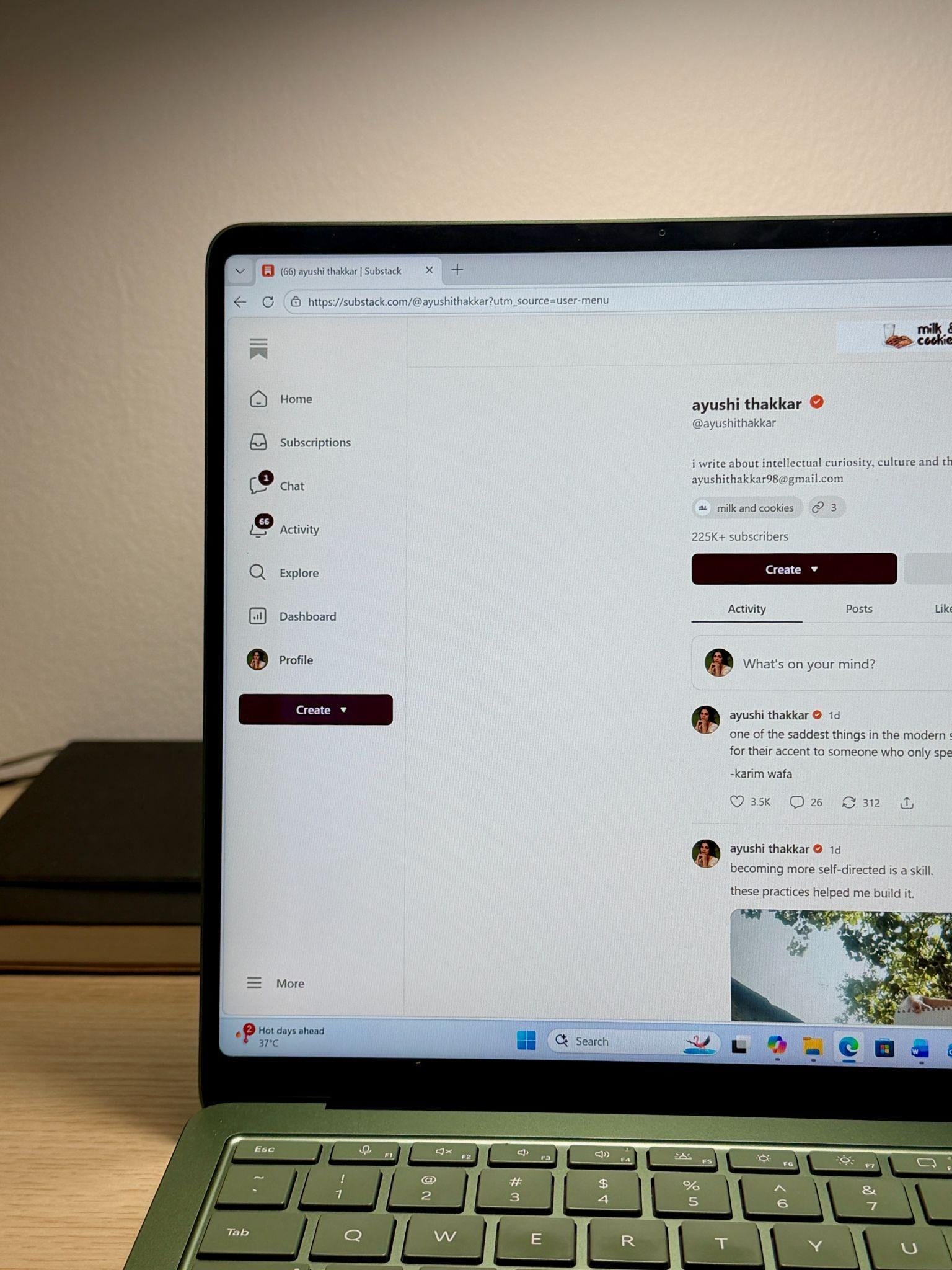
7. i turn subscriber language into a private swipe file
readers often describe their lives with more precision than polished writing advice ever could.
when someone leaves a comment such as “i feel like i spend my whole day recovering from the day,” i save the sentence. i do not copy it into an essay as my own. i study the feeling inside it.
the line reveals a contradiction: recovery has become another form of labour. that contradiction can lead to an entire piece about why rest no longer feels restorative.
my swipe file is organised by emotional theme rather than topic. instead of sections called career or relationships, the headings are feeling behind, wanting to disappear, resenting people you love and trying to become someone else. this makes the document far more useful because people subscribe to have their internal lives understood, not because they require another folder labelled self-improvement.
once a month, i read through the file and highlight any sentence that still creates a physical reaction. those are usually the ideas worth developing.
this practice has shaped creative desk too. creative desk exists for the part of the process readers rarely see: how ideas are found, how the work gets organised and how a vague feeling becomes a piece of writing somebody else can use. the more closely i listen to readers, the more specific that space can become.
8. i edit in passes because editing everything at once is exhausting
editing used to mean rereading the draft repeatedly and changing whatever annoyed me. the process was slow because each paragraph required decisions about argument, rhythm and grammar at the same time.
now i edit in separate passes.
the first pass is structural. i read only the opening sentence of every paragraph and ask whether the argument still makes sense. if the paragraph order feels confusing at this level, prettier sentences will not solve it.
the second pass is for repetition. i search the document for words i tend to overuse and cut ideas that appear twice in different outfits. one of the most useful tricks is searching for phrases such as “this is why” or “the truth is,” since these often reveal places where the essay has started explaining itself too heavily.
the final pass is read aloud. microsoft word’s read aloud feature is useful here because hearing the piece in another voice catches clumsy rhythm and sentences that look elegant while requiring a lung transplant to finish. any section where my attention drifts while listening probably needs shortening.
separating the passes reduces decision fatigue and gives each edit a clear purpose. the work becomes less personal because i am solving one type of problem at a time.

9. i keep a weekly content ledger rather than a rigid calendar a traditional content calendar can become a museum of plans that no longer fit the week.
mine is a simple table with five columns:
idea
status
next action
why it matters now
possible format
the status can only be captured, researching, drafting or ready. “thinking about it” is not allowed because it disguises indecision as progress.
the next-action column must contain something physical. “work on essay” becomes “write the section on reader comments.” “develop idea” becomes “find three examples from the archive.”
the fourth column protects relevance. an idea about creative confidence may matter now because several readers recently asked about beginning a project. an essay about friendship may be better saved for a week when the conversation around the publication already leans in that direction.
the final column prevents every idea from being forced into a full essay. some belong in a note, a creative desk post or a reader discussion. choosing the correct size for an idea has saved me from stretching small observations into exhausted newsletters.
i review this ledger every friday and choose one main piece for the following week. the rest remain available without becoming promises.
10. i end every work session by leaving a handover note
returning to a draft is harder than starting one when the previous session ended without context. the document looks familiar, yet the thought that animated it has disappeared.
before closing word, i leave a note at the top of the draft under a heading called next time.
the note answers four questions:
where did i stop?
what is still weak?
what should i write next?
which decision have i postponed?
an actual note might say:
“the opening works, although section three repeats the same point. move the subscriber example earlier. next, write the paragraph explaining why ambition becomes harder to measure after motherhood. decide whether the ending should return to the opening story.”
this takes two minutes and saves twenty the next morning. the next session begins with instructions written by the person who still remembers the problem.
i sometimes leave the final sentence unfinished as well. an incomplete sentence provides an immediate way back into the rhythm of the piece, which is far kinder than expecting a fresh mind to produce a perfect opening at 9:12 on a tuesday morning.
these systems made the work less dependent on ideal circumstances.
milk & cookies reached more than 200,000 subscribers through thousands of ordinary decisions that readers never saw: saving a useful comment, restoring an earlier version of a paragraph and leaving myself enough context to return the next day. the newsletter grew because the process became sturdy enough to survive interruption.
the most useful creative system is the one that still works when a child needs something, the inbox is full and the available hour has already lost fifteen minutes. a sustainable process does not demand a better life before allowing the work to begin. it knows how to use the life already happening, which is exactly what i have been building around my microsoft surface laptop. have a look here if you want to see the device that has become part of my everyday creative setup.
Comments
Nothing yet. Say the first thing.
Sign in to join the conversation.