
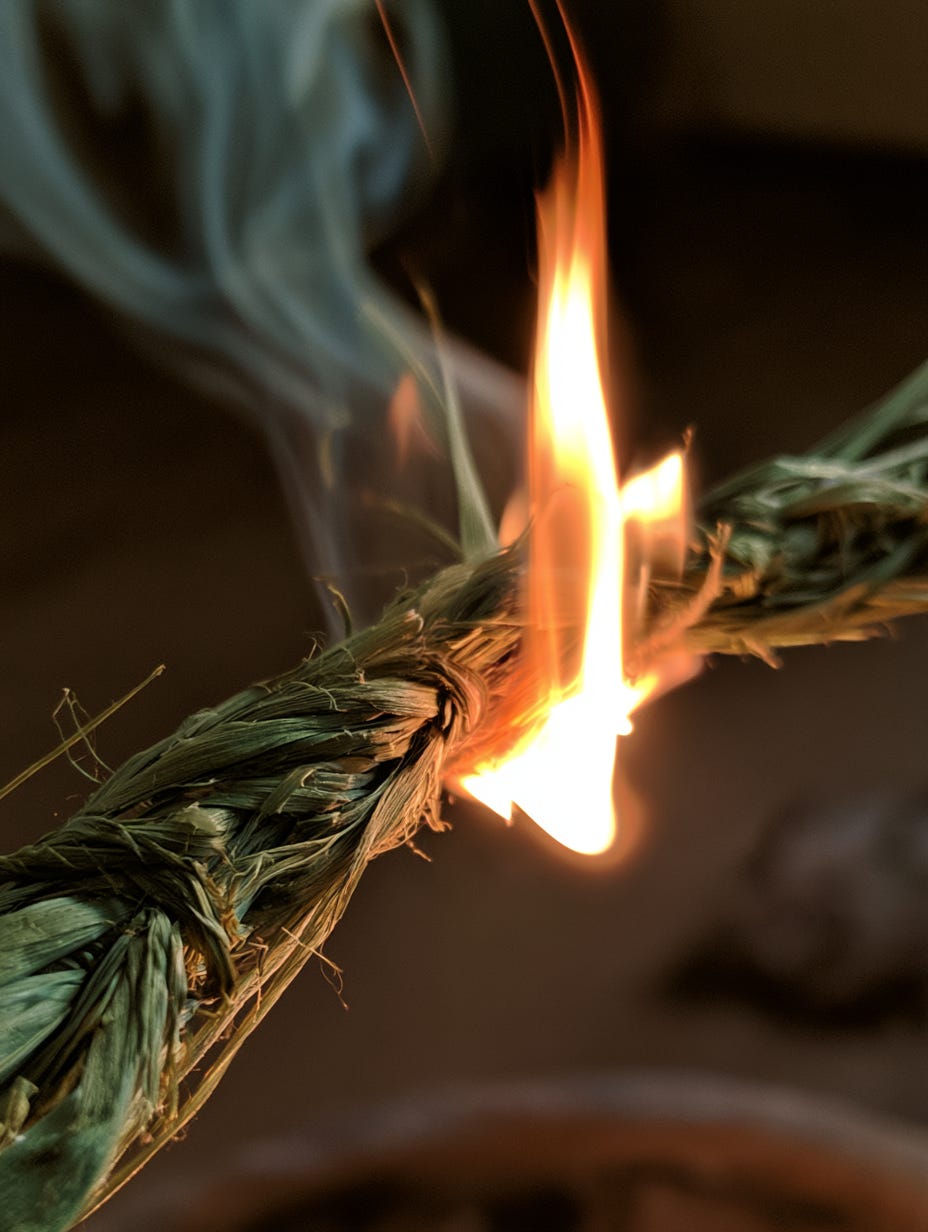
If you spend any time in spiritual or witchy circles, you already know the fight I’m talking about. Someone posts a photo of a white sage bundle and the comments catch fire. Someone asks about palo santo, or the seven chakras, or the phrase “spirit animal,” or whether hoodoo is open to everyone, and within the hour there are two camps, each certain, each furious. Words like “closed practice” and “appropriation” fly back and forth like hexes. People block. People unfollow.
What I almost never see, on either side, is clarity. Why is a practice closed? Who closed it, and what were they protecting it from? Why are some traditions freely given to the whole world while others are held close and fiercely protected? The loudest voices rarely say, and so most of us are left holding a list of rules we don’t understand, enforced by strangers, with no story underneath.
I want to offer what I can of that story. Not because I have perfect answers, but because I believe respect built on understanding lasts, and rules followed out of fear don’t. So this is my attempt to bring some light, and some nuance, to what open and closed actually mean, where those boundaries came from, and how we can participate in this beautiful, borrowed, braided world with integrity.
So let’s step out of the comment section and begin somewhere much older: with hands moving through hair at the close of a day, over and under and over again, three strands becoming one. Whoever first did this is unimaginably far behind us. One of the oldest human faces we have, the Venus of Brassempouy, a sliver of ivory carved some twenty-five thousand years ago, seems to wear a braid. Before we had writing, before we had the wheel, we were weaving each other’s hair.
No one invented the braid, or everyone did. Everywhere we look, in every lineage we can trace, people have braided. It may be our oldest inheritance passed hand to hand: the elder behind, the child in front, the pattern crossing and crossing until it holds.
And into that one shared gesture, every people poured its own meaning. Strands worked with red ochre until they gleam like the earth they came from. Hair wrapped in white wool for ceremony. A ribbon woven in, quietly telling a village that a girl is promised. A parent praying over a child, the prayer moving down through the fingers into the braid itself, so the child carries it all day without knowing.
Same three strands. A thousand different sentences.
That is where I want to begin, because the braid holds, in miniature, the question at the heart of everything I want to say. What do all of us share, simply by being human? And what belongs to a people, made by them, kept by them, paid for by them? What is open to everyone, and what is a door we should knock at softly, or leave in peace?
Braids themselves are not a closed practice. No one needs permission to cross three strands; every lineage on Earth arrived at that gesture on its own, and whoever your ancestors were, braiding is already yours. But a braid is never just a braid. A suku swept up like a crown in Yorubaland was the style of queens, and other named styles marked the priesthoods of the orisa. A Lakota parent braiding a child’s hair is, as Sicangu Lakota writer Wakinyan LaPointe describes it, engaged in prayer: hair as spirit, medicine, memory. Across West Africa, a braided style could tell you a wearer’s people, age, and standing before they said a word. Two braids wrapped and crowned in Ukraine told you a woman was married; a single plait told you she wasn’t. And the Suebian knot told a Roman legionary he was facing a free Germanic warrior.
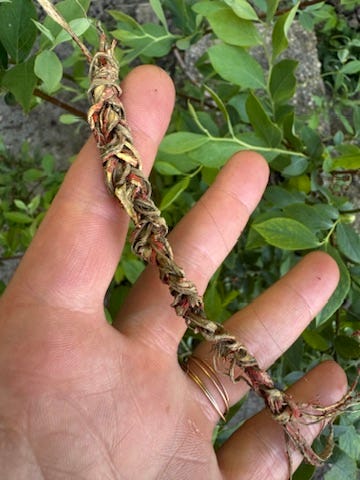
Look across the world and the meanings rhyme, braids marking love, belonging, marriage, mourning, prayer, protection, and yet no two traditions are saying quite the same thing with them. The technique is open. The meanings are particular, and they belong to the people who made them.
That distinction, between a shared human gesture and the sacred language each culture speaks through it, is the heart of the whole conversation about open and closed practices. Everything that follows unfolds from it.
The terms themselves are newer than the traditions they describe. This vocabulary only really crystallized in internet communities over the last fifteen years or so, but it points at something old and real.
An open practice is one you can simply take up. No one gatekeeps it. You can learn it from books, from teachers, from experimentation. Smoke cleansing with rosemary from your garden. Reading tarot. Celebrating the turning of the seasons. Brewing a cup of chamomile with intention.
A closed practice is one you enter through a door, and someone on the inside has to open it. There are actually two different kinds of doors, and conflating them causes most of the confusion:
Closed by initiation. Some traditions are closed the way a mystery school is closed: you may be welcomed regardless of your ancestry, but only through formal initiation, apprenticeship, and community relationship. Haitian Vodou works this way. You become an initiate through the kanzo rite and through years of relationship with a temple community, not through a book. The door exists. It opens. But you cannot climb through the window.
Closed by heritage. Other traditions are bound to a people. They were forged inside a specific historical experience, often an experience of enslavement, colonization, or attempted annihilation, and the ancestors at the center of the practice are that people’s ancestors. Hoodoo is the clearest example, and we’ll get there. Many Native American ceremonial traditions are another.
Here is the thing I most want to say about closed practices, because it sets the frame for everything: practices are almost never closed out of spite. They are closed because of what was done to the people who hold them.
When a practice has been criminalized, mocked, stolen, and sold, when people were starved, jailed, and killed for keeping it, the boundary around it is not a wall built to keep you out. It is protection: the way a people keeps something sacred intact and alive after the world tried to take it from them.
Nearly every culture on Earth discovered that burning sacred plants changes a space. Smoke rises, so we made it carry things: prayers, grief, welcome, protection.
In Mesoamerica, copal has burned since long before Cortés, and it still burns on Día de los Muertos altars, its smoke guiding the beloved dead home. In Southern Africa, imphepho is burned by sangomas to call the ancestors into divination. In India, agarbatti smoke has carried daily puja for centuries. In the Gulf, bakhoor, chips of oud cured in fragrant oils, perfumes homes and guests as an act of hospitality so warm it is practically a language. And in Japan, incense appreciation became Kōdō, the “way of incense,” one of the three classical arts alongside tea and flowers.
Smoke, like the braid, belongs to everyone. Specific smoke does not.
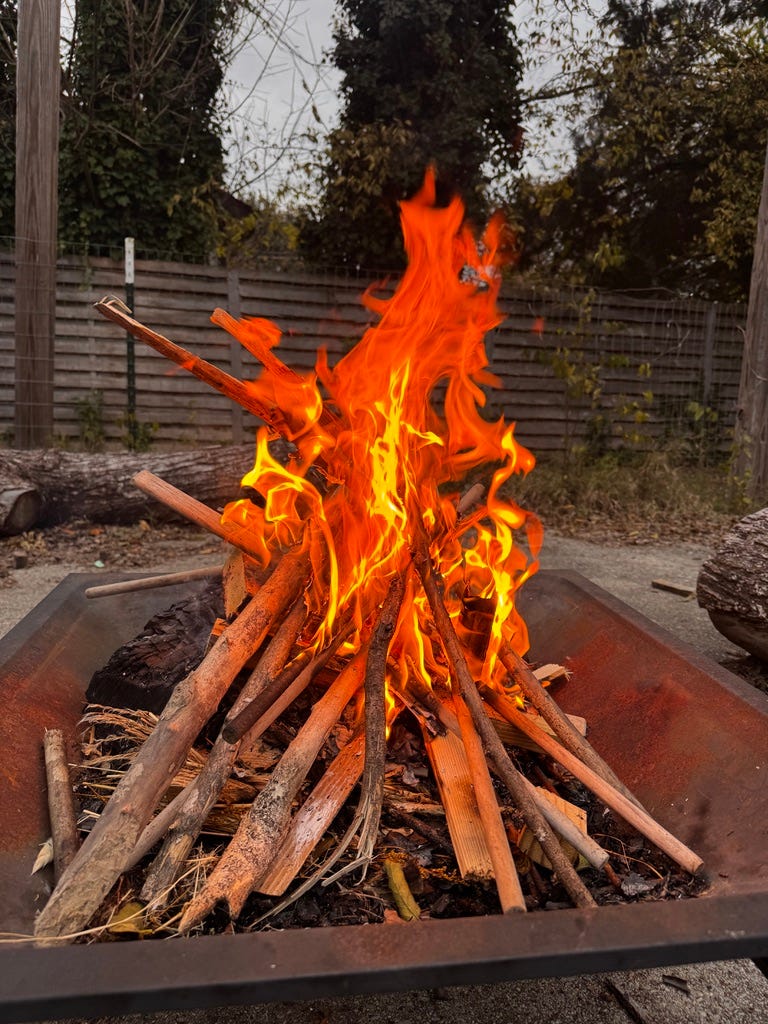
White sage, Salvia apiana, is not a generic herb. It is a specific plant that grows wild in essentially one place on Earth: a narrow band of coastal scrub from around Santa Barbara down into northern Baja California. The nations of that land (Chumash, Tongva, Kumeyaay, Cahuilla, Acjachemen, Luiseño, Pai Pai, and others) have been in relationship with this plant for thousands of years. For the Tongva, that relationship in the Los Angeles Basin runs back some seven thousand years.
“Smudging” is not a synonym for “burning herbs.” In the traditions where the English word is used, it names specific ceremony, often involving one of the four sacred medicines (tobacco, sage, cedar, sweetgrass), an abalone shell, an eagle feather, particular prayers, particular protocols that vary from nation to nation. There is no one universal “Native American smudging ceremony.” There are hundreds of distinct nations, each with its own medicines and ways, and Native writers often remind outsiders not to blur them all into one. Rose Ramirez, a Chumash and Yaqui artist and co-creator of the film Saging the World, points out that the image of Native people constantly waving sage around for “good vibes” is itself a non-Native projection. In many communities, white sage belongs to specific contexts, such as funerals and ceremony, not ambient home décor.
Now the history that most people burning sage in their apartments have never been told. In 1883, the U.S. Department of the Interior enacted the Code of Indian Offenses: administrative policy, enforced by federal Indian agents, that banned Native dances and ceremonies and criminalized the work of medicine people. Punishments included imprisonment and the withholding of food rations. This machinery of suppression, alongside the boarding schools that cut children’s braids and beat their languages out of them, ground on into the 1930s. The United States did not affirmatively commit to protecting Native religious freedom until the American Indian Religious Freedom Act of 1978. Sit with that. People are alive today whose parents and grandparents risked jail and hunger to keep this medicine. The ceremonies that wellness culture now sells as an aesthetic were treated as crimes, and the smoke that families protected in secret for generations is now a lifestyle product on a boutique shelf.
Then the wellness industry turned that medicine into a commodity, in front of the very families who had kept it alive. Wild white sage is now poached by the ton. The California Native Plant Society estimates that the vast majority of commercial white sage is illegally wild-harvested: twenty thousand pounds from one Southern California preserve alone over about five years, rangers confiscating up to a thousand pounds at a time, tons stripped from Kumeyaay and Pai Pai lands in Baja. Poachers typically cut the plants before they flower, which means they never reseed. Roughly half the wild populations have already been lost to development. As Dr. Adrienne Keene (Cherokee Nation) puts it: “That smudge stick represents the deep pain, sacrifice, resistance, and refusal of Native peoples... It’s not about who has the ‘right’ to buy or sell. It’s about power.”
So when Native people ask non-Native people not to buy white sage and not to call what we do “smudging,” they are not overreacting, and they are not gatekeeping for the sake of it. They are asking us to stop participating in the literal and spiritual strip-mining of a medicine their people protected through generations of persecution.
And I want to tell you what the right door looks like, because I have watched it open. My husband recently confirmed that he has Indigenous ancestors, Anishinaabe peoples of Franco- Ontario. Not long after, life brought him a friend: an Indigenous teacher from that tradition. His friend gifted him an abalone shell. He began sharing teachings with him. And he reminded him of something he needed to hear: that he is Indigenous because he carries Indigenous blood, and that belonging does not require him to be one hundred percent of anything. There was so much love and connection in that exchange. Watching it, I felt like I was seeing his soul awaken for the first time, parts of him finally feeling connected to home.
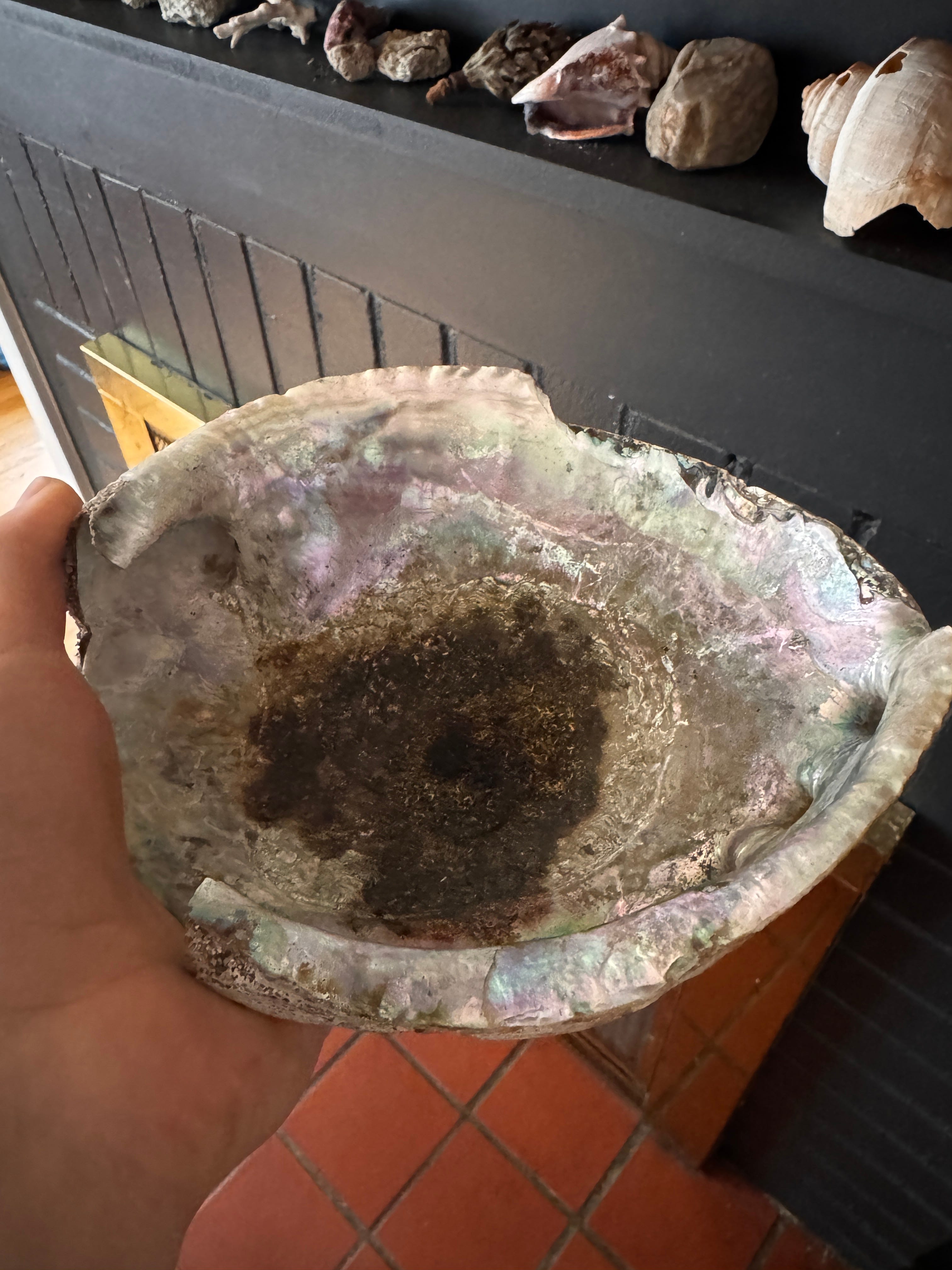
His story holds both kinds of belonging at once. The heritage was already his, carried in his blood and his ancestors. And the welcome came the way it is meant to come, through relationship: a living keeper of the tradition sharing teachings and saying, this is yours, come sit down. That is what a true opening looks like. It cannot be bought from a shop or downloaded from a course. It moves at the speed of relationship, and it is worth every bit of the wait.
The beautiful part: honoring this costs us nothing, because the world is full of smoke that is ours to burn. There are hundreds of sage species. Garden sage (Salvia officinalis), the kind in your kitchen, has its own long European history and can be grown on a windowsill. Rosemary, lavender, thyme, bay, mugwort, juniper, pine, frankincense: all of these carry documented folk-cleansing traditions with no closed door in front of them. (One caution: cedar is often suggested as a “safe swap,” but cedar is itself one of the four sacred medicines. Reaching for it to avoid appropriating sage rather misses the point.)
This is what moves me most. Those of us with European ancestry so often reach for other people’s ceremonies as if our own lineages left us nothing, as if we are spiritually orphaned. We are not.
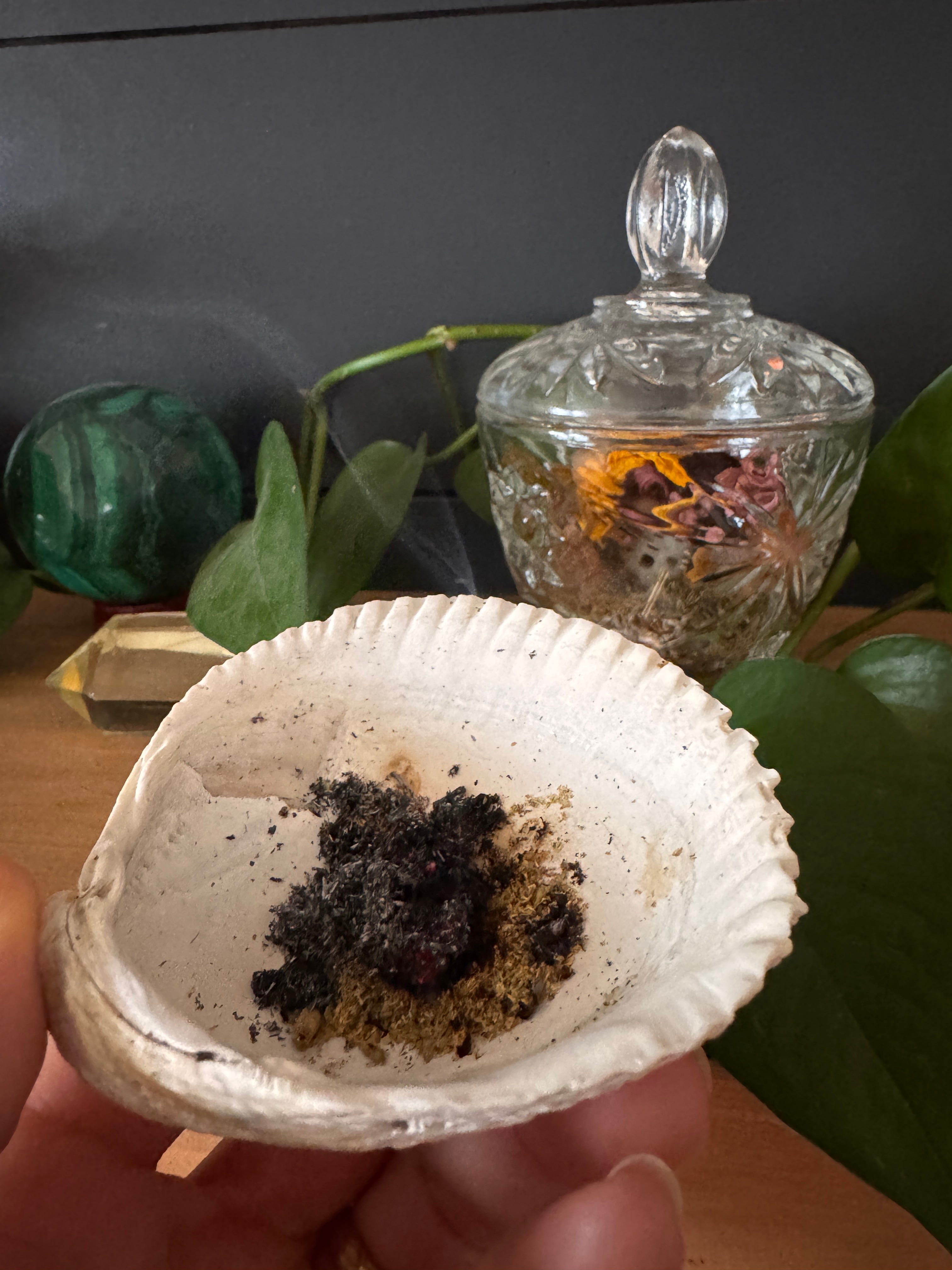
In Scotland, the old word is saining, from the Gaelic sian, a protective charm, and it names a whole tradition of blessing and protection by smoke and water. At Hogmanay, the Scottish New Year, households were sained: water drawn from a “dead and living ford” (a river crossing used by both the living and funeral processions) was sprinkled through the house, and then juniper branches were burned indoors until the rooms filled with smoke and everyone was coughing. At that point every door and window was flung open, and the old year, the old air, the old sorrows went out with it. Folklorists like F. Marian McNeill and Alexander Carmichael recorded these rites a century and more ago.
Today’s saining revival is a reconstruction. The unbroken chain snapped somewhere in the nineteenth century. But it is our thread to pick back up: documented, ancestral, and wide open. When I fill my house with juniper smoke and open the windows, I am not borrowing anyone’s grandmother. I am remembering my own.
Yoga is a practice I have put a great deal of thought and intention behind, because I care deeply about honoring the cultures I learn from and doing no harm to them. I am not Indian, and I hold a 500-hour yoga teacher certification. Holding those two truths together has meant asking hard questions. Long before I wrote this, and long before I ever became a yoga teacher, I went looking for what Indian scholars, teachers, and institutions actually say, not what Instagram says on their behalf.
What I found brought me real clarity. Essentially no significant Indian voice calls yoga a closed practice. It is one of history’s most deliberately opened practices. Swami Vivekananda carried it to Chicago in 1893. Yogananda arrived in 1920. Krishnamacharya’s students, including Iyengar, Pattabhi Jois, and Indra Devi, carried it across the world and built schools to receive Western students. In 2014, India’s own government asked the United Nations to establish an International Day of Yoga, calling yoga “an invaluable gift from our ancient tradition,” and nominated yoga to UNESCO’s list of the intangible cultural heritage of humanity, described in India’s own nomination as a practice for everyone, “regardless of gender, age or social status.” You do not offer your treasure to the whole world and mean “keep out.”
An open door, though, is not the absence of a threshold. The South Asian teachers leading this conversation, like Susanna Barkataki and Arundhati Baitmangalkar, are not asking white teachers to quit. Their asks are specific. Stop erasing where yoga comes from. Stop teaching the postures as if they were the whole tradition; asana is one limb of eight, and Patanjali gives it roughly three sutras out of nearly two hundred. Keep the Sanskrit, the philosophy, and the ethics instead of stripping them out to make yoga “palatable,” and retire “namaste” as a punchline on a tank top. Learn the real history, including the humbling modern history in which the flowing postural yoga most of us teach was substantially synthesized in early twentieth-century Mysore, partly in response to colonialism. As one Indian teacher put it, the remedy for appropriation is not white people leaving the room; it is white people learning what room they are in.
This is how I hold my certification now. Yoga being open does not mean it comes free; it comes with homework. The question was never “am I allowed?” Indian teachers threw those doors open a century ago. The question is whether I am carrying this practice with the depth it deserves, and whether my teaching honors or erases the people who gave it.
If yoga shows us an open practice with obligations, hoodoo shows us why closed-by-heritage practices exist at all.
First, the distinction, because pop culture has smeared these together for a century. Hoodoo, also called conjure or rootwork, is African American folk magic: a system of ancestor veneration, herbal knowledge, and spiritual work, historically practiced alongside Christianity, with no clergy and no formal initiation. Vodou is a religion. Haitian Vodou has priests (oungan and manbo), congregations, a supreme God (Bondye), and the lwa, the spirits who stand between. Vodun is the West African religion of the Fon and Ewe peoples that stands behind it. Louisiana Voodoo is a third, distinct tradition with its own history. They are cousins, not synonyms.
Hoodoo was forged by enslaved West and Central Africans in the American South: Bakongo, Fon, Ewe, Yoruba, and Mande people whose religions were outlawed, who braided what they carried in memory together with the Bible they were handed, the North American plants Native people knew, and whatever else survival required. And it worked as survival. Conjurers made protective charms against enslavers; freedom-seekers used graveyard dirt to throw bloodhounds off their scent; Frederick Douglass himself writes of the protective root the enslaved conjurer Sandy Jenkins gave him. Hoodoo is a Black American sacred tradition in its own right. Not a superstition, not a curiosity.
This is why many Black practitioners today name hoodoo a closed practice: it is ancestral technology. The spirits at its center are the ancestors who created it, people who were enslaved, and whose descendants watched, within two generations of Emancipation, as white-owned pharmacies and mail-order curio companies packaged their tradition into “Fast Luck” candles and sold it back at a profit. Sociologist Katrina Hazzard-Donald calls this “marketeered hoodoo,” and the pattern should sound familiar by now: suppress the practice, punish its keepers, then sell it. When practitioners like Hess Love of the Chesapeake Conjure Society say that “for centuries, white people got to define Hoodoo” and that the pushback is finally here, the boundary being drawn is the same act of protection we saw with white sage.
Vodou’s story adds the other kind of door. It is initiatory. Outsiders have legitimately entered, through years of relationship, through kanzo, through a community choosing to bring them in, but never through a weekend workshop or a book. And this tradition has been viciously slandered. The zombie movies, the pin-stuck dolls, the “devil worship”: that imagery was manufactured almost wholesale during the U.S. occupation of Haiti from 1915 to 1934, when sensationalist books and films like White Zombie turned an Afro-Caribbean religion into a horror trope to justify what was being done to Haitians.
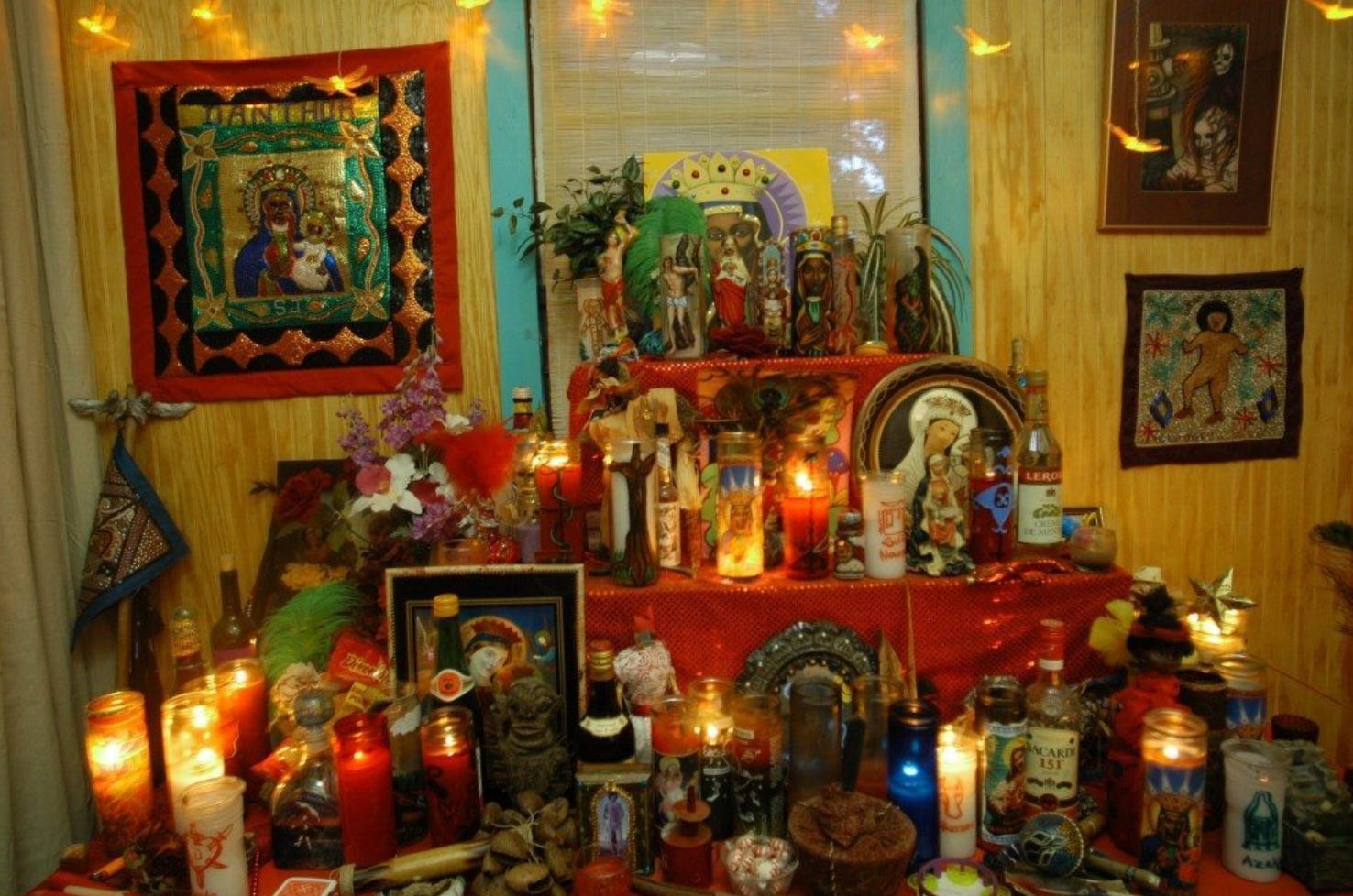
The pin-cursing doll isn’t even African in origin. It descends from European image-magic, the wax and clay figures of the ancient Mediterranean and the poppets of European folk practice, which were used for healing and love at least as often as for harm. Where sacred figures do appear in African and diaspora traditions, they do very different work.
In the Kongo tradition, each nail driven into an nkisi figure sealed an oath or settled a dispute; the figure was a guardian of justice, not an effigy of a victim. In Haiti, dolls are sometimes pinned to trees in cemeteries not to torture anyone but to carry messages to the beloved dead. Hollywood took the European curse doll, dressed it in racist fantasy, and called it voodoo.
Meanwhile, the actual religion helped birth the only successful slave revolution in modern history and wasn’t officially recognized by the Haitian state until 2003. When people treat Vodou as a costume or an aesthetic, they are wearing a century of racist propaganda as an accessory.
Here is the ironic, liberating truth: modern witchcraft is itself a young, hybrid, mostly open tradition, and it is strongest when it’s honest about that.
What most of us practice was not handed down unbroken from paleolithic moon priestesses. It is a patchwork revival, gathered from European folk magic, from old charm and herb lore, and from a great deal of honest modern invention. That is not a weakness. The cunning craft, kitchen witchery, hedge-riding, the folk magic of Cornwall to the Carpathians: this is open ancestral ground, wide and deep enough for many lifetimes.
But precisely because eclectic witchcraft absorbs everything it touches, witches carry particular responsibility for checking what’s in the cauldron. “Spirit animal” is not a personality quiz result; it trivializes specific living Indigenous relationships, and Native-led organizations have plainly asked that the phrase be retired. The rainbow seven-chakra system on the wellness poster is largely a twentieth-century Western construction layered over one sixteenth-century Sanskrit text drawn from a vastly more varied Tantric tradition, worth knowing before we teach it as ancient fact. White sage bundles, “smudge kits,” voodoo-doll aesthetics: we’ve covered what those carry.
None of this diminishes the craft. A witch who knows exactly where each of their tools comes from, who can name their sources the way a good herbalist names their plants, is more powerful, not less. Sloppy provenance is sloppy magic.
You never needed to reach for anyone else’s altar. The most powerful tools a witch carries are the ones no culture can claim, because they were never outside of you: your intuition, your breath, your own guides and ancestors, your quiet knowing.
If you’ve read this far, you can feel that the question was never really “what am I allowed to burn?” The question underneath is: what is my relationship to the things I use, and to the people they come from?
And before you go searching outward at all, I would encourage you to look inside first. Check in with yourself, with your higher self, with your guides and your ancestors, before you go exploring the outside world. So much of the grasping in spiritual spaces comes from believing the answer must live somewhere out there, in someone else’s tradition, when the deepest well you will ever draw from is already within you and behind you. Trust that inner pull first. Then move out into the world with reverence and curiosity.
When you do move outward, this is the practice I’ve arrived at, and the one I offer you. Before bringing something into your spiritual life, sit with it the way you’d sit with any serious relationship. Where does this come from? The real history. Rather than the marketing copy. Is it open, closed by initiation, or closed by heritage, and who says so? (Listen to voices from inside the culture, and notice that “I found it on Etsy” is not a lineage.) If it’s closed by heritage, honor it from the outside: learn its history, tell the truth about it, credit and pay its keepers, defend it when it’s mocked, and don’t take it. That is not exclusion from spirituality; it is spirituality. Reverence for something can look like leaving it where it lives. If it’s closed by initiation and you feel truly called, then the way in is the community’s own door: relationship, time, teachers from within the tradition. Years, not weekends. If it’s open, walk through the door the way a good guest walks through any door: name where it came from, keep its depth intact, and give back to the people who set the table.
And be gentle with yourself as you go, because we will all make mistakes. None of us will ever know everything there is to know, or how to avoid every harm before we understand it. But once we do know better, it becomes essential that we spread the word, gently and clearly. That is how the harm stops traveling from one generation to the next. That is how we help heal generational curses and traumas, both the ones done to our lineages and the ones done by them.
And here is my last word, the one I most want you to carry: you are not spiritually poor. The panic that drives so much taking, the sense that meaning lives only in someone else’s tradition, is itself a wound worth tending. Your ancestors, whoever they were, braided. They burned fragrant plants and opened the windows. They blessed water, baked intention into bread, sang over their children, read the birds and the weather and the dead. Somewhere in your own line there is smoke that belongs to you.
Go find it. Learn its name. And let your neighbor’s fire burn in peace. Or better, stand beside it as an invited guest, and defend it as a friend.
Wherever possible I’ve leaned on voices from inside each culture, on scholars, and on primary records. Where popular claims are contested (and several beloved internet “facts” are), I’ve either flagged them or left them out.
Braids and hair traditions
Wakinyan LaPointe (Sicangu Lakota), on hair, prayer, and healing: Cultural Survival
Hairdressing and hairstyles in Yorubaland: Oriire
A regional history of African hair braiding: OkayAfrica
Ayana Byrd & Lori Tharps, Hair Story: Untangling the Roots of Black Hair in America; Emma Dabiri, Don’t Touch My Hair
White sage, smudging, and the four sacred medicines
“Saging the World,” a film and project by Rose Ramirez, Deborah Small, and the California Native Plant Society: saging the world
White sage conservation and poaching: California Native Plant Society and High Country News
The Code of Indian Offenses and the suppression of Native religions: Native American Rights Fund
The American Indian Religious Freedom Act of 1978: HistoryLink
Dr. Adrienne Keene (Cherokee Nation) and Ruth Hopkins (Dakota/Lakota) on sage and smoke cleansing: Bustle
Smoke traditions around the world
Copal and Día de los Muertos: World Sensorium
Imphepho and its use by Southern African healers: SANBI PlantZAfrica and “Imphepho is not a smudge,” Phytoalchemy
Saining: F. Marian McNeill, The Silver Bough; Alexander Carmichael, Carmina Gadelica
Yoga
Susanna Barkataki, Embrace Yoga’s Roots and “A Letter to All White Yoga Teachers”
Arundhati Baitmangalkar on avoiding appropriation in yoga: Yoga International
South Asian practitioners on Western yoga: Vice
India’s nomination of yoga to UNESCO’s Intangible Cultural Heritage of Humanity: UNESCO
Mark Singleton, Yoga Body: The Origins of Modern Posture Practice (Oxford University Press)
Hoodoo, Vodou, and the “voodoo doll”
Yvonne P. Chireau, Black Magic: Religion and the African American Conjuring Tradition (University of California Press)
Katrina Hazzard-Donald, Mojo Workin’: The Old African American Hoodoo System (University of Illinois Press)
Hess Love of the Chesapeake Conjure Society on hoodoo: Reckon News
Juju Bae, The Book of Juju: Africana Spirituality for Healing, Liberation, and Self-Discovery
Haitian Vodou: Open Encyclopedia of Anthropology
The U.S. occupation of Haiti and the birth of the Hollywood zombie: JSTOR Daily and Museum of the Moving Image
Natalie Armitage on the European origins of the “voodoo doll” myth, in The Materiality of Magic (Oxbow Books); David Frankfurter, “’Voodoo Doll’: Implications and Offense of a Taxonomic Category” (Arethusa, 2020)
Nkisi nkondi figures and their true function: Khan Academy and the Detroit Institute of Arts
Witchcraft and borrowed terms
Cultural appropriation guidance from Native people: Native Governance Center
Christopher Wallis (Sanskritist), “The Real Story on the Chakras”: hareesh.org
If this stirred something ancient in your bones, don’t let it fade.
Subscribe and stay close. This space is for the wild ones, the ones who feel the storm coming and choose to dance in the rain, to light candles when the power structures fail. Each post is a spell, a gathering, a reminder that you are not alone, and that your magic matters now more than ever.
We are building something under the surface. Come be part of it.
Comments
Nothing yet. Say the first thing.
Sign in to join the conversation.