
Read: The Interview
Podshots: This Week on SWAJ
Watch: YouTube Clip of the Week
Network: What’s Happening at Axis Mundi Media
Reasons for Hope
The Spotlight: People, Organizations, and Events You Should Know About
SWAJerati: What We Are Reading
SWAJJER: Discord Comment of the Week
Shoutouts: Welcoming New Members
Read: The Interview (cont.)
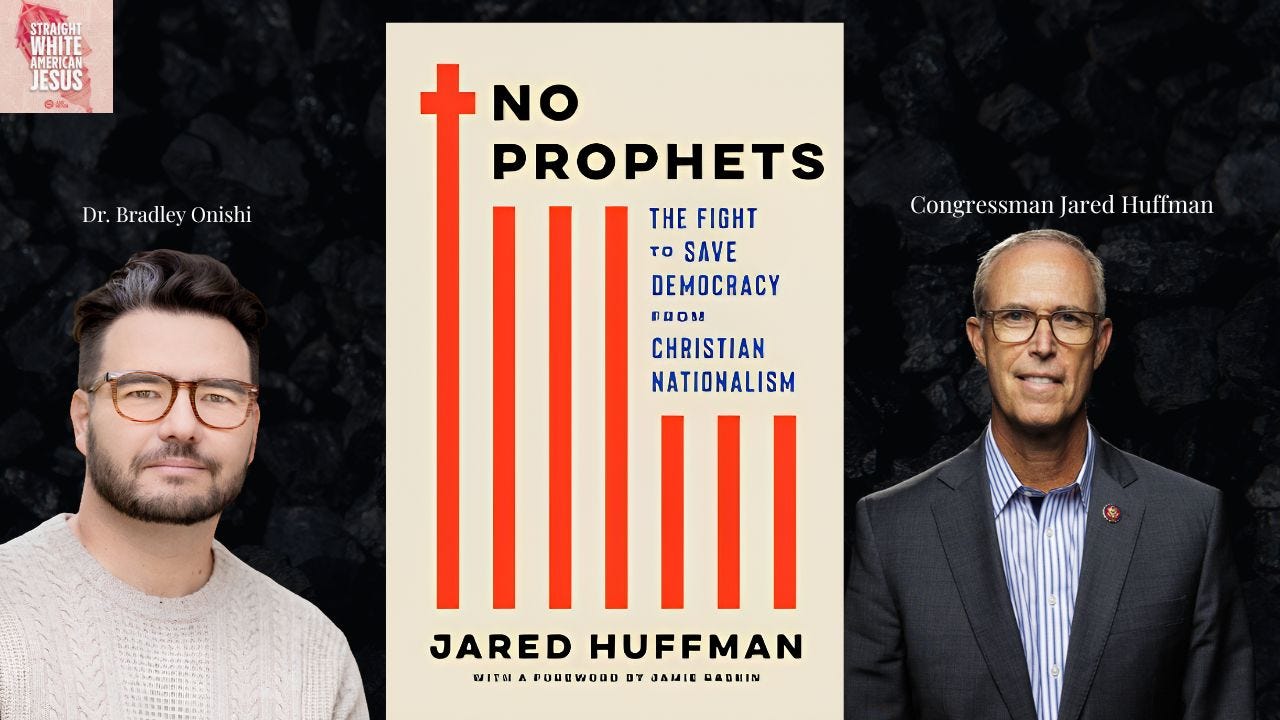
A conversation between Brad Onishi and Congressman Jared Huffman.
Brad Onishi: You’ve written a new book, No Prophets: The Fight to Save Democracy from Christian Nationalism. You’re the only member of Congress who is openly and publicly a non-believer. You’re a humanist, a member of the Free Thought Caucus, and you grew up in Independence, Missouri, as part of an offshoot of the Church of Jesus Christ of Latter-day Saints. Tell us about that.
Huffman: How lucky am I to have grown up in the place where God told Joseph Smith Jr., the prophet and founder of the LDS movement, that that was the original Garden of Eden? My hometown, Independence, Missouri—how lucky am I?
I’m being a little tongue in cheek, but that tells you about where I grew up. It was the world headquarters of an offshoot of Mormonism, the Reorganized Latter-day Saints Church. I was a devout believer in that church throughout my childhood and young adulthood. I left the church and kind of went into spiritual drift that ultimately landed me in humanism. That started while I was at UCSB, when I was about 20 years old.
Onishi: What does it mean for you to be a humanist?
Huffman: I try to make it relatable and simple. It means I believe in pretty much all the same things that you and your listeners do. I just don’t see it from a supernatural perspective.
I don’t believe in any inducement or threat of an afterlife. I don’t believe in any God figure that intervenes or even exists. I think this is all there is. I think it exists for provable, science-based reasons.
But I very much believe in the values that I think we should think of as universal: Let’s love each other and treat each other with respect and be honest and kind, and all that goodness from the Sermon on the Mount.
Onishi: Studying religion at UCSB seems to have led you away from the somewhat fundamentalist upbringing you had, but it didn’t turn you away from religion as such. It opened up the complexity of the human condition.
Huffman: I’m still endlessly curious about religion. I find it fascinating, the way people from these different faith perspectives and from none continue to struggle with the big questions: What does it all mean? Where do I fit into this crazy universe? What do we know and what don’t we know?
I’m not one of these spurned former Christians that had a traumatic experience. For me, the precepts and the doctrines just stopped working. I started asking hard questions that I couldn’t find answers for within the box of revealed religion, at least. So that’s just where I am, but it’s not a hostility in any way.
The Interview continues at the end of the Report…
The Sunday Interview: He’s The Only Nonbeliever in Congress - And He’s Fighting Christian Nationalism
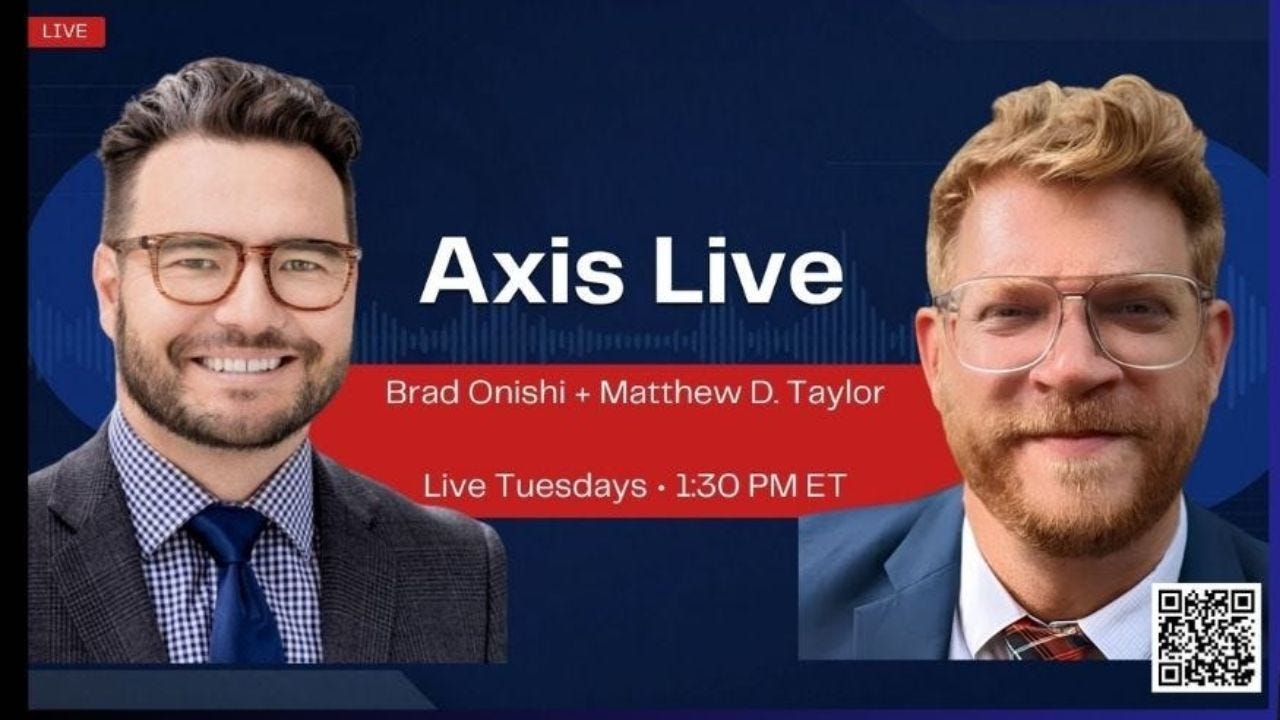
Tuesday: Axis Live - with Brad Onishi and Matthew Taylor
Wednesday: It’s In the Code

Friday: The Weekly Roundup - Live!

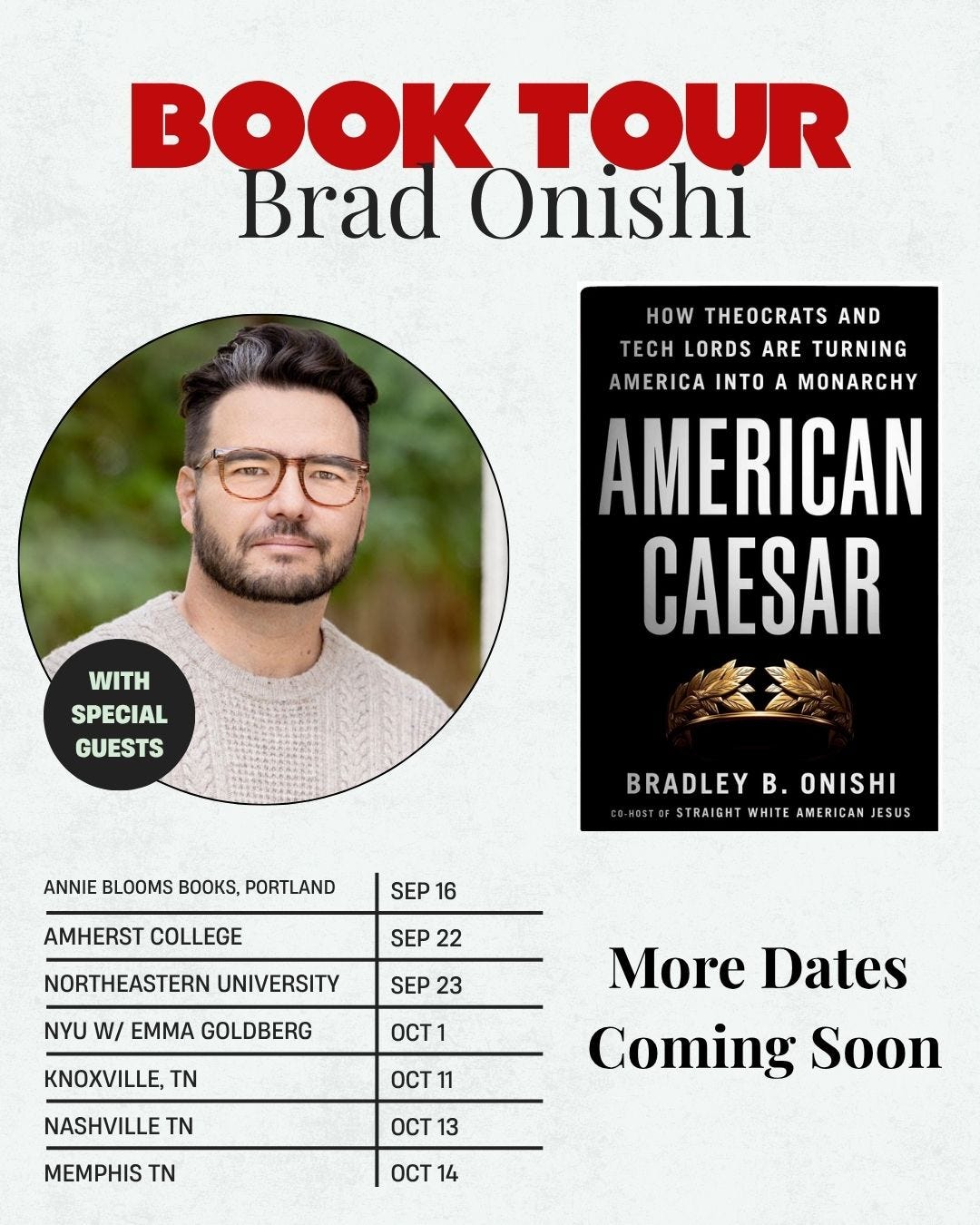
September 16th!
If you can’t make it to the party, order a copy from Annie Bloom’s and it will be signed by Brad!
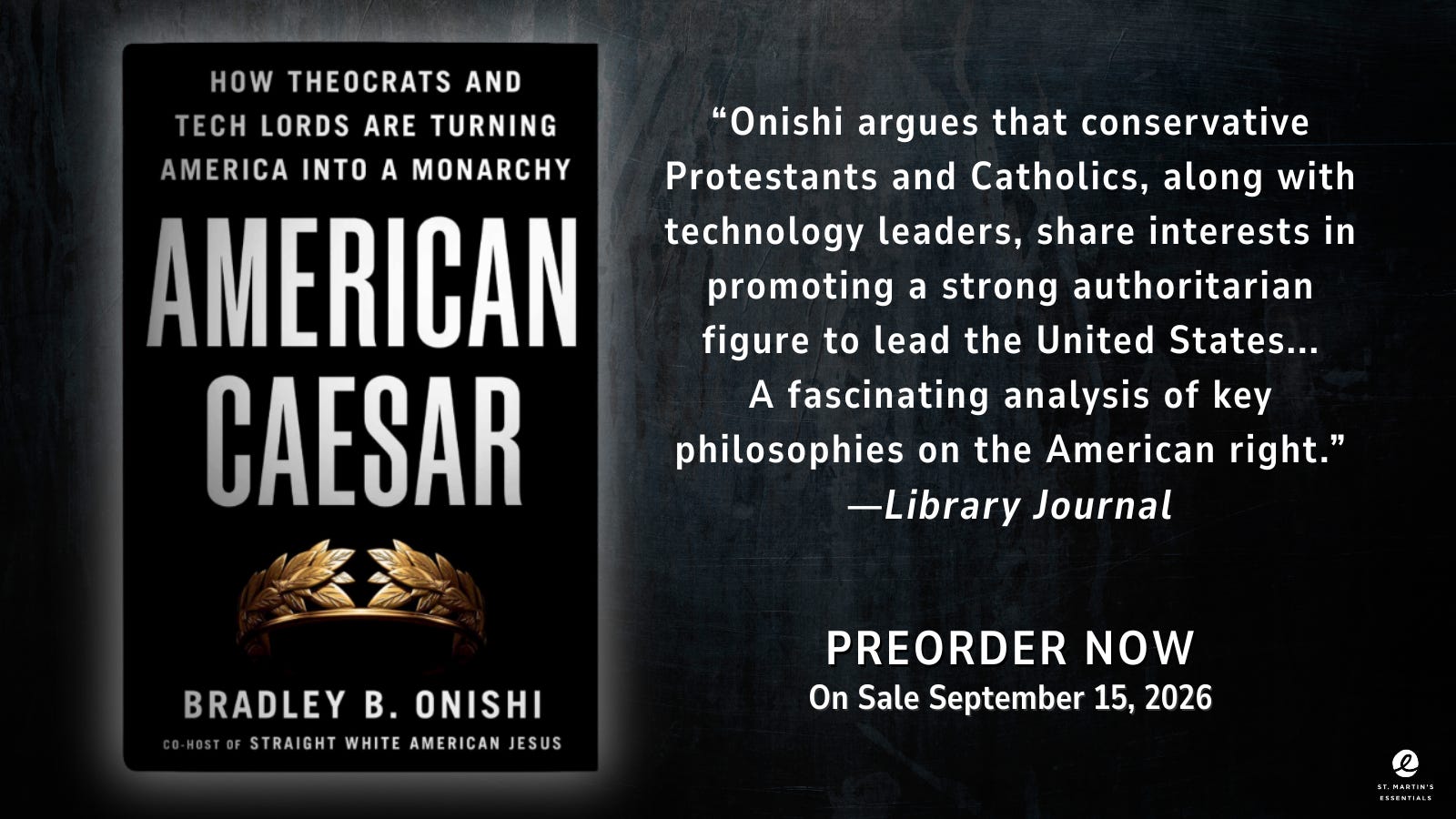

More book tour stops:
“Go Woke, Go Broke” is objectively false. As reported by The Guardian, companies that pushed back against the Trump administration and kept their DEI policies in place did just as well as those that caved under pressure.
Dolly Parton’s Imagination Library is coming to a new state. They have officially partnered with Utah-based nonprofit Operation Literacy to deliver free books to children and help them develop a life-long love of reading.
Polls are showing that James Talarico and Gina Hinojosa both have the potential to win their elections this fall in Texas (a state that hasn’t elected a Democrat to statewide office since 1994).
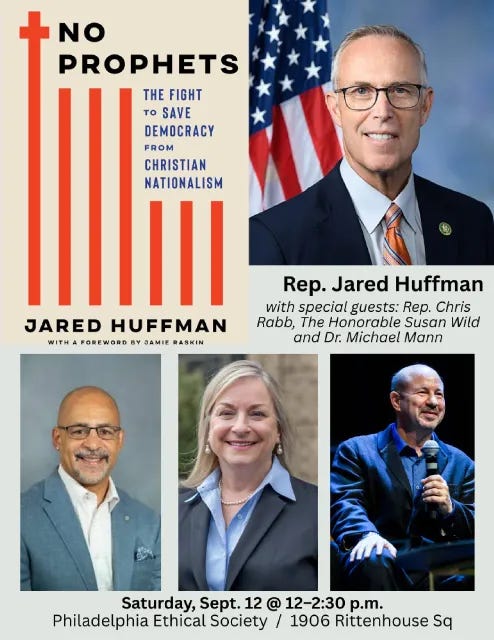
If you live in the Philly area, be sure to join Discord user alexist on September 12 at “Combatting Christian Nationalism in Congress: An Afternoon with Free Thought Champions.” Tickets and additional information are available here.
Be sure to check out Jared Huffman’s No Prophets: The Fight to Save Democracy from Christian Nationalism as well as Brad’s new piece for Rolling Stone: How Saving Western Civilization Became the New MAGA
lelya: The Odyssey was always "woke" by today's standards. In the beginning of the text, the goddess Athena appears to Odysseus' son, Telemachus, as a man. She is in drag, so deep in a masculine role that Telemachus says to "him" - "My dear guest, you speak to me as kindly as a father to his son." (Book I, lines 324-325) Text after Telemachus first meets Athena: Athena's seagrey eyes glinted as she said: "I'll tell you nothing but the unvarnished truth. I am Mentes, son of Anchialus, and proud of it. I am also captain of the seafaring Taphians. I just pulled in with my ship and my crew..." Book I, line 192-196 Here we have a goddess, cross-dressing, advising a young Greek man, passing so well he believes she is an older and wiser man, a captain no less, and friend of Odysseus. Scandalous.
Thank you to Lisa M., Justin G., Sabrina B., and the 5,000+ others who made the switch to Substack with us!
A conversation between Brad Onishi and Congressman Jared Huffman.
Onishi: You write about studying under Walter Capps at UCSB and encountering figures from the New Religious Right. You describe that movement as “not a spiritual revival, but a political machine, one that cloaked its ambitions in scripture and wielded faith for partisan ends.” Why did that strike you so powerfully?
Huffman: I’d spent most of my life at that point within this religious moral framework. I’ll say some nice things about the church that I grew up in: It wasn’t political at all. Nobody talked about abortion or the Supreme Court or any of the nonsense that I was hearing Jerry Falwell talk all about.
That’s what was so jarring for me as I began studying the New Religious Right and hearing this carnival barker Jerry Falwell, just so blatantly political and so judgmental and so absolute. All of it was deeply off-putting to me. I wasn’t a Christian anymore, but I think that was a big part of what was upsetting me.
I was skeptical of religious dogma, but still steeped in the values and sensibilities of my Christian upbringing. The entire performance felt deeply offensive.
Onishi: You were already a non-believer when you entered Congress in 2013, but you weren’t public about it.
Huffman: Totally fair. I had pretty much figured out that I was a humanist, but it’s not something that I had really told my mom directly, who was still very, very religious. It’s not something I’d ever talked about publicly.
I’d served 12 years in local government and six years in the state assembly. Nobody had ever asked me what my religion was. It just didn’t come up. Of course, it was easy to keep that private, and I felt that was probably the smart thing politically to do too.
I was the only member of 535 members of Congress dumb enough to publicly admit that I don’t believe in God. The story tells how I went from sort of closeted in those early days—including my swearing-in, where I had to awkwardly put my hand on a Bible because I just hadn’t thought about what to do in that moment—to later, when Donald Trump’s first term and the platforming and mainstreaming of all of these, I believe, unhinged prophetic Christian extremists became a triggering event for me.
Onishi: How did Trump coming into office lead you to finally say, “Enough’s enough. I am a humanist and let’s talk about it”?
Huffman: I had been in the closet for four years as a member of Congress and planned to just sort of keep it that way. A couple of things happened. My mom died at almost 87. She had a great run, but I no longer needed to worry about upsetting her.
Two, Trump just weaponized Christian nationalism in the most craven ways. I had never seen anything like it.
I was already getting uncomfortable with what I considered encroachment of religion into our nation’s government. Washington is much more compromised in terms of church-state separation than most people understand, far more so than my experience had been in the state legislature.
And then Trump took it to a whole new level with the folks that he platformed and brought in.
I’m an environmental policy guy. That’s why I went to Congress. I work on water and fish and critters and natural systems and climate issues. To watch Scott Pruitt take over at EPA and just start this blitzkrieg of environmental rollbacks and giveaways to polluters, and to justify it all through the dominion mandate of the book of Genesis, at that point it was just really clear: I can’t just stay in my little environmental lane and be closeted and specialized in this moment.
Our democracy, church-state separation, and even my own policy priorities are under attack by these religious extremists. So that was a huge part of what drew me out.
Onishi: You call the book No Profits in part because of your experience with the New Apostolic Reformation and prophetic Christianity. Why is that so dangerous?
Huffman: This subculture of right-wing religion, prophetic Christianity, is the most dangerous and the most volatile. I know that from personal experience because the church I grew up in believed in prophetic Christianity.
We weren’t full-blown Pentecostals—nobody was handling serpents or doing any of that—but there was some speaking in tongues, some glossolalia. There were people who would just stand up and spontaneously say that God was speaking through them. It wasn’t all that uncommon in my youth.
That prophetic belief system is a little bit like a Petri dish for these spin-off prophets that will come along and believe God is talking to them. And if they’ve got a little charisma and can persuade others to follow them, you’re going to have a new church.
One of them popped up, and one of my high school basketball teammates followed this so-called prophet off to Ohio to live communally with others that he had persuaded to follow him. He convinced them to sell all their belongings and get ready to go into the wilderness and build Zion. Before they could do that, he said that God had ordered him to do a blood sacrifice and that this family that had been part of their new sect had to be killed.
My basketball teammate and another kid I grew up with in Independence, Missouri, helped murder this innocent family, believing that God was telling them to do it.
It’s one of many examples that I’ve experienced and I share for why you’ve got to be real careful with this prophetic Christianity. It is volatile stuff.
So back to Paula White and the gang, who I was watching Donald Trump mainstream into the White House—VIP status, laying their hands on him, whispering policy into his ear—that too was hugely triggering for me.
Onishi: When you saw what was happening on January 6, did you detect the religious overtones and spiritual warfare motifs that were at play?
Huffman: I detected some of them. As I thought about it later and learned more, frankly, from you and Matthew Taylor and others who were screaming from the rooftops about all of the religious symbols and religious themes and elements of worship that were all over the insurrection, it became very, very clear to me.
In the moment, that day, I detected aspects of it that most of my colleagues just didn’t see.
I saw the flags. I heard the crazy sound that—I didn’t grow up evangelical, so I didn’t know what a shofar sounds like. But I was hearing this weird sound just ringing from all directions as things sort of ramped up. I later learned that those were shofars. It was a Jericho march underway.
You start out thinking nothing is going to happen because the Capitol is this fortress, where the security is so extreme that nothing could happen. I thought it would just be another protest that is controlled and we will move on with our business.
But when it spun out of control and we literally lost control of the Capitol to the mob, that’s when you start really worrying about Trump. Has he somehow compromised the military or the police? He’s constantly working to co-opt those institutions. So yeah, that got pretty darn scary.
Onishi: One of the most striking parts of the book is your account of the January 6 committee and the decision not to include Christian nationalism in its final report.
Huffman: It wasn’t her and others trying to keep Christian nationalism out of that final report. It was all Liz Cheney. She was the only one.
I talked to my colleagues on the committee, including Adam Kinzinger, and there was a full staff report written by a group called the Purple Team. That included a lot about Christian nationalism because there was a mountain of evidence. The Smithsonian had developed a digital exhibit for all of this religious violence that was part of it. All of that was going to be there. It was in the Purple Team report.
Everybody except Liz Cheney wanted it in the final report.
She put her foot down, and they had to please Liz Cheney because she was the vice chair. She was the only way this committee was going to be able to claim bipartisanship when it rolled out its final report. So she got her way.
Onishi: What did you learn from that about Christian privilege and the limits of what someone like Cheney might be willing to do?
Huffman: It was so cynical and, in that sense, revealing to me. This was a nothing burger: a relic of an oath, obviously illegal, simply taking it out so the witnesses don’t have to do it. It should have been nothing. And they just made such a big deal—they jumped all over the opportunity to grandstand.
Liz did a good thing by standing up to Donald Trump, but she was terrible on Christian nationalism. And she really did the country a grave disservice.
I can’t look into her heart. I can’t say exactly why she did this. Was it her cultural blind spot to Christian nationalism? Or some might say she wanted to run for president of the United States at that time. And yeah, you’ve got to win the Republican nomination. You’d better not pick a fight with right-wing Christianity.
Onishi: What does Mike Johnson represent to you in terms of his power in our country and his religious zealotry?
Huffman: What you should know is just how extreme Mike Johnson is. He spent his whole career deeply embedded in the most extreme groups and factions within this Christian nationalist movement. He’s a true believer.
This is a guy who, in any normal world, could never have been Speaker of the House. He would have been vetted. There would have been scrutiny. The public would have started to dig into his wildly extreme past and his crazy personal beliefs. And he never would have made the cut.
But because Kevin McCarthy had been dumped as speaker and we went over a month with no one in the speaker’s chair, at the last second, by default, the Republicans quickly voted in Mike Johnson. He sort of sailed in and became the accidental speaker.
I think that tells you we missed an opportunity to do some serious vetting, but it also tells you that he had the votes. It tells you how normalized and mainstream this very, very religious Christian nationalism and extremism has become within Republican politics.
Onishi: You’ve said that separation of church and state is more compromised in Congress than you experienced in the California legislature. What does that look like?
Huffman: I can give you a little bit of that in a person, and his name is Ralph Drollinger.
He’s an extremist, a right-wing pastor who started out in California when I was in the state legislature. He had a group called Capital Ministries. They were making their rounds back in 2006 through 2012. I met with him in my office and heard him out.
It didn’t take long into the conversation to figure out that this guy’s an extremist and he is trying to suggest to people in public office that they have to do their job in strict accordance with his notions of the Bible and biblical morality.
He was bounced out of California and moved to other states, but then really started revving things up in Washington with a Bible study in the House, then one in the Senate, and then one in the White House.
Fast-forward to today, Ralph Drollinger’s Capital Ministries operation is huge. They’ve got dozens of members of the Trump administration once a week in Bible studies led by Russell Vought, and Pete Hegseth is a co-sponsor. You’ve got all of these Christian nationalist power players sitting in with Ralph Drollinger while he tells them what God wants them to do with their power.
He does the same thing in the House. Dozens of members go to his Bible study. He does the same thing in the Senate.
If you really want to see behind the theocratic curtain at what they’re being told they should do with their power, Ralph Drollinger puts it online. He’s got all his Bible studies on his website. You can see how he makes these arguments that this biblical passage requires you to deregulate industry, this biblical passage requires you to take away women’s rights, or provide absolutist support to Israel no matter what they do.
It’s all right there. That’s a pretty good example of just how compromised the wall of separation between church and state is in Washington right now.
Onishi: Why is Christian Zionism such an important movement to address right now?
Huffman: I think for two reasons.
One, it’s about as glaring an example as you will find of “Bible as policy.” We have a secular government where decisions and policies, especially on foreign policy and national security, are supposed to be made through very rational and fact-based, careful process about our actual interests. Christian Zionism brings a whole bunch of wild biblical prophecies into foreign policy. It’s had enormous influence, and it does right now to this day.
Second, it is this rumbling fault line in the MAGA coalition. For a long time, absolutist support of Israel, no matter what Israel does, was sort of an article of faith for most because that is the ethos of white evangelicals who are steeped in Christian Zionism.
The other two ascendant subcultures, the traditionalist Catholics and the Reconstructionists, or Theobros, aren’t so keen on Israel or Jews. They’re, in fact, pretty anti-Semitic, but they didn’t assert themselves.
I think the last couple of years have really changed that with Gaza and with some other things where you’ve seen Republicans start to question. It’s also changed within white evangelical circles, where younger people no longer buy into the religious doctrine of Christian Zionism.
So we’ve got to unpack this and understand it. It’s relevant to our foreign policy. It’s relevant to church-state separation. And it’s relevant to this unraveling, potentially, politics of the MAGA coalition.
Onishi: How do we have hope in this age? How do we look at our little kids and hope for a world that will make sense for them?
Huffman: I’m a lousy guy to talk about hope because I am a stoic. I don’t want to sugarcoat how bad this is right now. It’s really bad.
I share examples from Antonio Gramsci, a figure in the Italian resistance to Mussolini, who famously wrote about “pessimism of the intellect, but optimism of the will.”
I’ve always thought that’s a neat way to look at it because I don’t want to sugarcoat how bad this is right now. Pessimism of the intellect would get you to that conclusion, but we’re certainly not going to let it win. And that’s where the optimism of the will comes in.
I am just a firm believer we’ve got to power through this and win.
If we do, there’s plenty of rays of hope out there for those that want to look for them. I think the Christians who are speaking out against Christian nationalism are a very hopeful development and a pretty recent one, frankly.
My big takeaway in the book is, as much as I’m rooting for the good Christians to kind of win the struggle for the integrity of their faith, they can’t do this alone. This movement is too big. It’s too far along. And, by the way, you’ve got a third of the American people over here on the sidelines that are non-religious. You’re going to kind of need them in the fight too.
Let’s remember that this is about more than a theological debate about whether Christian nationalism is right with the gospel. You guys work that out and tell me when you’re done, but we have to save democracy together. And that is the biggest thing in my view.
Onishi: I love that, because it takes a coalition of people—secular and religious, Christian and Muslim and Buddhist, humanist and agnostic. This is about fighting for a system where we share power rather than allowing a few, or one, to take all the power and impose their will on us.
Huffman: That’s right.
Onishi: There’s no chance I’m going to give up.
Huffman: That’s right.
Onishi: No Profits: The Fight to Save Democracy from Christian Nationalism is available now.
The Interview has been edited for length and clarity.
No posts
Comments
Nothing yet. Say the first thing.
Sign in to join the conversation.