
Often, words don’t come out like I want them to, the way I’ve dreamed them in my head. But giving birth to a fully formed thought takes patience and discipline. And there’s a necessary period of gestation that must take place after conception. But often, the fault of many amateur writers, myself included, is that we seek only to copulate with an idea, to look for satisfaction in a session, or maybe a few, until the sultriness of the idea no longer attracts us. Certainly, there is an allure to this hedonistic approach to writing (which is less of an approach, and more of a default-mode-of-settling). But it doesn’t usually translate to great literature.
There is a great disconnect between the grand emotion a writer feels and what’s recorded on the page. The mark of an ineffective writer, in my opinion, is in failing to manifest the illuminated state of the speaker for the person listening. This is only true for certain types of literature however. Specifically, personal essayists and auto-fiction writers, regarding themselves as the central voice, and assuming the desire to express oneself creatively, intellectually, or emotionally as the primary pursuit, barring any type of writing whose goal is to articulate an objective state, and not the subjective experience.
You see this failure more often than not in the type of poetry you see on social media, or in the kinds of books that line the shelves of contemporary poetry sections at popular book chains: a vain self expression in the form of flat words, cliched verses, and an over-simplified use of language that fails to arouse imagination.
So, what does a writer need to do in order to successfully transcribe this elusive, phantasmic spirit which lifts them to an elevated state, or that terrible demon, which, gnawing at their guts, drags their consciousness through the seven layers of hell?
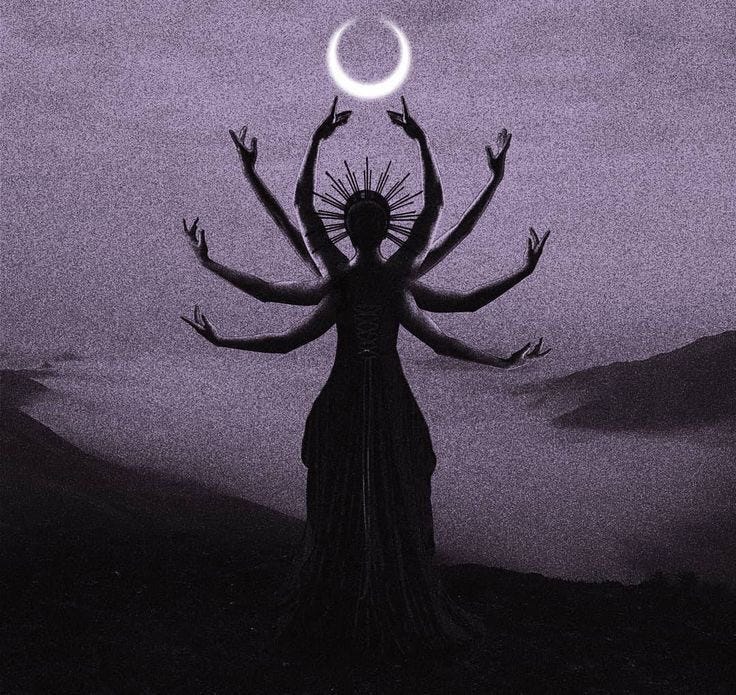
Firstly, the writer must become like a shaman, allowing things of unknown nature to overtake them, to open the gates of the psyche, to explore the extreme ends of the emotional spectrum, and of life. Of love, and pain, and things of virtue, and immorality. They must become like a sponge — porous and absorbent, unquestioning what it is they’re consuming and just taking the ride.
And yet, they must too be like a scientist, meticulously decoding the shamanic trance, and organizing it in a way that can be understood and experienced by the observer.
All writers, good or bad, are shamans to a certain degree. But what are the requirements of the reader to reach the state of the shaman? The reader requires discipline too, but also with varying degrees.
At first, when I started writing this, I had it in my mind that certain types of literature, like the Rupi Kaur style of poetry I previously mentioned, fail to capture the subjective state of the writer for the person reading. And that, if all writing with the goal of self-expression, not storytelling, aims to imitate and project the subjective experience of the emotion onto the reader, that it would be impossible to do so with such dead delivery and un-original language. But I’ve now come to the understanding that if all writers are shamanic in nature, that there is a spectrum to that nature; a hierarchy.
At its essence, a person can neither understand what is above them or below them.
For the person who doesn’t read or care for poetry or literature (large swaths of the population), they are blind to the language of even the most accessible voices. The readers of the contemporary poetry books therefore, in my estimation, have an elevated sense of that creative spirit; they are open to the trance from which the shaman speaks, where the pragmatic and utilitarian minded see the shaman as a false prophet; a crazy person under the influence of delusion and grandiosity. For this kind of person, depending on your perspective, it is possible to debate whether they are above or below the ability to see the merits of literary art, and if you’ve read this far already, we are probably in agreement with the latter.
But just as the philistine who cares not for literature, there is a ceiling also for the consumers of this mainstream brand of poetry (which can be overcome). Just as there is a ceiling for anyone, and myself, for example, with certain writers I’ve failed to grasp, who I deem to be above my current level of understanding. I’m blind to the merit of what I consider to be hack poetry, just as I am to that which is over my head. Therefore, for a shaman to truly translate their experience into words, the observer has to meet the shaman where they’re at. And for the reader to have a truly profound experience, which is to either hear something they haven’t heard before that arouses their spirit, or to resonate deeply with something they were not able to articulate for themselves, they have to be willing and courageous enough to listen to the man on the hill. Reading is a discipline in itself. Sometimes it’s easy. Sometimes it’s difficult. But for the writer, the more time they spend organizing their thoughts, instead of spending all their time in trance, only copulating with an idea, the more effective shaman they will be. And to the reader, the more they allow themselves to be open to seduction, especially by that which is difficult, the greater their pleasure will be.
But then again, you probably shouldn’t listen to me, as I wrote this in a moment of lusty impulse, setting it aside after I reached the first climax, like a lazy literary libertine, copulating, then immediately falling asleep.
Maybe it means that I’m wrong. Maybe I’m a hypocrite. Maybe it doesn’t mean anything at all.
I may be deaf to even my own voice, but I’m on my way now too, mapless and hungry, off to seek the man on the hill.
Comments
Nothing yet. Say the first thing.
Sign in to join the conversation.