
Leaving your apartment for the first time after writing all morning and day feels like being born again. If it went well, everything is fresh and beautiful and people are lovely, and the weather, regardless of what it is, is acceptable and pure because nature is pure and the buildings once gray and monotonous take on more classical shapes and vivid colors and you’re at peace for once with the state of things and with yourself.
When you’re young, you tend to have a fixed identity. You’re pulled toward the current of separation, to which youth is especially susceptible, and one that many never outgrow:
this is the music I like, my fashion style, my politics, etc. All shorthands for identity, like clothing, meant to conceal the fluidity of nakedness, and the shame that nakedness brings.
We validate these symbols of unconscious intent by surrounding ourselves with mirrors: people who reinforce the illusion, narrowing our vision of the world.
All art is an expression of repression. You can tell a lot about what an artist is not and what they wish to be by knowing their art.
The internet, having formerly been an extension of the physical realm, has become inverted: the physical now an extension of the synthetic realm.
Early internet: gathering in chatrooms with IRL friends. Downloading music from artists whose CD’s you already owned. Reading excerpts of books you’d already known about and wanted to buy.
Modern internet: Meeting IRL your online friends. Attending a concert of a band you found on Spotify. Buying a paperback of a novel you heard about on Substack.
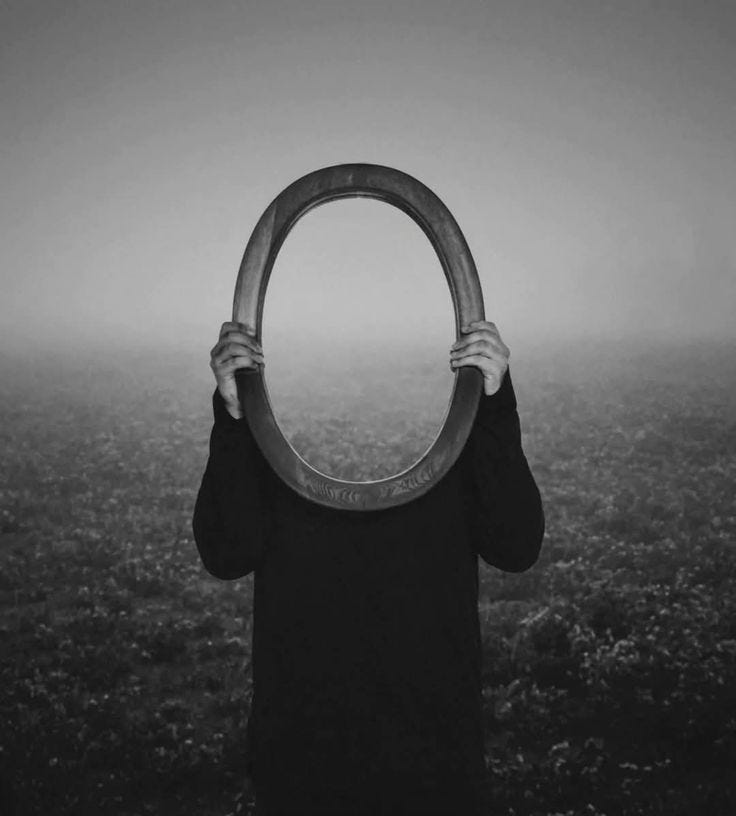
Social media is a stage. Organic dialogue can’t develop, because every exchange takes place under the gaze of an actor looking for applause.
You have to, for a period of time, become anti-social to create something truly profound. That is why we lack such great contemporary art. The importance placed on networking, on social media, on constant visibility, makes temporary isolation almost impossible, or at least deeply de-incentivized.
Those who are locked away creating masterpieces are not immediately visible.
The most common frame for escaping the present is to look toward the future. But, for those who realize the future is bleak, the past is their only outlet of relief.
Lately, I find myself slipping into irony and cynicism as primary forms of self-expression, as an assimilation of what goes on around me, and in reflection I feel a deep sense of self-betrayal for it.
Sincerity and optimism are not traits exclusive to naivety and anti-intellectualism. There is a willful path that can be held in balance with both realism and intellectual thought.
The “intellectual” often becomes a figure of detached analysis rather than lived experience. The intellectual is, by definition, a man who takes no real part in the world, but who watches it, studies it, judges it. A symptom of spiritual decay, emotional constipation, losing touch with the mysteries of existence, with sexuality, with God. A man afraid of life’s chaos.
The vitalist, by contrast, favors instinct, intuition, and experience over cold logic. He sees wisdom not in theorizing from an armchair, but in the act of living fully.
[note to self]
— Simplify yourself, your thoughts, your emotions. Seek out that which is unknowing and naive. Explore it with a now older, more learned eye. It’s time to return to the cradle of youth. To rapture.
Good or bad, it is better for someone to have a strong opinion about you as an artist than to have no opinion at all.
Great art creates more questions than it answers.
Exodus
Text within this block will maintain its original spacing when published
Youth is no Lazarus rising from the dead.
It is Moses parting the Red Sea,
leading us unknowingly,
to the promised land.
And there,
in paradise,
with roots planted,
the fruits become bitter.
Comments
Nothing yet. Say the first thing.
Sign in to join the conversation.