
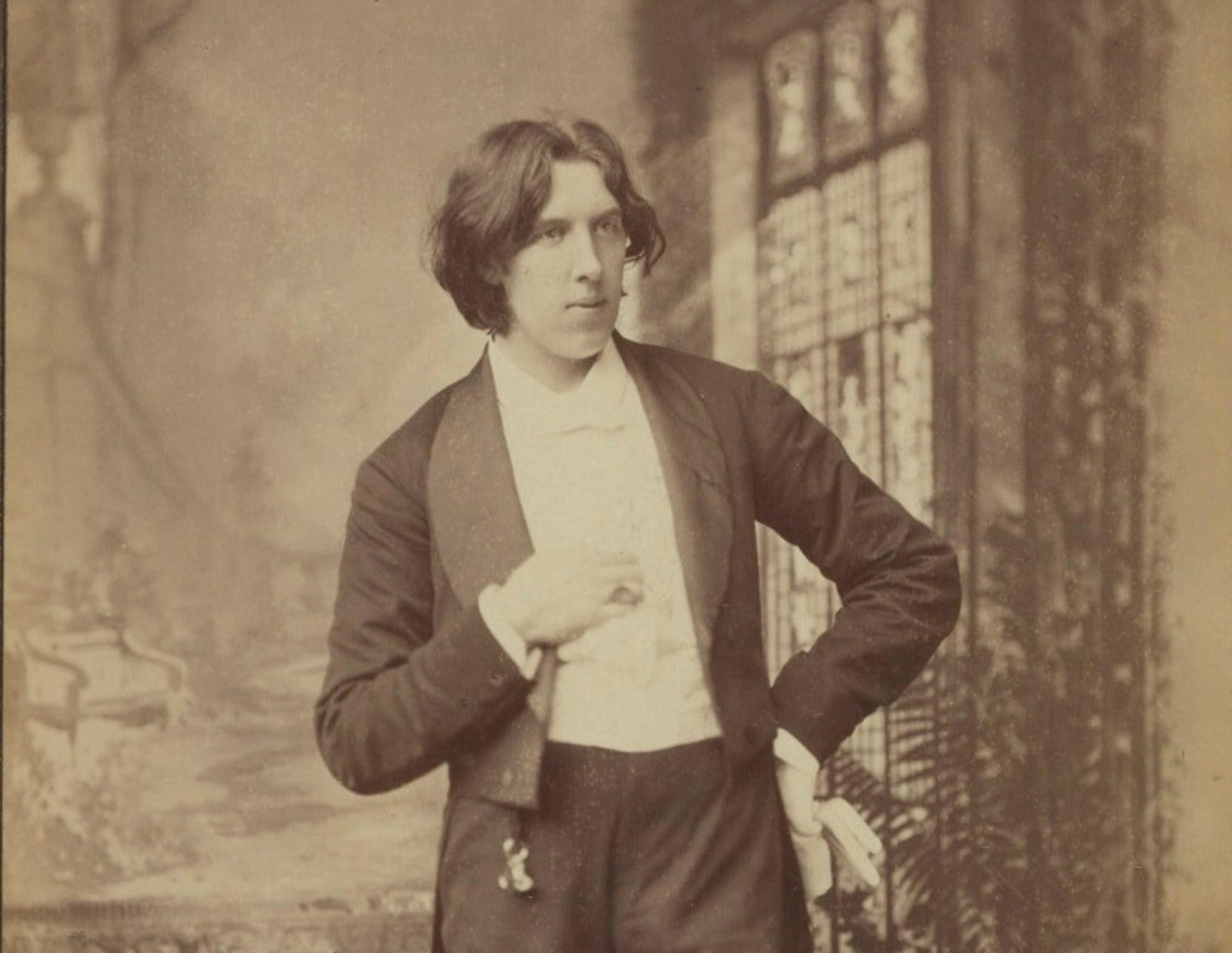
Oscar Wilde wrote a very fun essay on Zhuangzi, or “Chuang-Tsu” as it was spelled in the old Wade-Giles romanization (either way, Wilde is right to say his “name must carefully be pronounced as it is not written”).
Wilde wrote the essay in 1890, when an English translation of the whole book appeared by Herbert Giles himself. Giles’s translation immeasurably enriched the Anglo literary universe, although it also entrenched certain misunderstandings that then carried over into translations in other European languages and remain with us to this day.
Some of my favourite passages from Wilde’s essay:
[P]ortraits of the wonderful sage seated on the flying dragon of contemplation may still be found on the simple tea-trays and pleasing screens of many of our most respectable suburban households. The honest ratepayer and his healthy family have no doubt often mocked at the dome-like forehead of the philosopher, and laughed over the strange perspective of the landscape that lies beneath him. If they really knew who he was, they would tremble.
[I like this, partly because it is an obvious echo of one of the first stories in the Zhuangzi, where the cicada and turtle dove mock the great bird Peng, who soars above them.]
He pities the rich more than the poor, if he ever pities at all, and prosperity seems to him as tragic as a thing as suffering. He has nothing of the modern sympathy with failures, nor does he propose that the prizes should always be given on moral grounds to those who come last in the race. It is the race itself that he objects to; and as for active sympathy, which has become the profession of so many worth people in our own day, he thinks that trying to make others good is as silly an occupation as “beating a drum in a forest in order to find a fugitive”. It is a mere waste of energy. That is all. While as for a thoroughly sympathetic man, he is, in the eyes of Chuang Tsu, simply a man who is always trying to be somebody else, and so misses the only possible excuse for his own existence.
All modes of government are wrong. They are unscientific, because they seek to alter the natural environment of man; they are immoral because, by interfering with the individual, they produce the most aggressive forms of egotism; they are ignorant, because they try to spread education; they are self-destructive, because they engender anarchy.
The age is rotten with its worship of success. As for education, true wisdom can neither be learnt nor taught. It is a spiritual state, to which he who lives in harmony with nature attains. Knowledge is shallow if we compare it with the extent of the unknown, and only the unknowable is of value. Society produces rogues, and education makes one rogue cleverer than another. That is the only result of School Boards. Besides, of what possible philosophic importance can education be, when it serves simply to make each man differ from his neighbour? We arrive ultimately at a chaos of opinions, doubt everything, and fall into the vulgar habit of arguing; and it is only the intellectually lost who ever argue [my emphasis ;)]
Who, then, according to Chuang Tzu, is the perfect man? And what is his manner of life? The perfect man does nothing beyond gazing at the universe. He adopts no absolute position. ‘In motion, he is like water. At rest, he is like a mirror. And, like Echo, he answers only when he is called upon.’ He lets externals take care of themselves. Nothing material injures him; nothing spiritual punishes him. His mental equilibrium gives him the empire of the world. He is never the slave of objective existences. He knows that, ‘just as the best language is that which is never spoken, so the best action is that which is never done.’ He is passive, and accepts the laws of life. He rests in inactivity, and sees the world become virtuous of itself. He does not try to ‘bring about his own good deeds.’ He never wastes himself on effort. He is not troubled about moral distinctions. He knows that things are what they are, and that their consequences will be what they will be. His mind is the ‘speculum of creation,’ and he is ever at peace.
All this is of course excessively dangerous, but we must remember that Chuang Tzu lived more than two thousand years ago, and never had the opportunity of seeing our unrivalled civilization. And yet it is possible that, were he to come back to earth and visit us, he might have something to say to Mr. Balfour about his coercion and active misgovernment in Ireland; he might smile at some of our philanthropic ardours, and shake his head over many of our organized charities; the School Board might not impress him, nor our race for wealth stir his admiration; he might wonder at our ideals, and grow sad over what we have realized. Perhaps it is well that Chuang Tzu cannot return.
It seems to me that if we once admitted the force of any one of Chuang Tzu’s destructive criticisms we should have to put some check on our national habit of self-glorification; and the only thing that ever consoles man for the stupid things he does is the praise he always gives himself for doing them. There may, however, be a few who have grown wearied of that strange modern tendency that sets enthusiasm to do the work of the intellect. To these, and such as these, Chuang Tzu will be welcome. But let them only read him. Let them not talk about him. He would be disturbing at dinner-parties, and impossible at afternoon teas, and his whole life was a protest against platform speaking. ‘The perfect man ignores self; the divine man ignores action; the true sage ignores reputation.’ These are the principles of Chuang Tzu.
No posts
Comments
Nothing yet. Say the first thing.
Sign in to join the conversation.