
Moral abolitionism is on the rise, at least according to Stephen G. Morris’s interesting book.1 It is the view that we would be better off, in terms of overall wellbeing, if we gave up all our moral beliefs: that is, all our beliefs about people being morally good or bad and actions being morally right or wrong.
Contrary to the dogma that morality makes us more compassionate and less prone to attacking and exploiting each other, moral abolitionism claims that moral beliefs play a major role in causing humans to act with violence and cruelty towards each other. Giving up all our moral beliefs (supposing that we could) would make us kinder and more cooperative, which would in turn help us to solve many of our biggest problems by working together.
Virtuous Violence, by Alan Page Fiske and Tage Shakti Rai, gives many examples where even acts of violence whose motivations might initially seem purely selfish or impulsive (e.g. domestic violence) are experienced by the perpetrators as discharging some kind of moral duty (e.g. the duty to maintain the appropriate hierarchy within a household). Similar findings appear in Roy Baumeister’s Evil: Inside Human Violence and Cruelty.
Moral abolitionists draw from this the possibility that if we didn’t feel morally obligated to do anything—if we simply followed our natural social inclinations—we might end up more at peace with ourselves and each other. We might be happier and nicer. It’s at least worth considering the possibility.
In ch.6 of Zhuangzi there is an image that recurs in later passages:
泉涸,魚相與處於陸,相呴以溼,相濡以沫,不如相忘於江湖。與其譽堯而非桀,不如兩忘而化其道。
When the springs dry up, the fish have to cluster together on the shore, blowing on each other to keep damp and spitting on each other to stay wet. But that is no match for forgetting all about one another in the rivers and lakes. Rather than praising Yao and condemning Jie, we’d be better off forgetting about them both, letting their course melt away in their transformation (Brook Ziporyn translation).
If we take “praising Yao and condemning Jie” to stand for moral thinking, we can take this story to suggest that forgetting all about morality and following our natural social inclinations would better achieve what morality is after.
An obvious concern is that our natural inclinations are limited. People don’t seem to naturally empathise with those outside their in-group. Thus Zhuangzi’s near-contemporary, Mengzi, presents a philosophy in which morality sometimes appears as an exercise in stretching the extension of our natural empathy and compassion to include ever more patients: Peter Singer’s “expanding circle” (Mengzi also uses a drowning child thought experiment).
But we might reply by questioning whether morality is an effective instrument for expanding natural empathy and compassion. Moral abolitionists argue that it isn’t. Morality, they say, is much more often used to justify cruelty towards out-groups. If we want to expand empathy and compassion, we need a different tool; this one backfires far too much.
In ch.8 of Zhuangzi there is another image that nicely captures this backfiring effect:
將為胠篋、探囊、發匱之盜而為守備,則必攝緘、縢,固扃、鐍,此世俗之所謂知也。然而巨盜至,則負匱、揭篋、擔囊而趨,唯恐緘、縢、扃、鐍之不固也。
To protect your trunks, your sacks, your cabinets from thieves who would break into them, rifle through them, bust them open, no doubt you will bind them tightly with seals and ropes, secure them firmly with latches and locks. This is what common sense calls wisdom. But when a great thief arrives, he will take the cabinet on his back, haul off the trunk, shoulder the sack, and make off with it—fearing nothing more than that the seals, ropes, latches, and locks are not secure enough. So this thing you’ve been calling “wisdom”—is it anything more than the piling up of loot for the really great thieves?
Morality might be like the locks and ropes we put in place to guard against our violent and exploitative tendencies towards out-groups. History repeatedly shows how easily moral beliefs can be coopted to motivate and justify atrocities. Here is how the moral abolitionist and Zhuangzi scholar Hans-Georg Moeller puts it at the start of his book The Moral Fool: A Case for Amorality:
Hardly any political purge, religious war, or ethnic cleansing was not justified, embellished, or inspired by great moral values: justice, righteousness, freedom, liberty, equality, human rights—you name it.
Although the cases get more complex, Morris, Moeller, Fiske, Rai, Baumeister and others show that the same goes for other traits we invoke morality to guard against—corruption for example. “Everybody else is doing it, and I’ll lose out if I don’t”, for example, only works as a justification by appealing to some notion of fairness.
Some object to moral abolitionism by denying the empirical claim that it rests upon. Jessica Isserow, for instance, argues that moral abolitionists exaggerate the role that morality plays in generating atrocities.2 This is a deep and complex historical question, but at least some of Isserow’s examples make things a bit too easy by telling an incredibly simplistic story about the origins of evil.
One of the most striking occurs when she answers a point very similar to that made by Moeller, which comes in Joshua Greene’s rhetorical questions:
Has a military aggressor ever not claimed a moral right to carry out its plans? Has a nation ever been moved to war by leaders who said, “It would be good for us economically, and we can get away with it, so why not?
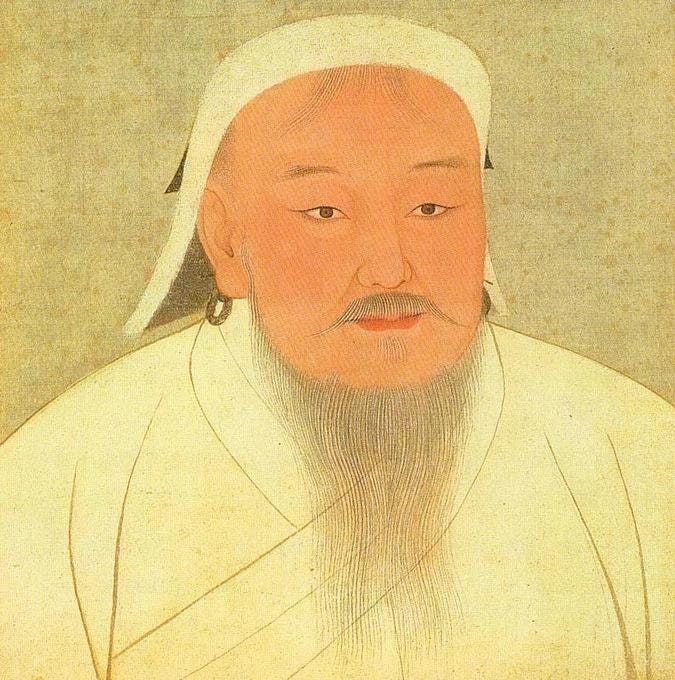
Isserow’s answer is “a resounding yes”. Here she supplies an example: “I take it that Genghis Khan did not have to tread carefully around his marauders’ moral sensibilities, ensuring that they felt morally justified in riding off to rape and pillage.” In writing “I take it” she admits that this is an assumption. But why make such an assumption? I followed the footnote expecting some historical citations, but all I found was: “I thank Ben Fraser for the example”.
Perhaps the assumption seems plausible in light of a familiar cartoon image of Mongols as bloodthirsty louts with raging libidos. Of course we can find such depictions, but this is a standard way for military propagandists to represent their enemies. After all, effective propaganda isn’t content to represent the enemy as evil; it must also depict the enemy as stupid—too stupid to think of a moral justification for their actions or to work at the sophisticated level of justification in general. It is easier to motivate soldiers to go out and kill the enemy when they can think of this as not very different from shooting a rabid dog. The enemy must be considered subrational, lest too many on your own side ask why we aren’t instead trying to reason with them.
Jack Weatherford published a controversial book on Genghis Khan, which goes very far the other way, likely overstating the civilisational contributions of the Mongol Empire. But it makes the very valid point that the historical sources of the standard Western depiction were written by those who had most cause to be embittered at the Mongol conquest: the aristocratic rulers who were regularly killed and displaced by the more meritocratic Mongol invaders.
Weatherford’s own account draws on three sources: the Secret History of the Mongols and two Persian sources: the Tārīkh-i Jahāngushāy, and the Jāmiʿ al-Tawārīkh. None of these sources is unbiased. The Secret History presents an internal Mongol perspective, while the Persian historians wrote under Mongol rule and naturally reflect that political context. But even less friendly accounts, e.g. David Morgan’s The Mongols or Timothy May’s The Mongol Empire, present a picture entirely at odds with the savage barbarians in the cartoons.
I am not denying that there are psychopaths who commit acts of violence without even attempting moral justification. But it’s a bit much to imagine a whole nation of such psychopaths. It seems much easier to imagine that the Mongol “horde” needed to feel about as morally justified as warmongers generally need to feel.
It doesn’t seem wildly implausible, for example, to suppose that the Western Xia and Jin dynasties didn’t always treat their impoverished, nomadic neighbours with immense respect, leading the Mongols to feel quite justified in taking these arrogant metropolitan elites down a peg.
Or in the Tārīkh-i Jahāngushāy we have the story, equally plausible, of how war escalated with the Khwarazmian Empire. The Khan at first sent a caravan of merchants to this region, whom the local governor suspected of espionage and ordered to be executed. When the Khan then sent an envoy to request recompense from the Shah, the Shah killed some of the envoy and sent the others back with their beards shaved off as humiliation. The Khan wouldn’t have needed to work too hard, in an honour culture like that of the Mongols, to make his soldiers feel justified in teaching these arrogant Khwarazmids a lesson. Military invasion might be rough justice, but the justice of the day was rough, and people still saw it as justice.
Given the historical records we have, what leads Isserow to “take it” that the Mongols simply wanted to rape and pillage, without the need for moral justification? Why assume that they were just licentious thugs out on the prowl rather than ordinary people with a deep sense of honour, pride, and retributive justice?
I think it is much more helpful to try to imagine what could possibly lead you to commit such an act than to ascribe it to the inscrutable evil of some brute (like Captain Ahab with the whale). Yes you might lie to your boss, or pocket the money from a lost wallet before handing it in while feeling like you’re doing the wrong thing. You might even cheat on your partner (though people who do that are often inventive in their justifications). But you’re not going to beat somebody to death or set a villager’s house on fire and say “ooh, I’m a bit naughty”: to do those things, at least part of you would have to think you were doing the right thing, or at least the lesser of evils. The fact that so many people do such things suggests that it’s not very difficult to believe them to be right and good.
I don’t think I’m being naive here. I’ve seen the same examples of “senseless” violence as everyone else. But only in a Johnny Cash song does anyone shoot a man “just to watch him die”. In the real world, I’ve always been struck by how fervently perpetrators of violence give justifications for their actions, even if they’re as basic as: “they should know not to come to our street”. Ah yes, they should thank you for helping them to morally improve in their geographical duties.
Whatever you think about moral abolitionism, explaining away the complexity of human violence using crude stereotypes doesn’t seem like a constructive way to object to it. Of course it is uncomfortable to admit how often and easily moral thinking can be co-opted to motivate and justify violence, just as it’s embarrassing to discover that your locks, chains, and ropes ended up helping the thieves you were trying to deter.
Still, it raises the question: then what are we meant to do? Leave our luggage unguarded? That sounds absurd—until we notice that our “safeguards” did precisely the opposite of what we intended. Moral abolitionism sounds absurd too, but we need a clear-eyed view of history—not cartoon villains and propagandist stereotypes—to decide whether it might in the end make us safer from the things that morality tries to hold at bay. And it’s only fair to remember that moral abolitionism isn’t denying that a safeguard is wanted; the claim is that this one doesn’t seem to be working.
Morris gives a very clear explanation of his version of moral abolitionism in this interview with “The Dissenter” on YouTube.
Her main counter-theory is that religion is often the culprit. Morris has a good response to her, in my opinion. He points out that religion on its own could at best motivate people to commit violent acts because they feared divine punishment, but this would not explain the pride, zeal, and often enjoyment experienced by the perpetrators of acts of religious violence. Clearly they believe they are on the side of right; we have few historical examples of people committing atrocities with the despair and reluctance of somebody who is only doing it because they fear punishment.
No posts
Comments
Nothing yet. Say the first thing.
Sign in to join the conversation.