
I recently found Arthur Waley’s old book, One Hundred and Seventy Chinese Poems at a charity shop. First published in 1918, it’s an interesting old artefact, full of quaint touches. For instance in the preliminary note Waley explains that he has taken the liberty of translating a few Chinese poems that have already been translated, because “they are mostly in German, a language with which my readers may not all be acquainted”.
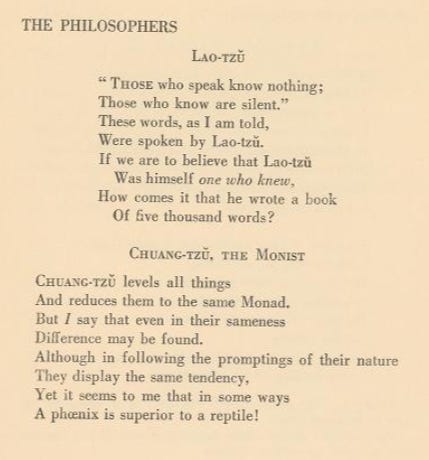
Naturally, I turned to the end, where Waley places two poems by Bai Juyi (“Po Chü-i”) under the title “The Philosophers”. The first is a poem on Laozi, asking the common enough question of why a philosopher who proclaimed that what is vital is unsayable, and that those with knowledge are silent, had so much to say about this.
The second concerns Zhuangzi (“Chuang-Tzŭ”). Here is an interesting blog post on that one.
The original poem is:
Text within this block will maintain its original spacing when published
莊生齊物同歸一
我道同中有不同
遂性逍遙雖一致
鸞凰終校勝蛇蟲
Waley’s translation is:
Text within this block will maintain its original spacing when published
Chuang-tzŭ levels all things
And reduces them to the same Monad.
But I say that even in their sameness
Difference may be found.
Although in following the promptings of their nature
They display the same tendency,
Yet it seems to me that in some ways
A phoenix is superior to a reptile!
The “phoenix” (luán huáng 鸞凰) is likely a reference to the gigantic bird Peng, who appears right at the start of Zhuangzi, ascending to impossible heights and travelling unimaginable distances. The “reptile” (shé chóng 蛇蟲) is likely a reference to the “little creature”, illustrated by the cicada and fledgling dove, who seem to mock the giant bird for its vastness (quoting Ziporyn’s translation):
“We scurry up into the air, leaping from the elm to the sandalwood tree, and when we don’t quite make it we just plummet to the ground. What’s all this about ascending ninety thousand miles and heading south?”
These creatures are chastened for their small-mindedness:
What do these two little creatures know? A small consciousness cannot keep up with a vast consciousness; short duration cannot keep up with long duration.
What Ziporyn has translated as “little creatures” here is the same term, chóng 蟲, that appears in Bai’s poem and Waley translates as “reptile”.
The passage is naturally read as asserting the superiority of Peng’s vast perspective and consciousness to the cramped and limited consciousnesses of the little creatures. The little creatures are “provincial” in the sense that Hilaire Belloc once nicely described:
Provincialism does not mean a limitation of experience to some one small department of life—we are all of us subjected to such limitations […]. Nor does Provincialism mean seeing things through the medium of one’s own habitat and character, both necessarily limited. […] No, Provincialism means thinking that one “knows all about it”; Provincialism means a satisfied ignorance: a simple faith in the non-existence of what one has not experienced. Provincialism involves a contempt for anything foreign and, what is worse, an actual denial of things which the provincial person has not been made familiar with (A Companion to Mr. Wells’s Outline of History, p.15).
The chóng 蟲 seem very provincial in this sense, dismissing Peng’s vast ascent with contempt because it goes outside their limited experience. They cannot imagine any purpose to such great travelling, and so they deny that there is one. Whereas Peng, so far as we are told, is not provincial in this way; we have no record of Peng dimissing the small flights of the little creatures as foreign and therefore valueless. So far, then, Bai seems right to call the luán huáng 鸞凰 superior to the chóng 蟲.
But his third line contains part of the title of the first chapter of Zhuangzi—xiāoyáoyóu 逍遥游—which is sort of just three words for “wander”. This line appears to be an admission that the great and the small creatures are alike in that they are all wandering. Alternatively, the line could be read as saying that following one’s nature and wandering are one and the same—this is how it is read in the blog post I linked. Either way, the line can be read as admitting that there is some sense in which the great and small creatures are alike; either because they both wander according to their nature, or because the one follow their nature and the other wander, but these amount to the same in the end.
Bai addresses himself against a conclusion he believes Zhuangzi to draw from this, namely that all creatures are equal, which Bai expresses in the first line in saying that Zhuangzi “levels all things” qí wù 齊物. This pair of characters is part of the title of the second chapter of Zhuangzi—qíwùlùn 齊物論—”Equalizing Assessments of Things” in Ziporyn’s translation.
Bai might be responding to Zhuangzi as interpreted in Guo Xiang’s commentary, which reads (again quoting Ziporyn’s translation):
Though some are larger and some are smaller, every being without exception is released into the range of its own spontaneous attainments, so that each being relies on its own innate character, each deed exactly matching its own capabilities. Since each fits perfectly into precisely the position it occupies, all are equally far-reaching and unfettered. How could any one be superior to any other?
Guo Xiang’s interpretation is often criticised for defeating any conceivable philosophical lesson that might be drawn from Zhuangzi, suggesting that its overall message is that everything is just fine as it is (zìrán 自然). This doesn’t entail that we should try to be ok with everything, since, according to Guo Xiang’s principle, somebody who isn’t ok with everything is also fine just as they are.
Nor can his principle be taken as a lesson against provincialism. While it is true that each creature has its own unique way, and therefore there is no real sense in mocking or contemning from your perspective something that might be perfectly sensible and uncontemptible from another perspective, mocking and contemning is also just the way of certain creatures, who again are fine just as they are.
This isn’t just Guo Xiang’s interpretation, I think. There is a constant air of paradox in Zhuangzi, which constantly presents an attitude of open-mindedness and pluralism without ever being able to endorse that attitude or hold it superior to others, precisely on account of the attitude itself! Bai finds the central self-contradiction in Zhuangzi just as effectively as he finds the central self-contradiction in Laozi.
But one difference is that the Zhuangzi is full of wry self-awareness about this self-contradiction. Zhuangzi’s weapon against the criticism of Laozi—why so many words to praise the worthlessness of words?—is a humourously open embrace of the paradox: “Where can I find a man who has forgotten words, so I can have a few words with him?” (ch.26).
He would likely deploy the same delightful irony in replying to Bai. That is, he would say with a wink: “Of course you can find the great creature superior to the small one; doing so is not inferior to holding them equal. I hold all things to be equal, including holding all things equal and not holding them equal.”
No posts
Comments
Nothing yet. Say the first thing.
Sign in to join the conversation.