
Qualcomm is executing one of the most ambitious pivots in semiconductor history. The company known for smartphone modems and mobile SoCs now wants to become a data center power player alongside Intel, AMD, and NVIDIA. This shift rests on bringing to market a portfolio of AI accelerators, data center CPUs, and more. Recently on STH, we covered the Qualcomm Investor Day 2026, but I wanted to take a moment here to give some thoughts on the Qualcomm C1000 server CPU and the company’s High Bandwidth Compute (HBC).
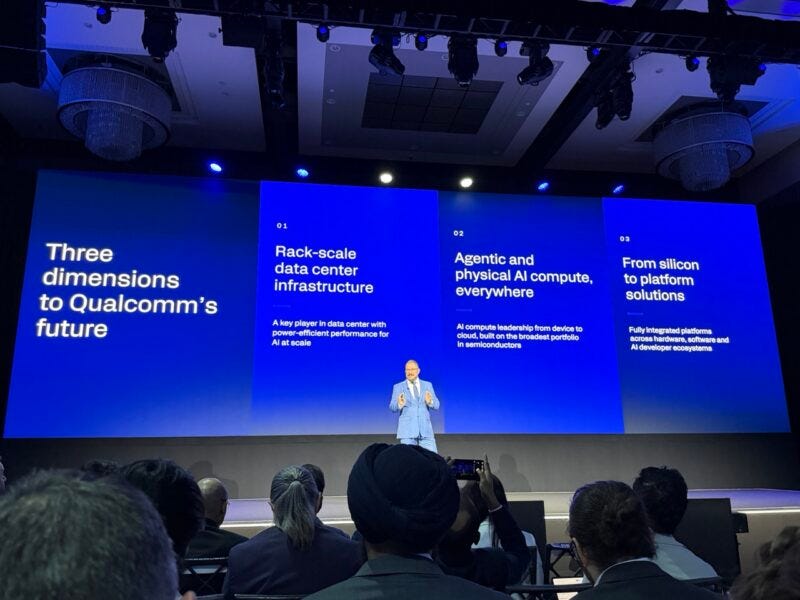
As some important background, I think the Qualcomm Investor Day was aimed squarely at addressing the company’s growth drivers, given an Apple business wind-down and a really tight memory market. 18 months ago, before memory prices started their sharp ascent, memory was the #1 cost item in the STH lab. The current prices are making us rethink how we operate the lab, for example, by going back to sharing modules between servers rather than buying them for each server. As a result, I tend to think of a memory-constrained environment as allocating memory to the highest-value compute. That presents a challenge for the Android handset market as well as the PC and notebook segments, since the cost of memory will cause people to delay upgrades, hurting Qualcomm in both segments. This is not just a Qualcomm thing, this is impacting the entire industry.
For our Substack readers, I went into this in more detail when discussing Apple and explaining why I went out in May and purchased a 128GB Apple M5 Max system. Shortly after that, Apple raised prices, and that same notebook now costs an extra $2000. Analysts at the Qualcomm event raised their eyebrows at a $7000+ notebook. At the same time, it meant that Qualcomm needed to show at the event how it would attach higher-value silicon to memory and drive revenue.
From Mobile Leader to Data Center Contender
Qualcomm’s transformation starts with connectivity and custom silicon that seems like an extension of the Alphawave Semi business.
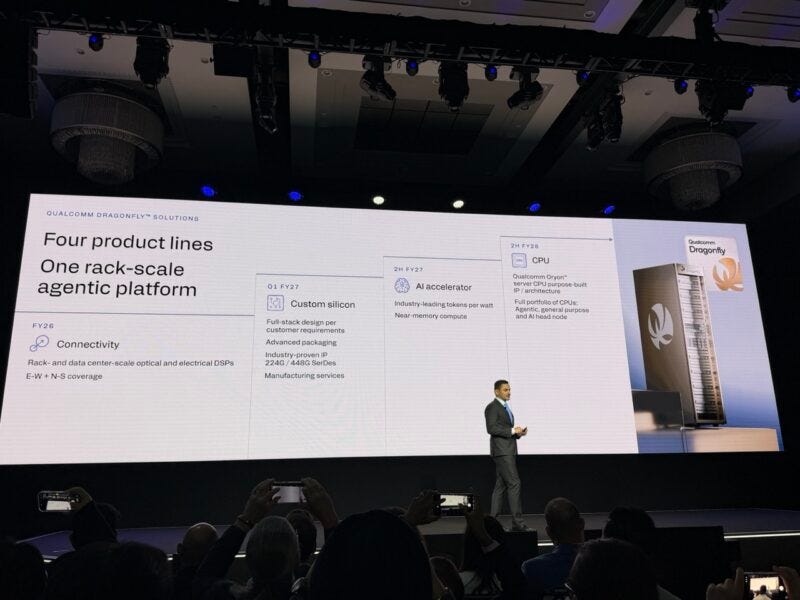
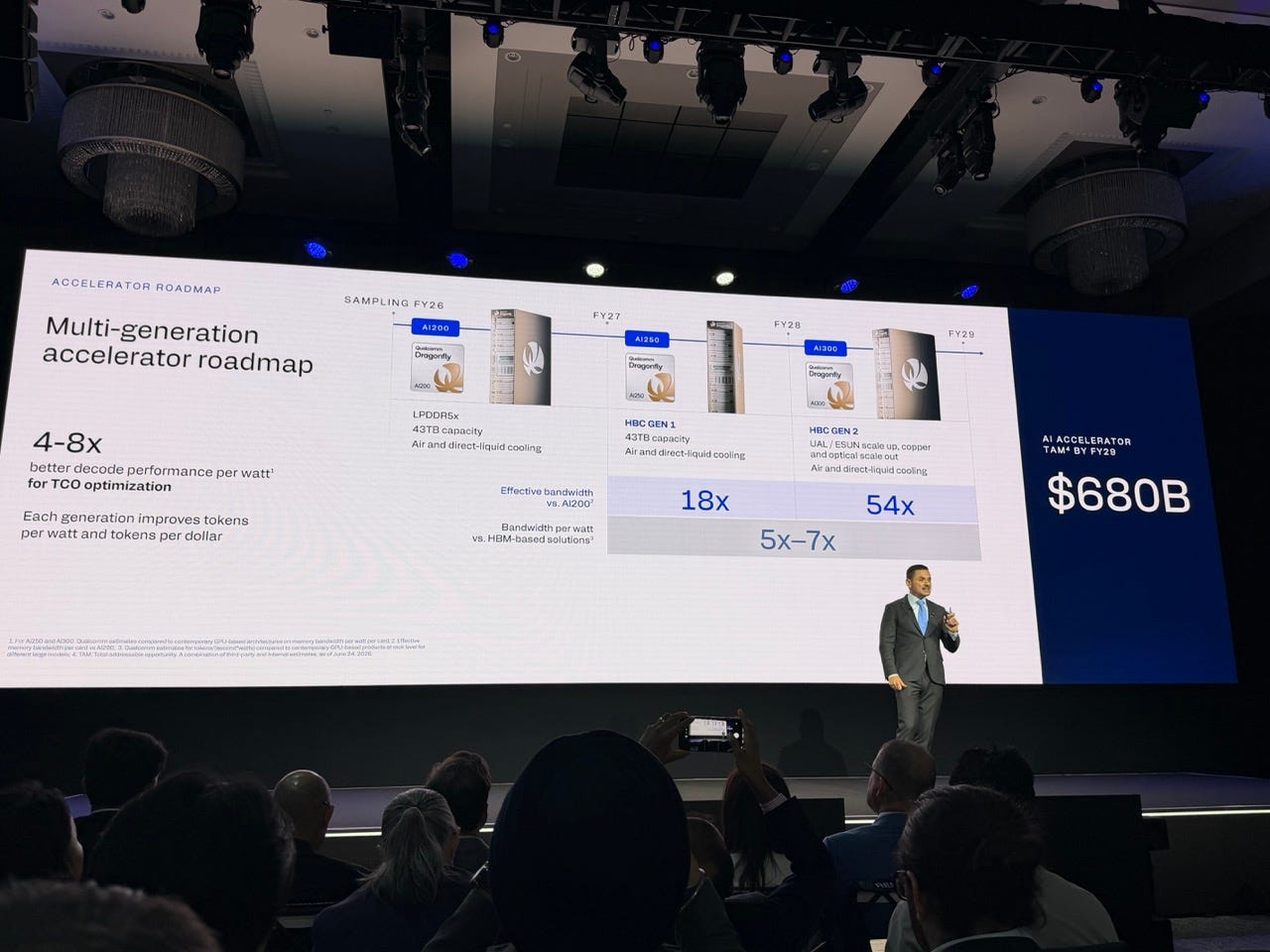
It then transitions to introducing a custom AI accelerator: the AI200, the AI250, and the AI300. The AI250 starts with HBC, which we are going to discuss after the CPU portion.
Qualcomm’s competitive position differs from Intel’s or NVIDIA’s in one critical way. The company maintains dominant positions across smartphones, PCs, automotive systems, and IoT devices while building data center capability. This breadth enables unified architecture decisions that competitors focused on single market segments cannot match.
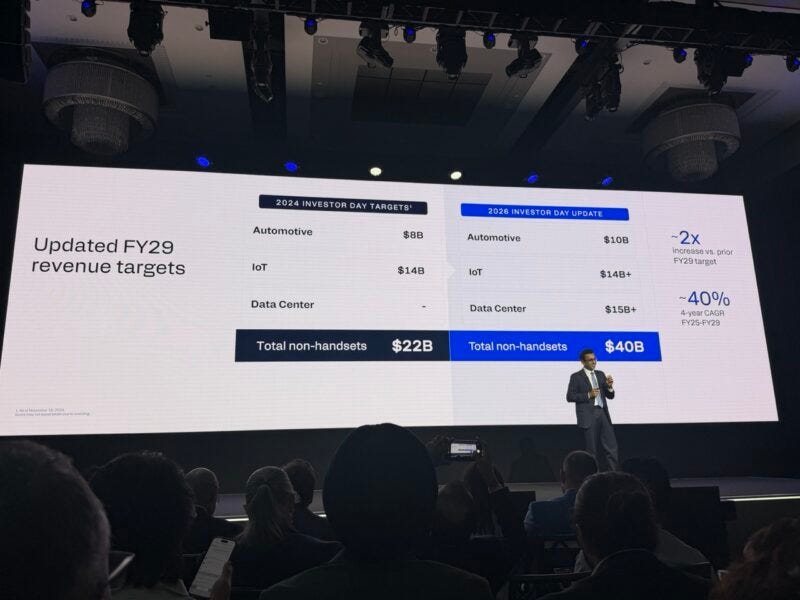
Fiscal year 2029 revenue targets quantify the ambition:
Total Non-Handset Revenue targets reaching $40 billion
Data Center Revenue target exceeds $15 billion
Automotive Revenue target is $10 billion
IoT Revenue target exceeds $14 billion, split between $8 billion for industrial and robotics, plus $6 billion for personal AI and compute
Non-GAAP EPS Target exceeds $18.00
The $40 billion non-handset target serves a specific purpose. Qualcomm expects to lose all Apple modem revenue by 2029 as iPhone production moves in-house. Non-handset growth must absorb that multi-billion dollar reduction while still delivering overall company expansion.
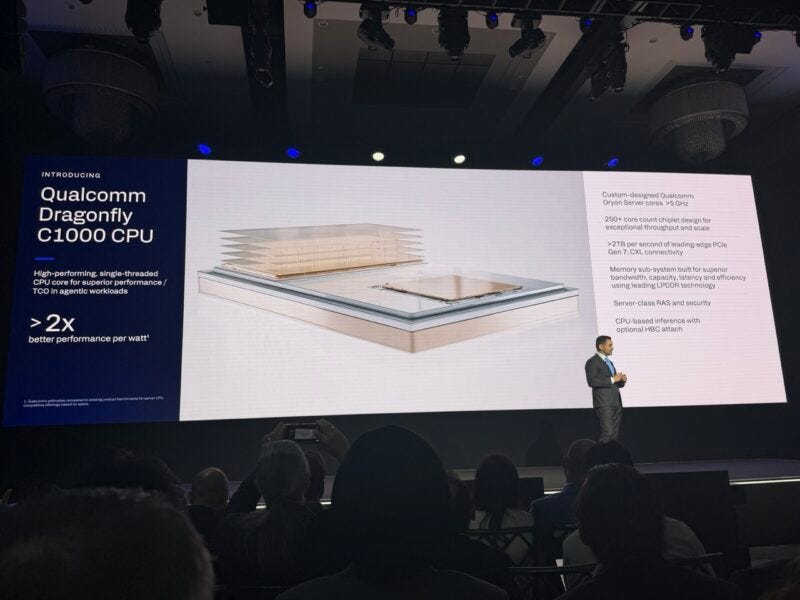
Qualcomm Dragonfly C1000 Architecture
Qualcomm is betting that its first CPU, the Qualcomm C1000, will be a big part, and the specs are certainly substantial, but there is a lot more to get into.
Comments
Nothing yet. Say the first thing.
Sign in to join the conversation.