
While I hold the top-line belief that Intel Foundry is the company’s growth story, the company’s Q4 FY2025 call confirmed what Lip-Bu Tan took over: the product roadmap was off target. It also feels like a bit of an expectation reset to underpromise/ overdeliver, which I appreciate, since that is generally how we operate as well. Still, there was a big red flag when it came to the Clearwater Forest.
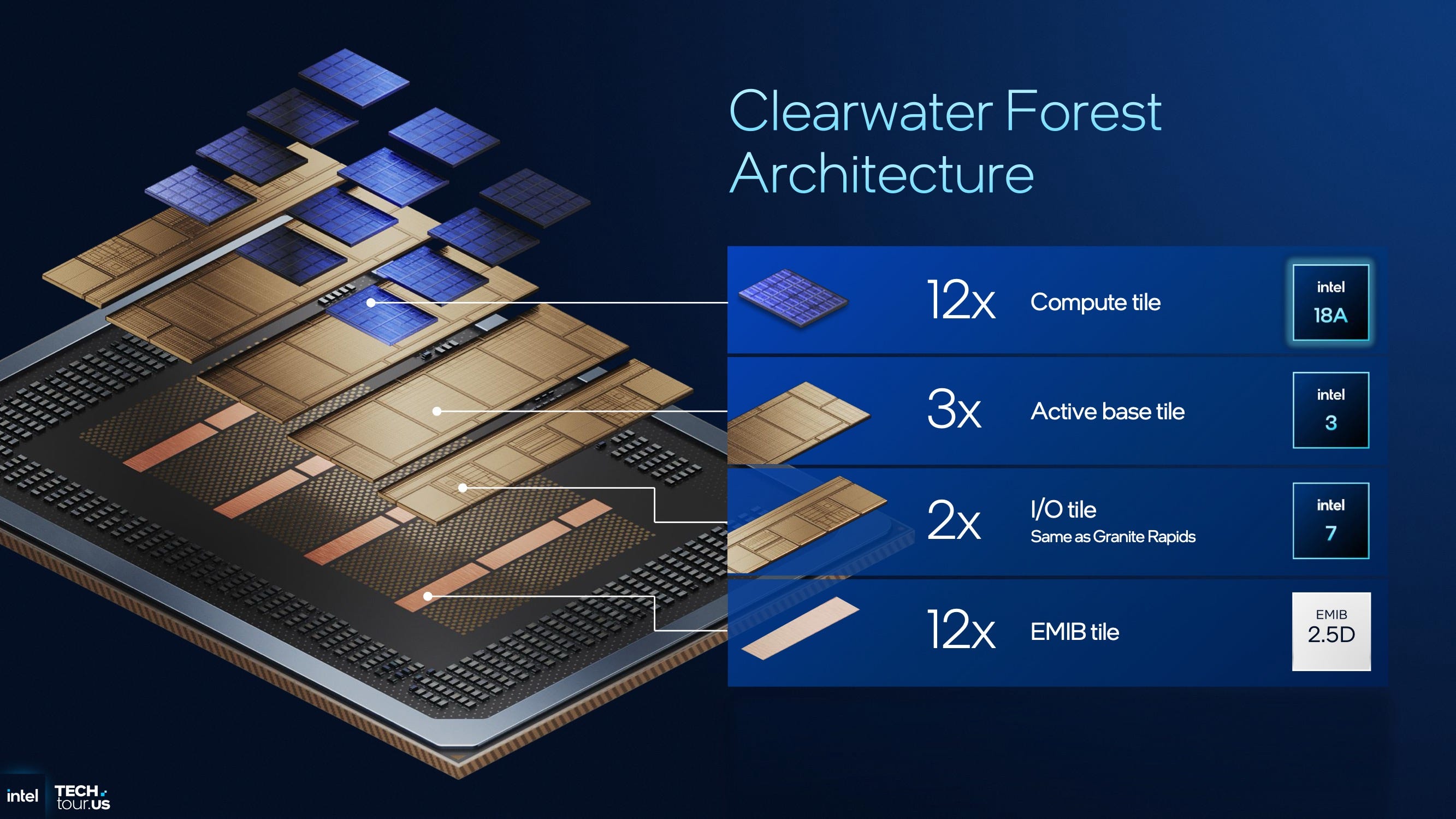
As soon as the earnings presentation came out, this slide was nothing short of baffling.
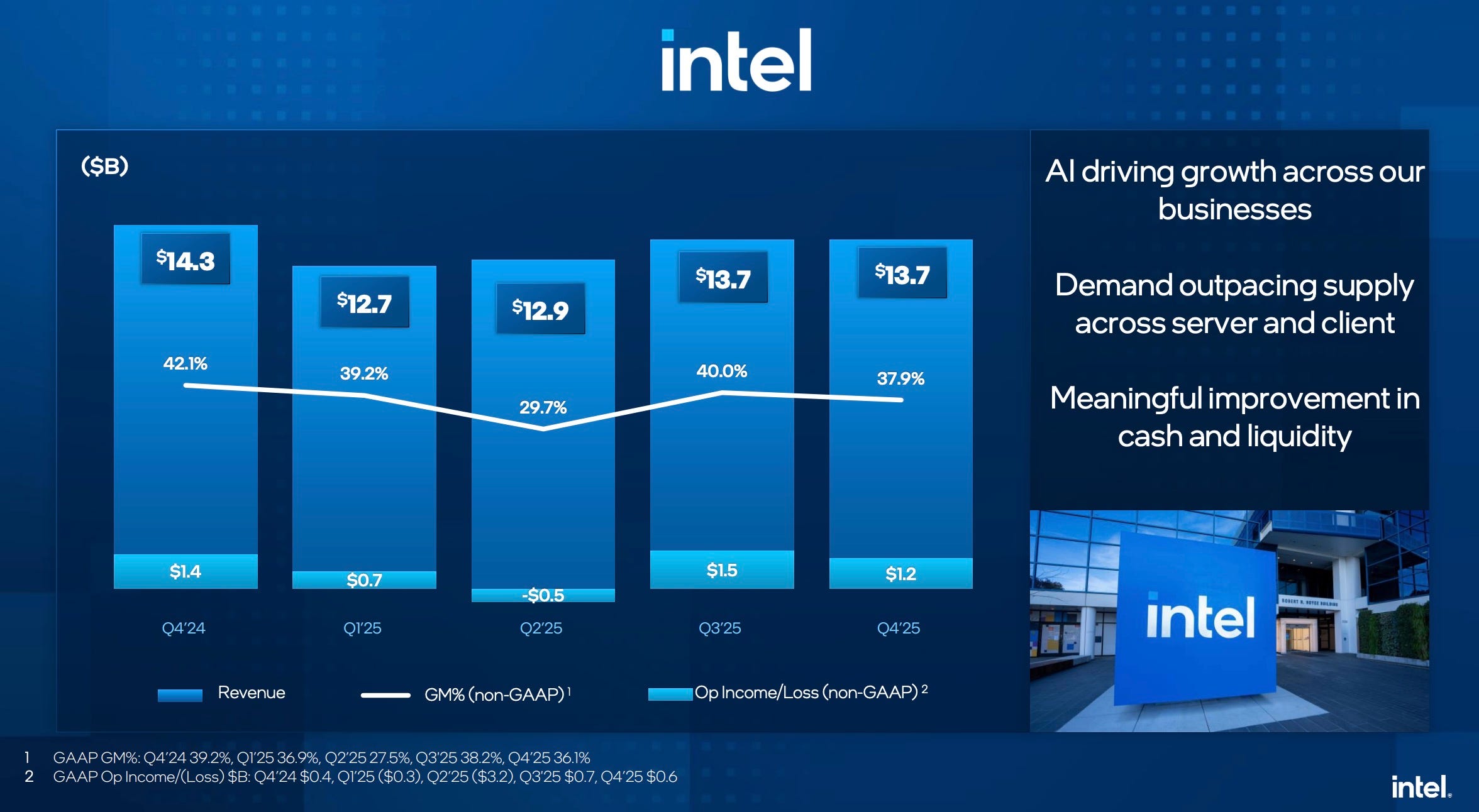
First off, I am not sure that this is a story of growth when you look at the revenue for companies like AMD and NVIDIA. Indeed, NVIDIA’s networking business that stems from NVIDIA buying Mellanox out from Intel in 2019 is on track to look like a better business alone than Intel Products will in 2026. If you want a story on how that deal went down, here is an older post for you.
NVIDIA Outplayed Intel for Mellanox in 2019 and Added $100B of Market Cap in 2024
·
December 7, 2024
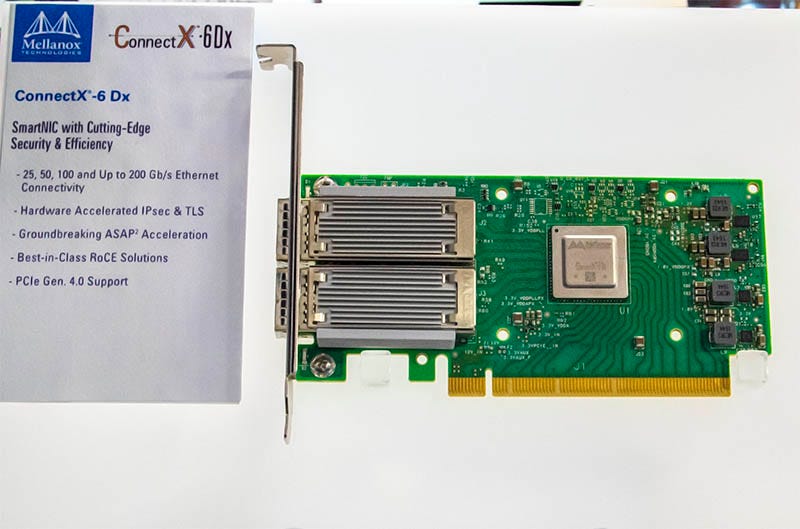
The year was 2019, and it quickly became clear that Mellanox would no longer be a standalone company. Although there were rumors of other companies mulling an offer, we know that Intel and NVIDIA both put offers on Mellanox. The strategies of Intel and NVIDIA during those negotiations could not be more different.
My biggest challenge with Intel’s FY2025 revenue slide was simply “AI driving growth across our businesses”. I am not entirely sure that, in the context of AI buildouts, where $13.7B in systems for a single data center buildout would not even raise an eyebrow. Let me put this into a clearer context for you.
Just after NVIDIA GTC 2025, we filmed the Factory that Builds AI Factories video. That was in the era of NVIDIA GB200 NVL72 racks, whereas I would be certain that both Dell and Supermicro are more focused on GB300 NVL72 now, versus three quarters ago.
When we did that video, a GB200 NVL72 rack was generally considered a $2.75-3M rack. Memory pricing, higher-end networking, and systems updates have changed a NVL72 rack pricing over the last year, but that $13.7B of quarterly Intel revenue if we are talking “AI demand” is roughly 5000 of NVIDIA’s GB200 NVL72 racks using Q1 2025 pricing.
That is 360,000 NVIDIA B200 GPUs and 180,000 NVIDIA Grace CPUs plus all of the networking and other bits that go into these racks, but it does not include additional racks of networking, storage, and support servers that sit around these in a cluster.
Even with Intel’s client business still at a higher revenue figure than its data center business, Intel’s revenue, as a whole, is like one large AI data center’s worth of just the AI racks per quarter.
Since I have already been on manufacturing floors for GB300 NVL72 racks this quarter, seeing “AI driving growth across our businesses” might be a forward-looking statement, but I could not align what I have been seeing and experiencing with the statement and historical revenue figures.
Many folks have discussed the “Demand outpacing supply across server and client” and having competing core tiles for client and server. One needs to remember that even within server, Intel has competing 18A core tiles.
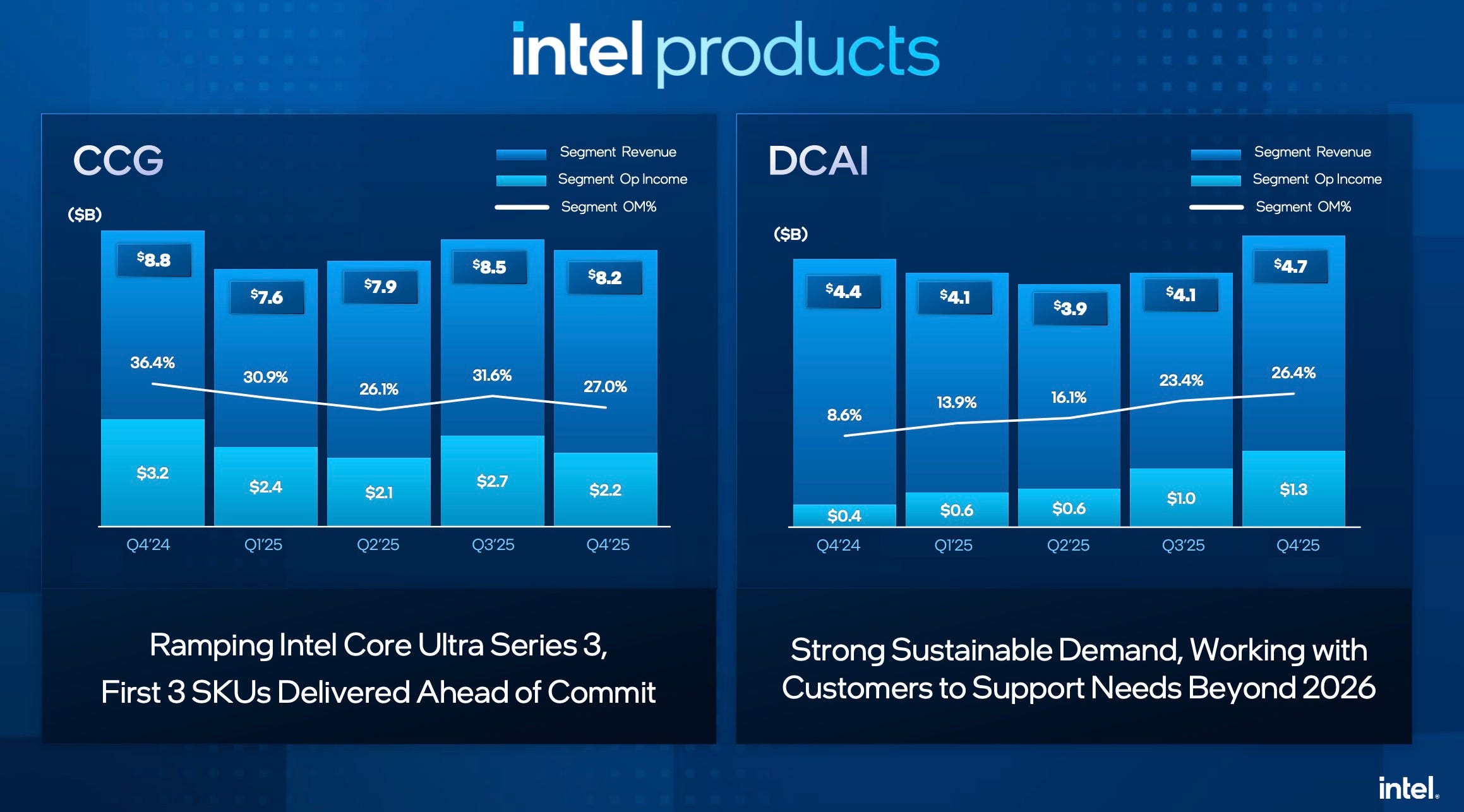
Clearwater Forest and Diamond Rapids will need to use different 18A tiles. Diamond Rapids is what would be used in a modern AI server. Clearwater Forest is aimed at cloud-native workloads. As a quick recap, Clearwater Forest and Diamond Rapids were Intel’s main server products launching in 2026. Clearwater is the E-core or efficient core part that was built at a time when Intel was focused on delivering an answer to lower-end Arm Neoverse cores being adopted by hyper-scalers. The theory was that de-featuring x86 cores removing features like Hyper-Threading, big caches and AVX pipelines, and so forth would reduce the footprint of server CPU cores so more could fit on a package. In addition to that, removing Hyper-Threading helps Intel from a security standpoint after having dealt with Spectre/ Meltdown and having to rush a Cascade Lake fix generation in 2019.
Just a few months ago Clearwater Forest-AP, the company’s 18A server part that brought more advanced packaging to the data center, was touted as a major leap over Sierra Forest-SP/-AP. After the company’s event in October 2025, the question I posed to Kevork Kechichian, GM of DCAI at Intel, was around the part’s proposed value proposition. While it uses Intel 18A, the manufacturing complexity appears to increase significantly, while the performance gains shown were modest.
The Math of Intel Clearwater Forest
·
October 12, 2025
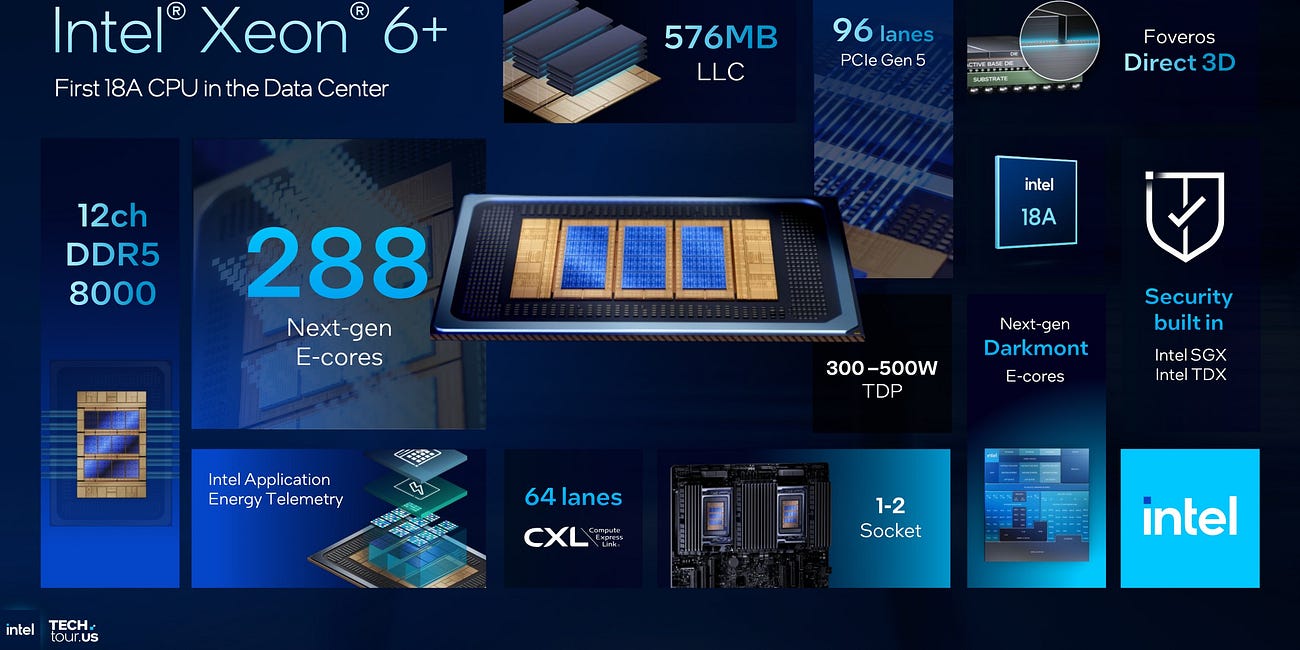
Earlier this month, I attended an event in Chandler, Arizona, where we toured Intel’s newest 18A fab and heard about both the company’s upcoming Panther Lake consumer CPU platform and the Intel Xeon 6+ Clearwater Forest part. Clearwater Forest is a massive 288-core server processor designed to meet the threat from Arm in cloud-native computing head-on and win. Without a doubt, it is a part that I have been excited about for a long time. I was bummed when we
Per core performance is not a trivial metric. It was one of the major challenges Ampere ran into with its AmpereOne (and Altra/ Altra Max) lines of Arm CPUs. In x86 AI servers, generally we see either very high core count CPUs, or we see higher-frequency 64-core CPUs. When an entire system can be blocked waiting for a single thread, having more low-performance cores does not matter. Instead, you can think of the E-core strategy is basically making many low-performance cores for web hosting, low performance virtualization, and there are also pockets of telecommunications that work very well with E-core designs. Sure there are other areas, but conceptually, think of an E-core CPU’s value as having stable low-to-mid performance. AI servers, in contrast, are focused on removing tail latencies so that huge numbers of silicon components can all run at top performance.
Then came Intel’s earnings call where the bombshell was in the omission.
Comments
Nothing yet. Say the first thing.
Sign in to join the conversation.