
A Reflection During Men’s Mental Health Awareness Month
0:00
-2:45
Dear Readers,
Before I begin, I understand that not everyone will agree with my perspective, and that is completely fine. This article is not written to attack men, women, families, creators, or any particular group of people. It is simply a personal reflection based on observations, experiences, and concerns about the direction social media culture, public behaviour, and emotional disrespect seem to be taking in modern society.
Some readers may disagree with certain points, while others may deeply relate to them. My intention is not to spread hatred or division, but to encourage thought, balance, dignity, and honest conversations about emotional well-being, respect, and mental health in today’s world.
There was a time when families protected each other in private. Arguments stayed behind closed doors. Pain was handled with dignity. Respect mattered. Today, however, we live in a world where cameras are always on, where humiliation is often disguised as entertainment, and where social media rewards attention more than emotional responsibility.
Only recently, the world spoke about Mental Health Awareness as a whole. And now, as we step into Men’s Mental Health Awareness Month, perhaps this is not a moment to divide conversations, but to continue them more honestly. Mental health is not limited to one gender, one age group, or one type of struggle. Everyone carries silent battles in different ways. While this month encourages greater awareness toward the emotional struggles many men silently endure, it should also remind us that compassion, dignity, emotional safety, and respect are things every human being deserves.
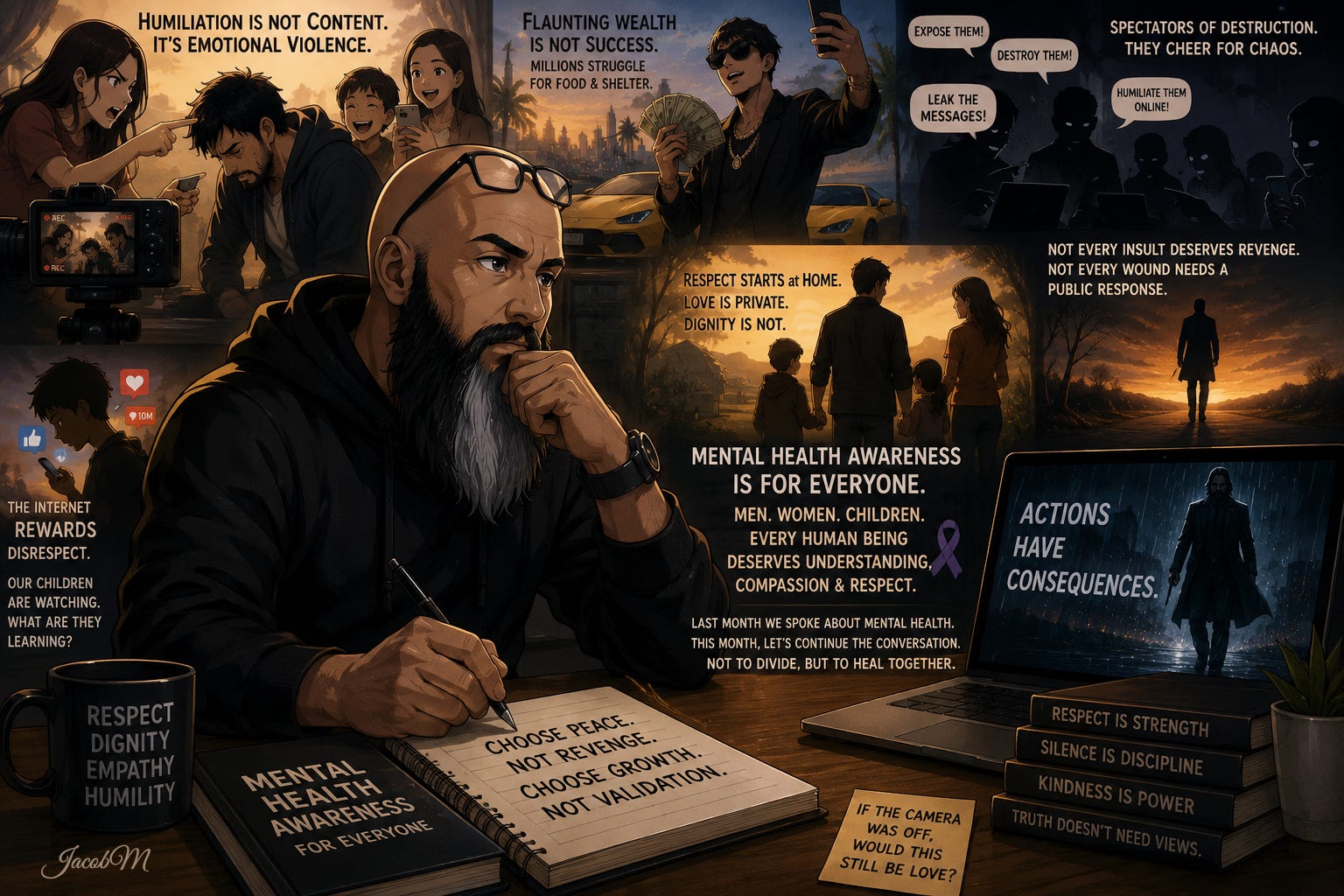
As June arrives and conversations begin around Men’s Mental Health Awareness Month, I believe we need to discuss something deeper than statistics, trends, or hashtags. We need to talk about emotional humiliation, public disrespect, and the silent damage caused by a culture that normalises mockery inside homes and relationships.
This is not an attack on women.
This is not an attack on men.
This is not an attempt to divide anyone.
This is about human dignity.
Over the years, I have watched countless videos online. Family channels. Couples’ content. “Prank” videos. Public arguments recorded for views. Emotional reactions turned into entertainment. At first glance, many of these videos appear harmless. People laugh. Audiences share them. Millions watch them. But when you begin observing carefully, you notice something troubling underneath the smiles and editing.
Disrespect has become normalised.
A husband is mocked publicly while everyone laughs behind the camera.
A wife is humiliated while comments call it's “just a joke.”
Children speak to parents without basic respect because they have grown up believing embarrassment is funny if it gets views.
And the saddest part is that many people no longer notice the emotional damage because the internet has conditioned us to consume humiliation as entertainment.
We often hear people say:
“It’s only a prank.”
“It’s only content.”
“They are making money.”
“They are happy.”
But are they truly happy?
Sometimes a person smiles because the camera is recording. Sometimes people tolerate disrespect because millions are watching. Sometimes silence is not acceptance; it is exhaustion.
I recently watched a video involving a family that appeared successful and admired online. They spoke publicly about helping people, supporting causes, standing against injustice, and donating food to those in need. On the surface, everything looked beautiful. Yet inside the same video, there was open disrespect within the family itself.
A husband made a slight mistake while speaking. Instead of correcting him gently, the wife insulted him publicly. The children laughed. The videographer continued recording. Nobody paused to notice the embarrassment on the man’s face. Nobody stopped to ask whether the moment should have remained private. Nobody thought about dignity.
That moment stayed with me.
Not because I wanted to judge anyone, but because it revealed something larger happening in society.
We are becoming emotionally careless.
We have become so obsessed with producing content that we forget the people inside the content are human beings with emotions, pride, memories, and pain.
Mental health is not only about anxiety, depression, or loneliness. Mental health is also connected to respect. To feel valued. To feel safe inside one’s own home. To not constantly be humiliated for public amusement.
Many men suffer silently because society teaches them to stay quiet. If a man speaks about emotional disrespect, people often mock him, dismiss him, or accuse him of weakness. If he reacts emotionally, he is called unstable. If he remains silent, the damage slowly grows inside him.
But this issue does not belong only to men.
Women suffer emotionally, too. Many women carry unbearable pressure to appear perfect online. Many are emotionally neglected, publicly criticised, or reduced to objects for attention and validation. Society damages both men and women in different ways.
That is why this conversation must remain balanced.
The goal is not to declare one gender innocent and the other guilty. The goal is to ask ourselves why respect has disappeared from so many relationships and why social media rewards disrespectful behaviour.
There is also another group of people we rarely discuss, the people hiding in the shadows, quietly adding fuel to the fire.
These are the individuals who encourage division. The ones who provoke conflict for entertainment. The people who sit behind screens encourage people to expose, insult, humiliate, destroy, and retaliate. They cheer for chaos because it entertains them.
They tell people:
“Expose them.”
“Destroy them publicly.”
“Leak the messages.”
“Humiliate them online.”
But these same people disappear when lives collapse.
They are spectators of destruction.
And this is where wisdom matters.
Not every insult deserves revenge.
Not every betrayal deserves exposure.
Not every wound needs a public response.
We live in an era where many people believe that proving someone wrong publicly is a strength. But true strength is often restraint. True strength is choosing dignity even when you have evidence, screenshots, anger, or reasons to retaliate.
I could say many things about people who have disrespected me in life. I could expose conversations. I could point fingers. I could speak about injustices I have experienced personally.
But what would that truly achieve?
Temporary satisfaction? More hatred? More division? More noise?
Eventually, someone has to choose peace.
And that is something many people misunderstand about silence. Silence is not always weakness. Sometimes silence is discipline. Sometimes silence is emotional maturity. Sometimes silence is a decision to stop participating in destruction.
There is a verse many people hold onto during difficult times:
“Vengeance is mine; I will repay, says the Lord.”
Whether one calls it karma, divine justice, or simply consequences, the principle remains the same: people eventually face the results of their actions.
“People often forget that actions, words, and disrespect all carry consequences.”
That does not mean we become passive or blind. It simply means we do not allow bitterness to consume us. We do not become monsters in response to pain. We do not lose ourselves trying to punish everyone who hurt us.
The internet today encourages instant reactions. Instant outrage. Instant cancellation. Instant humiliation. But wisdom often asks us to pause.
Before recording someone at their weakest moment, pause.
Before humiliating a spouse publicly, pause.
Before mocking a parent online, pause.
Before encouraging conflict in comment sections, pause.
Ask yourself: Would I want someone I love treated this way?
Many people today are desperate for attention. They measure worth through likes, followers, money, and virality. But real character is revealed in private behaviour, not public performance.
You can donate money publicly and still disrespect people privately.
You can speak about kindness online while humiliating your family at home.
You can build a large audience while slowly destroying emotional trust in your relationships.
Flaunting wealth is not proof of goodness.
Showing muscles is not proof of strength.
Going viral is not proof of wisdom.
There was a time when I genuinely enjoyed watching certain family creators, couples, and influencers online. Their videos felt lighthearted and entertaining. But over time, something changed. I began noticing how much of modern content is built around attention-seeking behaviour, public embarrassment, unnecessary drama, and emotional immaturity disguised as humour.
What disturbed me most was not the jokes themselves, but watching grown adults behave in ways that even children sometimes would not. A twenty-five-year-old woman publicly humiliated someone for their views. A twenty-six-year-old man is behaving recklessly for attention. Endless flaunting of money, luxury, status, and material things while millions of people around the world struggle for food, shelter, medical care, and dignity. Somewhere along the way, social media stopped being about connection and slowly became a competition for validation.
That realisation made me quietly distance myself from many creators I once followed. Not because I hate them, but because constant exposure to shallow behaviour eventually becomes emotionally exhausting. Real maturity is not about going viral. Real maturity is learning humility, emotional responsibility, and respect for people, especially in a world where so many are silently suffering.
Real strength is emotional control.
Real strength is protecting the dignity of people around you.
Real strength is knowing when to stay silent and when to speak with fairness.
Children are also watching everything we normalise online.
What worries me even more is how many children and young adults today no longer pause to understand the sacrifices their parents made quietly throughout the years. Many fathers and mothers spent decades working, struggling, protecting, providing, and enduring emotional pressure so their families could survive and grow. Yet in the age of social media, outside influence, validation culture, and constant online noise, many young people are slowly becoming emotionally disconnected from those sacrifices.
There is also a great deal of mental influence happening through social media, peer pressure, online trends, and public opinion. People are constantly being told what to admire, what to hate, what to cancel, and who to disrespect. Sometimes individuals become so influenced by outside voices that they stop thinking deeply about their own actions and how their behaviour affects the people closest to them.
And perhaps the saddest reality is this: many people who are truly doing wrong may never pause long enough to reflect on themselves. Many will never read articles like this. Many will continue believing attention is more important than respect. But that does not make these conversations meaningless. Sometimes the purpose of speaking honestly is not to change everyone. Sometimes it is simply to remind those who still care that dignity, humility, and emotional responsibility still matter.
They learn how to speak to parents from what they see. They learn how relationships function from what trends online. If humiliation becomes entertainment, future generations may begin confusing disrespect with humour and cruelty with confidence.
That should concern all of us.
Social media itself is not evil. It can inspire, educate, connect, and uplift people. There are creators who genuinely spread kindness, awareness, and hope. But we must also acknowledge that social media rewards emotional extremes. The louder, more shocking, and more humiliating something is, the more attention it often receives.
And attention has become an addiction.
Many people no longer ask: “Is this right?”
They ask: “Will this go viral?”
That shift is dangerous.
During Men’s Mental Health Awareness Month, we should encourage men to speak honestly about emotional pain without shame. But we should also encourage women, families, creators, and communities to reflect on how they treat one another publicly and privately.
Respect should never be conditional.
A man deserves dignity even when he is quiet.
A woman deserves dignity even when she disagrees.
Parents deserve dignity after sacrificing for their children.
Children deserve dignity while growing and learning.
Nobody deserves emotional humiliation for entertainment.
Some people reading this may disagree with me. Some may say:
“You are overthinking videos.”
“It’s not that serious.”
“It’s just modern humour.”
Perhaps.
But emotional damage rarely appears dramatically in the beginning. It grows slowly through repeated disrespect, repeated mockery, repeated dismissal, repeated humiliation.
Small moments matter.
One humiliating joke may seem harmless. A hundred humiliating jokes can destroy emotional trust.
This article is not written from hatred. It is written from observation. From concern. From seeing how people slowly lose empathy while pretending everything is normal.
I believe society desperately needs balance again.
Not male superiority. Not female superiority.
Not public revenge. Not humiliation culture.
Balance.
Mutual respect. Emotional responsibility. Human decency.
The strongest people are not always the loudest ones online. Sometimes the strongest people are those who choose not to expose others despite having reasons to. Sometimes the strongest people are those who walk away quietly instead of turning pain into spectacle.
There is enough hatred already in this world.
We do not need more people humiliating each other for views.
We do not need more strangers encouraging destruction from the shadows.
We do not need more families losing respect while pretending to be happy online.
What we need is honesty.
Honesty about loneliness.
Honesty about emotional pain.
Honesty about how public disrespect affects mental health.
Honesty about the fact that human beings are not designed to live constantly performing for an audience.
At the end of the day, cameras turn off. Views slow down. Trends disappear.
But words remain in people’s hearts.
Embarrassment remains. Humiliation remains. Regret remains.
That is why we must choose carefully how we treat people, especially the people closest to us.
Mental health awareness is not only about therapy sessions, awareness campaigns, or inspirational posts. It is also about creating homes, relationships, friendships, and communities where people feel emotionally safe and respected.
Perhaps before uploading the next prank, the next humiliation, or the next public argument, we should ask ourselves one simple question:
If the camera was off, would this still be love?
Perhaps that is the question modern society needs to ask itself more often. Because dignity should not disappear when entertainment begins, and real love should never require humiliation to be noticed.
Jacob Mascarenhas
Comments
Nothing yet. Say the first thing.
Sign in to join the conversation.