
0:00
-2:56
On fiction, poetry, reality, imagination, and why I have never been very good at staying inside one box.
I know this is going to be a long article. Perhaps longer than most people would normally want to read, and I can already imagine someone reaching the middle and thinking, “Jacob, this is getting a little too long.” And perhaps they will be right. But I wanted to make a point, and I felt that this particular point deserved more than a few hurried paragraphs. There are things I wanted to explain, things I wanted to share, and perhaps a few things I needed to say for myself as much as for anyone reading this.
The funny thing is, this article wasn’t planned at all. Neither was tomorrow’s podcast.
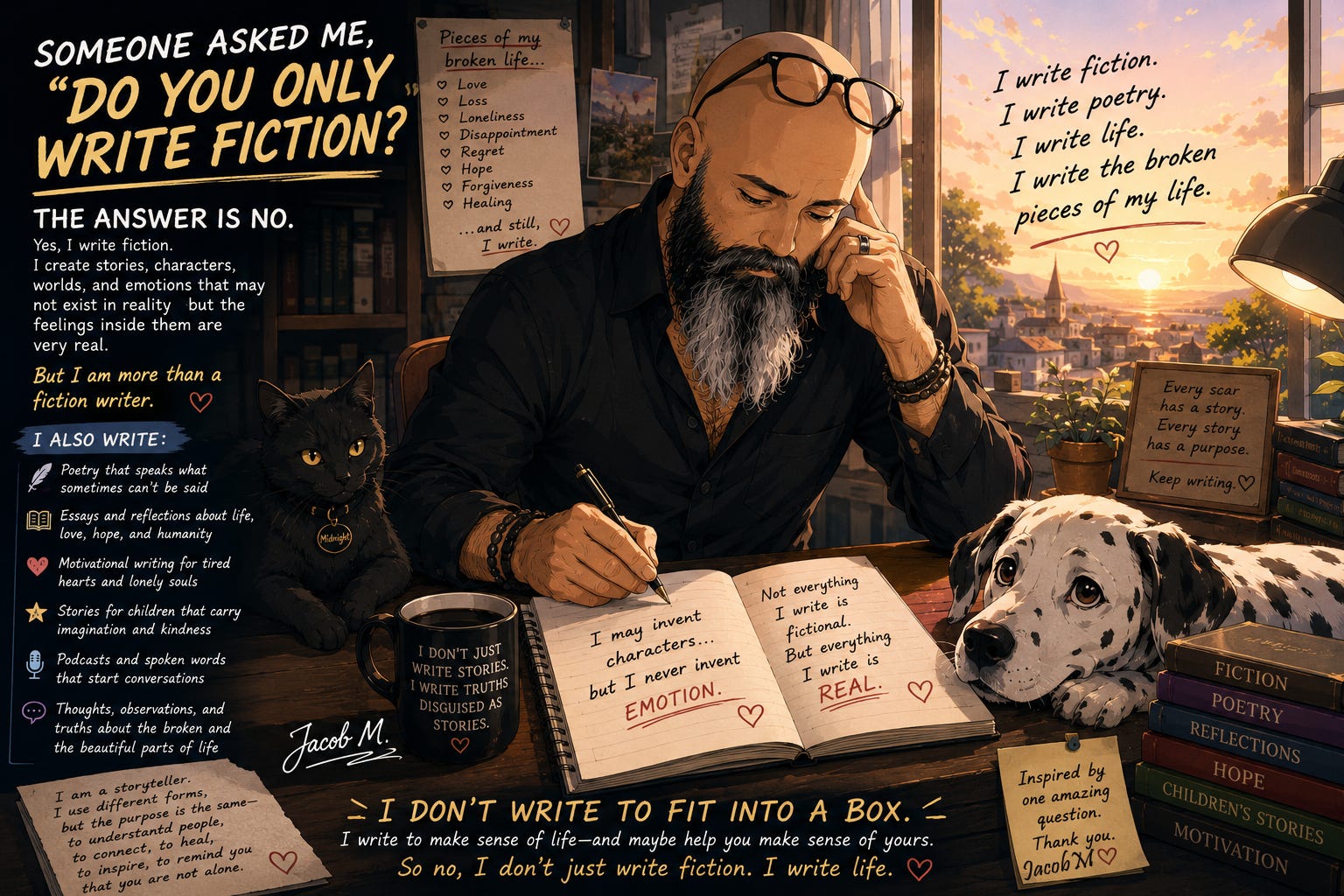
It began with a message on Instagram from one very thoughtful and intellectually curious person who asked me a deceptively simple question: “Do you only write fiction? Are all your writings fiction?”
It was around five in the morning when I read those words, and for some reason, the question stayed with me. I had been sitting there without a clear topic for today’s “Letters from Awriterstip” Desk, wondering what I would write about. I had no particular subject in mind, no idea that was demanding to be written, and certainly no plan to turn a simple question into a long article.
But that question opened something. Suddenly, I had a subject.
Not only for this article, but for tomorrow’s podcast as well.
Sometimes the best ideas are not planned. They arrive unexpectedly, through another person’s words, and before you realise it, a simple question has opened the door to an entire conversation. That is what happened here. One question made me stop and think about everything I have written, everything I continue to write, and perhaps even why I write in the first place.
So, if you have the time, stay with me.
I promise I am not trying to make you read a novel before breakfast. There is simply a story behind the answer to a very simple question, and I realised that answering it honestly required a little more than a sentence or two.
So yes, this is long. But I hope that by the time you reach the end, you will understand why I needed it to be.
And to the wonderful person who asked me that question: thank you.
You may have thought you were simply asking me something about my writing.
You gave me today’s article. Thank You.
Dear Readers,
Someone asked me a rather funny and serious question recently: “Is your work only fiction?” I smiled when I heard it because, at first, the answer seemed obvious. No, it isn’t. But the more I thought about the question, the more I realised that it was actually a much more interesting question than it appeared to be. It made me think about the way we look at writers and the way we try to categorise them. We seem to have an almost instinctive need to put people into boxes. This person is a novelist. That person is a poet. Someone else is a non-fiction writer. Another is a romance writer, a horror writer, a children’s author, an essayist, a journalist or a motivational writer.
Once we have given somebody a label, we seem to feel that we understand them. We know where they belong. We know what shelf to put their books on and, perhaps more importantly, what to expect from them. But I have never been entirely comfortable with that way of looking at writing. I have always felt that writing is far too alive, far too personal and far too unpredictable to be neatly contained within a single category. So when someone asks me whether my work is only fiction, the honest answer is no. Fiction is an important part of what I write, but it is certainly not the whole of it.
Yes, I am a fiction writer. I have written novels and stories that explore romance, desire, intimacy, darkness, obsession, fear, psychological conflict, mystery, relationships and the many complicated ways in which human beings can hurt, love, misunderstand and ultimately affect one another. I have written stories in which people meet, fall in love, lose one another, betray one another, search for one another and sometimes find themselves in situations they never expected.
I have written darker stories in which the human mind becomes a frightening place and stories in which the supernatural becomes a way of exploring fear, injustice, vengeance and the darker side of human nature. I have written children’s stories as well, in which the world becomes gentler, simpler, and more imaginative. Fiction has allowed me to create characters who never existed, places that may exist only in my imagination, circumstances that never happened and worlds that can be entered by anyone willing to turn a page. That freedom is one of the reasons I love fiction. There are very few limitations when you begin with a blank page.
But I think there is an important distinction that is sometimes forgotten when people talk about fiction. Fiction may be invented, but that does not mean that everything inside it is false. A fictional character can experience a completely real emotion. A fictional relationship can contain truths about relationships that exist in the real world. A fictional woman can experience heartbreak that thousands of real women have experienced. A fictional man can carry loneliness, regret, fear or grief that millions of real men understand. A fictional death can make a reader think about someone they have actually lost. A fictional conversation can express something that two real people have been unable to say to each other for years.
The circumstances can be imaginary while the emotion remains completely human. That, to me, is one of the great powers of fiction. Fiction gives us the freedom to invent the circumstances while still telling the emotional truth.
I don’t necessarily write about things that have happened to me simply by changing people’s names and putting those events into novels. Writing isn’t quite that straightforward. What enters fiction is often something much less literal. It might be an emotion, a memory, a conversation, a gesture, a look, a silence, an observation or a particular kind of human behaviour that stayed somewhere in the back of my mind.
Writers are collectors, whether we realise it or not. We collect people. We collect voices. We collect expressions. We collect places, smells, conversations, arguments, silences, laughter, sadness and little moments that other people might forget. A writer may see two people sitting across from each other in a café and never consciously think about it again, only to discover years later that something about that scene has quietly found its way into a story.
A sentence heard in passing may become the foundation of a conversation between two fictional characters. A feeling experienced once may become the emotional foundation of an entire novel. We take fragments of life and, often without even realising it, carry them with us.
There are also pieces of my own life that have found their way into my writing, not always as stories, but as emotions I could never quite leave behind. I once loved someone deeply, a long time ago, and that love taught me things I never expected to learn. It taught me what grief really feels like. It taught me about abandonment, about loss, about punishment, about the strange ways love can remain inside you even after the person you loved is no longer there. Some of those experiences became broken pieces of my life, and for a long time I simply carried them with me. Eventually, some of those pieces found their way onto the page.
Eventually, the imagination rearranges them into something new.
That is why I don’t think fiction and reality are as far apart as people sometimes imagine. Fiction is not a photocopy of reality. It is something transformed. It takes what we have seen, felt, remembered, imagined and understood and turns it into something that can be shared with another person. The characters may not be real, but what they feel can be. The village may be invented, but the loneliness of the person sitting in that village can be genuine. The romance may never have happened, but the longing can be completely recognisable. The monster may not exist, but the fear does. In that sense, fiction has always fascinated me because it can tell the truth without necessarily telling a literal factual story.
Then there is poetry, and poetry takes me somewhere completely different. I have never felt that poetry needs to explain itself in the same way that a novel does. A novel can take hundreds of pages to develop an idea, introduce characters, build a world and lead the reader towards a conclusion. A poem can take a single moment and hold it still. It can take an emotion that would otherwise be difficult to explain and give it a handful of words. Sometimes a poem is a memory. Sometimes it is grief. Sometimes it is love. Sometimes it is loneliness. Sometimes it is hope. Sometimes it is simply a thought that arrived at an inconvenient hour and refused to leave until it had been written down.
I have written poems about people, relationships, pain, hope, loss, longing and those strange moments when life suddenly becomes very quiet, and we find ourselves thinking about things we have tried not to think about. Poetry gives me a different language from fiction. It doesn’t always require characters or a plot. Sometimes it only requires honesty.
And perhaps that is why poetry can sometimes say something in a few lines that an essay would need several pages to explain. A poem can capture a feeling before the rational mind has had time to dissect it. It can allow an image to carry an emotion. It can leave something unresolved and still feel complete. Not everything in life needs an explanation, and not everything in writing needs one either. Some things are meant to be felt. Some things are meant to remain slightly mysterious. Sometimes the reader doesn’t need to know exactly what inspired a poem. They only need to recognise themselves somewhere inside it.
Beyond fiction and poetry, there is another significant part of my writing: the writing that comes directly from my observations about life. I write essays, articles and reflections about loneliness, hope, relationships, respect, forgiveness, disappointment, resilience, emotional exhaustion and the strange difficulties of being human. I write about people who have been hurt and are trying to find a way forward. I write about those who feel forgotten. I write about people who have lost something important and are trying to figure out what comes next.
I write about men and the emotions that men are often encouraged to hide. I write about fathers, relationships, dignity, kindness and the damage that can be caused when we stop treating one another with basic respect. I write about what happens when life falls apart, and we still have to wake up the following morning and somehow continue. Those pieces are not fiction. They are reflections and observations. Sometimes they are simply my attempt to make sense of something that has been troubling me.
In fact, I think writing is often the way I think. There are thoughts that remain vague until I put them into words. There are questions I cannot properly understand until I begin writing about them. There are emotions that become clearer when I see them sitting in front of me on a screen. Sometimes I write because I have something I want to tell other people. Sometimes I write because I need to understand something myself. And sometimes I write because a thought has been sitting inside my head for too long and needs somewhere to go.
That is also where my motivational writing comes from. I don’t write about hope because I believe I have discovered some secret formula for life. I don’t write about continuing because I think continuing is always easy.
Quite the opposite. I think hope is most meaningful when it is written about by someone who understands that there are days when hope can feel very far away. There are people who don’t need another person to tell them how to solve their entire life. Sometimes they simply need somebody to say, “Keep going.” Sometimes they need to know that difficult periods do eventually change. Sometimes they need to be reminded that being tired is not the same thing as being defeated. Sometimes a person doesn’t need an answer at all. They simply need to feel that somebody understands.
That is one of the reasons I have written about tired hearts, lonely souls, life falling apart, continuing to walk and the possibility that tomorrow may still need us. Those ideas are not fictional characters in a novel. They are reflections of things that human beings experience every day. And if something I write can reach a person who is having a difficult morning, a difficult night or simply a difficult period in life, then the writing has done something worthwhile. It may not have changed the world, but perhaps it changed one person’s hour. Sometimes that is enough.
I also write for children, and that might seem like another complete departure from everything else. In some ways, it is. Children’s writing requires a different kind of discipline. You cannot simply take an adult story and make it smaller. Children see the world differently. They notice different things. Imagination is often more immediate for them. A simple character, an animal, an adventure or a small act of kindness can carry an enormous emotional weight. Writing for children reminds me that storytelling does not always have to be complicated to be meaningful.
Sometimes a very simple story can contain a very large idea.
Then there is podcasting and spoken storytelling. Writing doesn’t always have to remain on a page. Sometimes words are meant to be heard. Through my podcast work, I have explored subjects that matter to me, including mental health, fatherhood, respect, silence, creativity, authors, books and the experiences that shape us. Speaking changes the relationship between writer and audience. A written paragraph allows the reader to pause and return to a sentence. A spoken piece carries the rhythm, hesitation and emotion of a human voice.
Yet the fundamental purpose remains the same: communication. The form changes, but the desire to connect does not.
Perhaps this is where the question about fiction becomes more interesting. Maybe the real issue isn’t whether I write fiction. I obviously do. The real question is whether fiction defines me as a writer. I don’t think it does. Perhaps “storyteller” is closer. A storyteller can work in many forms. A novelist tells stories through novels. A poet can tell an entire story through a handful of images. An essayist can tell a story through an observation or an argument. A children’s author can tell a story through a simple adventure. A podcaster can tell stories through conversation and voice. Even a short reflection on social media can contain a story about what it means to be alive at a particular moment in history. The form changes. The instinct remains. My instinct is to tell stories and to explore what those stories reveal about people.
That is why the same questions keep appearing in my writing, even when the genres change. What does it mean to love someone? What happens when love disappears? Why do people hurt the people they claim to love? Why do people remain silent when they should speak? Why do some people leave while others keep waiting? What does loneliness really do to a person? Can people forgive? Can people begin again? What happens to someone after they have been broken by life? How does a person find hope when hope feels unreasonable? What makes someone stay? What makes someone walk away? How much of ourselves do we hide from the people closest to us?
Those questions can exist inside a romance novel. They can exist inside a horror story. They can appear in a poem. They can become the subject of an essay. They can even appear in a children’s story in a much simpler form. The genre may change, but the human questions remain.
And that is perhaps why I have never understood the pressure to choose one identity and remain there forever. We don’t ask painters why they sometimes paint landscapes and sometimes portraits. We don’t ask musicians why one song is joyful, and another is sad. We don’t ask human beings why they are capable of feeling different emotions on different days.
Yet writers are often expected to define themselves very narrowly. I don’t think life itself works that way. Life is not one genre. A person can experience love and grief on the same day. Someone can be frightened and courageous at exactly the same moment. A person can laugh while carrying enormous sadness. Someone can be deeply lonely in a crowded room and completely understood by another person who says almost nothing. A relationship can contain tenderness and cruelty. A day can begin with despair and end with laughter. A person can lose something precious and still find a reason to be grateful for something else.
Life is messy. Life is contradictory. Life moves between genres constantly. So why should writing be forced to behave more neatly than the life it is trying to describe?
I think one of the most interesting spaces for a writer exists somewhere between fiction and reality. It is the space where something imagined can carry an emotional truth. It is the space where a real experience can inspire a fictional situation without becoming a factual account. It is the space where a writer can take something they have observed and transform it into something entirely new. A writer doesn’t necessarily reproduce reality. A writer interprets it. That interpretation can become a novel, a poem, an essay, a reflection or a conversation. And perhaps that is why I don’t want to spend my life repeating the same kind of story simply because somebody has decided that it is the category in which I belong.
I want to remain curious. I want to be able to write something dark and then something tender. I want to write romance without being forbidden from writing horror. I want to write a frightening story without being told that I cannot also write about hope. I want to write something for children and then write something intended for adults. I want to write a serious reflection and then, when the mood takes me, write something funny. I want to explore loneliness, love, grief, desire, fear, forgiveness and hope without first checking which publishing category gives me permission to do so.
Perhaps that is what happens when a person has been writing for a long time. You stop being as interested in proving that you belong to a particular genre and become more interested in following the idea that has arrived. Sometimes the idea wants to become a novel. Sometimes it wants to become a poem. Sometimes it needs only a thousand words. Sometimes it needs ten thousand. Sometimes it belongs in a podcast. Sometimes it belongs in a children’s book. And sometimes it is simply a sentence that appears in the middle of the night and makes you reach for something to write with because you know that if you don’t write it down, it will disappear. I have learned not to ask the idea what category it belongs to.
I simply listen.
There is also something else I have come to understand: writers change. The person who wrote something years ago is not necessarily the same person who would write it today. Experience changes vocabulary. Loss changes perspective. Love changes the way we understand intimacy. Disappointment changes the way we understand trust. Time changes the way we see people. The things we once believed to be simple become complicated, and sometimes the things we thought were complicated become surprisingly simple.
All of that finds its way into writing, sometimes consciously, sometimes unconsciously. The writer we become is shaped by the life we live, the people we meet, the people we lose, the places we visit, the conversations we remember and the things we survive. That doesn’t mean every piece of writing has to be autobiographical. It simply means that a writer cannot completely separate the person from the work. There is always something of us in the way we choose a word, describe a character, create a silence, build a relationship or decide how a story should end.
Even imagination has its fingerprints.
There was a time when many of those pieces remained hidden. I wrote them down, kept them somewhere inside myself, and then buried them again because I was lost and didn't really know what to do with them. And then, somewhere along that road, a wonderful soul came into my life and gave me a nudge when I needed it most. She looked at the writer in me when I could barely see him myself and told me, in her own way, not to give up. She encouraged me to write, to publish, to stop hiding the words that mattered and to allow those pieces of my life to become something meaningful.
She loved me in the way I had always wanted to be loved, and because of that, I owe her something I can never properly measure: the courage to let my words leave the darkness in which I had kept them. Many of the books I have written might never have found their way into the world without that beautiful soul who simply chose to believe in me.
So when somebody asks me whether my work is only fiction, perhaps I should answer the question more carefully. No, my work is not only fiction. It includes fiction, but it also includes poetry, essays, reflections, motivational writing, children’s stories, observations, podcasting and whatever other form a particular idea needs to take.
Some of my writing is entirely imagined. Some is inspired by reality. Some is deeply emotional. Some is humorous. Some is dark. Some is hopeful. Some is personal. Some is simply an observation about the world around me. But underneath all of those things, there is one constant: I am trying to understand people. I am trying to understand what makes us love, what makes us hurt, what makes us leave, what makes us stay, what makes us forgive, what makes us afraid and, perhaps most importantly, what makes us continue. That is what connects the different pieces of my writing. The genres may look completely different from one another, but the questions underneath them are often remarkably similar.
And perhaps that is why I don’t want to be remembered simply as a romance writer, or a horror writer, or a poet, or a motivational writer, or a children’s author. Those descriptions may all be accurate, but none of them is large enough to contain everything I want to do. They describe individual rooms. They don’t describe the house. The house is storytelling. The house is curiosity. The house is the human condition. That, ultimately, is what I keep returning to: people, their contradictions, their secrets, their loneliness, their love, their mistakes, their hopes, their wounds, their capacity to hurt one another and their equally extraordinary capacity to show kindness.
There are stories everywhere if we are willing to notice them. Sometimes the story is a dramatic romance between two people who meet under extraordinary circumstances. Sometimes it is a terrifying tale about something that should not exist. Sometimes it is a poem about someone who has been gone for years but still occupies a corner of our memory. Sometimes it is an essay about the importance of kindness. Sometimes it is a children’s story about an animal who simply wants to find a home. And sometimes the story is nothing more dramatic than a tired person getting out of bed in the morning and deciding that, despite everything, they will try again. That last story may be one of the most important stories we can tell: the story of continuing, the story of surviving, the story of beginning again, the story of refusing to disappear.
Perhaps that is why I don’t see writing simply as a profession or a collection of genres. Writing is a way of paying attention. It is a way of noticing what other people might overlook. It is a way of preserving moments that might otherwise disappear. It is a way of asking questions that don’t always have answers. It is a way of turning silence into language. Sometimes writing is entertainment. Sometimes it is escape. Sometimes it is art. Sometimes it is therapy for the writer, although I don’t think it should ever be confused with professional therapy. Sometimes it is companionship for the reader. Sometimes it is simply a conversation between two human beings who may never meet.
And perhaps that is the greatest privilege of being a writer. You can write something in the quiet of your own room, not knowing who will eventually read it, and somewhere in the world another person can encounter those words at exactly the moment they needed them. You may never know. The writer rarely does. A person may read a paragraph and keep scrolling. Another person may save it. Someone else may send it to a friend. Someone might read it years later. Someone may recognise themselves in a fictional character who never existed. Someone may find comfort in a poem written by a stranger. Someone may laugh at a story on a day when they desperately needed to laugh. We cannot control what happens after we release words into the world. We can only make them honest enough to deserve being there.
So, is my work only fiction? No. And perhaps I am glad that it isn’t. Because I don’t want to spend my life writing the same story in different clothes. I don’t want to wake up every morning knowing exactly what kind of writer I am supposed to be. I don’t want to ask permission from a genre before following an idea. I want the freedom to write what needs to be written. If that means a novel today and a poem tomorrow, so be it. If it means a dark story followed by something gentle, so be it. If it means writing about heartbreak one day and hope the next, so be it. If it means creating a story for a child and then sitting down to write something intended for an adult, so be it. If it means writing an article about the very question of what kind of writer I am, well, apparently that is what I am doing now.
Perhaps the irony is that the question itself has become a piece of writing. And maybe that is the best answer I can give. I don’t know whether everything I write belongs to one category. I don’t particularly care anymore. I care about whether it says something. I care about whether it makes somebody feel something. I care about whether it makes somebody remember. I care about whether it makes somebody think. I care about whether it makes somebody laugh, cry, question, wonder or simply pause for a moment. And, above all, I care about whether there is something human inside it. Because if there is, then perhaps the label doesn’t matter quite as much.
A writer doesn’t have to spend a lifetime standing in one room. We can open doors. We can walk into different worlds. We can become different voices. We can tell different kinds of stories. We can change our minds. We can grow. We can surprise ourselves. And sometimes the most interesting thing a writer can do is write something nobody expected them to write. So, yes, I write fiction. But I am not only a fiction writer. I am a storyteller. I am a poet when a poem is the only language that will work. I am an essayist when an idea needs room to breathe. I am a children’s storyteller when imagination calls for something gentler. I am a reflective writer when life gives me a question I cannot ignore. I am a motivational writer when I feel that somebody somewhere needs a reminder that tomorrow is still possible. And sometimes I am simply a man sitting at a desk, looking at a blank screen, wondering what words are going to arrive next.
Perhaps that is the truest definition of all. I am a writer. Not because I have mastered every genre. Not because everything I write belongs neatly on one shelf. Not because I always know what I am going to say. But because I continue to listen for the stories. Some of them are fictional. Some of them are rooted in reality. Some are poems. Some are essays. Some are reflections. Some are simply moments. And some may never become anything at all. But they are all part of the same journey: the journey of trying to understand this strange, beautiful, painful, complicated thing we call being human. And if that makes my work difficult to categorise, then perhaps I can finally say something I never expected to say: I’m perfectly comfortable with that. After all, I have never really wanted to fit inside a box. I have always wanted to open one.
Jacob Mascarenhas
Author • Podcaster • Storyteller
Comments
Nothing yet. Say the first thing.
Sign in to join the conversation.