
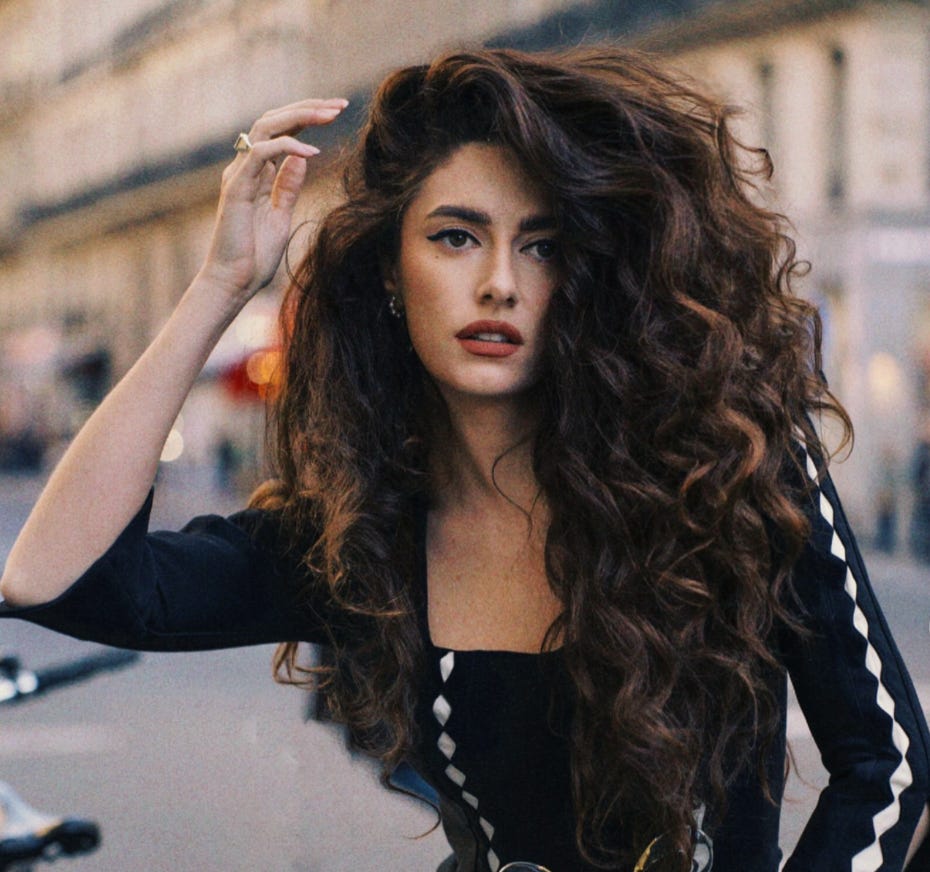
Leanne Ansar is on a Zoom from Paris when she tells me, by way of describing how she finds ideas, that she once watched an apartment dweller on the sixth floor toss a set of keys down to the street, where someone caught them, let themselves in, and walked upstairs.
“That’s magic,” she said. “That moment was beautiful. People ask me where my ideas come from. I’m just looking around me.”
It is late afternoon in Paris. The sky behind her is the indigo of l’heure bleue. Leanne is a French-American creator we co-hosted a retreat with in Tuscany last year, and one in France in 2027. She is the woman behind the romantic-New-York-and-now-Paris feed your most cinematically inclined friend probably already follows. She also spent her first thirty years more literally split than you would think possible: between the village of Rochecorbon, in the Loire Valley, and Beaver County, Pennsylvania, trailer park included, until age fourteen. I asked her, as I ask everyone on the show, for the three places that changed her.
Rochecorbon, in the Loire Valley
The first place Leanne names is the small village of Rochecorbon, fifty minutes by train from Paris, ten minutes from Tours, and the entire emotional weight of one side of her family. Her French grandparents — Jacques and Marie Antoinette — still live there.
“Iconic,” I said.
She agreed, drily.
She spent every summer there until she was twenty-one. Three months a year.
“Every other day,” she said, “my bonpapa and my bonmama would take me to a castle to learn history. Every morning we’d go to the boulangerie for our bread. Then the butcher. Then into town to see my cousins, who worked at the shops, and our friends and neighbours, who were the best framers in France. I was being surrounded by culture and history and art. Constantly.”
She thinks the small specialised shop is where her aesthetic comes from. The framer who only frames. The butcher who only butchers. The boulangerie that does only what it does.
“That’s the heart of who I am,” she said. “And what made me, was definitely Rochecorbon.”
She still goes back at least once a month. She does not put it on her feed.
Beaver County, Pennsylvania
“On one side of me you have this small village French girl in Rochecorbon,” she said. “On the other side, the rest of the year, from age four, I was raised in Beaver County, Pennsylvania.”
It is, she tells me, exactly what it sounds like. “Small town. Country. Woods. Hunting. Trump supporters. Sorry, I don’t want to get political.” Her American grandparents — Bob and Faith — had fifty acres. She mowed lawns, raked grass, walked to the farms for food. Until she was fourteen, the family lived in a trailer park.
“Jacques and Marie Antoinette on one side,” she said. “Bob and Faith on the other. Actual stereotypes of France. Actual stereotypes of America. And I got to feel at home in both.”
The thread between Rochecorbon and Beaver County, she said, was that both of them were almost entirely outdoors. “I’m thirty-three now, and I’m only just realising I’m much more of a nature person than a city person. Looking back, it makes a lot of sense. It’s where I come from.”
New York City, on twelve dollars
The third place was the obvious one, but the way she told it was not.
She had finished her master’s in international business and gone to New York on a three-month, no-salary internship.
“New York is very expensive,” she said. “So you really, really hustle.”
At one point, between paychecks, she had twelve dollars to last five days. She told me what she bought. “Eggs. Bread. Milk. Cereal. Especially if you have butter in the fridge. You’re good.”
She worked her way into being marketing director at France-Amérique, the bilingual cultural magazine that has been in print since the Second World War. Then Covid hit, and Leanne — like a number of women on a number of Zoom calls in the spring of 2020 — looked at the laptop she had been chained to since five in the morning and decided to leave.
She gave herself six months to grow her platform. She told her mother. Her mother — who runs her own travel blog and is, in fact, coming on the retreat — said yes.
In one month, Leanne had a hundred and fifty thousand followers, and four retainer clients booked for the next half-year.
“What do you attribute it to?” I asked.
“I had to make quality content every day,” she said. “Three shoots a day, four days a week. And the niche of romantic New York hadn’t been done. Everyone was doing hipster Brooklyn coffee vibes. I was going to the Upper East Side and dressing like Sophia Loren, asking the question — what would she do if she lived here?”
The dressing test, in case you ever need it, has hardened, in Leanne’s wardrobe, into one phrase she still uses.
“Would Monica Bellucci wear this? No. OK. That, I’m not wearing.”
Two years of being told she was dumb
The other thing she told me is that for two years, before any of the romantic-New-York work happened, she had stopped creating entirely.
“Friends, family, people who didn’t even know me,” she said. “They all said it was dumb. Trying to be an influencer. I heard it so many times. No one believes in you until you’re successful. It’s the nastiest thing. It shut me down for two years.”
I asked how she came back from that. She paused.
“Honestly? I don’t even know how I overcame it. Creating was my escapism. So it spoke louder than my insecurities.”
Magic is real
We came back, near the end, to the keys from the sixth-floor window.
“Magic is one hundred per cent real,” Leanne said. “Once you change your mindset to realise the sky is actually this beautiful colour of indigo, that the lights are coming on at different times because people need light at different times — every human is magic. The stars are magic. The moon is magic. We are walking magic. The fact that we are living, statistically, is so improbable that we are. Seeing life that way has helped me, just, live happily.”
The three books Leanne named on the episode
The Nightingale by Kristin Hannah. Set in the Loire Valley, in occupied France, very near where Leanne was born. “It brings me back to my hometown, and to the strength of the French people, and to the strength of two young French women.”
Circe by Madeline Miller. “Read it in Greece if you can. I read it on a boat in Symi, near Rhodes. Hermes was flying through the sky in the book, and I looked up at the sun and I was on a boat in Greece looking at the sun. It was something.”
The Monster of Florence by Douglas Preston. A true-crime account of a still-unsolved series of killings in the Tuscan hills in the late 1970s. “There’s a very good hypothesis at the end. But it’s still unsolved today.”
Listen now
The full conversation with Leanne is on Three Places on Spotify.
Comments
Nothing yet. Say the first thing.
Sign in to join the conversation.