
A note for paid subscribers: After the main article, I'll be sharing a few additional mentoring reflections and practical planning questions. I'll see you at the end!
I get it. I’ve totally been there. Every summer there comes a point when you start looking around and thinking, Okay...I should probably get started.
You’ve had a few weeks to sleep in, spend time in the garden, travel a little, and frankly enjoy NOT having to think about tomorrow’s lesson or the adorable little angels in your class. And then, somewhere in the back of your mind, the next school year begins to tap you on the shoulder.
I always think summer planning is a balancing act. We need the rest—I mean that is a true fact! And though there have been some years when the appeal of a fresh start is so captivating I buy my new planner before school gets out, I don’t think this is necessarily the best approach. I don’t think we should rush into planning the moment school gets out.
But at the same time, September will feel SO much better if we’ve taken a little time during the summer to prepare thoughtfully.
So when you do finally sit down and get to work, the temptation, of course, is to dive straight into lesson plans. Fill that planner and sort out what exactly you’ll be teaching. That daily two-hour main lesson won’t fill itself!
I’ve done it myself more times than I can count.
I sit down with the curriculum books, start outlining the first block, and dive headlong into Botany, Hebrew Legends, or Form Drawing. Inevitably, I realize at some point that I can’t really plan the individual block, without developing picture of the whole year. Unfortunately, this often happens after two weeks of puttering around with resources and not really getting anywhere.
Over the years I’ve found that I have a much better experience if I slow down a little and begin somewhere else.
Here are the four places I always recommend starting.
I’m not talking about ordering classroom supplies.
I’m talking about your supplies.
The sketchbook you love writing in. The pens that make you want to sit down and work. A fresh planner. Maybe a new notebook. Whatever makes the planning process feel inviting. (And if you want some suggestions, check out my favorites.)
This might sound like procrastination, but really, it’s not.
There’s something about creating a beautiful workspace that makes planning feel less like another task on the to-do list and more like a creative project you’re looking forward to. And if you think about it, this is why we spend so much time beautifying our classrooms for our students. Don’t we deserve the same care and attention?
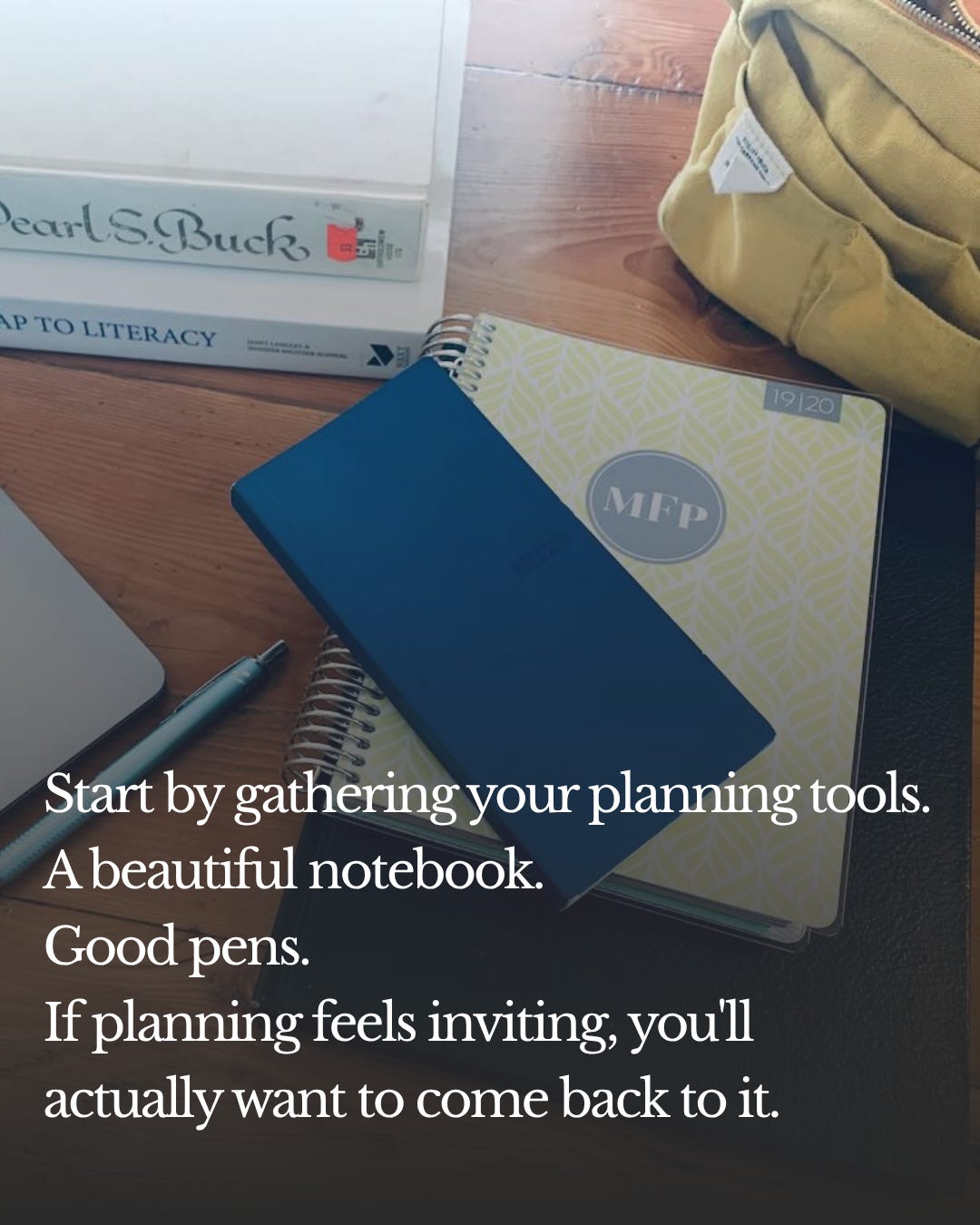
For me, that’s always the first little step. Before I ask myself to do the hard thinking, I create a space that makes me want to come back tomorrow.
(And, to be honest, this is my secret hack for making my Sunday planning more enjoyable, too. My favorite fountain pen only gets used in my lesson planner. It’s like the spoonful of sugar!)
We know that Waldorf education is all about the development of the child. How many hours in our teacher training were dedicated to understanding human development? A lot!
And we may think that we’ve got all that child development understanding internalized, but I’ve been at this for 20 years, and I still give myself a little refresher every summer. Have you ever found yourself completely surprised and maybe even a little flummoxed by student behavior that you later realized, “Oh yeah, that’s classic 2nd grade!”
You could’ve saved yourself the emotional energy by brushing up on child development ahead of time. Then, when they ask tons of questions about tiny details, or start crying at drop-off again, or come to you to settle arguments after every recess, you’ll nod and smile thinking, “Aha, I knew this was coming!”
Before I think very much about what I’m teaching, I want to spend time thinking about who I’m teaching.
What is happening developmentally at this age?
What capacities are emerging?
What questions is this stage of childhood asking?
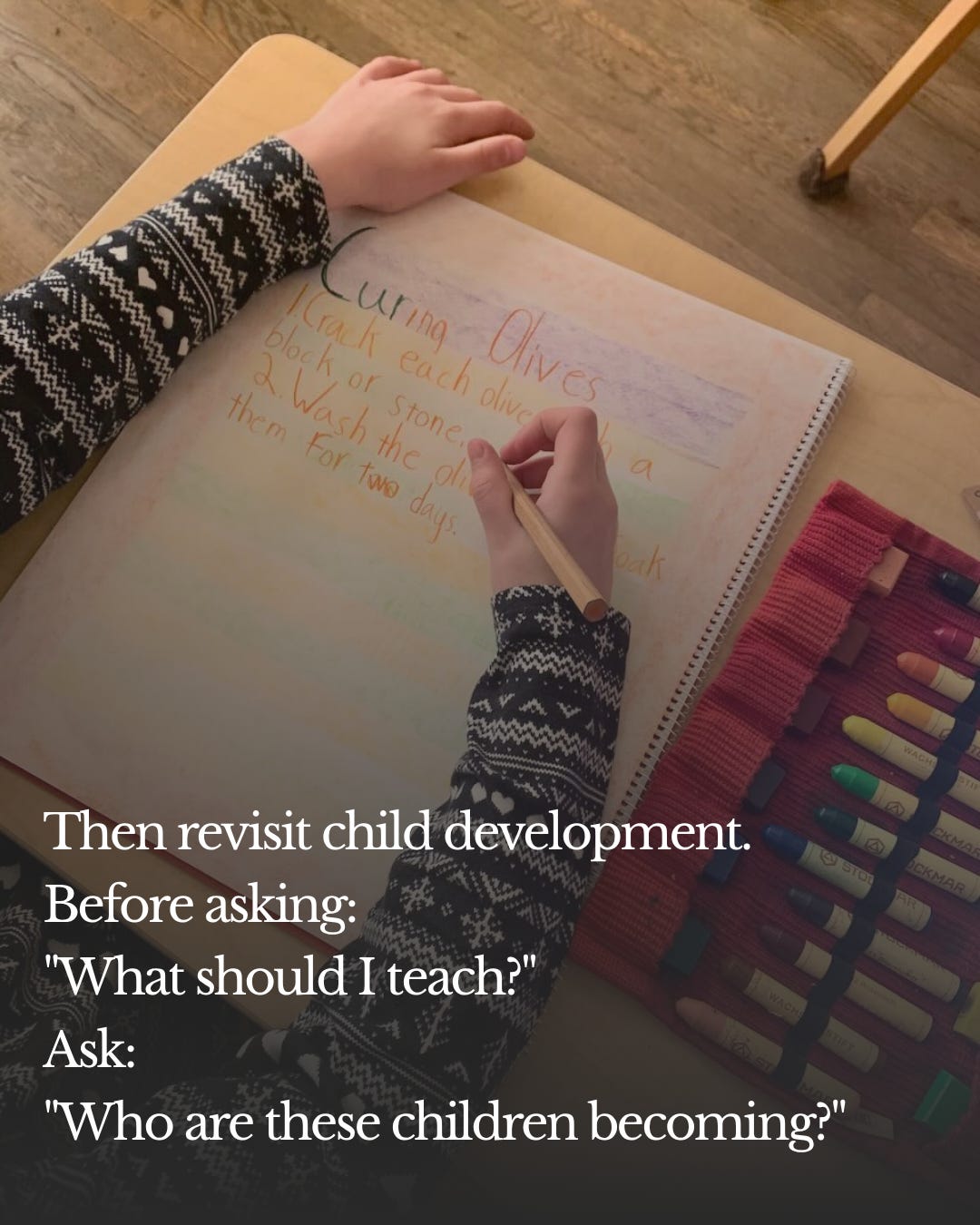
I like to return to books like School as a Journey, the big yellow curriculum guide, and Steiner’s lectures. But I also reflect on the children themselves.
If I’m returning to teach the same group I taught last year, I’ve found it helpful to spend some time journaling about a few individual students who feel pretty representative of what’s going on in the class as a whole. What changed this spring? What surprised me? What social shifts did I notice? Sometimes the end of the school year gives us a glimpse of who they’ll become in the fall.
For me, that’s the real foundation of planning.
Only after I’ve spent time thinking about the children do I begin thinking about the year itself.
Not the daily plans, or even the individual blocks.
Just the shape of the year.
I like to move month by month and think about the seasons, festivals, school events, field trips, concerts, holidays, and the natural breathing rhythm of the year.
Once that larger picture starts to emerge, placing the blocks becomes much easier. Instead of fitting everything into the calendar wherever it happens to fit, the curriculum begins to feel like it belongs exactly where it is.
Some blocks fit best in the fall or spring, when the weather is nice and there’s room for an outbreath. Others are focused and inward, and are actually hard to do at this time of year. Thinking through the year in this way will help make sure the placement of your blocks of study is optimized for the yearly rhythm.
Okay, this one might surprise you (considering I actually sell curriculum resources for teachers), but truly, there is no replacement for the curiosity and enthusiasm that arises when you do your own research.
Don’t get me wrong, there is a time and place for packaged curriculum resources, lesson plans, and ideas from other teachers. I create those resources myself because I know how helpful they can be.
But at the beginning of summer, it’s worth spending some time with the primary material first. Read the history. Watch the documentary. Find the biography. Go to the library.
Become interested in the subject yourself.
This experience of discovery, and the enthusiasm and excitement it can create, is what we try to awaken in our students every day. Don’t we deserve the same experience? Don’t just go find the information. Get curious! I’ll never forget the first time I taught the 6th grade Rocks and Minerals block. I was utterly fascinated as I prepared the content. Who knew that ROCKS could be so interesting!
When we discover something ourselves, our teaching becomes more alive. We aren’t simply passing along someone else’s understanding—we’re sharing our own enthusiasm.
That’s a very different experience for us, and for our students.
These four steps won’t produce a finished lesson plan.
They won’t fill your planner.
But they will give you something much more valuable: a strong foundation.
When the time comes to sit down and write your blocks, you’ll know the children more deeply, you’ll have a clearer picture of the year, and you’ll be planning from understanding instead of from urgency.
If you’d like to hear me talk through these ideas in a little more detail, this week’s podcast episode explores each of these four starting points and the reasoning behind them. And if you’re looking for a more guided approach to summer planning, that’s exactly why I created Summer Vision—a course to help teachers enjoy both the rest of summer and the satisfaction of feeling genuinely prepared for the year ahead.
Below, I’m sharing some of the things that don’t fit neatly into a podcast episode—the planning mistakes I’ve made, the questions I return to every summer, and a few mentoring reflections from more than twenty years in the classroom.
Paid subscribers can continue reading below, and if you’re a free subscriber, I’d love to have you join us.
Comments
Nothing yet. Say the first thing.
Sign in to join the conversation.