
Welcome to Awaken Tango’s new Substack. We are proud to begin sharing findings from the Inner Experience of Tango report. Here is the first post. I’m grateful to the tango community for participating in the research project and your patience, and hope you find it helpful. Mitra
As part of the Tango Inner Experience research project, we asked people to rate how impactful nineteen different kinds of experiences had been on their tango growth.
We discovered five main categories of growth factors. These categories came from a technique called factor analysis, which creates groupings based on the pattern of responses from the individuals. In factor analysis, the items within each group are closely correlated with one another. That means, if someone chose one of the items in a group, they were also likely to choose another item in the same group. Each of the groups are also statistically distinct from one another. The five groups, which we created labels for, were:
Concentrated immersive learning: Private lessons, and Trips to Argentina
Local tango activities: Local milongas, Local practicas, and Group classes
Beyond social dancing: Becoming a teacher, Learning to DJ, Becoming a community organizer, Competing in tango competitions
Big weekend events: Festivals, Marathons, and Encuentros
Tango-related content: Studying tango through videos, Lectures about tango, Reading tango books, Participating in tango social media, Reading tango blogs
And, there were also two items that weren’t strongly correlated with any other items: Practicing with a partner, and Socializing with tango people
As you’re reading, take a moment to consider: Does one or two of these categories stand out to you as especially impactful when it comes to your own growth as a tango dancer? Are there other activities, not mentioned here, that are impactful for you?
In the below chart, the average rating for each of the categories is shown. Also, there is a teeny-tiny blue dot representing average response across the category for each 981 tango people who took the survey.1 Now you can see how your answers relate with this group.
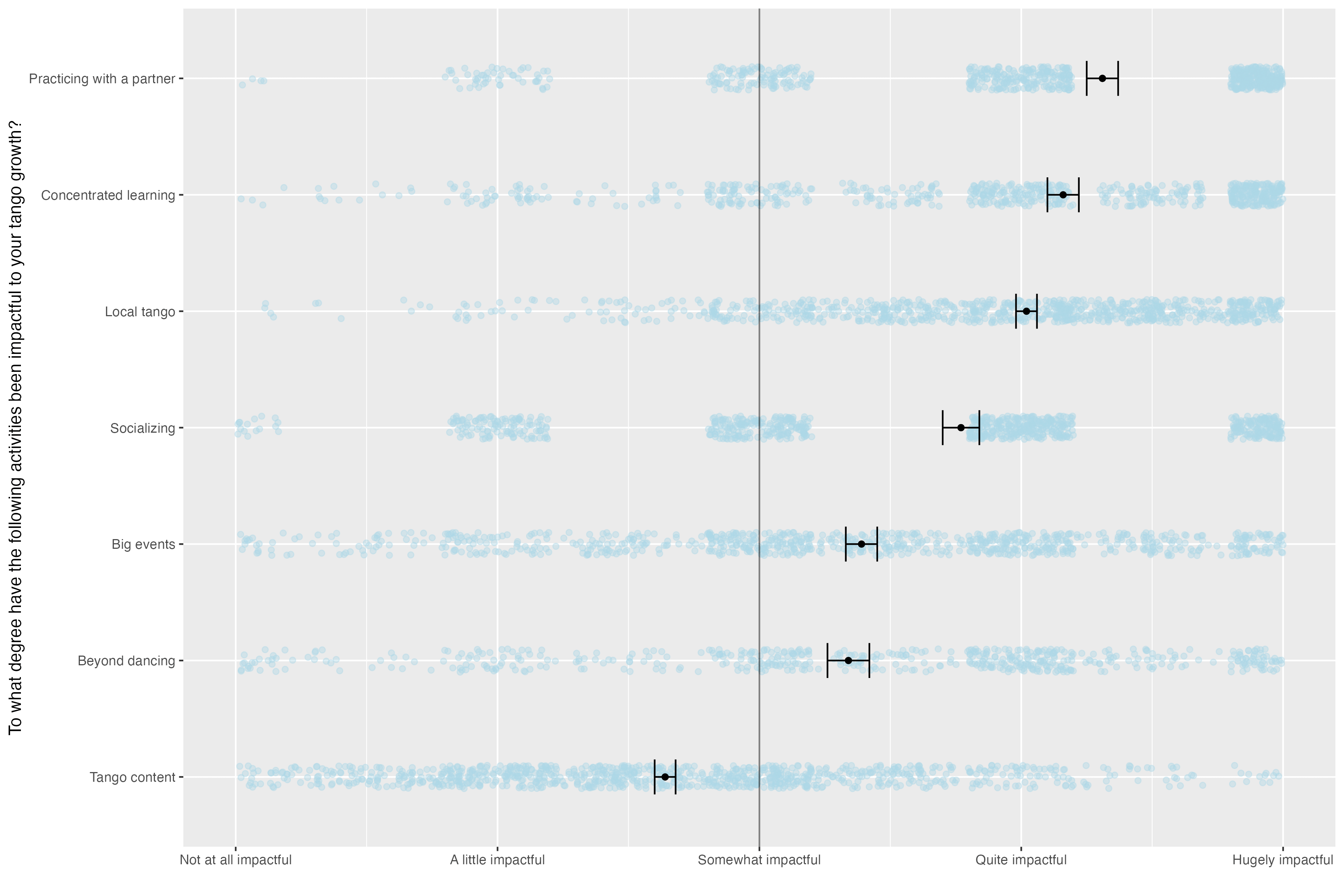
For each type of activity, there was a large spread of perceived impactfulness. That means, for any given activity, there are some people who found it impactful, some who did not, and some who were in-between. That suggests that since what is going to improve your tango can vary quite a bit, it’s worth experimenting with different kinds of inputs. Something that very few others find useful could, in fact, help you out a lot.
For instance, consider the category of consuming Tango-related content (like this article). For a lot folks, this activity hasn’t been tremendously impactful to their tango growth. But, there is this geeky handful of people for whom it’s had a tremendous impact.
It’s the same for the other factors. While most people might get a ton out of their private lessons or Buenos Aires trip, it’s not a surefire sign that you will. These data remind us how unique each of us is, and how important it is to listen to our own inclinations as we navigate the tango learning landscape.
That said, if you’re unsure about how to proceed with your tango growth, or you’ve hit a plateau and feel you need to shake up your approach, it might be helpful to know what lots of people tend to usually find impactful, which is indicated by the averages in the above chart.
If you’re not sure where to start, the data suggest three rules of thumb:
Focus on those activities in which you are standing in front of another human being and dancing the tango. On average, people tended to find activities such as private lessons, practicing with a partner, and dancing socially, more effective than non-dancing activities such as organizing events, learning to DJ, teaching tango, or consuming content.
Focus on activities close to home. On average, people tended to find local tango activities more effective than big events.
Build relationships with tango peers. Finally, the data show that our tango peers can be hugely impactful to our growth. On average, practicing with a partner was even more impactful than the most concentrated immersive experiences. And simply socializing with tango people was more impactful than many other activities. Focusing on learning from and with the people around you is an impactful and accessible way to grow.
These findings resonate with my own (Mitra’s) experience. They also surprised me. For instance, it was good to be reminded that while learning to DJ has been incredibly impactful for me, it’s not the same for everyone.
We are all different and will probably find different experiences valuable at different times in our tango journey. If you’re lost in the foothills, remember that the journey of growing as a dancer requires first and foremost: dancing tango. Cherish your partners, friends, and your local community, because that’s where the magic is likely to happen.
Think of a time when you felt you were really growing as a tango dancer. What was your mix of inputs and influences? How does it compare/contrast with the data?
How do you feel about your growth as a tango dancer right now? Are you interested in experimenting with new activities that might have an impact? If so, which ones are you drawn to trying? What is your next step?
We’re looking forward to sharing more from the Inner Experience study later this year.
[We hope that this content fosters high quality conversation among tango community members. Awaken Tango does not have the capacity to create space for and moderate conversations online, which is why Comments are not available on this or other posts.]
No posts
Comments
Nothing yet. Say the first thing.
Sign in to join the conversation.