
Hi everyone,
“To the world we dream about — and the one we live in now!”
- Orpheus, in Anais Mitchell’s Hadestown
What kind of tango world do you wish existed?
What’s a tiny thing you could do to build it — this month, this week, today?
This post shares some notes from my recent fieldwork. I’ve been partnering with tango facilitators to build “tango worlds” worth spending time in, and immersing in innovation-focused environments. Here’s what it includes:
Pop-up village recap: the innovative culture of Edge Esmeralda
A controversial DJ take: Do cortinas support the goals of prácticas?
The ideal learning environment: ways to prioritize motivation, vs content
Spotlight Minneapolis: A growing tango innovation ecosystem
On big fat creative risks: An invitation to take more, and normalize mistakes
Free resource for tango facilitators: Patterns of Everyday Care cards
Supercharge your practice: Tango Fairytale Game cards now available again
I’m pretty alert to the the vibes of a place. Whether that place is a dinner party, a marathon, or an embrace: either I open up, or go inward.
There is an art to creating places that encourage people to open up: to be themselves, to play, and, if all goes well, to create, contribute, collaborate from an authentic place. I discovered a new place like this this year.
Edge Esmeralda was a pop-up village that brought together around 800 innovators including artists, founders, scientists, innovators, and their kids for a month in Healdsburg CA this June. And there were even a few tango dancers in residence!
What made it transformative was the systematic, explicit, ongoing invitation to step into creative agency. Leadership modeled this, facilitated it, celebrated it.
I hosted the village’s intergenerational program, Edge Tomorrow, which served 22 families. In our village-within-a-village, the culture that the kids forged mirrored these qualities. One of the group agreements that they insisted on, week after week, was “Weirdness is welcome.” Read more about what happened here.
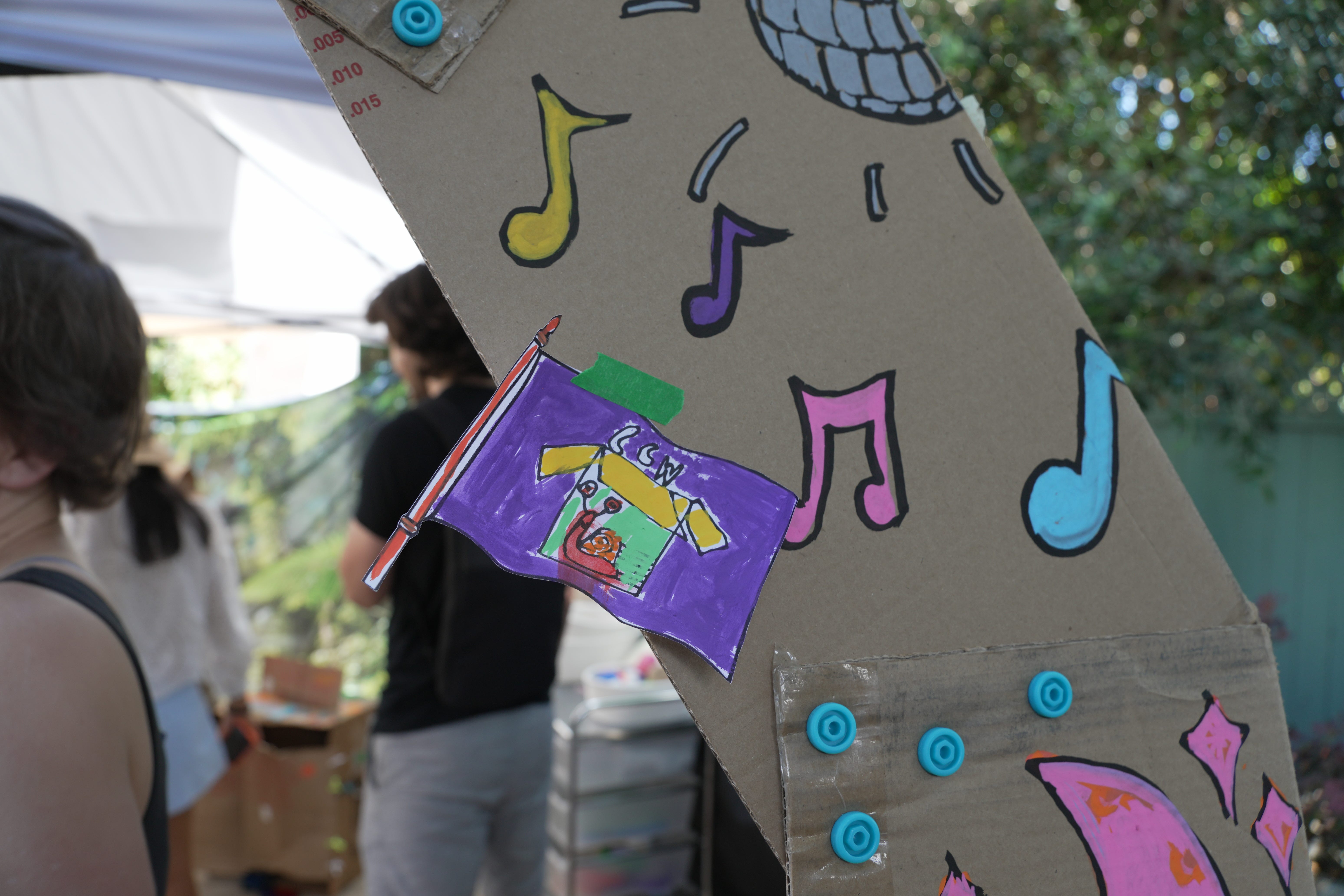
Leaving Edge Esmeralda, the contrast was stark. Outside of this world, it was normal to engage wild new ideas with doubt or skepticism, insetad of curiosity.
What would our tango communities be like if we made it a point to create a culture of permission and liberation?
If you’re interested in a culture of possibility and love creative multi-age learning, join us in Goa for the next Edge Tomorrow, October 11-November 3. Apply here.
I remember long days practicing at Estudio Dinzel in Buenos Aires in the early 2000s. It was the one place that felt like my tango home there: truly inclusive, wildly creative, deeply resourced.
For some crazy cheap price (40 pesos?), I got a pass that included all-day prácticas, four days a week. We’d practice and practice and practice, and then take breaks sitting on the stoop in the courtyard, enjoying dulce de leche crêpes from the grill.
Those practices were profound, productive, and worldbuilding for me. They were everything I needed in a tango learning environment: skilled and curious partners, endless time, a good wood floor, snacks, and music. What they didn’t include: cortinas.
Music was collaboratively “dj’d” by the participants with CDs. Someone chose a CD from a pile, we danced. When it was done, someone else put a different one in. The musical landscape was perfect for practice. We didn’t stop before we had gotten somewhere with our practice and arbitrarily switch partners, just because “cortina”.
I think that cortinas milongify prácticas (wow, that’s a weird looking sentence!). I don’t think they are necessary, if you come with a sincere practice agenda. What about trying a cortina-free práctica and seeing what it does for you?
Comments are open to paying subscribers — welcome your input and lively discussion!
In my work with tango teachers, we tackle the thorny problems of how to recruit and retain beginning dancers, and how to motivate and engage intermediate dancers.
Many teachers think they can solve these problems by focusing on content. What to teach? What steps in which order? Which techniques? Which teachers? How do I make sure they are dancing tango well?
But a persona can have the most beautiful curriculum and perfect pedagogy and still have a tiny, struggling community. Why? Because they didn’t optimize for learner motivation.
Motivation-first tango facilitation is about creating the conditions that ignite someone’s passion and catalyze their commitment to become the best dancer they can be. It is more about context than content.
When Stefan and I were founding Oxygen Tango, we thought a lot about this. One resource that inspired us a lot was this piece by Robin Good, The 10 Key Components of an Ideal Learning Environment. As we built Oxygen Tango, we worked hard to include these layers.
But there’s a difference between knowing this and actually implementing it. Today it’s very rewarding for me to be mentoring a group of amazing Tango teachers who are putting in the hard, detailed and satisfying work of creating tango worlds that unlock motivation. If you want to join us, apply to the Tango Guild. Our next cohort opens in September.
Join the next Tango Guild Cohort
The Minneapolis tango community is one of those rare ones that keeps the focus on innovation and growth. Hosting the first tango worldbuilder weekend there was such a joy because of Minneapolis’ wonderful tango culture.
One thing that fuels and energizes Minneapolis tango is the explosive musical innovation spearheaded by Charles Gorczynski. Charles runs several ensembles and is a deeply inclusive and energized facilitator.
In the Twin Cities, there is a strong culture of learning and dancing both roles, which gives the scene an inclusive, collaborative, non-judgy, non-competitive feeling. Participants were open to experimental tango spaces where we could create new kinds of explorations supported by nontraditional DJing and open investigation. The Tango Society of Minneapolis, the city’s main tango non-profit, even provided a grant to support bringing a peer-to-peer learning lab to the community.
The serious interest in learning and pedagogy is modeled and guided by Sabine Ibes of Tango And I. Sabine’s interest in models of tango learning, openness to new thinking, grounded observation skills, and deep care for her community members makes her a gift to her tango community. And she knows how to create a party!
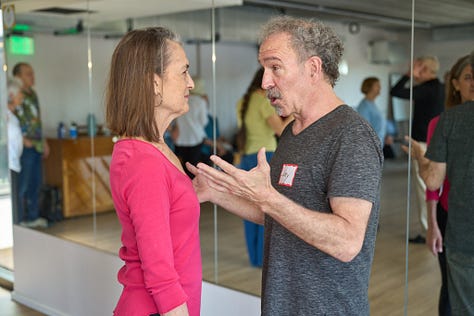
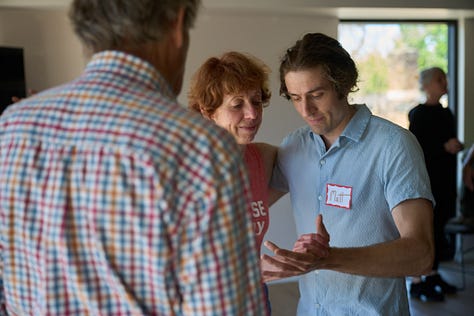
“What kind of tango world do you wish existed?” We started our weekend in Minneapolis with 10 community leaders and that question. I’m so inspired by the new thinking and experiments they designed: tango challenges introducing music to tango spouses, creating tango short films, supporting women leaders, healing toxic masculinity.
This weekend made me hopeful about the tango world we’re going to see over the next few years as people like this step into authorship.
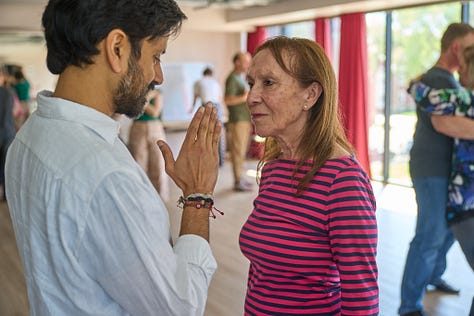
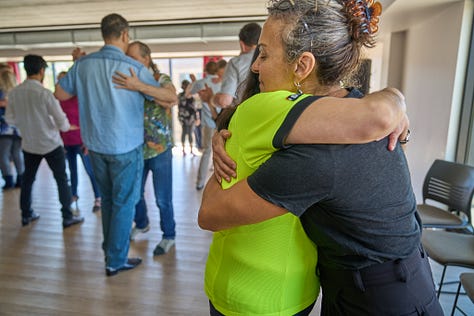
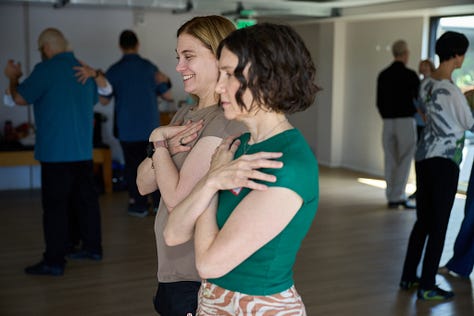
Cheers to Liz Sabiatuk, who continues to be a voice encouraging and amplifying authenticity and humanity in our tango world through the Humans of Tango podcast. Recently she shared a new excerpt from my conversation with her last fall on the topic of creative risk taking.
Tango facilitators and community members in tango leadership, I encourage you to check out I absolutely loved this beautifully-researched and clearly-produced digital card deck that articulates “patterns of care” in a well-functioning community.
The “Habits” and “Atmosphere” sections opened up a lot of new space for me, and made me consider some community-building blind spots I have. I also spent a lot of time sitting with the ones in the “Boundary” section. This one, “Departures and Protections” opens up some space that requires thoughtful discernment.
The wait is over. I’m excited to announce I’m reopening the online store where you can get this little magic deck of tango practice cards, along with an online email course to help you. use them.
Once you get into it, this deck is gamechanging. Here’s a story: I wasn’t sure what to practice, when I went to práctica last week with my partner. But I brought my deck and we randomly chose the following cards:
Octopus Ostrich Eleanor Buddha Orphan
Wow! It kept us busy for a good hour. We explored different amounts of pivot and step size, and we worked it on both sides of the embrace. It was an unexpected, charming combination to follow, a fun challenge to lead, and definitely got me out of my patterns. I can’t tell you how satisyfing it is to have a concrete focus in práctica. And it makes dancing later feel so much smoother and more alive!
Supercharge your tango and grab your Tango Fairytale Game cards today.
Thank you for getting all the way to the end. If you’ve found this valuable, please take a look at the new subscription levels and benefits.
Warmly, Mitra
PS, If you haven’t yet seen the Hadestown pro-shoot in theaters— it’s epic! See this story about the way that the world could be — in spite of the way that it is.
No posts
Comments
Nothing yet. Say the first thing.
Sign in to join the conversation.