
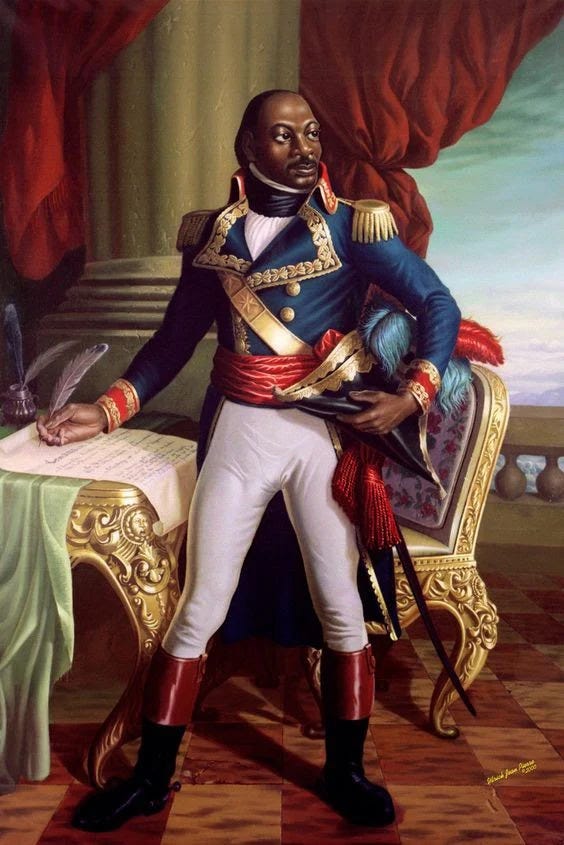
May is almost over, which means we’ll be shifting to read the next book y’all voted for, which is “Pedagogy of the Oppressed” by Paulo Freire next week!
Before we officially begin, I wanted to share “The Black Jacobins” discussion questions we unpacked together during our IRL gathering in Miami last Sunday!
My hope is that this helps guide you to revisit what may have come up along the past 8 weeks.
With care,
“The Property” (Ch 1) explores how enslaved people were brought to San Domingo, and the conditions they experienced on the island–all of the details being of course appalling. Consider the ways that history, in the West, had to be strategically taught in order for the U.S. and European powers to avoid accountability for their participation in the slave trade; and thus amassing immense wealth as a result of imperial pursuits. What comes up for you?
In “The San Domingo Masses Begin” (Ch 4), we learn about how the revolts began, and how much subversive coordination was required to disrupt “business as usual” on the plantations.What aspect(s) of their approach to organizing stood out to you the most?
Jean Francois and Biassou were the early leaders of the slave revolts. Yet, most times their names aren’t at the top of people’s minds when they think about the Haitian Revolution. Without them, the revolution as we know it today wouldn’t have been possible; Jean Jacques Dessalines and Toussaint L’Ouverture wouldn’t have had a revolutionary movement to join. What does this say about how history is often told? In the end, should legacy be measured in how history remembers you, or is there more to it?
Upon learning that many of the mixed race people in San Domingo were against the liberation of the enslaved, how did that compute in your mind?
Toussaint was in many ways a genius. He outmaneuvered and out strategized the most advanced military generals across European empires. He did this having received very little formal education. So often, people are counted out for not attending the right schools or having privileged access, but they possess innate genius. How do you think that this phenomenon impacts and applies to our society today?
Throughout the book, C.L.R James makes it a point to emphasize that Toussaint tried his best to spare bloodshed–even if that meant not harming planters who had a history of abusing enslaved people. This approach differed from that of other leaders. It was this empathy and way of being that so many admired in Toussaint, he treated every person like a person. However, it’s also what ultimately led to him being sequestered by the French and dying alone in exile. What do you make of this?
Toussaint wanted to maintain a relationship with the French because he believed that without them, the formerly enslaved wouldn’t know how to comport. He viewed them as a model. He desired for his people to act like “civilized society”---as determined by the Europeans. His new republic would ban slavery, but customs would still be influenced by the French, including pardons of egregious behavior conducted before the revolution. Was he naive to think this way? If he hadn’t adopted European ways of being, what other sources of inspiration could he have turned to?
Your turn! Drop a question related to the book in the comments below that we can all respond to. 👇🏽👇🏽👇🏽👇🏽👇🏽
No posts
Comments
Nothing yet. Say the first thing.
Sign in to join the conversation.