
(If you have received this by email, please click on the title to read the latest version. I often correct typos and continue to edit my essays after publishing the first version).
Strip away the tailored suits, the tech campuses, the diplomatic language, and what you find underneath is surprisingly simple: a primitive creature doing whatever it takes to survive. Our imperialist and colonial mindset — whether it shows up in wars, in economics, or in the way a parent dominates a child — is not a sophisticated system. It is survivalism, glorified. The tech billionaires, the disordered people in positions of power, the architects of endless war — they are not visionaries. They are frightened creatures hoarding resources, exactly as our ancestors did, only with far more devastating tools at their disposal. Trump’s ignorance and crassness exposes a truth that more sophisticated survivalists were always careful to hide. Too many people still view successful survivalists with an awe they don’t deserve, instead of seeing them for what they are — successful at surviving, but not so much at being human.
We still behave as if we are running across an ice age savannah in rabbit skins, scanning for predators, hoarding what we can, trusting almost no one. Modern humans with brains just like ours faced massive and dangerous predators who either hunted them or competed with them for food. Life was not safe or easy for our ancestors, and the evidence isn’t only in what we find buried in the ground. It is alive in our psychology, in the patterns we enact, and in how we still organise ourselves as societies. The evidence of where we come from is in who we are now. We are the descendants of those who were good at surviving. That is our inheritance, and it shows.
Our ancestors faced genuine existential threats: massive predators that hunted them, brutal competition for food, the ever-present possibility of extinction. The ones who survived were not necessarily the most empathic. Feeling empathy towards a hungry smilodon (sabre-toothed ‘tiger’) about to pounce and eat you or your child probably didn’t enable survival as well as the instinctual, fear-based, survivalist limbic fight-flight-freeze system. Equally, feeling empathy towards the antelope or bison you were about to hunt to feed your group didn’t work so well for physical survival. We are the descendants of those for whom fear and aggression worked. This isn’t a moral judgement. It is simply what happened.
Empathy is still with us — thank goodness. It’s evident for example in the growing number of humans who are moving towards plant based or vegetarian diets, or who oppose war and refuse to serve in armed forces. But empathy and compassion are not the dominant forces in the world. The dominant aspect of us, the one that still runs most of our institutions, our economies, that wages our wars, is the limbic system’s ancient, fear-driven imperative — dominate or be dominated, hoard or go hungry, stay vigilant, don’t lower your guard and don’t trust outsiders.
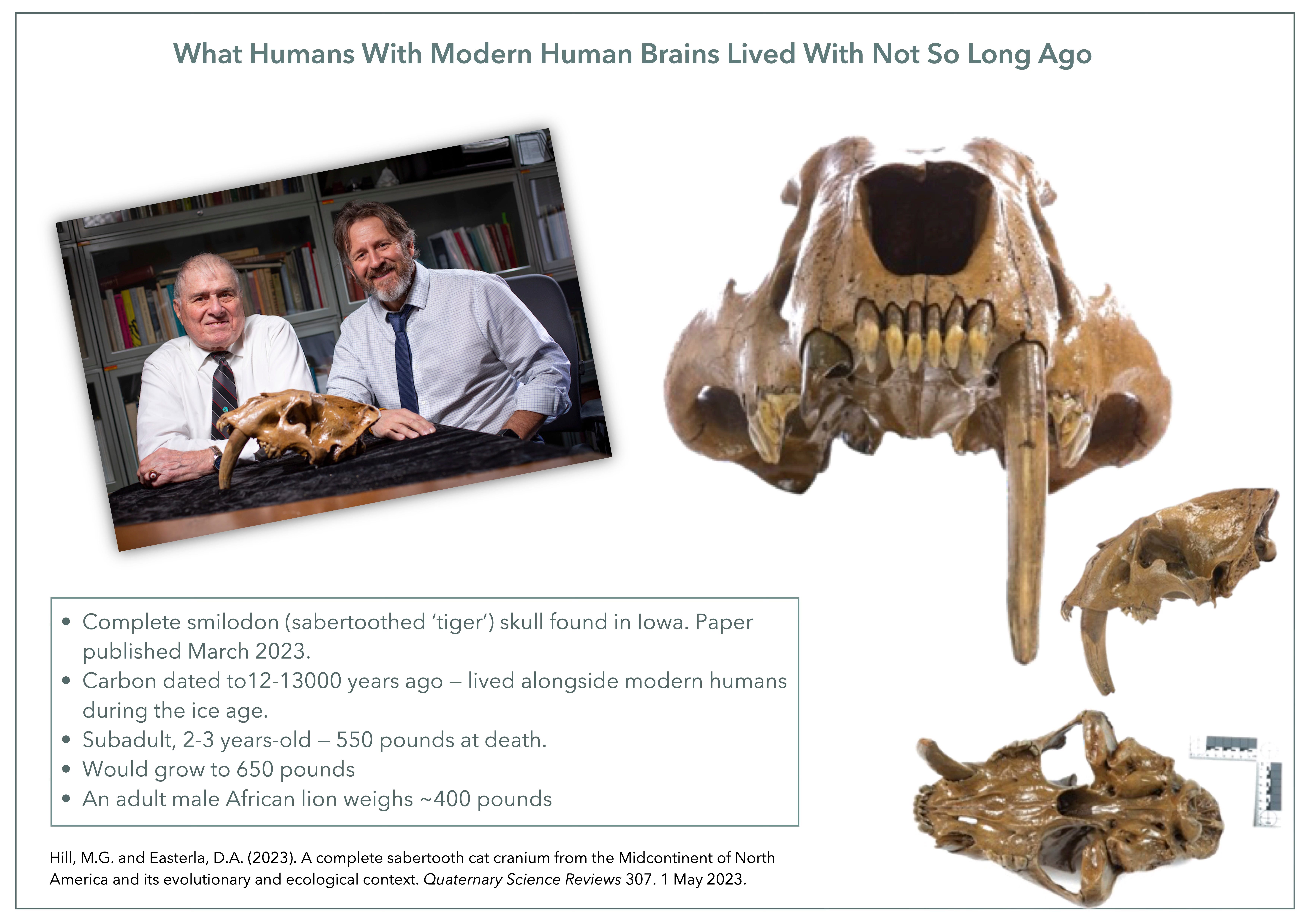
What makes our situation tragic rather than merely unfortunate is that the threats that shaped us are mostly gone. There are no smilodons or giant hyenas — they are extinct. There is enough food on this planet to feed everyone. The dog-eat-dog reality we continue to live by — the wars, the ruthless competition, our never-ending ‘othering’, the casual cruelty and cold-heartedness of our economic systems — is now entirely of our own making, and entirely unnecessary. We are running ancient survival software on a problem that no longer exists. At their root, imperialism and capitalism are just hoarding and eliminating competition. The same instinct that once drove our ancestors to secure the lion’s share of berries from the forest floor, or fish from the nearest river, is now scaled up into the control of labour forces, raw materials, trade routes, and real estate. The predator is still doing exactly what predators do. The difference is that there is no longer any excuse for it.
Those who feel themselves entitled — usually those without empathy — are humanity’s apex predators. But they cannot do what they do alone. They never could. For every ruthless, empathy-free operator at the top of the human food chain, there are thousands of essentially decent people enabling them — not out of malice, but out of their own survivalism. Those who help humanity’s apex predators have simply made a calculation: they may not have what it takes to reach the top, but proximity to power has its rewards. They settle for the scraps that come their way when the predator they serve is feeding. The more successful the predator, the bigger and more nourishing the scraps. This is how predation comes to drive and organise everything we call civilisation in a world where survival is the dominant imperative.
Democracy was a genuine attempt to elevate us from primitive brutes to beings with a more universal and inclusive mindset. The idea was that every person’s survival and flourishing mattered equally, and that no one was entitled to dominate anyone else. Power belongs to the people — to everyone. Elected leaders are lent some of this power temporarily, in order to serve those who elected them. But democracy was compromised at its very origins. Athenian democracy, the model we still invoke, was built on the labour of slaves and the systematic exclusion of women and foreigners — groups that together constituted the vast majority of the population. Democracy for some, domination for everyone else, was never really democracy at all. It took thousands of years of struggle to extend even partial democratic benefits more widely, and that extension remains incomplete and uneven across the globe.
The pattern of hijacking has never stopped. Caesar retained the institutions of the Roman Republic whilst gutting their substance. Napoleon did the same with the French Revolution’s ideals. In our time, democracy has been hijacked by billionaires who are either in power themselves or have disproportionate influence on those who were elected to serve. The result is a system that preserves democracy’s institutions whilst continuing to hollow out their substance.
Democracy is not what it should have been — a way to enable everyone to live safely and well and to grow to their potential. It has been rapidly reduced to a poor mitigator of the worst excesses of the survivalist mindset. We live with the performance of democracy but not its true spirit. And yet democracy, or something that grows beyond it, is not wrong. It is premature. It has been a failed experiment not because the idea was bad, but because it keeps being handed to people who have not yet outgrown the psychology it was designed to replace. In a society of genuinely mature human beings, something like it would arise naturally, without anyone having to fight for it.
We are not well put-together. It is quite possible we are a failed species — and the particular cruelty of our situation is that we are self-aware. Whatever is coming, if we continue on our present path, we will know exactly what is happening and why. We will have no excuse of ignorance. Self-awareness was always a double-edged gift. It is the source of our suffering — we can see ourselves, and we can see the gap between what we are and what we could be — but it is also our only real hope of closing it. The same brain regions that give us self-awareness give us our humanity. They are not separate things.
My heart breaks most for the children. Most of them are never given a chance. The adults around them should show them the way towards their potential — but adults cannot teach what they don’t know. Too many children grow up not only without good models, but in the presence of active predators — in their own homes, in the very families that are supposed to protect them and guide them towards their full humanness. Almost everyone in society fails young people. And beyond their own homes and schools, the world itself is failing them. Children are routinely murdered, maimed, displaced, and traumatised in wars and genocides they did nothing to cause — whole generations of young lives destroyed before they have had a chance to begin. It is not surprising that so many develop what we call ‘mental health problems’, and go on to repeat the same patterns as their parents and grandparents before them, all the way back to our earliest beginnings.
The fault does not lie only with the imperialistic entitled ‘alphas’ among us. We enable them. We have always enabled them. And we can no longer blame ignorance. Despite everything we know about our history, despite watching the same patterns repeat themselves with numbing familiarity, we continue to give power to the wrong people, and then express shock when they use it as predators do. Our limbic system always prefers what it already knows, however destructive, over the uncertainty of something genuinely different. We are all implicated — not equally, not in the same ways, but we all play our parts: as predators, as enablers, or as people who have simply stopped believing that anything else is possible.
There is a way out of this. I have lived and breathed it in my work, week after week, for nearly three decades. But the way out requires something most people find harder than suffering: the willingness to change.
Most people either don’t believe change is possible, or they surrender to the ancient ‘devil we know’ strategy that helped our ancestors survive on a dangerous planet but serves us very poorly now. Most people hold on to what little they have for dear life, continue to cope, continue to suffer, and will not risk the uncertainty of something different. And who can blame them? Every baby arrives in the world with an intact, unconscious hope — that they will be welcomed, that they will be helped to become whatever they are capable of becoming. Almost immediately, that hope begins to be crushed. What most children discover, very early, is that the only life on offer is a life of survival. Their families, schools, the societies around them teach them that survivalism, earning a living, getting ahead, is the only thing that matters and the only thing to look forward to. Not potential. Not becoming.
This is not a problem of poverty or privilege. It permeates every class, every culture, every society on earth. Wherever survivalism dominates, mental health always suffers. A life of survivalism for a human is a psychological dead end — a life sentence of chronic anxiety and depression. These conditions are not a sign of individual sickness. They are the entirely predictable result of asking a human being — a creature with an enormous potential for growth — to spend their whole life merely surviving. Our mental health crisis is not a medical problem. It’s a social one. We are focusing on the wrong thing.
But my clients know what the right thing is. One day they decide that enough is enough. The cost of staying the same has finally outweighed the fear of changing. What they discover is that their desire for wholeness has always been there — intact, waiting to be encouraged, nourished and supported. Just like me, they had never seen it modelled, and had often been actively discouraged from believing it was there, or that it was important. Therapy is not a process of fixing something broken. My clients are not broken. They are healthy people who were never given the right conditions or guidance to develop towards their full humanness. They are walking into the unknown because none of them have ever seen a model of what a genuinely well-integrated human being actually looks like. But they find the courage to begin because they tried the alternative and it nearly destroyed them.
In my own case it was not courage that drove me to change. It was desperation. The life I knew — lived in the shadow of childhood abuse and trauma, in a bleak, survivalist society — was something I simply could not imagine continuing. I didn’t want it anymore. I had had enough. I took the risk, walked into the unknown, and discovered it was not nearly as dangerous as what I was leaving behind.
We do not all need to be healed to make a difference. We do not even need a majority. A sizeable, determined minority — people who have had enough, who are willing to call the bluff of the brutal, survivalist way of living — can shift the course of things. Hungary’s recent election, which ended Viktor Orbán's grip on power after years of creeping authoritarianism, was not won by a population of enlightened, fully integrated human beings. It was won by people who were simply fed up. Desperation can be a legitimate and political force. If enough people decide that the cost of staying the same is higher than the risk of something different, things can change.
“How many therapists does it take to change a light bulb? Only one, but the lightbulb needs to want to change.”
There is a reason the old ‘light bulb’ joke works. And there is a reason why when I write about dysfunction, or express anger or pain, those essays gather far more likes than the ones about change and possibility.
We are a stubborn and confused species that doesn’t like change — perhaps especially when it is change for the better, because better is unknown, and unknown is, to the limbic system, indistinguishable from dangerous. This is not stupidity. It is neurobiology. Left unintegrated, our brains will always prefer the familiar — however painful, however destructive — over the uncertainty of something new. It is why people repeat childhood patterns they hate and pass on damage they swore they never would. And it is why we keep repeating the same destructive patterns as a species, generation after generation, century after century.
The tragic trap is that we don’t believe in what we haven’t already experienced. Our threat-averse limbic system tells us that what is always will be. It tells us that only what we have experienced or witnessed — what is already wired into our individual and collective minds — is real. Everything else is a fantasy, a pipe dream, too idealistic. Left unintegrated, our neurobiology predisposes us to stick with what is familiar, even if it is horrible and makes us suffer. Change means changing the brain’s architecture. We know what our unintegrated brain can do. We also know what a better-integrated brain is capable of.
What is remarkable about our species is that we are not just hapless limbic brutes. We do have the capacity to imagine something we have never yet experienced. But with the limbic system at the helm we dismiss our own vision even as we deeply yearn for it. We relegate our capacity to imagine a better world to fiction and fantasy — escapism from our self-inflicted reality — instead of understanding that it is our blueprint for change, the vision we should be concentrating on realising.
Ursula Le Guin understood the tension between the familiar and the unknown. She recognised our ability to choose the unknown over the safe and familiar as fundamental to change. Her story The Ones Who Walk Away From Omelas is one of the most precise and devastating accounts of the choice that faces each one of us — the choice between complicity in a system built on suffering, and the terrifying freedom of walking away from it into the unknown. I recommend it to anyone who hasn’t yet read it.
I am by no means the first or the last to lament our low aspirations as a species. But I am a practitioner, not a philosopher. I am fortunate to see what has long been believed to be impossible become possible before my eyes. Therapy is confidential and I don’t believe in testimonials. But I do sometimes wish there was a one-way mirror in my therapy room, and that the rest of humanity could sit on the other side and see what I see. I want people to realise that what we are told is impossible is exactly what we are built for.
As long as most human beings continue to settle for what they can bear rather than reach for what they have been falsely told is beyond them, we will remain stuck. And stuck, for us, does not mean standing still. Stuck means slowly sliding backwards — towards regression, towards psychological and spiritual suffering, towards the squandering of everything we could be. It’s really simple. Wasting our human potential causes us to suffer. The choice is ours. It has always been ours.
I don’t know what the number of ‘likes’ on posts really means. The practice of clicking a ‘like’ button started with social media, and I’ve never paid that much attention to it. But I can’t help noticing that the number of likes on essays that not only diagnose problems but offer a clear solution, is consistently and substantially lower than essays that express indignation, pain or anger, or expose bad behaviour, injustices and crimes. This has been consistent ever since I started to publish essays here on Substack back in 2022. If the reactions to essays are anything to go by, then here is what I am thinking:
Every revolution in history has been driven primarily by pain, hurt, and rage against the existing order, rather than a genuinely developed vision of something different. As a result they have reproduced the same dominance structures they claimed to replace. We don’t just get ‘more of the same’ after a revolution, but often worse. The French Revolution produced Napoleon. The Russian Revolution produced Stalin. The US Revolution produced Trump. Trump’s voters were promised a transformation for the better of the existing system that has failed them, but is producing a dictatorship/pseudo-monarchy instead.
Human psychology which is a direct product of our neurobiology hasn’t changed much in the last 50,000 years. Changing the people in power without changing the neurological substrate of enough individuals is doomed to produce more of the same. Often worse, because the new predators in charge have the additional energy of recently won power, and the moral cover of having been previously oppressed.
The mechanism is always the same. Strong feelings, limbic energy, are sufficient to destroy the existing structure, but they cannot build anything genuinely different. Building something different requires the very prefrontal capacity for vision that limbic dominance overrides. Because the limbic brain is so dominant in almost everyone, essays that validate strong feelings offer a real dopamine hit. They can be very gratifying psychologically, even if the feelings they express and validate — pain, indignation, incredulity, anger — are uncomfortable or unpleasant. Less emotive essays discussing a vision of something we have not yet experienced probably don’t offer the same gratification.
Our limbic brain can only recreate what it already knows, which means what’s already wired in from lived experience, witnessing, and powerful cultural inheritance. Without prefrontal vision in charge, we’re doomed to repeat patterns both at the individual and group levels. We always end up with new people in charge running the same software as their predecessors.
I have no doubt people want change, but what we need is not merely a regime change but a complete paradigm change. We need a new vision, and enough integration (maturity) to make it happen.
Perhaps the low like count is evidence that whilst people want change, they are not yet able believe in an entirely new vision for humanity. They may not even be that attracted to reading about it. This essay and others like it may be proving their own argument in real time through the response they generate.
Avigail
29th April 2026
A comment on paid subscriptions
Substack encourages writers to activate paid subscriptions. They take a small cut to enable them to provide this, otherwise free-to-use platform. I am grateful to the readers who have pledged money for monthly or yearly subscriptions, but I have no intention of monetising my work.
I do not want to turn my writing into an obligation, but even more importantly, I don’t believe in a tiered system where those who can pay get preferential treatment over those who can’t, such as the right to comment, or privileged content. This hierarchy of ‘worthiness’, especially based on such an arbitrary principle like how much money people have, couldn’t be further away from my values.
If you do feel moved to make a contribution to support my writing, see the ‘buy me a coffee’ button below. If you haven’t seen it before, it is a way of offering a donation to freelance writers. Payments are processed securely by Stripe on the ‘Buy Me A Coffee’ site. I believe people can keep donations anonymous if they wish. This is entirely voluntary. Everyone is and always will be welcome to read my work free of charge.
Thank you so much for reading my work!
Comments
Nothing yet. Say the first thing.
Sign in to join the conversation.