
(If you have received this by email, please click on the title to read the latest version. I often correct typos and continue to edit my essays after publishing the first version).
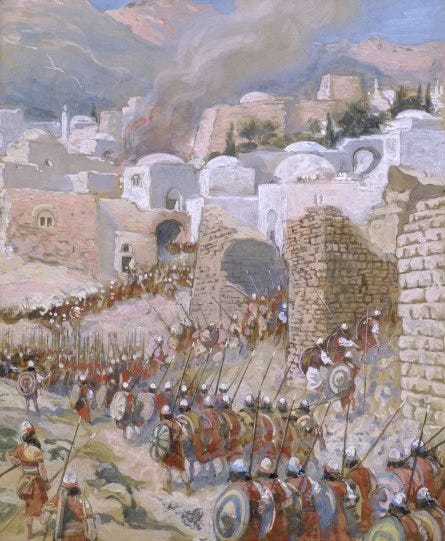
The inhabitants of Jericho committed no crime. They were no more enemies of the Israelites than the Palestinians were enemies of the Jews — or for that matter, than the resident of a home are enemies of the home invaders. They just lived there on the property the settler-colonialists coveted. According to the Book of Joshua, God choreographed their annihilation — seven days, seven circuits of the walls, the blast of the shofar, and then the slaughter of every man, woman, child and animal inside. The taking of Canaan and the story of Jericho and the deaths of its inhabitants are celebrated uncritically to this day as a miracle and a proof of faith in both Judaism and Christianity.
WARNING! Taboo-breaking material below. Not for the fainthearted.
I heard about Alice Rothchild a few years back. Believing her to be an anti-Zionist, I subscribed to her Substack. Rothchild publishes weekly reviews where she writes her own posts or highlights writings by others. Her latest bulletin stopped me in my tracks and made me question how much of an anti-Zionist she really is. There were two items that I found troubling. The first is her description of celebrating the Passover Seder with a group of anti-Zionists, and the second is a paragraph she wrote where she highlights a recent Mondoweiss article, Israelis are being recruited as spies for Iran in what security experts call an espionage ‘epidemic’. I will try to comment on the second item separately.
Rothchild is a Boston-based retired doctor, published author, and Palestine solidarity activist. Rothchild is openly anti-Zionist and we should be in agreement, except after reading her latest Substack post, I’m left questioning where she really is on her journey. I don’t believe any of us deserve a medal for being a decent human being and standing up for those who are oppressed or mistreated. So from the outset, the ‘as a Jew I support the Palestinians’ is problematic. Like Rothchild, I too have received a great deal of attention because ‘as a Jew’ I stood up for Palestinian human rights and against Zionism and Israel. But really it shouldn’t matter where you come from. Humanity is our real common heritage. A decent, moral human being looks after their fellow human beings and speaks out when they are harmed, regardless of who they are.
In the original 2012 introduction to Beyond Tribal Loyalties I wrote:
“In my years of public speaking about Israel-Palestine in Australia, I consciously used the Western bias in favour of Jewish voices. I knew that as a Jew, and especially one who was born in Israel, I was more likely to be listened to than a Palestinian telling exactly the same story. In this book, once again Jewish voices were going to be given a stage, and I was concerned that I was colluding with this bias rather than challenging it. After all, haven’t Jewish voices been heard enough?”
I’ve moved a long way even from what I said in that anti-Zionist introduction. More specifically, I no longer identify as a Jew. I don’t even know why I ever called myself a Jew. I was born and raised in Israel to parents whose birth certificates identified them as Jewish. But neither my parents nor grandparents were ever religious. My family did not teach faith in a god. The Jewish traditions that my school and my secular family followed were watered down versions of religious festivals. We didn’t observe any strict religious rules, but the essence of the Biblical stories and their relationship to our identity were never questioned or examined. They were a given. These stories told us who we were, why the state of Israel was there and what it was supposed to mean to us. I don’t observe anything. I don’t follow any Jewish traditions, and I certainly do not believe Jewishness is a race. So in reality I am not Jewish and what my Israeli birth certificate says about my identity has nothing to do with how I see myself or who I am.
In her latest bulletin, Alice Rothchild describes the Passover Seder — the Jewish ritualised Passover meal — she celebrated earlier in the month with a “diverse group of 24 family and friends ranging in age from 3 to 85”. Never mind that I have a problem with the very idea of celebrating the Seder, I then read that Rothchild and her fellow anti-Zionists used the original Haggadah. In my comment to Rothchild I wrote this:
“Alice, if you used the original Haggadah, it means you celebrated the killing of the eldest sons of Egypt and the rest of the plagues and as you know, the story leads to 40 years in the desert and the genocide and settler-colonial conquest of Canaan. Anti-Zionists have no business celebrating the Seder or most Jewish festivals for that matter. Can you not see that these stories are at the very heart and core of the Zionist justification to colonise Palestine and replace all its non-Jewish inhabitants with Jews? (Please read my article: ‘Zionism Was Always Genocidal: On What Even Anti-Zionists Miss’. The second half is about this topic).”
I referred Alice to my critique of Jewish religion, which forms part of my reaction to Avi Shlaim’s comments about Judaism in a recent interview.
For those who don’t know, Haggadah in Hebrew means something like ‘a telling’. The Haggadah is a traditional ‘order of service’ that sets out the proceedings of the Seder meal. Seder in Hebrew means ‘order’ or ‘order of things’. In a traditional Seder, even in otherwise secular families and communities, the entire Haggadah is read out and its instructions are followed precisely: when to say what, when to drink one of the four cups of ceremonial wine, which symbolic food items are to be eaten, what they each symbolise and when. Eating and drinking are interspersed with the reading of the Haggadah and every part of it has a meaning: what children say, the questions they are required to ask, how adults respond, and so on.
Back in the days of the Roman Empire, everyone was what we now call ‘religious’. All aspects of life were regulated by religious rules, so being Jewish meant living by some version of Jewish religion. The Jewish Temple in Jerusalem was the centre of that religious life — all practices and observances centred around it. This was not much different from how other ancient civilisations organised their religious lives. Sumerians, Egyptians, Greeks, Romans and others all built temples to their gods and focused their religious practice around them. The only distinction is that Judaism worships one god rather than a pantheon. The destruction of the Second Temple by the Romans in 70 CE, following their brutal crushing of the last Judean rebellion against Roman occupation, was not a random act. The Romans knew exactly what they were doing. Destroying the heart and soul of an observant community dealt a devastating blow to its identity and eliminated what was also the political hub of the Judean struggle against Roman occupation.
Faced with the real threat of losing their faith and identity, Jewish religious leaders set out to create a written substitute for the Temple to ensure the people and their faith didn’t simply disappear into other cultures and faiths. If Jewish rituals could no longer be performed at the Temple, they could be performed in people’s homes and communities. The Haggadah replaced the Temple and expanded the story of Jewish identity to communities far away from ancient Palestine, many of which were converted to Judaism. Contrary to what we were told when I was growing up, Judaism was not always a persecuted religion — for a time it actively spread itself, gaining many converts in the ancient world. Until I read Shlomo Sand’s The Invention of the Jewish People, I had no idea that Judaism in its heyday converted many, sometimes even by the sword.
The Haggadah is a sophisticated instrument of identity transmission, combining narrative and sensory experience — food, drink, song, the warmth of family — with children’s ritual participation to tell and retell the founding myths of Jewish identity. It was created as a way to preserve Jewish identity and continuity without a physical centre of worship. Everything the Temple once provided — communal belonging, sacred narrative, a shared sense of purpose — the Seder now provided in the intimacy of the home. The Seder is never merely about Passover; or rather, Passover is itself about the foundations of that identity. The Seder isn’t just something you do. It tells you who you are. Children are at the centre of it, they are the whole point. Through powerful narrative and carefully choreographed ritual, children absorb the myths of their identity and are equipped to pass them on to the next generation through the same unchanging ceremony. The ritual has barely changed in seven hundred years, and that unchanging quality is not accidental. It is precisely the mechanism. I loved the Seder as a child and looked forward to it every year. My only gripe was that you couldn’t eat what you wanted when you wanted from the generous spread on the Seder table. You had to wait until the Haggadah told you it was time for the next dish.
The Seder Rothchild describes is explicitly framed as an “anti-Zionist liberation seder with original Haggadah.” The JVP poem she quotes in her post does name “the plague of Zionism” alongside racism, genocide and ethnic cleansing. Rothchild and her community attempt to repurpose the Exodus narrative for progressive ends, reading it as a story of liberation from oppression generally, rather than as a specifically Jewish nationalist text. But those two things cannot coexist. The original Haggadah contains the full narrative — the plagues, the killing of the Egyptian firstborn sons, the Exodus, and the destination, which is always Canaan. You cannot call that anti-Zionist. The original Haggadah is the foundational text of the very project anti-Zionists claim to oppose.
The JVP poem Rothchild quotes is worth examining closely too. It’s genuinely moving as poetry — “all of us refugees, all of us prophets” — but it is a wilful misreading of the text it draws on. It universalises the Exodus story, turning it into a general human liberation narrative that encompasses Black liberation, Palestinian liberation, LGBTQ rights. But this universalisation only works by erasing the story’s actual content and consequences. The Israelites in Exodus weren’t fighting for universal human liberation. They were fighting for their liberation, the (fully inhabited) land their God’s promised to them — exclusively. The universalisation is a modern liberal imposition on a tribal, particularist, survival and conquest narrative.
There’s also something worth saying about the emotional function of the Seder — 24 family and friends, ages 3 to 85, songs, poetry, belonging. That warmth is precisely what makes the critique difficult and what makes the ritual so resistant to honest examination. The Seder works because it creates profound communal feeling. I remember that feeling from my own childhood — and I understand exactly why it works. But that precise feeling is at the heart of tribal indoctrination, and it binds people to a narrative they might otherwise question.
The repurposing of the Haggadah narrative and the ritual of the Seder is problematic. It tries to detach the Exodus narrative from its consequences. It wants the liberation story without the Canaan story. It is selective reading — and it is intellectually dishonest. The Exodus narrative isn’t incidentally connected to settler-colonialism — it is the foundational settler-colonial text. The structure is right there: chosen people, promised land, divine mandate, and the slaughter and expulsion of the existing inhabitants. You cannot lift the ‘liberation from Egypt’ part out of that sequence and declare it clean, because it only has meaning within that sequence. The whole point of the Exodus is to get to Canaan. Egypt is the beginning of the story, not the story.
The repurposing move is deeply revealing psychologically. It’s the desperate attempt to preserve Jewish identity and Jewish ritual — to keep the warmth, the family, the songs, the belonging — while jettisoning the parts that are now embarrassing. But you can’t surgically remove the ideology from the ritual when the ritual enacts the ideology. Every year at the Seder table you rehearse the narrative. You relive it. You internalise it again. The repurposed Haggadah that mentions “the plague of Zionism” is enacting a contradiction. It uses the structure and authority of the very story that inspires and legitimises Zionism and the present state of Israel to oppose Zionism.
We should also ask what motivates JVP and people like Rothchild. They genuinely care. Their commitment to Palestinian liberation from settler-colonialism and erasure is real. But they also want to continue to be Jewish — and that is where the contradiction becomes irresolvable. To be Jewish in any meaningful sense requires engaging with the foundational texts and tenets of Jewish religious identity. And those tenets — the chosen people, the promised land, the divine mandate, the conquest of Canaan — are precisely what authorises the project they claim to oppose. JVP will challenge Zionism vigorously, but the religious soil from which Zionism grows remains untouchable. The foundational narratives are never subjected to the same critical scrutiny as the political project they inspired. That is the line they will not cross — and it is not a coincidental omission. It is a structural necessity. Cross that line and the whole framework collapses, because at that point you are no longer asking “how do we be better Jews who oppose Zionism” but something far more uncomfortable: whether an identity built on these foundations can be separated from the project at all.
A genuine anti-Zionist reckoning with the Exodus narrative would have to sit with serious discomfort — because as I said in my comment to Rothchild, that story doesn’t end with freedom, it ends with Canaan. The celebration of liberation from Egypt is inseparable from the mandate to colonise and the glee about the harm inflicted on the Egyptians.
Early in my activism I became acquainted with Egyptian diplomats in Canberra. They told me they had once been invited to a Passover Seder at the home of a senior Israeli government official in Tel Aviv. The wife recalled how stunned and shocked she felt sitting there watching the happiness, the triumphalism and the pleasure the hosts and their family expressed in recounting the plagues inflicted on Egypt. Seeing the Seder through her eyes, the final penny dropped. The Haggadah doesn’t just narrate liberation and the death and suffering that had to be inflicted to achieve it. It celebrates and revels in that suffering. If you want to understand how Israeli soldiers can delight in the carnage they have been inflicting in Gaza, remember that every one of them, secular or religious, was indoctrinated on the stories of the Haggadah. Liberal Zionists tend not to go there because going there risks destabilising the whole framework they need in order to remain both Jewish and progressive.
A truly enlightened religion would lament and mourn the suffering of its enemies, not celebrate it. If any human being is ever forced to kill or harm another in self-defence, the healthy response is not glee or triumphalism — it is grief. Grief for the suffering and death of the other, and grief for what the act of killing does to the person who commits it. I know this is possible because I have witnessed it. Many of my clients have gone through exactly this process when working through experiences in which they were forced to use aggression to protect themselves. The capacity to mourn your enemy and feel bad about your own behaviour, no matter how necessary or justified in the circumstances, is a mark of genuine maturity and moral development. The Haggadah, with its triumphant recounting of the plagues and the drowning of the Egyptian army, demands the opposite. It also validates, legitimises and permits everything Israel is and everything it is doing to the Palestinians.
Fanatical Zionists are easy to reckon with. They are actually doing the anti-Zionist movement a service in a perverse way — Netanyahu, Ben Gvir, Smotrich, the soldiers filming and broadcasting their looting and destruction, the settlers celebrating in Gaza — they strip away all pretence and show the project for exactly what it always was. They make it impossible to sustain the ‘but Israel is a democracy’ narrative.
Liberal Zionists are the sophisticated defence mechanism. They absorb criticism, reframe it, redirect it into manageable channels — two states, international law, war crimes investigations, humanitarian corridors — all language that implicitly accepts the legitimacy of the state while appearing to challenge its excesses. They give Western governments and institutions the vocabulary to express ‘concern’ without actually doing anything. And crucially, they give progressive Jews a way to feel morally clean while the project continues. The role of Liberal Zionism has always been to buy time for Israel. Every decade of ‘peace process’, every round of negotiations, every liberal Zionist op-ed in the Guardian lamenting settlement expansion, has been time Israel used to create facts on the ground. The Oslo years were arguably the most productive period of settlement expansion in Israel’s history. Liberal Zionism didn’t oppose that — it provided the moral atmosphere in which it could happen unimpeded. And there’s something more dishonest about it than open fanaticism, because it requires the liberal Zionist to perpetually not-quite-see what is directly in front of them. That’s not innocent confusion. At some level it’s a choice. I don’t think Alice Rothchild is an anti-Zionist. To me she seems much more like a Liberal Zionist.
For a long time I too wanted to separate Jewish religion from Zionism. I didn’t want people to use my writings to justify racism. I have long been criticised by Zionists for ‘giving ammunition to the antisemites’. The solution was to stay quiet. Not to criticise Israel and most definitely not go near Jewish religion. But silence is what enables evil to thrive at all levels of human society. Silence enables. Speaking out is the only thing we have to expose and challenge crime, with the ultimate aim of stopping it. Part of speaking out is critiquing and questioning especially what is considered to be too sacred to question.
I genuinely don’t know how you salvage an identity based on victimhood, a fixation on the survival of the group, a hierarchy of humanity, on vengeance and on settler-colonialism. Does such an identity need to be salvaged? What does it even mean to be Jewish if you aren’t observing Jewish religion? And if you are observant, you need to realise what it is you are expected to believe and ask how it sits with your human values. I believe that my position — to abandon and renounce the whole thing — is the only intellectually and morally consistent and coherent choice.
The entire Zionist project is a colossal crime against humanity — as was its mythical ancient predecessor, the colonisation of Canaan and the slaughter of all its inhabitants to make room for the twelve tribes of Israel. One crime authorised and inspired the other. We have a genocidal settler-colonial project in progress. There is no more excuse for hedging and trying to find a comfortable path salvaging something that cannot be salvaged. The genocide must be stopped. The entire project must be stopped.
Hear Prof. Nurit Peled-Elhanan discuss how Israel links its own identity with the myths of the Bible (From 07:51) in a podcast interview with +972 Magazine.
A comment on paid subscriptions
Substack encourages writers to activate paid subscriptions. They take a small cut to enable them to provide this, otherwise free-to-use platform. I am grateful to the readers who have pledged money for monthly or yearly subscriptions, but I have no intention of monetising my work.
I do not want to turn my writing into an obligation, but even more importantly, I don’t believe in a tiered system where those who can pay get preferential treatment over those who can’t, such as the right to comment, or privileged content. This hierarchy of ‘worthiness’, especially based on such an arbitrary principle like how much money people have, couldn’t be further away from my values.
If you do feel moved to make a contribution to support my writing, see the ‘buy me a coffee’ button below. If you haven’t seen it before, it is a way of offering a donation to freelance writers. Payments are processed securely by Stripe on the ‘Buy Me A Coffee’ site. I believe people can keep donations anonymous if they wish. This is entirely voluntary. Everyone is and always will be welcome to read my work free of charge.
Thank you so much for reading my work!
Comments
Nothing yet. Say the first thing.
Sign in to join the conversation.