
My new podcast is out: Think pink! I and my friend, Daily Telegraph wine critic Victoria Moore, discuss how and why rosé wine has got so big – but has pale Provence rosé jumped the shark now? Find out on Apple, Spotify or wherever you get your podcasts.

Last week’s heatwave smashed British May temperature records on two consecutive days. In West Sussex, Ambriel co-owner Wendy Outhwaite posted a picture of her grapes starting to flower: “It is amazing to see this before the end of May… I think this may be our earliest flowering ever.” The UN’s World Meteorological Organization warned that at least one year between 2026 and 2030 will almost certainly be the hottest ever (2024 holds the record for now.) Even British wine writers have been forced to rush out seasonal rosé pieces weeks ahead of their time-honoured slots.
In other words, the climate emergency is accelerating. But I’m struck by the unevenness of the response, both from government and the corporate world. Last week former Prime Minister Tony Blair piped up, urging the British government to abandon Net Zero measures, joining other voices on the Right demanding the same thing. Yet in fact, both recent Conservative governments and this Labour one have been pretty committed to action on climate change, delivering, as Business Green editor James Murray writes this week, “the deepest and fastest decarbonisation of any G20 economy”. Yesterday Energy Secretary Ed Miliband proposed even more ambitious targets.
Meanwhile in the world of food and drink, Michelin last month quietly dropped its “green stars” for restaurants operating sustainably, to protests from restaurateurs. The scheme had faced criticism during its six-year history over its lack of a formal framework for assessing environmental claims. But it’s hard not to see the move as of a piece with the perceived corporate retreat from sustainability commitments over the past few years, accelerated by Donald Trump since he regained power.
Yet at the same time, consumer demand for more sustainable food and drink surges ahead. Last week a new report from drinks consultants IWSR, Opportunities in Sustainable, Organic and Alternative Wine, found that sales of organic wines have grown in most markets over the past five years, driven mainly by younger drinkers – bucking gloomier wine sales trends. And it found that attitudes to sustainability – and to more sustainably made wine – were strengthening in the UK, US, Australia, Canada and elsewhere.
So should we feel optimistic or gloomy about the pace of change in response to climate change? And is wine meeting the challenge?
Across the wider corporate world, the past couple of years have certainly seen a downplaying of green and sustainability issues. Last year a rash of headlines warned of the death of ESG (Environmental, Social and Governance) strategies, above all in the US. In 2024 Shell and BP both cut their emissions reduction targets. Last year Coca-Cola, Nestlé and others postponed a target for cutting their use of virgin plastic. And last August the UN’s Net-Zero Banking Alliance collapsed following the departure of a number of banks.
Thanks to inflation and cost-cutting pressures, this trend was in fact well under way before the Trump’s return in January last year (yes – I know it seems longer.) Many companies still tend to see sustainability policies as a “nice to have” rather than a necessity – meaning they tend to be some of the first priorities abandoned when budgets are cut. Certainly cost pressures and falling sales in wine globally over the past few years have not helped.
But Trump’s relentless hostility to anything he deems “woke” – especially if it contradicts the interests of the energy companies and other corporates bankrolling him – has ramped up these pressures. In America, where a surprisingly large group of institutions have a stake in federal funding and contracts, many companies have gone quiet on climate goals to avoid political risk.
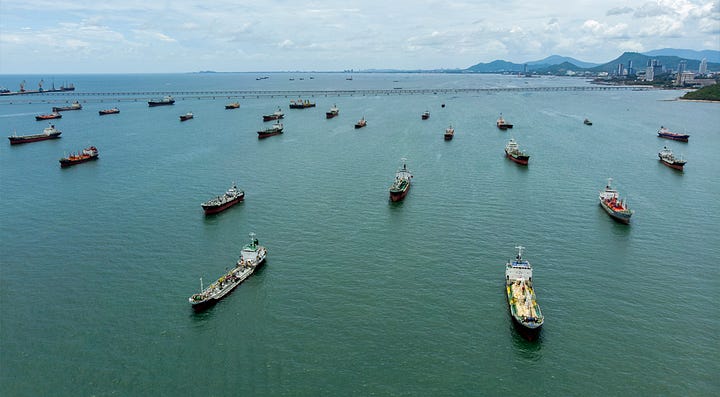
But beyond America, Trump has made an environmental mark too, including on the wine industry. Last October the US and Saudi Arabia derailed a landmark international agreement to reduce shipping emissions, which had been set to be agreed in London by more than 100 nations. This has a direct impact on the global wine trade, which relies heavily on sea freight. And last August the US and other oil-producing nations shot down efforts to agree an international treaty to curb plastic pollution – again, an issue with an impact on those wine businesses trying to produce more sustainably.
Yet destructive though such moves are, there is hope for wine and other businesses trying to do the right thing. First, what has been dubbed “greenhushing” – companies keeping quiet about their environmental and social strategies – doesn’t necessarily mean they are abandoning those efforts. A study last September by the Harvard Business Review found that 85 per cent of companies surveyed had maintained or even expanded their sustainability programmes – despite just 16 per cent publicly talking up those commitments.
Second, this is partly because those strategies are largely driven by the market. For despite the ravings of supposed free-marketers like Trump or UK Conservative leader Kemi Badenoch, markets are continuing to move in the direction of sustainable technologies. As James Murray notes, “global investment in the clean energy transition rose eight per cent last year to a record $2.3 trillion, while fossil fuel supply investment fell for the first time since the pandemic.” Renewables generated more than half of the UK’s electricity in both of the past two years. And the International Energy Agency predicts that the market for clean energy technologies will have overtaken the global oil market by 2035.
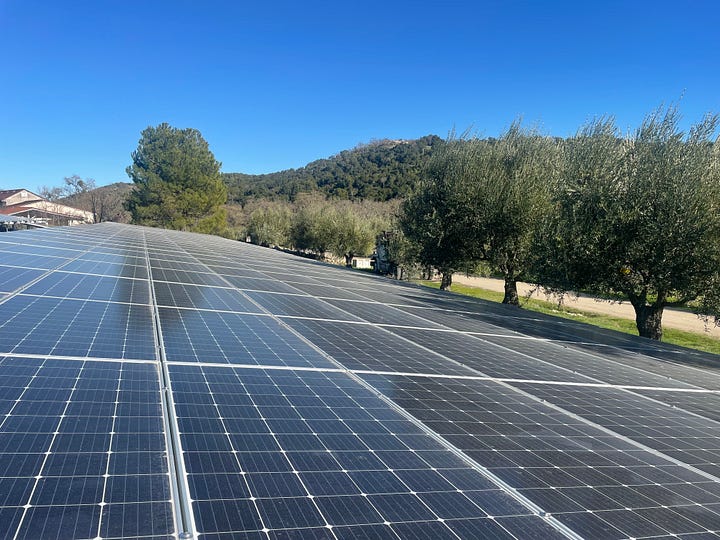
What this looks like at the level of the wine on your table is that it is increasingly likely to have been made in a winery powered by solar panels on its roof. Even in cloudy England and Wales, a 2024 survey by industry body WineGB found that 40 per cent of wineries were able to generate at least some of their own electricity. At Sandridge Barton, in Devon, CEO and winemaker Duncan Schwab told me that the 50kw solar panel system they installed in 2019 provides around half their energy needs and paid for itself in just three years. They are now looking at expanding that capacity.
This trend is only being accelerated by Trump’s most recent international intervention, his disastrous war in Iran. Ironically, the resulting energy shock has amply demonstrated the urgency of weaning ourselves off fossil fuels. As Josep Maria Ribas, Climate Change and Sustainability Director at big Catalan wine producer Torres, says, “renewable energy gives you autonomy”. The company generates over half of its energy needs from solar and biomass: he told me that as a result they were less affected by the energy price spike of 2022-23 than other producers, and presumably will feel Iran-related price hikes less too.
The Iran war has delivered a similar message on agrochemicals. Wine producers are already having to pay more for their nitrogen-phosphorous-potassium fertilisers. The war has blockaded around a third of the world’s supply of nitrogen fertilisers and the natural gas used to make them. Prices have soared in the UK and the EU by up to 70 per cent: even though European winemakers source little fertiliser from the Middle East, the war has driven up the price of these internationally traded commodities. Likewise for many vineyard pesticides, most of which depend on petrochemical feedstocks for their manufacture. But this is not a problem that will affect organic and other producers avoiding most synthetic chemical fertilisers and pesticides.
Lastly, we’re seeing gradual but promising progress in making wine’s packaging more sustainable – a major vulnerability to energy shocks. When Russia invaded Ukraine in 2022, natural gas prices soared, doing the same to the cost of wine bottles (almost all glass furnaces are gas fired.) With around 20 per cent of the world’s supply of Liquid Natural Gas now blockaded, and natural gas prices up by almost half, the same thing is likely to happen again, though hard figures on prices are tricky to pin down. But using lighter bottles – at a minimum, the 425g ones committed to by Tesco, Waitrose and others signed up to the Sustainable Wine Roundtable’s Bottle Weight Accord – can save money as well as carbon emissions. Moving more everyday wines to boxes would save even more.
In the midst of a war and political turmoil, it might seem counter-intuitive to talk about green advances – about progress in making wine more sustainable. But I do believe that the momentum is on the side of those producers trying to move away from fossil fuels, agrochemicals and unsustainable packaging. We undoubtedly face difficult economic times – the principal kitchen-table legacy of Trump’s war. That will hurt many wine producers. But it might just also move more of them in the right direction to better withstand future shocks.
My award-winning book with Jane Masters MW, Rooted in Change: The Stories Behind Sustainable Wine, explores wine’s shift towards sustainability at much greater length - without being depressing or worthy! No, really!

Green machine: wind turbines at Greencroft bottling plant, Durham

Maybe it was the hot weather that put me in mind of them, but I’ve noticed some refreshing and classy Rieslings at recent tastings:
The Society’s Exhibition Clare Valley Riesling 2025 – a decent budget example of this signature Australian style of Riesling: fresh, crisp with piercing lime notes and a hint of petrol (in a good way) (The Wine Society, £11.50.)
Jakob Schneider Grauschiefer Riesling 2025, Nahe – a dry, modern German Riesling offered by leading German wine specialist, The Wine Barn. Crisp, fresh, mineral with a touch of lime (The Wine Barn, £18.10.)
Domaine Camille Braun “Bollenberg” Riesling 2024, Alsace – Alsace Riesling can be some of the world’s best, though it’s often difficult to tell from the label exactly how dry/off-dry the wine is. This is, however, bone dry, zippy and fresh but with a little weight to it, juicy fruit yet taut. My kind of aperitif (The Wine Society, £18.50.)
Rippon Mature Vine Riesling 2023, Wānaka – Rippon make probably New Zealand’s finest Riesling from biodynamically grown grapes overlooking stunning Lake Wānaka. This is mineral, taut, elegant but with beautifully balanced fruit – world-class Riesling. The 2024, which I tasted when I visited earlier this year, is also superb, though doesn’t appear to be in the UK yet (Smith & Gertrude, Lea & Sandeman, Must Wines, from £30.)
Weingut Stadt Krems Grillenparz Riesling Reserve 2019, Kremstal – this Austrian Riesling comes from steep, terraced vineyards planted above the town of Krems. Crisp, racy acidity, pure, concentrated and long. Winemaker Peter Rethaller also showed me the 1990 vintage when he was in London last month, likewise available from importer Clark Foyster: complex, near-immortal freshness and crisp acidity for its age, an astonishing wine (Waud Handford, Clark Foyster, from £40.99.)
Weingut Göttelmann “Vollmond” Kapellenberg Riesling 2018, Nahe – I’ve put this wine last in this list because despite its crisp, citrussy acidity, it’s off-dry, with 9g of residual sugar. But that somehow comes through more as fruity depth in this long, lip-smacking wine. Good value for a Riesling with this age on it (The Wine Barn, £17.65.)
No posts
Comments
Nothing yet. Say the first thing.
Sign in to join the conversation.