


On a Sunday lunchtime ahead of Ecuador’s first World Cup 2026 match, it would be an exaggeration to say that football fever gripped Sabor Latino. Families filled the Ecuadorian restaurant in Loughborough Junction, south London, tucking into their nation’s hearty food (my mote con chicharrón – pork belly with white corn – was one of the lighter bites.) The middle-aged Ecuadoreño on the next table was enthusiastic about their national side, reeling off the names of stars playing in the European leagues. But he told me, “I don’t think I’ll manage to watch many games – it’s too difficult with work”: Ecuador’s opener against Côte d’Ivoire kicked off at midnight.
Still, having this Spanish conversation in the heart of south London, cumbia salsa playing in the background, was a reminder of the explosion in London’s Latino population and culture. Between the 2001 and 2021 censuses, the UK’s Latin American population grew almost fourfold: the capital is home to around two thirds of them, now estimated at over 150,000. The communities are concentrated in the boroughs of Southwark and Lambeth, where Spanish is now the most-spoken language after English, as it is in three other boroughs on the south bank of the Thames, and in Islington. Brazilians are the biggest national group, followed by Colombians (the second-biggest Spanish-speaking nation after Mexico).
Highlighting these food cultures is the aim of La Ruta London, a six-week festival across the city involving more than 60 Latin American, Spanish and Portuguese restaurants. Each week showcases a different country or region: having started on 1 June with Mexico and Central America, the focus then moved to Argentina, Chile and Brazil, and this week switches to Peru and Bolivia. Next week it’s Colombia and Ecuador, followed by weeks highlighting the Spanish Caribbean, then Spain and Portugal, before it winds up on 12 July, a week short of the World Cup final. Meanwhile this year’s tournament features eight Latin American sides: hosts Mexico plus Brazil, Argentina, Colombia, Ecuador, Uruguay, Paraguay and Panama – though London currently offers no Panamanian or Paraguayan cuisine.
Participating restaurants also offer a signature dish for £8. But you can of course show up at the participating restaurants and get the signature dish deal at any time. So it was that I stopped at El Catracho Feliz, a Honduran counter in Rye Lane Market, Peckham. They offer tacos catrachos (rolled, deep-fried tacos; “catracho” is local slang for “Honduran”), baleadas (a folded flour tortilla stuffed with beans plus eggs, meat and other fillings), quesadillas, and various dishes accompanied by tajadas, fried slices of plantain. The Salvadoran waitress recited their juice selection: I had to ask what lulo was, which turned out to be an odd but tasty Colombian tropical fruit.
Rye Lane Market also features Salvadoran, Bolivian and Colombian stands. La Casa de la Empanada, Colombian flag flying, does what its name suggests. But I wished I’d asked at Berta’s exactly what the Bolivian huminta cheese-filled tamales were before buying one (the cornmeal is cakey and slightly sweet, quite unlike a Mexican tamale.)
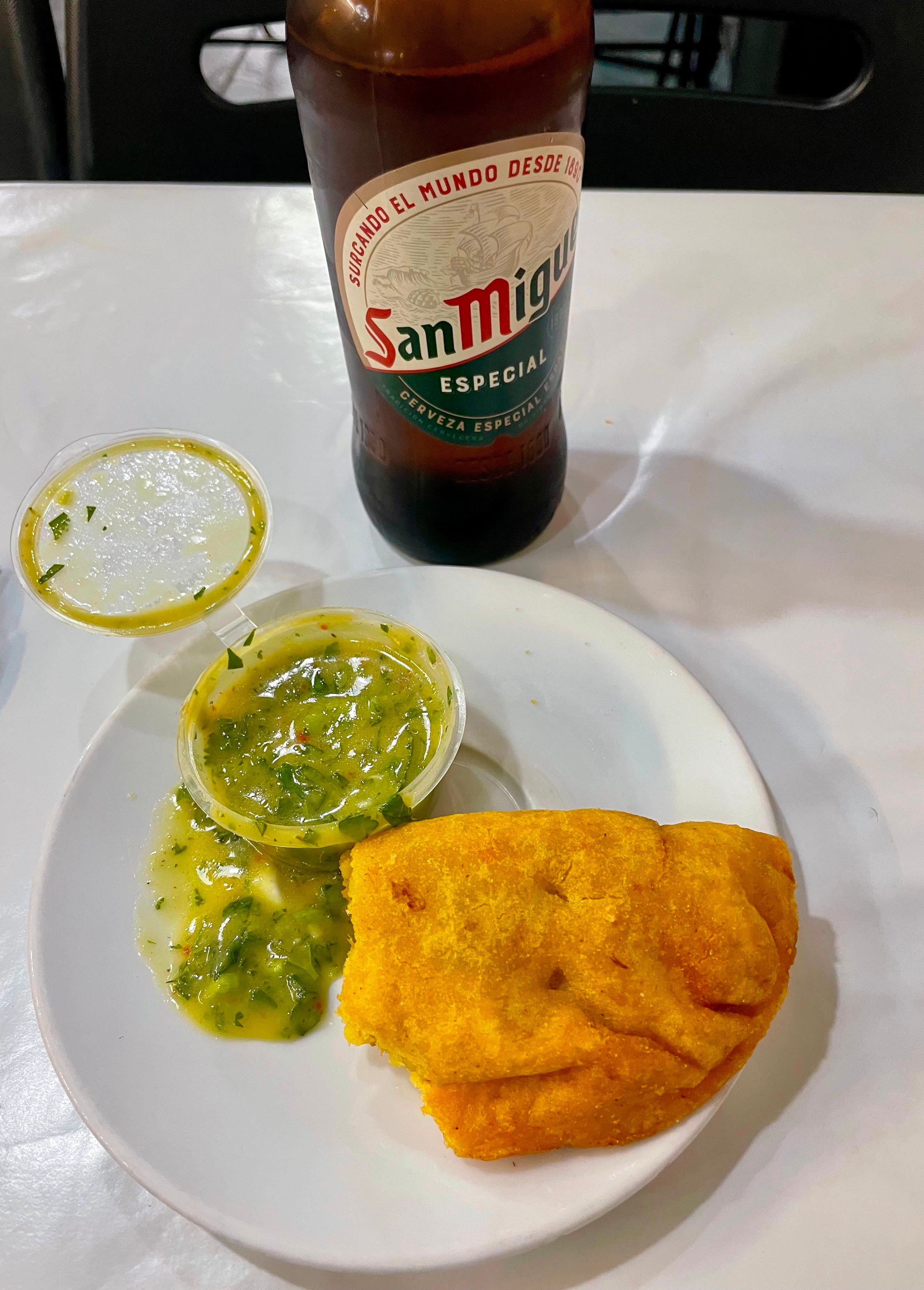
Brixton, meanwhile, is the only place except New York City where I’ve ever seen a Dominican restaurant. El Juidero, on Coldharbour Lane, serves up goat stew, rice, beans and plantains – though I confess I’ve only ever come here to drink cocktails in an authentically Latino environment. Brixton also boasts Colombian, Peruvian, Brazilian and Venezuelan restaurants: I stopped off last weekend at Brixton Village Market’s Colombian Santa Fe for a beer and an empanada to gauge World Cup fever (again, excitement for the national team’s prospects tempered by annoyance at the mad broadcast times.)
Yet the culinary giant among these is one of London’s smaller Latin American communities: Mexico. According to the 2021 census, of 138 million Mexicans, fewer than 15,000 were living in the UK, though a majority of them in London. Mexican food has, however, gripped the British imagination in a way unlike any other Latin American cuisine. And while for many years, the standard of Mexican food available in the UK was abysmal and authentic ingredients hard to find, that has changed in recent years. At the top end there are excellent, innovative restaurants like Fitrovia’s Cavita and Michelin-starred Kol (I wrote about such places here.) But the more noticeable change is in the flood of fine taco joints opening across the capital.
The biggest concentration is in Peckham, leading food writer Jimi Famurewa to dub this corner of south London Pexico. Looking out from the bar of Mexican Mama grocery on the snarled traffic of Peckham Rye, I asked owner Μaira Gallardo why that might be. “It’s a very multicultural area – there are lots of customers who like cooking different kinds of foods,” says Gallardo, a native of Guadalajara, Jalisco. “People are open to suggestions: a guy was in here the other day asking how to make huevos rancheros” (a classic breakfast dish of eggs with chorizo). And the huge redevelopment project up the road at Elephant and Castle has displaced some of that neighbourhood’s Colombian community, adding to Peckham’s Latin presence.
Gallardo was a pioneer in the neighbourhood, opening her store in a small nearby industrial estate in 2019 before moving to her current café site in 2023. She has customers coming from across London for ingredients, and for Mexican drinks such as michelada (a kind of beer Bloody Mary with tomato juice and lime) and a Paloma cocktail (tequila, grapefruit and lime) served with real Sangrita (orange and lime juice with chili).
More surprising are more recent trends for Mexican food promoted over social media. Chamoy sauce made from pickled fruit – sweet-salty-spicy – is apparently a TikTok thing, as is a craze for birria, originally a slow-cooked Jalisco stew now wildly popular in tacos across London. Gallardo says she currently gets two or three customers a day asking for chilies and tortillas to make birria. And her business is boosted too by odder examples of multicultural London: South Asian Muslims with a liking for Mexican tamarind-based drinks and sweets, and Chinese students partial to one of Mexico’s stranger culinary traditions, sweets containing chili.
In other words, unlike other Latin American cuisines, Mexican food has taken on a life of its own in London. Certainly there are older-school tacos to be had in Peckham: Guacamoles, founded by Mexican asylum seeker Manny de la Torre, offers meaty carnitas and decent tacos pastor (pork cooked on a spit with a squeeze of pineapple) amid the garish lighting of Rye Lane market. At Maíz on Peckham Rye, the very good tacos (the best pastor I’ve had in London) are supplemented with pozole, a dense chicken or pork soup spiced with chili and thickened with hominy corn. Very authentic – indeed I’ve never previously seen it outside of Mexico (I wrote about Mexico City’s street food here.)
But down the street at Taquiza, there’s more of a party vibe – though the pork belly carnitas and 10-hour braised goat shoulder cabritos are seriously authentic. Likewise at nearby Peckham Arches bar, heaving with twentysomething drinkers on a Friday night, which hosts Angeles, whose birria tacos are raved about on Instagram and TikTok (and in fairness, they’re amazing.) And at Taca Tacos, along with tacos of intense birria with cheese, and Baja fish, they offer Korean fried chicken tacos. “It’s not authentic in the slightest,” admits head chef Tommy. “Our tacos are Californian inspired but we have kookier flavours.”
It seems some distance from the homely charms of Ecuadorian mote con chicharrón or Bolivian tamales. Still, I hope World Cup fever inspires some Londoners to explore the food of the city’s Latino communities. And perhaps one day we can look forward to a London craze for Colombian empanadas with associated cultural mash-ups: chicken tikka empanada, anyone? If it happens anywhere, it will be here in Europe’s biggest city and melting pot.
Check out my podcast with my friend, Daily Telegraph wine critic Victoria Moore: Think pink! We discuss how and why rosé wine has got so big – but has pale Provence rosé jumped the shark now? Find out on Apple, Spotify or wherever you get your podcasts.
Since joining The Wine Society’s buying team last year, Spanish buyer Harriet Kininmonth has completed a remarkable update of the Society’s Spanish range. This is now a list with its finger of the pulse of all that’s so exciting in the contemporary Spanish wine scene, featuring key producers from Galicia, Sierra de Gredos, the Canaries, Balearics, Jumilla and indeed pretty much every Spanish region, including of course older favourites from Rioja and Ribera del Duero. It’s really worth exploring. These are the ones I’ve tried so far, from a load of wine I just ordered from their current Spanish offer:
El Escocés Volante Albilla de Villamalea sobre lías 2024, Manchuela – Scotsman Norrel Robertson MW and his family (“el escocés volante” – geddit?) have been making wine in this corner of Aragón for over 20 years now. They have a strong commitment to sustainability and to overlooked old vines – mostly Garnacha, though they make various whites from local grapes too, such as Albilla de Villamalea. It’s very rare, indeed found only around the village of that name, but Robertson has made a most engaging wine from it: fresh, subtle citrus fruit, white flower and mineral notes, very pretty. This is seriously good value at the price (£10.50).
Mustiguillo Finca Calvestra Merseguera 2024 – Mustiguillo is one of the most famous producers in Utiel-Requena, a mostly red denominación an hour west of Valencia. But this is white, from the Valencian Merseguera grape – and unexpectedly, both for a white here and for the normally cheap-and-cheerful Merseguera, it’s pretty serious. Organically produced at an altitude of 900m, this is crisp and fresh, white flowers and herbs, yet with complexity and length to it. Impressive (£23).
Bodega Cerrón “El Tiempo Que Nos Une” Monastrell 2025, Jumilla – sitting in the very hot country south of Alicante, for many years Jumilla mostly churned out big, alcoholic reds for bulk blending. That is now changing, and it’s a fascinating transition to watch: I’ve never been but am desperate to visit. Made from the region’s signature red, Monastrell (ie Mourvèdre) this just bursts with fresh, bright, joyous fruit. A red that really sings (£13.50).
No posts
Comments
Nothing yet. Say the first thing.
Sign in to join the conversation.