
Sydney Airport’s coordinator is holding 2,252 arrival and departure slots for the season that runs from October 2026 to March 2027. Bloomberg, reporting on August 6, attributes them to VietJet Aviation JSC — a carrier with no Australian operating certificate, no Australian aircraft and no confirmed launch date. We reached a comparable figure from the same slot filings and read it as roughly seven daily round trips. VietJet has publicly disclosed 307 international slots at Sydney. The rest are being held against a domestic airline that does not yet exist in Australian law.
Three carriers are walking through that door. Koala Airlines Pty wants to be flying by the end of this year. Zinc, founded by former Qantas executive Peter Kelly, is targeting early 2028 out of Western Sydney International. VietJet has applied to the Civil Aviation Safety Authority for an air operator’s certificate and for permission to fly domestically, per FlightGlobal reporting from June 30. Matthew Schroder, general manager of infrastructure at the competition regulator, told Bloomberg the field may not stop there: “We’re talking about potentially more than three.”
The number that brought them is 16.1 percent. That was the Qantas Domestic operating margin for the six months to December 31, on the group’s own accounts. Jetstar’s domestic business ran at 22 percent. American Airlines managed 2.7 percent in its most recent quarter and Delta 9.4, and Australians pay for the difference in ways that make good copy — a Perth–Melbourne economy return for the AFL Grand Final at A$3,667, on the fares Bloomberg checked.
In January, Australian domestic seat capacity grew 2.0 percent year on year. Passenger numbers fell 0.9 percent.
The coverage treats Koala, Zinc and VietJet as a single wave. They are three different businesses carrying three different regulatory problems, and only one of them proposes to sell a domestic ticket to an Australian on a trunk route.
Koala has an air operator’s certificate. It came with Desert-Air Safaris, a charter operator Bill Astling bought in 2019 and renamed — Koala Air first, then Koala Airlines in October 2022. CASA has issued a direction prohibiting operations under it. The regulator’s stated basis, in Business Traveller’s account, is that the certificate’s original scope “differed considerably from the large jet operations now proposed.” Small-aircraft charter and large jet public transport are not adjacent categories in Australian regulation. They are different certificates, different manuals, different training and checking systems, different oversight.
What Koala did in response is the interesting part. The airline announced leases on three 737 MAX 8s in August 2025 and originally aimed at the Sydney–Melbourne–Brisbane triangle. It has since repositioned to charter only: no retail fares, no seats sold to the public, domestic legs wholesaled into international itineraries for foreign carriers that want an Australian tail on the last sector. Astling says he is talking to more than ten of them. Target destinations moved with the model, toward Adelaide and Uluru, which is where inbound long-haul passengers actually want to go.
That is a coherent business. It is not a competitor to Qantas on price, because it never sets a price a consumer sees. Koala’s yield would be whatever those ten-plus foreign carriers agree to pay for block hours, which insulates it from a duopoly fare response and caps its upside in the same stroke. Wholesale capacity does not discipline a retail market.
Zinc is the opposite proposition and the furthest from the runway. Kelly worked at Ansett and Qantas, helped stand up Jetstar in 2004, and later founded the Cypriot low-cost carrier Cobalt Air. The plan is Ryanair transplanted — A321neos in a 232-seat all-economy layout, base-assigned crews, aircraft flying at least twelve hours a day. Zinc has a named CEO, CFO and CCO. It does not have an AOC. Kelly has said he would file for one within twelve months of closing the raise, which puts certification behind funding rather than alongside it.
VietJet is the only one of the three going after the golden triangle with scheduled seats. Its Australian entity would be locally incorporated, working Sydney, Melbourne and Brisbane with up to ten 737 MAX 8s, launching as soon as 2027. Australia does not cap foreign ownership of a purely domestic carrier, so VietJet can own and control the whole thing outright. That is the genuinely open door in this story, and it has been open the entire time — the last foreign carrier to walk through it was Tiger Airways, in November 2007.
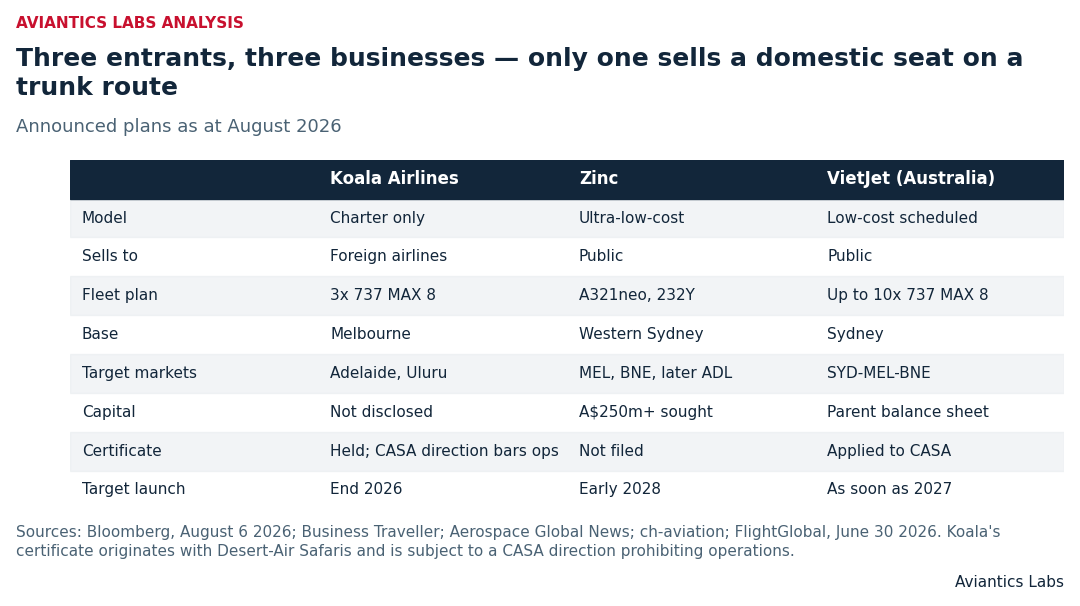
Three entrants, three business models. Only the VietJet plan competes for a retail domestic fare on a trunk route.
Capacity up 2.0 percent. Passengers down 0.9 percent. That is January 2026 on the ACCC’s numbers, and it was the sixth consecutive month in which capacity growth ran ahead of demand. Total seats remain 3.3 percent below January 2019. The route count fell from 154 to 151 across the year, and the Qantas group’s seat factor for the December half came in at 84.7 percent, down 0.8 points.
New entrants normally arrive into growth. They fill seats the incumbents cannot produce fast enough, and the incumbents tolerate them for a while because the market is expanding underneath everyone. None of that describes Australia in 2026. The 16.1 percent margin exists in large part because capacity is disciplined, which makes the margin and the opportunity the same object seen from two ends. Add ten 737s to the golden triangle and the number the business plan was underwritten on begins to move against the plan.
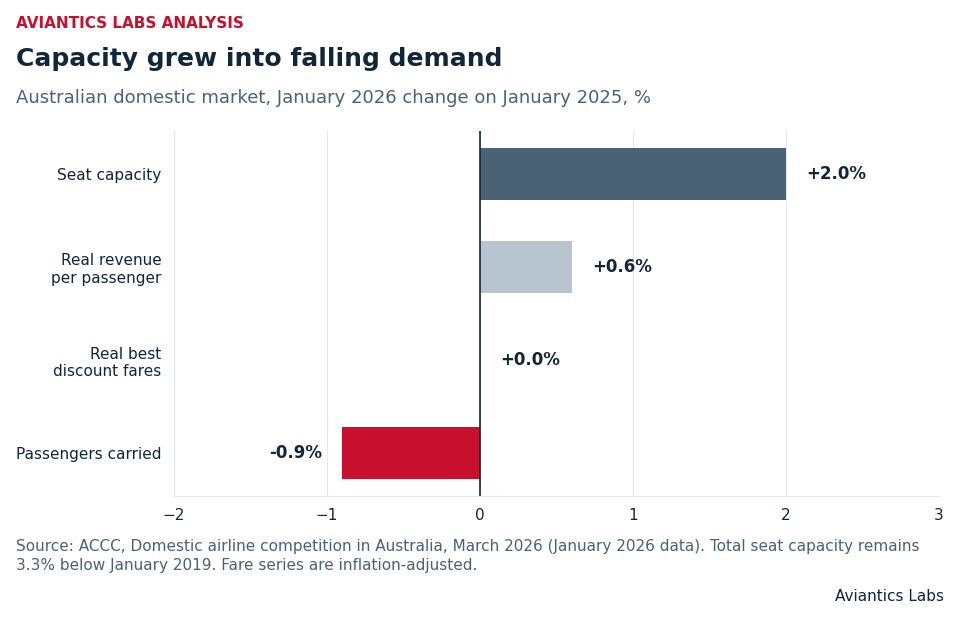
Capacity has outrun demand for six months running, and the market is still smaller than it was in 2019.
Fuel moved first. Between mid-February and early June, jet fuel prices rose more than 40 percent and refining margins rose 64 percent, on the ACCC’s June 16 figures. Virgin Australia put through economy and business fare increases of about 5 percent from March. Airlines suspended or thinned Adelaide–Mount Gambier, Alice Springs–Brisbane and Darwin–Gold Coast. Average revenue per passenger still fell 3.4 percent in April, because the bookings clearing in April had been sold before the fuel move.
The incumbents were hedged into it. Qantas covered 81 percent of its Brent exposure. Virgin covered 85 percent of fuel and 62 percent of refining margin for the second half of its financial year. A start-up has no hedge book, no counterparty history and no volume, and it buys jet fuel at whatever the into-plane price happens to be that morning. That asymmetry is not a passing feature of 2026. It is what scale buys, and it bites hardest in exactly the price environment that makes a low-cost entrant’s fare promise difficult to keep.
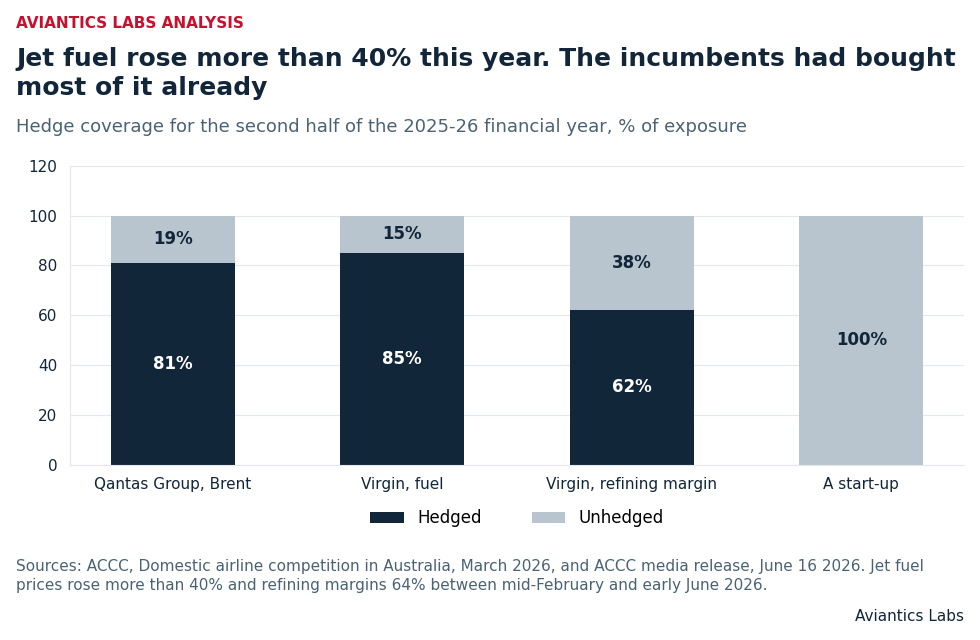
Hedging is a structural cost advantage, and it is widest precisely when a new entrant most needs cheap fuel.
Josh Gilbert of eToro gave Bloomberg the bear case in one line: “Nothing in the current crop suggests it will end differently this time.” That reads as glib until it is set against the demand data. Then it reads as arithmetic.
October 25, 2026. Western Sydney International opens to passengers, curfew-free, built for ten million a year, and the first Australian carrier through the gate is Jetstar — fourteen weekly to Melbourne, four to the Gold Coast, three to Brisbane, on A320-200s. Qantas follows on March 28, 2027 with four weekly each to Melbourne and Brisbane on Embraer E190s. The Qantas Group signed a five-year agreement with the airport to do it, and Qantas Freight had already been working the field since late July, so the group was on the ground months before the terminal opened.
Zinc’s entire thesis is that this airport changes the rules. Kelly put it plainly: “WSI fundamentally changes how competition works in Australian aviation.” He is right about the constraint. Where the reading breaks down is on who collects the benefit of removing it, because the incumbent read the same map and moved first.
By the time Zinc’s aircraft arrive in early 2028, Jetstar will have been operating out of Western Sydney for seventeen months. It will have local crew, established frequencies, catering and ground handling contracted at volume, and — the part that matters most to an ultra-low-cost challenger — a schedule position on Melbourne and Brisbane that Zinc has to attack rather than establish. Qantas will have had eleven months. The greenfield airport that was supposed to be the equaliser will have an incumbent low-cost carrier in it before the challenger sells a seat.
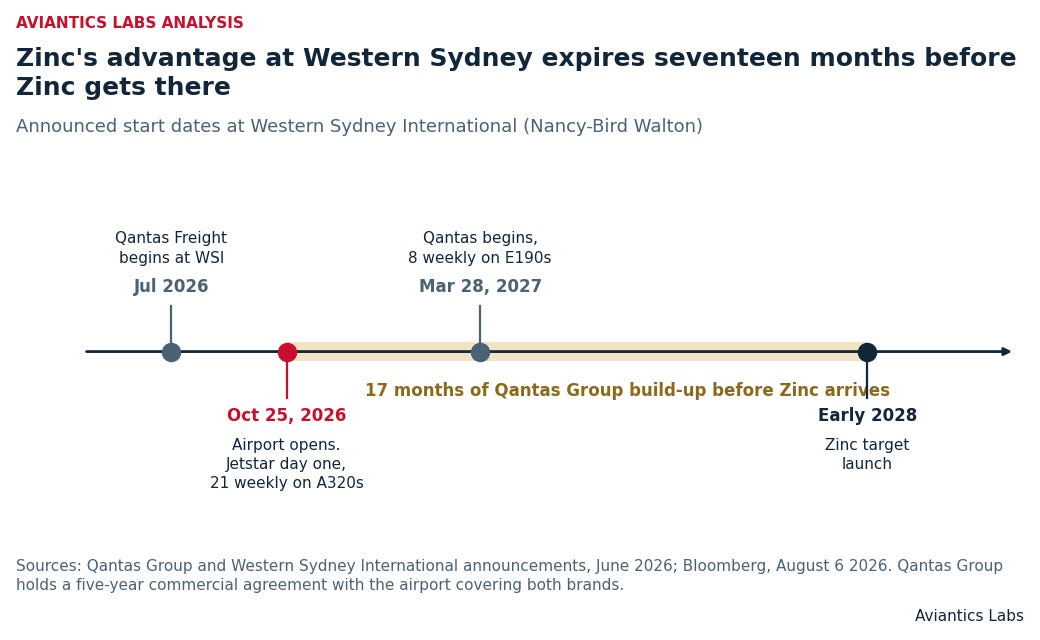
Zinc’s competitive advantage at Western Sydney expires seventeen months before Zinc gets there.
Zinc’s timeline has already slipped once. Earlier reporting had the airline launching within two years of its funding round, implying 2027. Bloomberg’s August piece puts it at early 2028. The raise moved too, from A$200 million in the documents ch-aviation saw last year — roughly US$143 million at the time — to more than A$250 million now, structured around one anchor U.S. investor and four or five smaller backers. Neither movement is unusual for a pre-launch carrier. Both cost schedule position in a market where the incumbent has already booked the slot.
We read the five-year Western Sydney agreement as the tell. Qantas did not need the airport to grow. Its Kingsford Smith position is the best in the country and group domestic capacity rose only 4 percent in the half. What it needed was for Western Sydney not to become somebody else’s fortress, and a five-year commitment on day one is a cheap way to buy that.
Compass Airlines was grounded at nine in the evening, five days before Christmas. It had flown for twelve months and change on four leased A300s and an A310, and it had been given the least accessible parking bays at the terminals it served while its competitors discounted into it for a year. The date was December 20, 1991. Twenty months later the second Compass, trading as Southern Cross, put MD-82s and MD-83s into the same market and lasted six months.
Access was the wall for three decades. Compass got bad gates. Tigerair Australia launched in November 2007, was grounded by CASA for five weeks in 2011, and ended up inside Virgin Australia — sixty percent for A$35 million in July 2013, the remaining forty percent for one dollar in October 2014. Bonza never got into Sydney at all, which is a large part of why 750,000 passengers across fifteen months was never going to be enough.
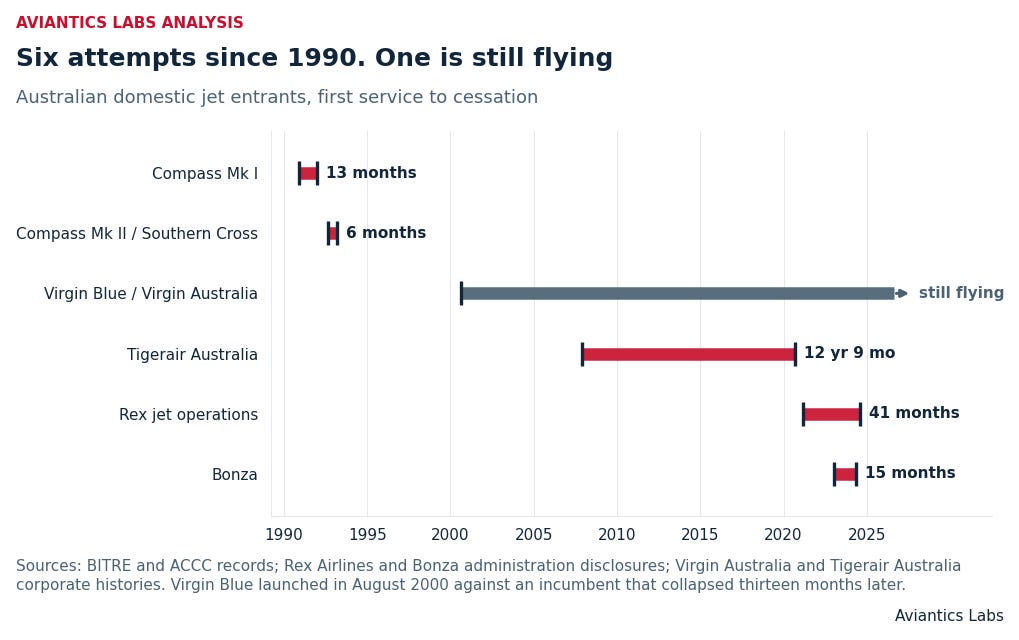
Six attempts since 1990. One is still flying, and it launched into a market with a collapsing incumbent.
That wall is down. The Commonwealth’s slot reforms, described by the department as the most significant at Sydney in twenty-five years, brought civil penalties of up to $99,000 per offence, powers to compel airlines to produce and publish slot allocation and usage data, a recovery period lifting movements from 80 to 85 an hour for up to two hours after disruption, and a rewrite of the regional peak windows. The audit that prompted them found incumbents using the system to hold slots they were not flying. Proof that something changed is sitting in the 2026–27 coordination file: 2,252 slots reserved for a carrier that has not yet satisfied CASA it can fly here at all.
The wall that replaced it is capital, and the numbers on that one are unforgiving. Bonza burned more than A$133 million in fifteen months operating roughly four 737 MAX 8s across 35 routes to 17 destinations, and it went down when 777 Partners stopped funding and the lessors repossessed the fleet. Zinc is raising A$250 million-plus to reach fifteen aircraft and seven route pairs by year five. Measured against Bonza’s burn, that raise is not obviously large. Bonza also had the easier job. It flew thin routes the duopoly had ignored, not the sixth-busiest air corridor on the planet.
Melbourne–Sydney carried 8,951,497 scheduled seats in 2025, on OAG’s count, behind only Jeju–Gimpo, two Japanese domestic trunks, Hanoi–Ho Chi Minh City and Jeddah–Riyadh. A route that size absorbs a new entrant’s capacity without much of a fare event for most of the market. It absorbs the entrant’s cash at the same rate, because the incumbent response on a corridor that dense is measured in seats rather than press releases, and seats are what the incumbent already has parked at both ends.
VietJet’s consolidated after-tax profit for the first half of 2026 was 1.372 trillion dong on consolidated revenue of 51.536 trillion. That is a net margin of about 2.7 percent. The airline it proposes to compete with earns 16.1 percent on domestic flying, and Jetstar earns 22.
Revenue grew 44 percent and the carrier moved 13.4 million passengers across 72,000 flights, so this is not a business in trouble. It is a business running thin. Net debt to equity stood at 2.37 times against total assets of 149.093 trillion dong. VietJet’s own half-year statement describes an order book of more than 600 next-generation aircraft, while Bloomberg’s August piece puts it at almost 400. That gap is worth naming rather than splitting the difference — order books get counted differently depending on whether options, purchase rights and unconverted commitments are folded in, and the gap between the two figures is 200 aircraft.
Either figure describes an airline with an enormous capital program ahead of it. Australia would be a third launch cost, in the highest-wage English-speaking labor market in the region, at a point in the fuel cycle that has already forced hedged incumbents to reprice.
CASA is the smaller obstacle and the one everyone writes about. Certification typically runs six to twelve months, which makes a 2027 launch tight rather than fanciful. The slots are held. The ownership rules permit it. What has to hold is a profit and loss statement in Hanoi that currently converts a 44 percent revenue increase into roughly two and a half cents on the dollar.
National share is the wrong lens, and 98.5 percent is a national share — 98.8 percent on the ACCC’s January passenger data, 98.5 in the regulator’s June release. Ninety-one percent of Australian domestic passengers already fly routes served by two competing airline groups. Seventy percent of major-city routes have three carriers on them. On the trunk network, the duopoly framing describes ownership rather than choice.
The concentration sits somewhere else entirely. Fifty-nine percent of regional routes and 68 percent of remote routes are served by a single airline. None of the three new entrants is going there. Zinc’s five-year map is five airports and seven route pairs. VietJet wants the triangle. Koala’s Uluru pivot is the closest thing to regional intent in the set, and it is charter capacity sold to foreign airlines rather than a scheduled service a Territorian could book.
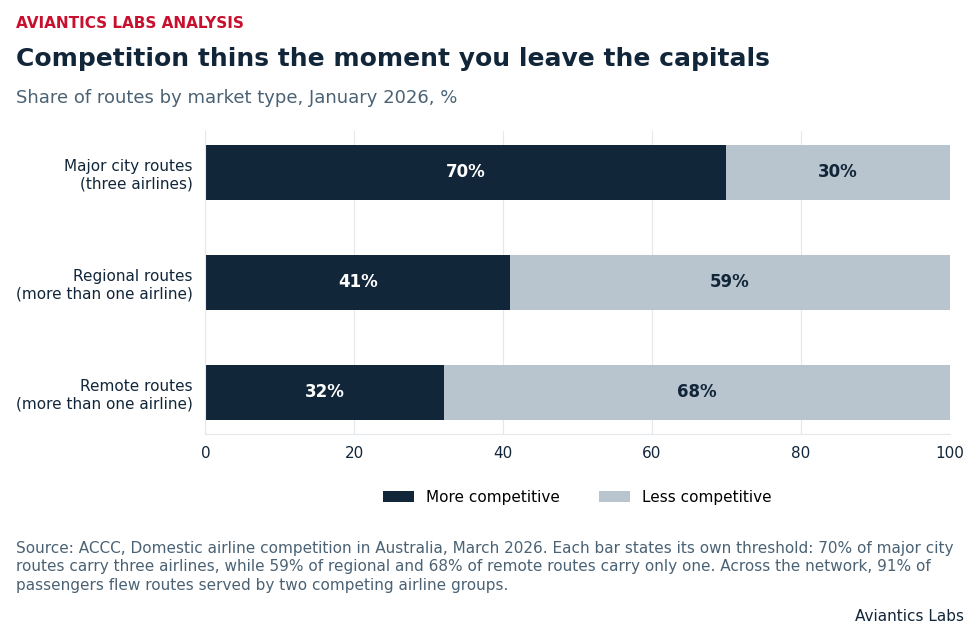
The trunk network is contested. The regional and remote networks are where single-carrier routes cluster.
What actually moved that number closed on December 18, 2025, and almost nobody covered it as competition policy. Air T, Inc. took full ownership of Regional Express out of administration, inheriting 31 aircraft and committing to return fourteen Saab 340Bs to service for a fleet of 45. The Commonwealth held its secured position on a A$60 million loan and restructured roughly A$90 million more, and one of Air T’s investors provided a A$50 million facility alongside it. Rex flew 1.2 percent of Australian domestic passengers in January. It flies them where the problem is.
“Competition is probably near a trough,” Morningstar wrote after the FY25 result. The same house rates Qantas no-moat. Both judgments look strange next to a 98-point-something duopoly, and both are defensible.
Look at the composition. Qantas Domestic earned A$676 million in the December half at 16.1 percent. Jetstar Domestic earned A$372 million at 22 percent. Loyalty earned A$286 million at 20.4 percent. Qantas International earned A$300 million at 6.2 percent, down on the prior year, and group underlying profit before tax rose 5 percent to A$1,456 million on revenue up 6.3 percent to A$12,896 million. The domestic business and the frequent flyer program are carrying an international operation under real pressure. Strip the domestic margin and the group’s earnings profile changes shape entirely.
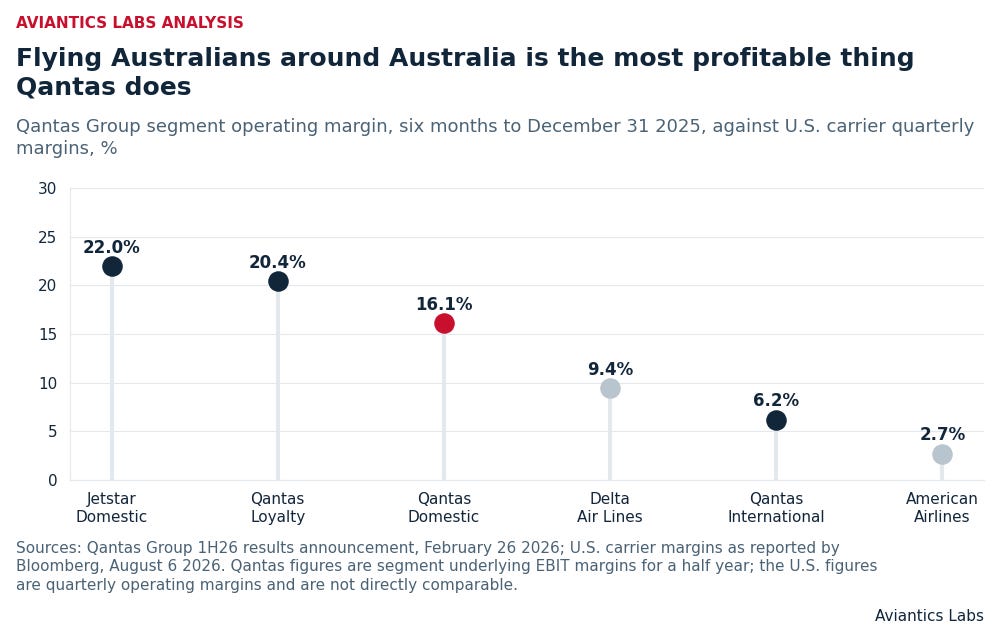
The domestic and loyalty businesses carry the group. Qantas International earns less than Delta.
Loyalty is the part a new entrant cannot replicate on day one, and it is the least discussed. A 20.4 percent margin on Qantas Loyalty describes a business selling points to banks and retailers, and its value to the airline is that it makes the marginal corporate traveller price-insensitive at the individual level. The company pays the fare. The traveller collects the currency. Virgin’s Velocity does the same work at smaller scale, with A$74 million of EBIT, up 14.8 percent, and 700,000 members added in six months. Zinc’s answer to that is a lower fare.
Virgin is the other complication in the impenetrable-duopoly story. It carried 33.2 percent of domestic passengers in January against Qantas’s 33.0 and Jetstar’s 32.6 — the first January it has led since 2022. The ACCC attributes the swing to seasonality and leisure mix rather than share capture, which is fair and worth stating. It still means a third entrant has to underprice two functioning airlines with hedged fuel, loyalty currencies and load factors in the mid-eighties, one of which posted A$279 million of underlying net profit for the half on revenue up 9.3 percent.
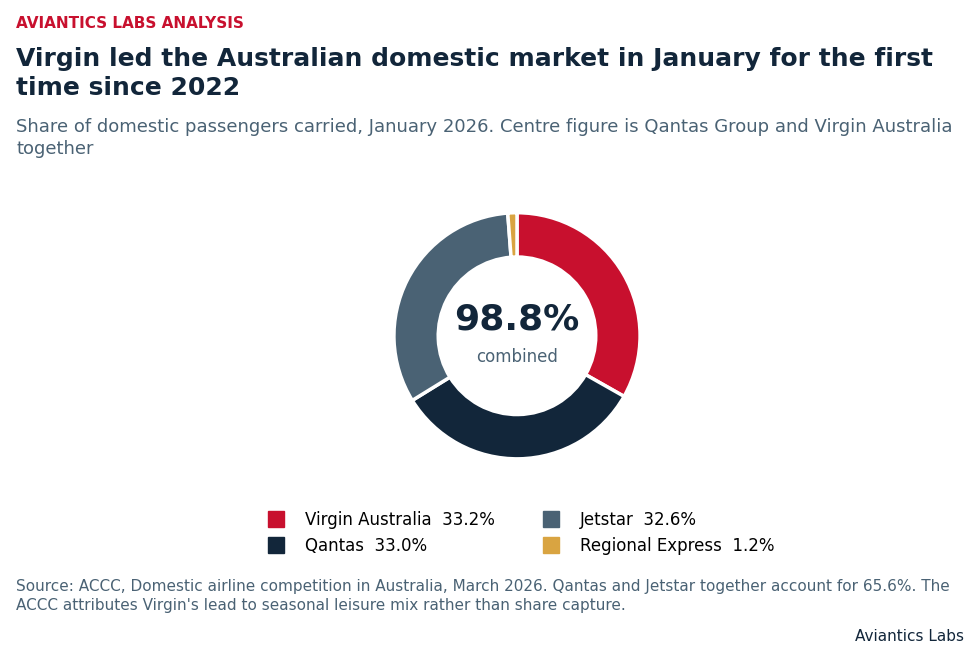
Virgin led the domestic market in January for the first time since 2022, on ACCC passenger data.
ACCC Commissioner Anna Brakey has been careful throughout, welcoming “credible interest from potential new entrants” while the regulator’s own reports keep publishing the demand numbers. Credible is doing the work in that sentence.
Every barrier that killed Australian new entrants between 1990 and 2024 has come down except one. Slots at Sydney are obtainable, a curfew-free second airport opens in October, and foreign ownership of a domestic carrier was never prohibited in the first place. What has not moved is the cash required to lose money on the golden triangle for three years against two hedged incumbents earning 16 and 22 percent, in a market that carried fewer passengers this January than last.
The decisive event is therefore a wire transfer, not a CASA sign-off. Zinc’s anchor investor either funds more than A$250 million or does not. VietJet’s board either underwrites an Australian launch off a 2.7 percent group net margin or quietly lets 2,252 slots lapse into the 2027 pool. Both answers land well before either airline files a certification plan. Watch the raise, not the regulator.
Analysis by Aviantics Labs · avianticslabs.com
Sources: Qantas Group 1H26 results announcement (ASX, February 26, 2026); ACCC, Domestic airline competition in Australia (March 2026) and ACCC media release, June 16, 2026; VietJet Aviation JSC H1 2026 results; Bloomberg, “New Airlines Target Qantas’s Grip on Lucrative Australian Market” (August 6, 2026), read via The Nightly, The Edge Malaysia, The Edge Singapore and Yahoo Finance syndications; FlightGlobal; ch-aviation; Australian Aviation; Business Traveller; Aerospace Global News; Simple Flying; Morningstar; OAG; Australian Department of Infrastructure, Transport, Regional Development, Communications, Sport and the Arts; Qantas Group and Western Sydney International announcements, June 2026; Air T, Inc. and Regional Express administration disclosures; The Runway Ventures
Comments
Nothing yet. Say the first thing.
Sign in to join the conversation.