
I. You live in the Tower of Babel
We started this substack with an image of a city on pillars. That is the vision of the idealized Western polis, with multiple economic pillars, supporting a broad level playing field, the marketplaces for deals and ideals, and a thin transparent dome of the state sheltering us from the elements. So that is the image that we want to get to, the cosmology of our ideal world.

But where do we actually live? What metaphor actually describes the place we find ourselves in?
This Substack is reader-supported. To receive new posts and support my work, consider becoming a free or paid subscriber.
[Cue Twilight Zone theme. Black-and-white. Rod Serling, cigarette in hand, addresses the camera:]
“For your whole life you have lived in the Tower. The Tower is all around you, and your culture has been building it for all of your life. You, bright intrepid explorer that you are, have probably found the cracks or windows in the Tower, but many of your countrymen have never seen the sky. Living in the Tower is an exercise in dealing with the immovable choices of those who came before you. Individuals and families cannot build their own houses, or dwelling units; they have to live within the templates set by the Tower, limits that govern how many friends you can have, and even how many CHILDREN you can have. And recently the Tower has been getting worse and worse: the water does not work, the air is frequently bad, and the lights are starting to go off more and more, and for longer and longer, and you worry that someday they will never come back on. But most people do not worry about that, because the main question that occupies the minds of your people is… who will be at the top of the Tower.”
“Now our Tower has heroes — a brilliant software engineer and manager, a manufacturing magnate, and a real estate investor with a second career as a reality TV star. They work really hard, and they climb really high, and they climb so high that they actually get to the top of the Tower, which has a table (there is always a table). [Insert ominous music to raise suspense]
But when the table they sit down at the table to discuss what they shall do, and they open their mouths to try and fix the Tower, and nothing but gibberish comes out of their mouths.”
“When this is your problem where are you? The Tower of Babel” [Insert jangling chimes to accompany announcement of the terrible truth]
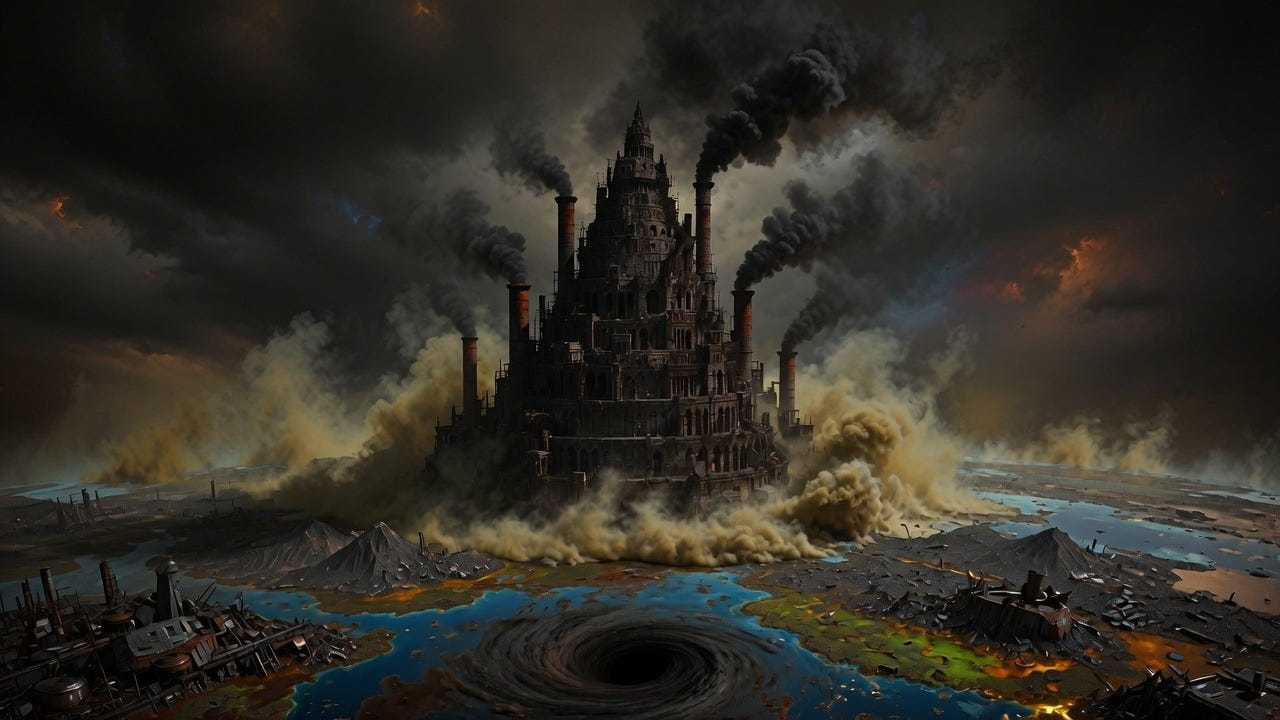
II. We have reached Peak Centralization… and We can No Longer Speak each other’s language.
I actually do not think this is as much of a metaphor as we would prefer. In case you did not notice the three men I mentioned are Bill Gates, Elon Musk, and Donald Trump, each of whom has climbed to the top in different ways and each of whom have been incredibly ineffective at building coalitions with their alleged peers.
Trump and Elon
As you may recall, DOGE was originally conceived of as a kind of public-private partnership between the Trump Administration and the various pools of talent that Elon had access to, which aimed to accomplish the same kind of top-down driven efficiency improvements that Elon had accomplished at Twitter and in his other companies. Given this mission it made sense for Elon himself (as arguably the most skilled fat trimmer in history) to lead the effort. The partnership was rocky from the beginning, I recall the black eye that Elon sported after meetings with senior members of the Trump staff, the constant news media and lawfare on even the most basic cuts that Elon proposed. The Trump Administration eventually bowed to the pressure to restrict DOGE’s mission and Elon’s role in particular until he resigned. Shortly after resigning the Trump administration proposed and rammed through the Big Beautiful Bill and there was a vicious back and forth online with Elon insinuating that Trump was in the Epstein files and Trump threatening to revoke the government contracts held by various Elon companies.
The point that I want to make here is that by the accounts of experts in the (ever more) disparate domains of corporate efficiency and public relations both men were performing at peak levels. Elon’s accomplishments with Doge, both personally and in terms of the team that he recruited and ran, were literally awe inspiring. In slightly over 4 months he uncovered so much fraud that the claim that our entire national debt is simply the result of private inurement by our managerial class is no longer a fringe conspiracy claim.
Likewise, Trump’s Big Beautiful Bill is a massive legislative accomplishment, certainly the most important piece of legislation in both of Trump’s terms, and arguably akin to Obamacare in terms of how much it will shift the landscape (assuming that its provisions are not stripped out by judicial fiat).
What I want to point out is that neither man has any kind of expertise in the other’s domain, and so they have no way to evaluate the difficulty of the feat performed, nor were they positioned to benefit from the accomplishment of the other person. Trump has very little concept of manufacturing efficiency (real estate of the kind he practices tends to reward “spend big, charge more” models). Meanwhile, Musk still has a very naive version of politics and constantly expresses feelings of betrayal by people who were openly signalling (for anyone familiar with political language) what they were about to do. This is despite an AMAZING amount of baseline political alignment in donors, investors, and allies. Trump and Musk’s political futures are so interlinked as to bring to mind Benjamin Franklin’s quip “We must all hang together, or we will assuredly hang separately.” Yet despite every incentive to align their lack of overlap in their domains of expertise means that they must deal through trusted intermediaries neither of whom can fully translate the concepts and intentions of one potentate into the language of the other.
As a friend of mine said in one of the conversations that birthed this article. “Musk and Trump are like two emperors of separate lands, separate languages, separate courts, separate power structures, separate moral hierarchies. The problem is that they are NOT separate at all. They are interdependent and intertwined on every level that it is possible to be EXCEPT that of communication.”
This nigh-inescapable interdependence of risk, despite deep incompatibility of communication style is what I mean when I say we are in the Tower of Babel.
Elon and Gates
A more obvious example is the way that both men interact with Bill Gates, who does NOT share their deep political alignment. Musk himself famously attempted to explain the math of his electric semi-trucks to Gates in person, and at the end of the conversation Musk concluded that “He [Gates] is not strong in the sciences.” I think that most people tend to read that as Gates being an intractable politicized bigot, deliberately refusing to understand something “because his salary depends upon him NOT understanding it” as the old saying goes.
But what if it is not that? What if it is literally true that Gates lacks the domain expertise to evaluate Musk’s claims and was dependent upon (presumably politicized) analysts and intermediaries to do the math for him. Do recall that Gates ultimately lost money (somewhere in the vicinity of 1.5B as I recall) on the shorts of Tesla and other Musk related enterprises. Two of the most successful men alive cannot evaluate each other on core factual claims. Each has the other’s domain mostly wrong.
Trump and Gates
In October 2025, Gates published a long climate memo arguing the world should refocus from emission-curbing toward preventing human suffering. Trump immediately began opining on Truth Social that: “We just won the War on the Climate Change Hoax. Bill Gates has finally admitted that he was completely WRONG.” Gates responded with: “a gigantic misreading of the memo.” Again these two elites cannot agree on what a memo says, let alone on the problem underneath it.
The point that I want to make here is that these men have no common language. No shared field of expertise. No language any of the three can use to honestly assess either of the others on the others’ own terms. They speak past each other because they have nothing in common other than money and a history of success in apparently incompatible domains.
Begging the Question
So our elites appear literally incapable of collaboration and genuine coordination, which would require a common understanding of aims, goals, methods, and a whole host of background knowledge on the costs and implications of the methods they are genuine experts in. Why is this?
The first answer that occurs to people tends to be egotism: three enormous egos colliding, as egos do. But the record shows each man behaving rationally and performing near his peak inside his own domain. Egotism explains the heat of the feuds but does nothing to explain the specific failure on display, which is the inability of each man to measure what the others had done.
A more complete answer lies, I believe, in the way that our culture has shifted the definition of “Economy” over the past 4 centuries, and the impact on the dominance games we no longer play.
III. Economies of Scale and Dominance Games.
Economy is derived liguistically from the Greek oikonomia: household organization, the law of the house. I once heard a lawyer maintain that the best modern analogue to the ancient concept is the company agreement of an LLC: a list of ways to determine what the organization will do in a given set of circumstances, with a fair amount of industry-specific business-model instruction thrown in for good measure. The ancient economy was many such households, each running its own agreement, each with its own storehouse, social hierarchy, and frequently tokens of rank and credit (issuing its own currency in effect). The city on pillars is exactly that image: many smaller hierarchies, many independent gatekeepers, many apex positions a man can spend himself achieving and occupying, with honor paid especially within families. That last part matters for fertility, among other necessary pillars of existence.
Industrial economics dismantled this traditional stasis. Limited liability, demanded by the managerial class, arrived with its evil twin, regulation, and together they turned every market into a monopolistic competition whose iterated endgame is one provider serving a global market of consumers. The specialized monopolies that result are efficient, frequently addictively so. Every corporate giant is autistically good at satisfying one tiny piece of the human soul: Apple at taste, Walmart at procurement, Amazon at delivery, Goldman at capital, Pfizer at compliance. None of them can manage a whole human, let alone a whole household. None of them can offer an employment arc longer than five or ten years, let alone a pension. (Though the Japanese seem to still manage it; more on that in a future post.)
The problem with this is that this leaves us with no way to play dominance games. Now why is that bad you ask? Much of modern culture is about AVOIDING dominance games (at least masculine ones) at all costs.
Dominance games are essential ritualized structures that transform potentially lethal competition into a manageable contest of status, allowing real competition to occur without robbing the tribe of the loser’s contributions. A famous example is the way that mountain sheep use head-bashing to establish hierarchy among themselves—a ritualized display that preserves the life of the combatants—while not hesitating to using their quite dangerous horns to gore all other species. They are perfectly capable of using their horns on their own... but they don’t as that would weaken the herd. Wolf packs only have the alpha, beta, etc ranks inside of zoos and prison environments, in the wild they actually have numerous and sophisticated ways of playing complex games of submission that allow authority to be shared and traded back and forth so that the pack is not fatally weakened.
Historically, humans utilized games around the dominant technology to determine relative rank without resorting to mutual destruction, which weakens the tribe (our version of the herd/pack if you like). In a healthy culture, these games create a shared, structured field of competition. The medieval tournament took the deadliest men in Europe, mounted, armored, and trained from boyhood for exactly one kind of killing, and ran them at each other with blunted lances under the arms of courtesy. A knight could be unhorsed in the lists before every peer he had, stand up, and ride home alive with his life intact. By the end of the tourney the heralds had called the standings, and everyone from the king to the grooms, including most importantly the MEN IN THE ARENA THEMSELVES knew who stood where. The loser knew that the winner had more skill, more strength, and was more capable of defending their shared interests than he was. The tournament made rank legible among lethal men while preserving the losers for the next war that the larger tribe would engage in. That competition allows elites to measure their standing and resolve conflict without threatening the survival of the tribe
Patrick Bet David famously discussed how billionaires tend to be people that are hyper-dominant in one field.
The basic problem with our current batch of elites, as I see it, is that they have convinced themselves that their game was “real” or “fundamental” or “justified” in a way that the games played by other similar men were not. Rather than making ALL elites play the same game, we have raised up men whose qualifications to play the great games of finance and politics is that they have no peers in one discrete game or another. They have learned from experience that the ONLY values that matter are the ones that they themselves embody the best. We have created artificial silos measuring only one tiny slice of the human soul, and the result of that hyper-specialized contest has been the production not of gods but of Titans. They are Titans embodying a narrow, inhuman concept with ruthless perfection, but their ruthless perfection leaves them deeply alienated. They are peerless, which is fine until you remember that one way to summarize essentially all of human culture as the quest to find and win the acclaim of one’s peers.
Underneath the Titans, the men who are themselves load-bearing pillars of our economy, the country has no resilient distributed network of Oiko-Nomias, with each households relatively independent, especially in matters of core survival of their neighbors. Rather our Tower of Babel resembles more and more a stack of cards, or that weird corporate icebreaker game where everyone sits on each other’s knees. We do NOT have multiple pillars that can endure the loss of some percentage of their fellow market-makers. We have dismantled those things leaving only a single fragile global stack.
The point that I want to make is that Trump/Musk/Gates communication breakdown is the INEVITABLE OUTCOME of our policy choices. We have specialized and centralized and specialized and centralized, again “added house to house, and field to field, until there is no more room” and we thoroughly deserve the woes that the prophet Isaiah pronounced upon us. Because our elites have no overlapping skill sets or domain mastery they cannot play honest dominance games. Each man feels himself to be performing well, and the objections brought by the counter-party are “cheating.”
What we are missing is one unifying game we can play against each other and understand our relative ranks. We technically share a major worldwide language, but English’s dialects and subdialects have diverged so far, especially along political and technical lines, that we are “one people divided by a common language,” as the Americans and the English used to be said to be.
What we have instead is something closer to mutual assured destruction. The separate games do not rank the players against one another. Each game is a binary veto on the system itself. A manufacturing magnate can only win by turning off production. A financier can only threaten by turning off liquidity that pays his salary. A platform owner can turn off the pipes, destroying his core IP. A regulator can strangle a sector leaving his specialty worthless. None of these moves settle any kind of ranking contest They only work if the loser is willing to burn the world to the ground starting with his house. You see this in the interaction between the SEC and Elon in the fines that were levied right at the end of the Biden administration. Elon wound up paying the fines because the alternative was for his line of credit to be cut off, destroying his company. Every successful venture requires the overlap of multiple actor who have no ground of moral similarity.
As I have often observed in discussing these matters, Roman Helmet Guy had the right diagnosis: these are artificial spreadsheet meritocracies. The standings are legible only inside each silo. They have little or no bearing on the actual meritocracy of violence, or on any shared field where lethal men could test each other and live. A man can top every leaderboard in his domain and still have no way to prove, to his peers or to himself, that he would prevail if the contest turned serious. So the separate games do not produce honor. They produce veto power.
What our current elites do is not fencing with the possibility of parrying. It is not even a duel with pistols at twenty paces, where it is plausible for both men to survive. It is more like two men with shotguns at twenty feet, each convinced the other cheated at a game neither of them fully understands. Worse, the stack keeps increasing the destructiveness of the arms of the competitors. Every hyper-specialized Titan holds up a load-bearing piece of the Tower. Any one of a thousand (or more) billionaires who feels his interests threatened could potentially crash the system, because his narrow excellence has been woven into something the rest of us cannot live without. The cold war between them stays cold only while everyone tolerates losing. The escalation does not stop at shotguns. It ends with each competitor armed with a nuclear suicide vest and a dead man’s switch, promising that if he cannot enjoy being king, no one gets to live in the Tower.
So what does this produce? In any situation where humans can leave, it produces a literal departure from the collapsing tower. This can look like people groups leaving Ancient Sumeria, or the American founders fleeing the constraints on thought and innovation that were centralizing the European nations into vast inflexible empires. People who do not understand the motivations, necessity, or benefits of divergent skillsets form a tribal hierarchy around what they DO value and leave. Defection incentives mean that as soon as the first group goes the others face ever increasing pressure to follow. You can still see this in the way that California’s attempts to raise revenue by taxing the heads of their productive tribes (tech startups) simply result in those value-creation engines departing the state.
Remember this was Elon’s original goal, to build an ark, take his tribe to Mars and essentially never return. But somewhere along the line he came to the conclusion that even his genius could not escape from the industrial Tower of Babel that we are all trapped in.
IV. The Tower is Falling, Whether We Like It or Not
So you have been in a Tower reaching toward the heavens all your life. And it is worth acknowledging that despite all its flaws and failures, despite its growing dysfunction, and despite the way that our Elites have become less and less able to talk to each other, the Tower has uplifted millions of people out of poverty, it has solved pricing dilemmas and allowed us to build supply chains of complexity undreamed of by the ancient world. We are, to put it mildly, not confident in our ability to provide an alternative structure that guarantees the survival of substantial populations both in our own countries and around the world, if we start turning things off so that we can update or refurbish them.
Almost any arguments for reforming or replacing it founder on the moral risk associated with disturbing this structure, and all the vulnerable people that are hyper-dependent on it. Whether you frame this as “the Tower is a net good” or “the Tower is a necessary evil holding back a greater horror” is more about personality than it is about a different analysis. This is why we do not know how to move forward, why we are all paralyzed by a lack of “permission structures”. The current system materially provides better than all past systems at least one order of magnitude and maybe more.
We can lament the social and political effects of our silos, we have lots of fear and disgust for the titans that those silos breed… but not enough to want to break them.
The truth is that these things carry within them the seeds of their own destruction. The current system has no way of offering our emerging elites a dominance game short of a cold economic and propaganda war, which remains cold… only so long as the losing side tolerates losing. At some point one of those titans will decide that if he cannot enjoy being the dominant political actor “then no man shall.” Another way (arguably the most healthy and pro-social way) of articulating this insight is Joe Lonsdale’s recent comments about being “willing to pay a 90% tax rate” if that allowed him and his to live in a “functioning society.” 90% of Joe Lonsdale’s fortune (properly applied) could have an INCREDIBLE impact on the democratic systems of even the First World, and could plausibly fund the outright conquest of several second tier nations, and essentially anywhere in the developing world. Lonsdale’s conservative temperament means that he, and other Right-Wing Billionaires are unlikely to actually DO any of these things (as Curtis Yarvin consistently bemoans on X). But presumably there are significant number of less virtuous, less restrained figures with vast sums. At some point one of them is going to make a move.
Even finance, which has long been the only remaining thread binding our fair republic (and the global system which it subsidized) together, is failing. To be clear, that is what all of these massive debt loads mean. They mean that the financiers are not able to efficiently calculate what comes next, what moves are necessary to keep the promises of growth going.
The problem is that the economic incentives of growth for our system as a whole are no different from Enron. One of my professors in law school had actually read the emails and transcripts of Enron’s corporate communications. He told me that before they decided to break the rules, they had very intensive conversation looking for another way to exceed their growth. They were trying to “win the game” as they understood it. Rather than accepting the ugly limitation of real growth in the real world, with real humans, and actual atoms, the board of Enron decided to introduce another layer of abstraction into the mix and financialize the difference, which I want to emphasize was the financially winning strategy. While the specific techniques that Enron used were illegal at the time, essentially the entire Private Equity industry, and more and more the emerging hyper-scaler industry (which is less and less related to AI as a technology) are following the same logic. As are our global central banks. The rumors around a new reserve currency or CBDCs are like the debt, just warning signs, evidences that the system as it exists lacks the moral and technical capacity to perpetuate itself.
What happens to a system that cannot perpetuate itself? Well the final scarce resource, high-quality, high-IQ, high-trust people drops more and more, until it cannot sustain the population. This leads to expulsions of certain groups, denial of benefits, and overall a contraction of the population, especially the high-IQ population, and the thing happens over and over again, until all confidence drops out of the bottom of the system. This is why you have so many people talking about the collapse of the Roman empire.
V. Conclusion
It is in the light of this that AI is spoken of by the Tech Right in terms analogous to an act of divine intervention (mediated of course by the Cult of Effective Altruism). This is what Elon means when he says “The government is basically unfixable….If AI and robots don’t solve our national debt. We’re toast.” (He says the same thing about our birthrate crisis by the way).
Interestingly, AI is incredibly good at bridging the literal communication gaps upon which the Babel story is built. On 25 March 2026, the Japanese artist @FUTOCHIMPO posted art depicting U.S. Navy sailors from Sasebo cooking bacon at a yakiniku restaurant. The post drew 24.2 million views and 79,000 likes inside a week, the great majority from Americans. Americans did not become fluent in Japanese in those seven days. Since mid-March, Grok had been quietly translating and recommending foreign-language posts into the For You feed; Musk announced the feature four days after the bacon post, and X’s head of product called the worldwide rollout the largest cultural exchange in history. What followed was a sustained convergence between Japanese and American X that had been latent for years and is now visible week to week, from Sanseito’s outreach to its American counterparts to the way Trump’s endorsement of Sanae Takaichi matured into her February supermajority.
One X user, in a moment of insight I would likely never have found without my own AI assistants, called the moment a reversal of the Tower of Babel. The curse of Babel was confusion: tongues sealed against each other, the building halted, the people scattered. What happened in March was the opposite event. A machine translated between sealed tongues, and two peoples who had no common language discovered they had a common culture. That is the curse lifting, by a crack.
And maybe that is all AI will be, is a way of perpetuating our current large-scale structure. And to be clear, I think that some people, maybe even most will use it in that way. Maybe Elon will build a version of Grok that he can trust to evaluate and predict the behavior of men like Gates and Trump, and give him the tools that he apparently lacks to persuade them toward useful collaboration. Maybe, though I find this possibility significantly less likely, Trump and Gates, and others like them will ALSO have AI assistants that they trust to bet their lives and political futures on. If so maybe we can shackle the Titans we have raised in the bowels of our Tower and limp along for another 100 years, declining slowly the way Rome did. Our elites are certainly incentivized to try.
But if AI follows the trend of other universalizing tools, maybe it will recreate the conditions for a new type of non-lethal dominance game, one that can be played by many many people. Maybe instead of revitalizing our leaning Tower we can build a new city, whose pillars and foundations are those who have mastered the new set of skills that AI will make hyperdominant in essentially all domains. Fortunately, this is not the first time that a new piece of technology has bridged multiple, apparently disparate economic and technical domains. And we will get into that…in the next post!
This Substack is reader-supported. To receive new posts and support my work, consider becoming a free or paid subscriber.
Comments
Nothing yet. Say the first thing.
Sign in to join the conversation.