
Hello friends,
Welcome to the Avalon Circle Substack. If you are here you are almost certainly part of that emerging movement in our country and our world that is concerned with civilizational projects. In part this is the story of every generation, as civilization must be renewed against the twin onslaughts of an ever-changing technical landscape, and the unchanging realities of imperfect human nature. But there is a sense, and I think it is a true one, that the challenges to civilization are particularly profound in our day.
For instance, in most times and places we would not need to start an inquiry with “What exactly IS civilization?
Is Civilization… FLAT?

When we think of civilization, we tend think of organized complexity built on top of level playing fields. These “flat spaces” are characterized by a set of conditions where individuals or entities can compete or interact as equals, regardless of their background.
• Modern corporations are funded by the “flat space” of stock markets which (we are told) efficiently conduct capital from anyone who has it to anyone who has a good idea, regardless of who their father was.
• Modern innovation is built on the“flat space” of university education. The idea is that we put all the smart kids in one place, grade them on a curve, and the cream in our meritocratic pail rises to the top to solve our problems.
• Modern politics is built on the “flat space” of “the marketplace of ideas.” We assume that all online forums are near perfect analogues of the ancient English town square and if we just let all “citizens of the world” speak to us about whatever they wish, at all times of day or night, without regard to the technologies being used, the best arguments will win and we will naturally move toward the truth.
Except... have you looked around lately?
Those “level playing fields” seem less and less level. The stock market feels rigged. The universities are producing conformity rather than innovation. The political marketplace is a shouting match where no one is listening. The complexity we built on top of these fields is less and less able to meet our most basic human needs.
What is happening?
The Minecraft Myth
The problem is that the modern myth assumes that the world is a series of flat places which naturally generate like the “Flatworld” setting of a Minecraft game. We think that “flat” is the default state of nature.
But that is not reality.
In the real world, if you go out into the woods, do you find perfectly graded soccer fields waiting for you? No. You find rocks, roots, cliffs, and swamps. The real world is jagged, crooked, and cruel.
You may even find a watery world of constant storms, with lightning crashing overhead and the only solid places being razor sharp crags rising from the oceans. This is a good description of the ancient concept of Khaos, the waters that existed before Fiat Lux brought a level of order under a protective firmament.

If you are playing a video game, you can build a flat place by simply adding more material out into the void on one side, and it just floats there. But if you see someone trying to do that in real life—trying to build a platform on thin air without support—you know it’s going to collapse.
Who Built This?
Whenever you see a level playing field in the real world, you have to ask one question: Who built this?
Who did the work to clear the trees? Who graded the dirt? Who creates the boundary that keeps the chaos out?
The reality is that flat spaces are artificial. They are expensive to build and expensive to maintain. And you cannot build them with other flat spaces. You have to build them on Pillars.
This is the great paradox of civilization: The only way to get the “level playing field” that we all want is to build “hierarchical pillars” that can support it.
To get the “flat places” that we want—those safe harbors for commerce and community—we have to build pillars. We have to construct hierarchies that are capable of handling the unequal reality of the world, bringing the low places high, and then those pillars can hold up the floor for everyone else.
The Household IS the Pillar
This brings us back to the Great House.
We tend to think of the “Village” or the “Assembly” as the ideal flat spaces—a place where equals come together to trade and govern. But a village isn’t made of disconnected individuals. A village is a “flat” organization made out of “vertical” organizations (more on this in a future post).
The Household is the pillar. It is the structure that bears the weight. It handles the jagged reality of the world—the sickness, the training of children, the accumulation of capital—so that the individual members can step out onto the “flat” field of the marketplace and interact as equals.
The Great Houses, and their subsidiary households, are the guarantors of successful generational transitions. It is they who stand in the gap to ensure that property, and position, and the intangible pieces of identity necessary for the continuation of a culture are preserved.
They do this not merely for themselves and their own dependents, but for EVERYONE in their community. The health and stability, the well-stewarded wealth of a people, is embodied in their Great Houses, often literally, which is why that name is associated with these key lineages.
They build pillars out of physical and spiritual families, from father to son, mother to daughter, teacher to student, generation to generation, with each successful transition raising the pillar of their line closer to the heavens. Or if you like, with every passing generation, they are capable of touching bedrock beneath a deeper and deeper abyss to support the beautiful cities that are built on top of their hidden foundations.
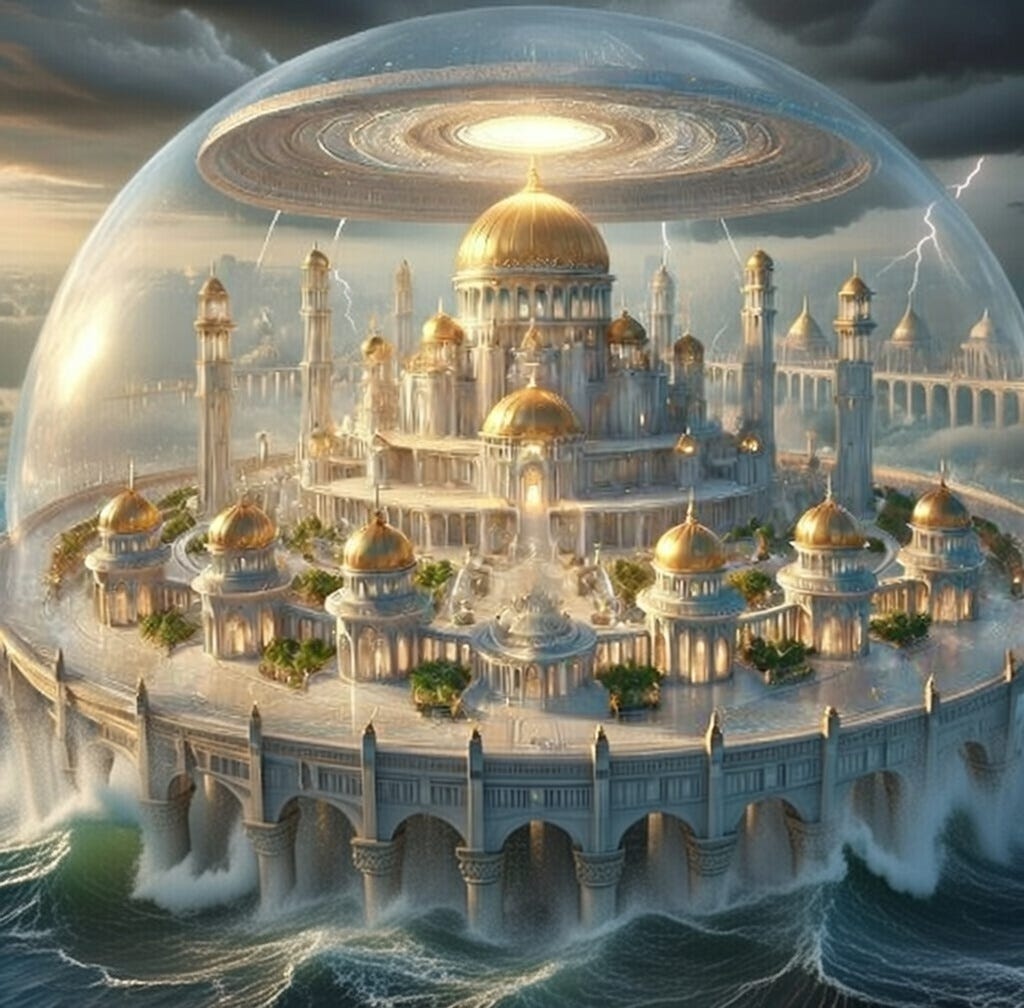
If you destroy the pillars—if you smash the Great Houses in the name of making everything flat—you don’t get a wider, freer world. You get a world where the jagged edges of the earth opens up and swallows you.
The Challenge
So, here is the reality. If we want to enjoy the benefits of a flat space—if we want safe markets, honest debates, and walkable neighborhoods—we have to stop pretending they happen by magic.
We have to start building the pillars. We have to build the Great Houses that act as the guarantors of ordered liberty. We need men and women willing to accept the burden of inequality—the burden of leadership and responsibility—so that they can create a bounded space where the “level playing field” can actually exist.
So when people ask why we need Great Houses? They are what is holding up the floor. And we need a lot more of them if we are going to preserve and advance the great Civilization that our ancestors wished to give to the generations that came after them and that we (if you are with us you know what I mean) desperately want to give to the generations that come after us.
Vivant Magnae Domus!
No posts
Comments
Nothing yet. Say the first thing.
Sign in to join the conversation.