
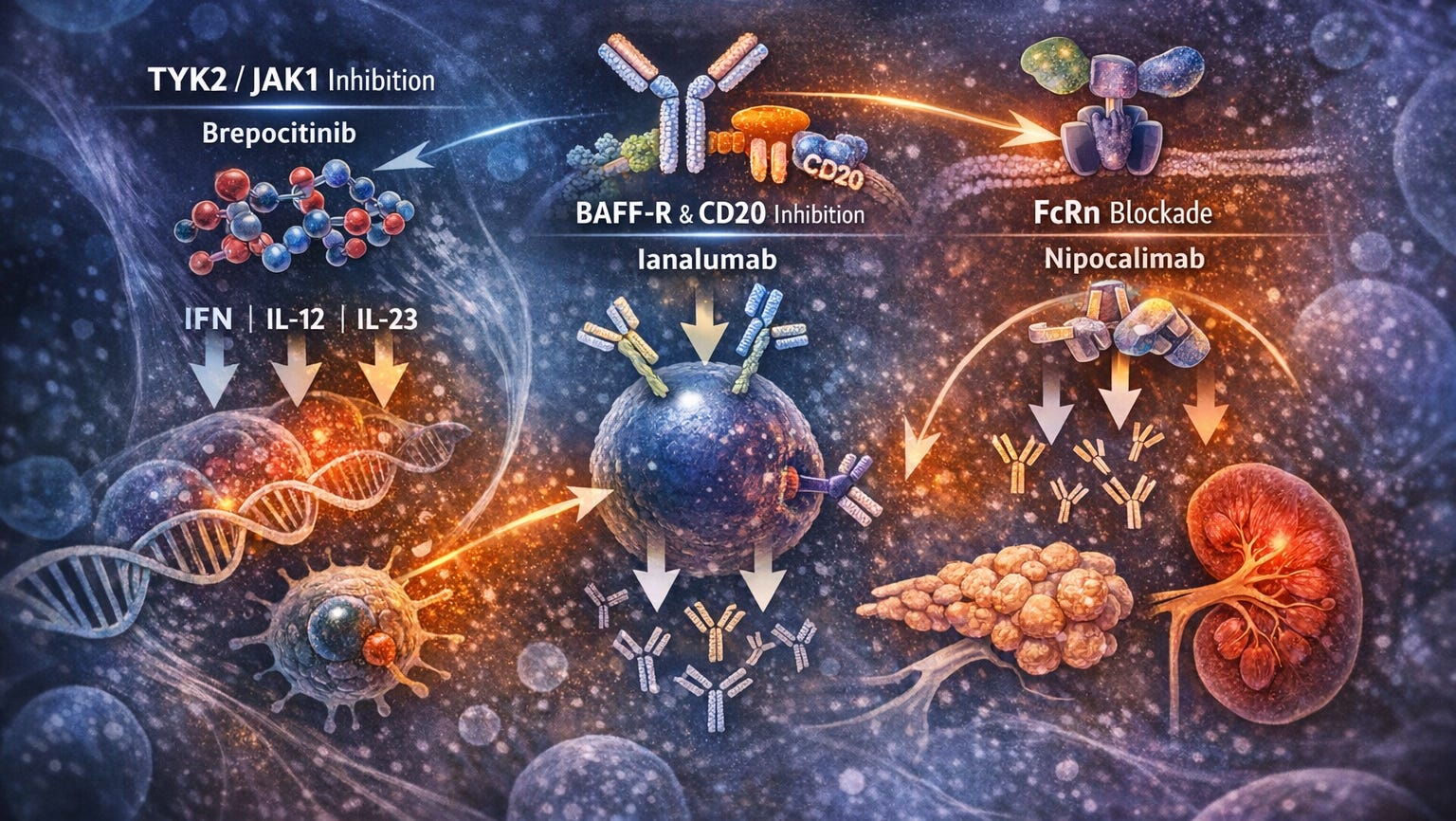
The Pipeline Monitor covers recent developments in autoimmune and inflammatory drug development - new data, FDA actions, phase transitions. Each item gets a write-up and a Buy/Sell/Hold rating. Six items this edition: avacopan (AAV), brepocitinib (DM), ianalumab (Sjögren's), nipocalimab (SLE), deucravacitinib (PsA), and obinutuzumab (SLE).
Signed up yet? Check w/your boss to see if you can expense a yearly subscription!
Avacopan - Amgen (via ChemoCentryx) - FDA Requests Voluntary Market Withdrawal
I have spilled a lot of ink about the ADVOCATE trial and have been vocal about its limitations. I did not see this coming. On January 16, the FDA asked Amgen to voluntarily withdraw avacopan (Tavneos) from the US market. Amgen said no.
Exactly why this happened remains murky. The EMA has launched a parallel review citing “questions regarding data integrity,” which is both highly concerning and completely nonspecific. As of this writing, the FDA has not publicly detailed the reasons for their request. Amgen posted the following on their website:
The FDA raised concerns about the process followed by ChemoCentryx to re-adjudicate primary endpoint results for 9 of the 331 patients in the ADVOCATE trial. Hepatotoxicity, which is a known infrequent risk of TAVNEOS treatment for AAV, was also raised in the context of the benefit-risk profile of the medicine.
Neither the re-adjudication issue nor the hepatotoxicity signal is new; both surfaced during the 2021 advisory committee meeting that nearly voted against approval. I would add those to the well-described problems background therapies (rituximab-induced patients did not receive maintenance therapy) and off-protocol prednisone prescribing (86% of patients) as reasons for ADVOCATE skepticism. None seem sufficient to explain the current regulatory fracas and we do not yet know if the FDA will be initiating a formal withdrawal process.
So what should you do while this gets sorted out? I still believe in the benefits at week 26 and have had multiple patients who have done better after initiating avacopan. I have also had multiple patients elect not to receive avacopan after I discussed this issue with them. If you want to play detective and have time to wade through hundreds of pages of legalese, there are hints to deeper disputes about the handling of BVAS scoring in this class action lawsuit (check out 133, 136, 141, & 142, 175).
HOLD - It would be an extraordinary step for the FDA to revoke authorization for avacopan, but the steps already-taken are extra-ordinary. Keep a close eye on this one.
Brepocitinib (Priovant ) NDA Accepted with Priority Review for Dermatomyositis
Dermatomyositis has had essentially zero targeted therapies for its entire history as a recognized disease. Aside from IVIG, which was only recently approved, our suite of options for myositis includes a menagerie of drugs with soft data (methotrexate, mycophenolate, azathioprine) and one drug that basically failed (rituximab).
Priovant announced that the FDA accepted the NDA for brepocitinib in dermatomyositis with Priority Review, based on the VALOR trial. This will be the first positive 52-week placebo-controlled study in DM and the first targeted therapy for this disease. The PDUFA date (ie when the FDA has committed to giving information) will be August 29 of 2026, with launch expected shortly thereafter.
Brepocitinib is a dual TYK2/JAK1 inhibitor, which means it hits type I and type II interferons, IL-6, IL-12, and IL-23 with a single daily oral pill. I have long been multiple-biologic-curious, and a TYK2/JAK1 happens to hit multiple interleukins at once. Priovant is also running a phase 3 in non-infectious uveitis and recently posted positive phase 2 data in cutaneous sarcoidosis, so the mechanism has runway across rheumatology if the safety holds.
The JAK safety question will come up. Mechanistically, it seems plausible that a TYK2/JAK1 inhibitor would have a better safety profile than a nonselective JAK inhibitor. I have firmly planted my flag on “This is a Class Effect Until Proven Otherwise Island,” but I am hopeful the pharma-spin on this one proves me wrong. For a disease where the alternative is indefinite high-dose prednisone and off-label immunosuppression, the risk-benefit conversation will likely favor wide adoption. I’d like to see the full VALOR dataset before getting too comfortable, but this is an early contender for the much-coveted “Autoimmune Drug Development Report Biggest Winner of 2026 Award.”
BUY! First targeted therapy for DM. The unmet need is enormous, the mechanism makes sense, and the market for myositis is relatively large
Ianalumab - Novartis - FDA Breakthrough Therapy Designation for Sjögren’s Disease
Sjögren’s disease is the second most common systemic autoimmune disease, and it has never had an approved targeted therapy. That’s not for lack of trying. Rituximab failed in two trials. Abatacept was a wash. Belimumab didn’t move the needle. Somehow even hydroxychloroquine did not help. The graveyard of Sjögren’s trials is large and well-populated, which is why the ianalumab Breakthrough Therapy designation, granted in January on the strength of positive replicate phase 3 trials (NEPTUNUS-1 and NEPTUNUS-2), is genuinely notable.
Ianalumab is a fully human monoclonal antibody with a dual mechanism: it depletes B cells via ADCC and blocks BAFF-R to inhibit B cell activation and survival. Think benlysta +/- rituximab? Novartis plans global regulatory submissions starting early 2026. I suspect it will be approved, making it the first targeted treatment for Sjögren’s.
Here’s where I get uncomfortable. The NEPTUNUS trials improved the ESSDAI, which is both the standard for Sjögren’s trials and also my least favorite outcome of all time. Patients with Sjögren’s disease suffer from dryness, fatigue, and pain, only one of which is (not even well) addressed by the ESSDAI. I wrote about this exact problem with the ianalumab data last year for RheumNow: physicians thought patients improved, salivary flow appeared better, but the patients themselves did not report feeling meaningfully different. I feel like I’ve seen this movie before.
I think I’d rather have an imperfect first-in-disease drug than no drug at all, but I would also rather not give false hope to patients who are suffering.
HOLD - First targeted Sjögren’s therapy would be historic. But improving physician scores without improving patient experience is a familiar and worrisome pattern.
Nipocalimab - Johnson & Johnson - Positive Phase 2b in SLE + FDA Fast Track
FcRn blockers have had a productive run in neurology - efgartigimod in myasthenia gravis, rozanolixizumab in the same - but they have not yet cracked a major rheumatology indication. In January, J&J reported that nipocalimab met the primary endpoint of a phase 2b study in SLE, where a significantly higher proportion of patients achieved SRI-4 response at week 24 compared to placebo. Key secondary endpoints, including steroid-sparing measures, were also met.
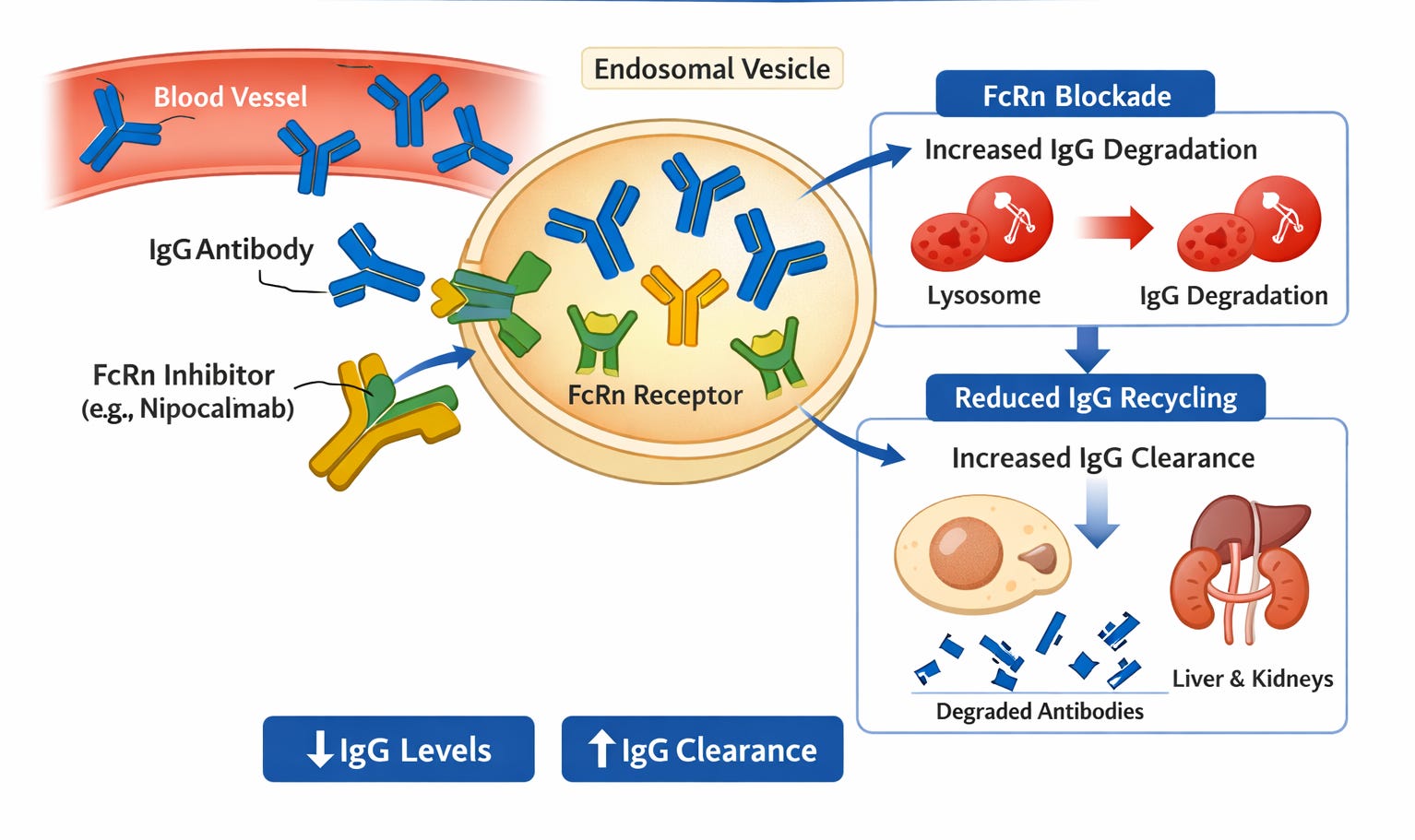
The mechanism may be novel to you. FcRn recycles IgG antibodies, keeping them in circulation longer. In an autoantibody-driven disease like SLE, blocking FcRn accelerates the clearance of pathogenic IgG. It’s the same logic as plasmapheresis (ie “lets get rid of the malhumors”), delivered as a subcutaneous injection rather than a pheresis catheter. Nipocalimab is also “immunoselective” - it preferentially reduces IgG while preserving other immune functions (ish) - which in theory means fewer of the infectious complications.
That said, SLE has the highest phase 2-to-phase 3 attrition rate in rheumatology. Expect that topic to arrive in a Critical Commentary someday soon. To cite a few examples: ustekinumab looked great in phase 2 and imploded in phase 3; baricitinib split its phase 3 trials, despite a BRAVE attempt to get approval; anifrolumab completely failed in the TULIP-1 but managed to pass muster on the back of TULIP-2… and that’s just the past few years.
HOLD - Novel mechanism with genuine clinical logic. But SLE phase 2 data are fool’s gold until confirmed in phase 3.
Deucravacitinib - Bristol Myers Squibb - PDUFA for PsA (March 6, 2026)
By the time you read this, the FDA will have already rendered its verdict on deucravacitinib (Sotyktu) for psoriatic arthritis, with the PDUFA date of March 6. I expect approval (UPDATE: was approved). Both pivotal POETYK PsA trials met their primary endpoint, with ACR20 response rates of roughly 54% versus 34–39% for placebo at week 16. The safety profile was consistent with the plaque psoriasis data, and no new signals emerged. If approved, deucravacitinib would be the first selective TYK2 inhibitor for PsA.
The case for deucravacitinib in PsA has always been more about safety than efficacy. The ACR20 numbers are respectable, falling somewhere in the “competitive with apremilast” (a very low bar) but “clearly inferior TNFs, IL-17, IL-23, and probably JAKs” zone. What deucravacitinib offers is an oral mechanism that (might) avoid the cardiovascular and malignancy concerns that have dogged the nonselective JAK inhibitors since ORAL Surveillance.
The question I keep coming back to is: who needs this? We rarely cycle through all of the already-available mechanisms for PsA. Deucravacitinib slots in somewhere between apremilast’s tolerability and the JAKs’ efficacy, with a cleaner safety narrative than either. That’s a real niche, but it’s a narrow one. I suspect the bigger story for deucravacitinib is what comes next. BMS has phase 3 programs running in SLE and Sjögren’s, where the mechansim may be more on-brand.
SELL- Approval likely, but it will be arriving into a saturated market. Development in other markets may swing prescribing more than this single indication.
Obinutuzumab - Genentech/Roche - Phase 3 ALLEGORY Positive in SLE
Rituximab’s failure in SLE remains one of the more vexing problems in rheumatology. We use it off-label regularly and patients seem to respond. Notably, two phase 3 trials (EXPLORER and LUNAR) failed to beat placebo, and rituximab has never been approved for lupus. Did rituximab drop the ball because of trial design (too much background prednisone), biology (maybe SLE isn’t very B cell dependent), or the drug itself (inadequate depletion or penetrence)? I generally favor all three, tilting slightly more toward the third option; rituximab is just not that great of a B cell inhibitor.
Positivity in ALLEGORY (and REGENCY before it) supporst my perspective. Obinutuzumab - a type II anti-CD20 antibody with glycoengineered Fc for more potent B cell killing - met its primary endpoint in ~300 adults with active SLE. A higher proportion of patients achieved SRI-4 at 52 weeks compared to standard therapy. Key secondary endpoints were also met, including BICLA response, sustained corticosteroid control, sustained SRI-4, SRI-6, and longer time to first flare.
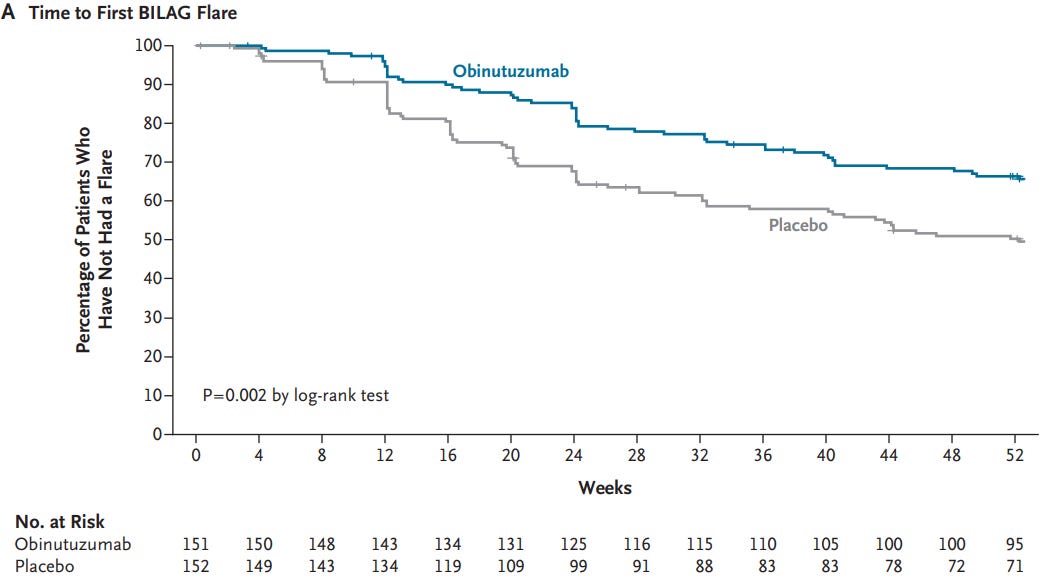
The ALLEGORY data are now published in the NEJM, and the magnitude surpassed my expectations (to be fair, they were “probable meh”). The SRI-4 separation was 23 points (76.7% vs 53.5%, P<0.001), which is larger than belimumab achieved in BLISS-52 or anifrolumab in TULIP-2, in a population with higher baseline disease activity than either of those trials. The steroid-sparing data are arguably the most clinically relevant finding: 80% of patients on ≥10mg prednisone at baseline got to ≤7.5mg sustained through weeks 40-52, versus 54% on placebo. DORIS remission (35.1% vs 13.8%) and LLDAS (57.6% vs 25.0%) also favored the drug. More too follow on the podcast.
These numbers have implications beyond SLE. Why are we still married to rituximab in ANCA-associated vasculitis, where the stakes are arguably higher? What about CNS diseases where deeper B cell depletion might matter more? And does this temper or accelerate the enthusiasm for CAR-T, given that a conventional antibody can apparently get you to 35% DORIS remission without the complexity of cell manufacturing? Lots to think about.
HOLD - It’s a crowded landscape, but I am a long term BUY on novel B cell depleters.
Avacopan may not survive 2026. The FDA's withdrawal request is unprecedented for an actively prescribed rheumatology drug. I have not taken patients off avacopan because of this and am still participating in a Phase 4 study of avacopan in AAV. That said, this is concerning; stay tuned.
Dermatomyositis may get its first targeted therapy. Brepocitinib’s Priority Review NDA makes a Q3 2026 approval the most likely outcome. If the VALOR data hold up under scrutiny, clinicians treating DM will need to figure out where an oral TYK2/JAK1 inhibitor fits relative to IVIG and rituximab.
Sjögren’s may finally get a drug, but the PRO gap is a problem. Ianalumab’s Breakthrough designation accelerates the timeline. A drug that improves physician-reported scores without clearly improving how patients feel will face a tough audience. Watch for the full NEPTUNUS data.
The lupus pipeline is deep, and mostly unproven. Obinutuzumab (anti-CD20), nipocalimab (FcRn), litifilimab (BDCA2), deucravacitinib (TYK2), CAR-T; there are more mechanistically distinct SLE therapies in late-stage development than at any point in history. Most will disappoint. A few won’t!
Obinutuzumab’s ALLEGORY result raises a question about rituximab. If a more potent anti-CD20 works in SLE, does that mean we’ve gotten better at running trials? Or have we been married to the wrong drug all along? Big implications for non-SLE diseases as well.
TYK2 inhibition is a platform story, not a PsA story. Deucravacitinib’s PsA approval is commercially incremental. The real question is whether TYK2-selective safety opens doors in lupus and Sjögren’s, where traditional JAK inhibitor risk-benefit has been prohibitive (also, spectacularly not-effective: see BRAVE studies)
If you found this useful, please sign up and subscribe!
No posts
Comments
Nothing yet. Say the first thing.
Sign in to join the conversation.