

17 photos
Photo: Car and Driver on YouTube
Generating four-figure horsepower outputs has become almost routine nowadays. Launching a heavy car to 150 miles per hour (241 kilometers per hour) requires little more than good traction and either electric muscle or forced induction. The actual test of mechanical grip, thermal management, and structural integrity, however, occurs when the driver stands on the left pedal at triple-digit speeds, demanding an immediate return to zero.

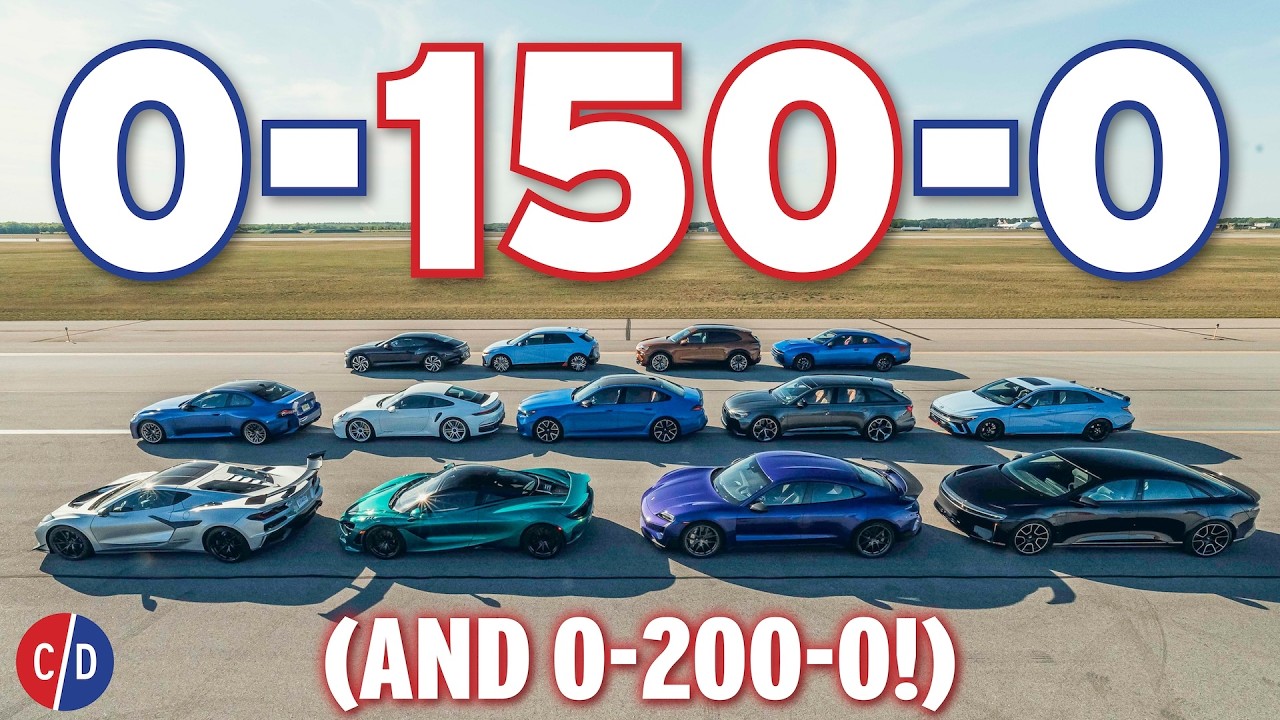
To evaluate this brutal dynamic, Car and Driver assembled a field of 13 performance vehicles at the Oscoda-Wurtsmith Airport in Michigan. Utilizing a 2.2-mile taxiway, the C&D team subjected each vehicle to a continuous zero to 150 miles per hour to zero run. Telemetry was recorded with GPS-based RACELOGIC VBOX meters, complemented by a pressure-sensitive ribbon switch affixed to the brake pedal to capture the precise instant of driver actuation.
Runs were evaluated as raw, uncorrected single passes without rolling subtraction or segment splicing. At the bottom of the timing sheets, budget-minded performance proved its mettle. The Hyundai Elantra N completed the trial in 43.6 seconds, making it the slowest car of the bunch. Moving up the hierarchy, the all-wheel-drive Dodge Charger Scat Pack deployed its 3.0-liter Hurricane twin-turbo I6 for a 37.2-second total.
The Hyundai Ioniq 5 N was next, posting 27.4 seconds compared to 24.7 for the Audi RS 6 Avant. Bentley's plug-in hybrid Continental GT S couldn't do better than 24.1 seconds, while BMW fielded two distinct philosophies. The M2 CS logged a 23.2-second pass with a 634-foot stop, whereas the M5 used its electric motor to overcome its curb weight, hitting 150 in 16.0 clicks and stopping in 609 feet (186 meters) for a 21.8-second overall time.
Porsche was present with three distinct contenders. The revised 911 Turbo S, featuring electrified turbochargers, recorded a blistering 17.4-second run and stopped remarkably well. Even more remarkably, it was eclipsed by the ridiculously heavy Cayenne Turbo Electric. The zero-emission SUV clocked 16.4 seconds in total, with the run to 150 miles per hour taking 10.9 seconds.

Photo: Car and Driver on YouTube
The midship 750S from McLaren, which is genuinely light when compared to the Cayenne, achieved the shortest braking distance of the day at 502 feet (153 meters). Unfortunately, its 16.1-second pass wasn't good enough to put the Taycan Turbo GT Weissach in its place. As it happens, the sedan-bodied Porker needed 14.8 seconds to hit 150 and get back to precisely zero miles per hour.
Quite a difference, for sure. The podium battle pitted electronics against V8 muscle. The tri-motor Lucid Air Sapphire, whose 1,234 horses do the talking, earned second place with an overall time of 14.4 seconds, posting the single fastest 0-150 acceleration time of 8.8 seconds and stopping in 622 feet (190 meters).
Taking the ultimate 0-150-0 crown for 2026 was the Corvette ZR1X. Combining a flat-plane V8 with twin snails and a front-axle electric drive unit for 1,250 horsepower, the hybrid supercar from Kentucky accelerated to 150 miles per hour in 9.1 seconds. Clamped by massive carbon-ceramic brakes working alongside high-downforce aero, the nastiest 'Vette yet hauled down in 515 feet (157 meters), putting it very close to the Macca.
The ZR1X recorded the winning overall time, posting a 14.0-second pass without breaking a sweat. Car and Driver then extended the challenge to a 0-200-0 speed trial for qualified contenders. While the 911 Turbo S hit a governor at 199 miles per hour and the Corvette's drag-inducing rear wing slowed its high-speed acceleration past 150 miles per hour, the Lucid Air Sapphire dominated the extended run.
Currently priced at $249,000 from the outset as opposed to a base price of $227,500 for the 2027 model year Chevrolet Corvette ZR1X, the zero-emission sedan teleported to 200 miles per hour (322 kilometers per hour) and dropped back to zero in 25.7 seconds within less than a mile. Pretty impressive, for sure.
Liked the article? Follow us to see more articles from autoevolution in your Google feeds.
Comments
Nothing yet. Say the first thing.
Sign in to join the conversation.