
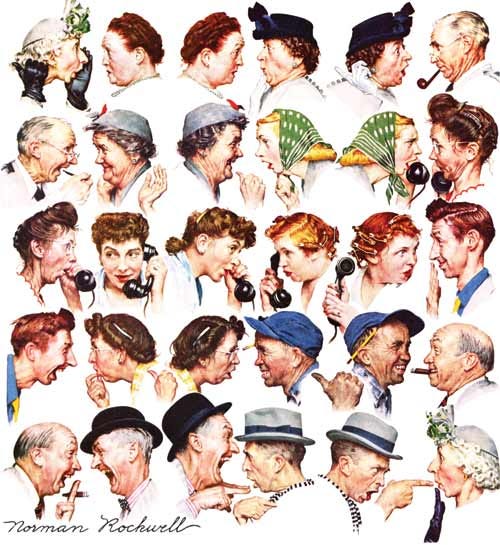
Normal Rockwell, Chain of Fools, 1948
“Hobbes, indeed, is the only great philosopher to whom the bourgeoisie can rightly and exclusively lay claim, even if his principles were not recognized by the bourgeois class for a long time. Hobbes’ Leviathan exposed the only political theory according to which the state is not based on some kind of constituting law […] but on the individual interests themselves, so that ‘the private interest is the same as the publique.’” – Hannah Arendt, Origins of Totalitarianism p.139
“membership in any form of community is for Hobbes a temporary and limited affair which essentially does not change the solitary and private character of the individual (who has “no pleasure, but on the contrary a great deale of greife in keeping company, where there is not power to awe them all”) or create permanent bonds between him and his fellow-men. It seems as though Hobbes’ picture of man defeats his purpose of providing the basis for a commonwealth and gives instead a consistent pattern of attitudes through which every genuine community can easily be destroyed. This results in the inherent and admitted instability of Hobbes’ commonwealth, whose very conception includes its own dissolution—“when in a warre (forraign, or interstine,) the enemies get a final Victory…then is the Commonwealth dissolved, and every man at liberty to protecte himself”—an instability that is all the more striking as Hobbes’ primary and frequently repeated aim was to secure a maximum of safety and stability” – Hannah Arendt, Origins of Totalitarianism p.140
“Deprived of political rights, the individual, to whom public and official life manifests itself in the guise of necessity, acquired a new and increased interest in his private life and his personal fate. Excluded from participation in the management of public affairs that involve all citizens the individual loses his rightful place in society and his natural connection with his fellow men. He can now judge his individual private life only by comparing it with that of others, and his relations with his fellow-men inside society take the form of competition.” – Hannah Arendt, Origins of Totalitarianism p.141
For over three hundred years the anglosphere has been organized by contract law. We have a ‘social contract’ with the state, which - although none of us signed it - binds us. On very practical terms, if you stop obeying that contract, you are at war with the state, and when that happens, the state usually wins and resultantly kills or incarcerates you for that breach of contract. This contract offers us a modicum of control insofar as it allows us to engage in other contract-making activities. For instance, we can vote and theoretically in doing so offer up our political voice to another who has contractually agreed to speak on our behalf. Of course, there is no real option to speak in first order political spaces (Parliament, House of Commons, the Senate, Congress) with our own voice. So really, the option is to attempt some minuscule influence or not to. Understandably, for most people, this pathetic little show of influence is not what their lives revolve around. Thankfully, there are so many other contracts to make. The true ultimate contract in most people’s lives is the marriage contract. If you get to sign one of those you’ve really made it. You’ve signed the contract that we’re told all people long to, dream of signing. Little girls dream of signing it. They know what outfit they’re going to wear to sign it. They’ve practiced their signature and made sure that it looks pretty. They have a location in mind, and several back up locations. Oh, wouldn’t it be glorious to sign that so very special contract on a beach, under some palm trees, as a golden sun sets over azure waters? They’ve thought about who they might sign it with. We all have thought about who we might sign it with. It would be absurd not to. It’s a big deal. It’s The Contract.
And oh, if that contract gets broken, what fun, what devastation. There’s reality shows and gritty legal dramas and everything in between about breaking the one great contract. It meant so much! How could he break it! And with her? Surely, she was not worth breaking it? Did he not understand how valuable she is, what a great wife he would lose? Was there a prenuptial agreement contract signed before hand? No? How silly. A couple should really sign a contract before signing the contract. The pre-contract is there to dictate how assets, debts, and support will be managed in the event of the contract breaking down. Yes, yes, I get it, you think signing the pre-contract removes the romance of signing the contract. But if you only sign the contract, then you have to obey the courts and the laws. If you sign a precontract to the contract then you can decide ahead of time the ramifications of contract breakage without having to worry about state interference. Afterall it is your contract. And we do our very best to pretend that it has always been like this, that marriage was not previously a covenant rather than a contract, and that that covenant itself was largely a medieval invention that emerged from the practice of the local church being the record keeper of the village, and thus usually informed when the average peasant couple wished to have it known that they were indeed sharing a life.
Then there’s the other contracts. There’s the software you’re obligated to use but have to hit “agree” with on a giant contract that you could not possibly read and which you pray does not do anything too too bad to you. There’s contracts with service providers, whether it be buying a coffee in the morning and getting that little piece of paper printed or mailed to you signifying that you did indeed contractually exchange capital for services, or something more obviously contractual, like when I got locked out last month and had to pay a locksmith to let me back into my apartment. He presented me paperwork that allows him to do what I hired him to do and stipulated the price of that service. All of capitalism is contracts, so I won’t spend too much time on that. You can open a bank account on your own at sixteen, or with parental supervision at twelve, you can begin working a job and sign an employment contract at fourteen (in Canada) and you can get a credit card at eighteen and that’s about the extent of it. Sometimes if you’re a fourteen-year-old who has signed an employment contract and you don’t really like it that much you can break the contract without much happening. That’s the grey area that exists, the good ol’ retail no-show. Otherwise, capitalism wants you locked the fuck in and subservient to your contracts. If you decide to do the ol’ retail no-show, you’ll probably get a talking to from your dad about how important responsibility is, about how you signed a contract, and how your boss is somehow dependent on you, this child, to show up and be an adult.
There’s also employment contracts that are a little more violent, and a little more weighty. They tend to demand more of you. They demand control over your life for a period of years, and they demand you to be okay with dying due to signing them. I am speaking, of course, of military contracts. You need to be seventeen to sign one of those. It used to be younger but we eventually decided that a year before you can vote is good enough protection. We, on the left, think you’re very dumb if you sign one of those. You decided that you were comfortable killing another human being to get out of poverty and maybe get some free education—what a sociopath. Seriously, this grade eleven teenager signed a contract to kill people. How fucked up is that. You’re clearly a piece of scum. Yeah, no, I would never have signed that. And, if I was drafted, I would have killed myself or escaped to some foreign country and lived as a wanted criminal the rest of my life. I was the most enlightened seventeen-year-old ever, and the fact you were not, well, I cannot associate with you. There’s no room for discussions of poverty, misleading advertising, or PTSD. If you’re a vet, fuck you. ACAB goes doubly for the military. You knew what you were doing. You’re probably a rapist and a racist too. I’ve seen documentaries.
Then there’s the rich people contracts. Rich people love contracts. There’s an entire season of Hacks about how much rich people love contracts. And who can blame them? We’ve been trained of hundreds of years to view all social interactions as contracts. This has only intensified as religion has taken a backdrop in our lives. If we can’t accuse people of being sinners, or expect them to obey G-d, then we must handle our affairs in the secular world, and the secular world is the bourgeois world of contractual obligations. Although, I would like to point out, that the Tanakh, and especially the Torah (and thus the Christian bible) is a deeply contractual document. In fact, swaths of the Torah appear to be worded alarmingly similarly to existing vassal contracts the Kingdom of Judea was the junior party in. For instance, the “order of the punishments in Deuteronomy 28:27-34, which otherwise may seem random, follows the order of punishments in the Vassal Treaty of Esarhaddon (681-669, BCE) sections 38A-42”. Because most of us live in a secular world, we cannot rely on religion. Because there are so many different faiths and interpretations of those faiths living in close quarters, even believers cannot reasonably rely on the mitigation of belief. So, of course, the rich sign NDAs and break NDAs and regulate their social behaviour down to the miniscule via contracts. Lawyers are affordable to them, and tort law a fun pastime for those with too much time and too much money on their hands. Besides, it makes things simple. It removes the issue of trust. We all live in Hobbes’ world, and it is not one with room for trust. We are governed by our private interests, and the company of others is a necessary neurotic burden— one that brings “no pleasure, but on the contrary a great deale of greife”. The people long for more contracts: more clear rules, guidelines, punishments, parameters. The rich can afford to add them in themselves. The poor cannot.
Where we most long for more contracts is in the sexual and romantic realm. We have the basics. You cannot have sex before you can vote or die in war. In most places you have be to over the age of eighteen and so does your partner, with some minor exceptions if the two concerned parties are close enough in age. We’ve actually gotten rid of some laws regulating sex in the last seventy or so years. For instance, gay sex is now legal in most places. Likewise, we’ve by and large struck down miscegenation laws. Beyond this, the same consent laws apply that apply to any other signing of consent when a contract is involved. It has to be voluntary, informed, mutual, and void of misrepresentation, fraud, mistake, duress, or the incapacity of one or more parties. These laws are very poorly enforced and there is an epidemic across the world to meet these minimum standards. We have several law makers and judiciary who we know or highly suspect violated the voluntary requirement. Likewise, we seem to be pretty lax about incapacity. I, for one, have had sex multiple times while intoxicated to a sufficient degree that I do not recall her proposition, or much of the sex after she led me somewhere private. It’s not exactly something I want to occur again, but I would hardly hold the various women criminally responsible. Several of them I remain friends with and have no harsh feeling towards. Often these instances (the asking, not the activity) were witnessed by sizable groups of people. No one has ever asked me if I was okay, or attempted to intervene in the situation. As a society, we are concerned about incapacity when the incapacity itself was not voluntary. However, as long as the incapacity was voluntary, we seem to disagree with that aspect of contract law.
Despite, or perhaps because of, our lack of contracts regulating sexual and romantic relations, alongside our society’s collective failure to obey the minimal ones we have, we seem to long for more of them. Perhaps this is what happens when you don’t want to live in Hobbes’ world anymore. Perhaps this is a direct result of Hobbes’ world—“He can now judge his individual private life only by comparing it with that of others”. We know that sex and romance can leave people feeling really awful. When it comes to romantic relationships, for the most part we seem to accept that this is par for the course. Sometimes, we invoke spousal abuse, which essentially is saying that the vows section of the marriage contract was broken, but rarely are these accusations believed. I know, I’ve done my best to report several violent occurrences to mutual friends with minimal belief or support. Sometimes people will admit to me that my partner was “annoying” when they screamed insults at me at the top of their lungs. But, we tend to not like ugly confrontations about how people behave, especially when we like the person. If a rumour does spread, it is usually by those not involved. It is remarkable how little the people involved actually matter. People hate one of my exes for what they did to me. But despite their mistreatment of me being well known and whispered about, no one actually checked in on me. The act and the impact did not matter. My health did not matter. All that mattered was that what occurred was agreed to be something that should not occur. That was the true purpose of the whole thing—“He can now judge his individual private life only by comparing it with that of others”.
Who can sign a contract, in what state, and with whom? None of us want to find out a contract we signed is invalid. If I think I paid a plumber to show up and he is a plumber but he’s also an electrician and that’s the contract he handed me to sign and I signed, that’s going to be a pain in the ass, especially if he demands that he do some electrical work. But at least that falls under the “mistake” category. What has increasingly griped our cultural neurosis is duress. As a denizen of the internet, I witness Gen Z griped by it. Can they sleep with their friends, or is that implicitly threatening the removal of friendship should they fuck (aka, is there duress involved)? What about age gaps? Does existing on this earth as an adult for an extra three years, an extra five years, an extra ten years, render in the older person a mystical knowledge that imbues them with a sage like knowledge of psychology that can reduce that thirty-year-old they’re fucking to the mental equivalent of a toddler? People who got mad about the George and Amal Clooney marriage seem to think so. Personally, I’ve never slept with someone who I had a bigger age gap with than my parents’ ten-year one, so perhaps witnessing their good marriage makes me miss something essential. And I have met enough boomers and seem them online to be pretty skeptical at this point that age produces the capacity to skillfully move through complex social interactions. What of wealth? Can the rich fuck the poor? Tiger Woods got his life turned upside down not necessarily for infidelity (common among celebrities), but for his penchant for gas station waitresses. Perhaps there is some cultural understanding that that sort of power differential, the realest that can exist among adults in capitalism, is wrong. Sorry to lesbians dreaming of a rich older woman. It is super problematic. The rich have a moral obligation to interbreed. They must never lower themselves to associate with the common classes. Last, there is work dynamics. Fucking your boss while he holds power over you removes consent because there’s explicit inequality and implicit duress. Hence why Monica Lewinsky did it, she was protected by the nation, raised to the status of national hero for speaking out about it, and why her boss, Bill Clinton, served a reasonable jail sentence before retiring forever from public life. It is clearly wrong to fuck someone under you in an official hierarchy. But what about your pressing your ex-boss into submission while stranded together on a tropical island before paralyzing him with octopus venom so that you can erotically castrate him?[1]
I am not trying to take a stance on the exact way that we should follow a contract, or to reappraise which contracts we are allowed to make when and with who. Instead, I have attempted to show the Anglosphere’s obsession with viewing the world via a contractual lens and the moral weight that we attach to these contracts. I have attempted to show that the attempt to search for definite clear-cut rules, and exact knowledge of when a breach of a contract has occurred is the result of this neurotic need to view everything in the binary legalistic framework that leaves little room for actual nuance or detail. I have attempted to show that the world by and large does not even respond evenly or appropriately to the rules that we do all agree on (see poor Ms. Lewinsky). I have attempted to do this with humour, levity, and extreme examples. I’ve tried to suggest that the reason we are so obsessed with determining whether other people have done right or wrong is because we seek rules by which to comport ourselves and use the experiences of others as a sort of case law, by which we can further avoid misstep. This strategy fails for the same reason that we need lawyers to interpret case law—that is, because case law is consistently contradictory and open to interpretation. As for how to proceed in this sick sad world without religious or legal law to aid us absolutely, and without contract law being of much assistance: I recommend a policy of full, open and honest communication between the parties involved, about all the concerns, the potential confusions, various power dynamics and insecurities that all relationships have. I recommend figuring out how to have a continuous and open dialogue with each other. This dialogue can serve you well not only when things are being established, but throughout friendships and relationships. The real reason contract law is insufficient is because factors evolve and change over time. A contract is only written once. Human relationships are ongoing. Talking as equals, and reaching agreements is what matters. Solidifying those agreements in stone does not. It merely ossifies things.
Auto_Anon is reader-supported. I am very broke and attempting to support myself via Substack. Please consider becoming a free or paid subscriber <3
[1] This is part of the plot of Send Help (2025) by Sam Raimi.
Comments
Nothing yet. Say the first thing.
Sign in to join the conversation.