
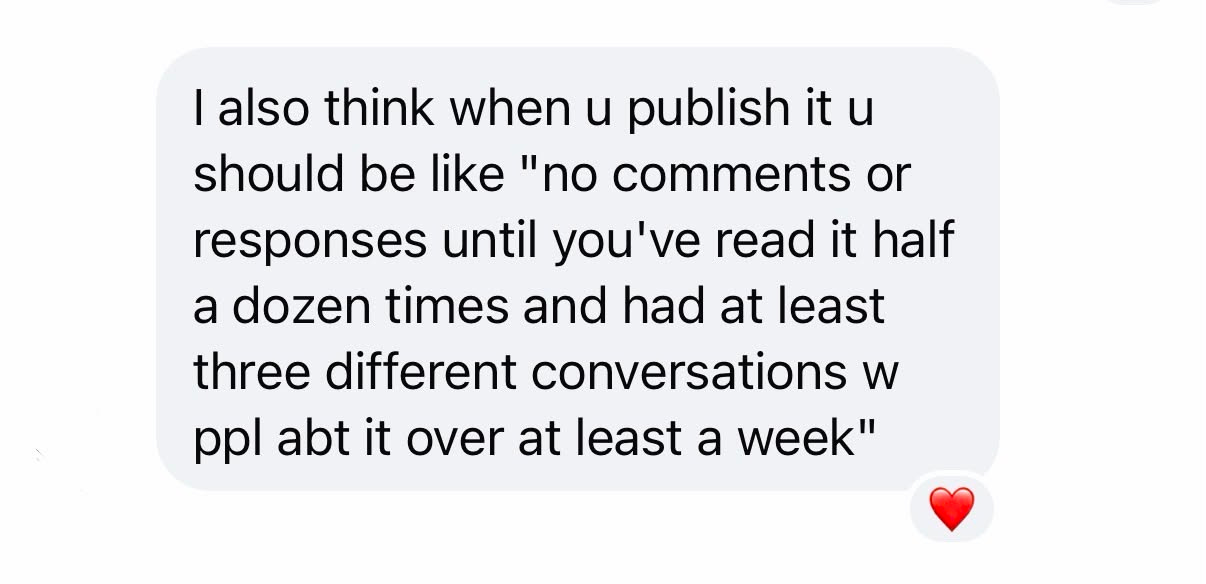
Usually I use this space, before the article begins, to talk about how I rely on Substack as my only source of income outside of sex work, and ask you to consider becoming a paid subscriber. However, due to the contentious nature of this article I want to make a few things clear. First, this is not rage bait; this is something I care a lot about. It’s extremely scary risking my income to talk about a topic no one wants to talk about, that will almost certainly lose me hundreds or thousands of dollars to do so. I wouldn’t take that risk if I didn’t think the subject was timely and important. Second, I am not going off half baked here. I’ve done years of research trying to figure out how to talk about this, and this article itself took well over a month of careful writing and rewriting. In doing so I have shared it with critical race scholars, Jewish studies scholars, Black academics, Jewish academics, members of the Orthodox community, as well as friends and family. A friend and Fanon scholar I shared it with sent me the above message during one of several discussions we had about the piece. I am sharing it with you at her request. I ask that you take this writing as something to sit with, ponder over, and think about. I love my audience because I believe them capable of sitting with uncomfortable and challenging ideas. I trust them, and I am trusting you, to treat this as an opportunity for careful engagement, and not a gotcha-strawman moment of gleeful takedown. Thank you, I mean it.
In 2017 at the “Unite the Right” rally in Charlottesville, Virginia, a mixture of around 1,500 alt-right, neo-Confederates, neo-fascists, white nationalists, neo-Nazis, Klansmen, and far-right militia scum joined together under the light of handheld tiki torches to chant “the Jews will not replace us!”. Centrist and progressive media denounced the chants as white supremacist. It started a national conversation about the supposed “re-emergence” of open white supremacy in the United States. Since 2023 we have collectively witnessed Israel commit a brutal and ongoing genocide against the people of Gaza and the West Bank, against Palestinians. Many centrists and leftwing Americans have declared this a white supremacist genocide. Antisemitism is at its highest point globally in decades. We tend to agree that this means that white supremacy is at a peak too. Meanwhile, we also seem to agree that the Jewish Apartheid Ethnostate of Israel is committing a white supremacist genocide. Both of these facts raise a lot of horrific questions. Among them, however, is the question: are Jews white? I am not here to answer that question. It is too categorical. It gives too much credence to this being a thing that we can really figure out, as if it were a scientific fact. But I want to ask a related one. I want to ask what sort of autonomy a Jewish person, like myself, can claim over her racial identity.
Race and Me: A Disclaimer
My grandfather was rushed to the hospital, so my mom came home early from her vacation. I went home too. By fluke, I had already been planning to. But I went home a day early. Home isn’t my childhood home. It isn’t even really my home although my parents maintain a bedroom there for me. We bonded over gossip and a Farm Boy rotisserie chicken. Then she left to take care of my grandfather. I took a small joy in washing up for her, in making sure she could come home to nothing she had to do. Then I went and read some Asako Yuzuki on the front porch. I have been enjoying tanning this summer. It had been many years since I last allowed myself the leisure time to tan. I think it suits my current look of long curly hair. A few minutes later the next-door neighbour pulled up in a Volkswagen. I had never met him before. He was a tall balding man with the prominent Scottish features common in this part of Ontario. He looked at me for a second before coming over. He didn’t introduce himself. He just said that he had seen my mother earlier that day. He asked if I was her daughter. The question shocked me. I said yes, but I felt guilty. Then he left. I never learned his name.
I don’t know what to say when people ask if I am my mother’s daughter. Biologically speaking, I am not. Yet, she has raised me since I was a small child. It feels like a betrayal to caveat it. Thankfully, I am not rarely asked. You see, my grandfather was born in Montserrat, my grandmother in Antigua. They were not colonists. To put it bluntly, my mom is Black and I am not. So, while I would never deny that she is my mom, I also do not want to accidently claim a Blackness I’ve no right to. Usually, it is obvious to people that I am white or Jewish. My skin is white. And, between various Jewish tattoos and a Hebrew pendant, I have gone out of my way to mark myself as Jewish for anyone who was on the fence about my nose or whatever else they judge me by. Frankly, I haven’t been taken for the biological child of my mother since I was a child. Then my hair was either buzzed non-existent short or long in dark locks. I remember going into Georgia and Carolina gas stations in the middle of the night, in the middle of nowhere, with my parents. My parents were nervous. They knew how we appeared, a light skinned muscular black woman, my father with his dark hair and near comically large, hooked nose, and me, a darkly tanned happy child standing between them beaming at the idea of our family road trip. The locals stared daggers.
Somewhat ironically, these experiences probably hamper more than they help the topic at hand. I want to talk about Jewishness and whiteness, and I barely count as a Jew. My Jewishness is paternal, which renders me a non-Jew to three out of four of the major North American Jewish denominations (Orthodox, Reform, and Conservative deny it, whereas Reconstructionists recognize it). I was raised in a mixed household, to socialist, anti-Zionist atheistic parents. My father virtually entirely centered his own identity around an obsessive interest in the Holocaust, family recipes, and a strong aversion to pork and shellfish. There was some minimal observance of a couple of the holidays, but really only when they easily fit into the Christian-centric holiday schedule Canada has in place. By and large, my Jewishness was defined for me as an absence. It was about what we didn’t do, and the history and people that had been ripped from us. I felt guilty about this and after the death of my grandmother, finally did what I had been talking about doing for years and began the conversion process to join the Reform movement. My girlfriend and I had been observing the holidays and hosting Shabbos dinners for years, and I felt ready to become ‘really Jewish’. My reconstructionist department chair, and my ex-orthodox now vaguely reconstructionist friends all told me I didn’t need to. But I felt I needed to. As I was ready to finally finish the conversation process Israel started killing Gazans with unprecedented speed and brutality. My synagogue stood firmly behind the apartheid state. So, I decided that I did not need their permission to be Jewish. Their authority now meant nothing to me. I shrugged them off and continued instead to practice at home and alongside the various other (primarily ex-orthodox) trans and queer Jews who have become my community.
So no, I’m not frum. You might not even consider me a Jew. That’s okay. What a Jew is has become a hotly contested thing lately. In Germany declaring yourself anti-Zionist has increasingly been seen as an abdication of Jewishness. In Israel, there has been a longstanding hatred of Diaspora Jews. They view us as weak, and lesser than, as not committed to the Pesha which is the contemporary state of Israel. Meanwhile, I tend to define my Jewishness and Jewishness in general by the experience of diaspora and of exile. As Naomi Scheman stated in her foundational article on queer Jewishness, “Queering the Center”, “there are many who would question the authenticity of my Jewish identity, who would claim that as a Jew I have obligations I am turning my back on. I, too, am tempted to make similar claims on others: It seems to me profoundly unJewish to be a Republican or to oppose affirmative action or, for that matter, to oppose the rights of Palestinians to self-determination.” What makes Jewish identity strong is ultimately the space for disagreement and for accepting that there are fellow Jews out there practicing, celebrating, and living life in a manner completely foreign and perhaps even morally opposite yourself. Many might question my Jewishness because of my birth, because of my refusal to remain associated with the synagogue that trained me. I have to accept that. Still, I am Lǝvīyyīm, a Levite, and a practicing one at that. The Nazis of old or new would not hesitate with regards to me.
I can say this for certain because my family has been attacked by people identifying themselves with Nazism. For two years when I was in high school my family’s house was regularly vandalized. Usually, it was egging. Egging sucks, but like most violence, its capacity for speech is limited. Who was egging us and why would have remained a mystery except they decided to start spray painting swastikas on our driveway and door. They also scratched, presumably with a key, repeatedly into our family car more swastikas and the word “N***er”. We repaired the car and then they did it again. So for a few months, we had to drive around marked, knowing full well that repair would only cost us money and save us no humiliation. They knew what we were, and they defined it for us in paint and gashes. They did not identify or privilege one side of my family or the other in their hatred. They scratched both into the cars just the same. Now, I live in a city where the Jewish spaces I inhabit or are adjacent too have been bombed and shot up with regularity over the past few years. Just last week, a kosher restaurant that I could find on no boycott lists, nor at the center of some Zionist turmoil, was firebombed. It burned to the ground.
The Expansion of Whiteness
A girlfriend of mine (different from the one I live with) calls herself white a lot. Fair enough, she looks white. She sounds white. She dresses white. She knows all of this. Her father is obsessed with the British Empire. He has renovated his entire basement to be an uncanny simulacra of a British pub. Her grandfather served in the Canadian army. Her name sounds Quebecois. Her accent sounds Ontarian. Really, there’s very little reason she shouldn’t call herself white, except for the fact that she’s a treaty card holding member of the Anishinaabe nation who jumps at the chance to explain traditional myth, medicine, cuisine, and correct my awful attempts at pronouncing Indigenous words. If there’s an Indigenous exhibit on at a local art gallery or history museum, she is making sure that we are seeing it. She mourns her grandparents, and although she learned much from them, bemoans not having learned more. When she calls herself white, it is almost always to belittle her own voice as an Indigenous woman. She does not feel she can claim what the Canadian government has documented that she is.
When I first started dating my boyfriend, we found ourselves in a large group chat together full of other people who had just met. His race is amusing to him. He claims to have been mistaken for everything from Jewish to Persian. To me he is very obviously Chinese, or at least, very obviously East Asian. So, in those early days, when he doggedly insisted that everyone in the GC try to guess his race, I and a few others, were very obviously confused and uncomfortable. For the record, I guessed Ainu because I knew that it was unlikely enough to not be taken seriously. He’s also called himself white quite a few times over the years, although less so these days. He’s half Chinese, half Irish, what people are now calling Wasian. But when I first met him, that term was not yet widespread and he was remarkably insistent that he was white. He was insistent that only other Asians could tell he was Asian.
There’s something to these two non-white insistences of whiteness. Whiteness is a North American invention. According to Alister Bonnet (1996) 16th century European traders in Africa “had no conception of Africans as racial pariahs” viewing them as “equals and superior to many of their countrymen back home”. Certainly, they were aware of regional identities, and very aware of religion (being one of the main ways difference was understood in the just-finished Middle Ages). However, these men did not think in terms of Black or white. As racism developed in Europe, it developed along nationalistic and religious lines. Questions of who colonized who, who was a relative backwater, and whether there was a perceived relation to the increasingly mystified “Orient” helped define racial conceptions and terminology. According to the historian William Roy (2001), this changed in the English-speaking world as the British empire and the American colonies increasingly desired African slaves because they were “more knowledgeable about tropical agriculture […] skilled iron workers, [and] had immunity to Old World diseases”. That is, Africans were preferred, as Roy puts it, “because they were more civilized than laborers from other parts of the world”. White and Black were constructed as useful categories that allowed for the rendering chattel slavery as understandable and ethical to the early modern Anglo-mind (Teresa J. Guess, 2006). How race emerges in a given society, says something about the material and social structures in place at the time of its emergence. As Peter Kolchin (2009) puts it, “because the white working class in the United States emerged in a slaveholding republic, its members came to define themselves by what they were not: slaves and blacks.” In Race and Racism, Pierre van den Berghe notes that “The existence of races in a given society presupposes the presence of racism, for without racism, physical characteristics are devoid of social significance”. And in North America, what we have is a binary system based on 17th and 18th century economic forces, that hardly captures today’s nuanced race relations (brought about both by immigration and increased awareness of Indigeneity), yet which we insist on attempting to use.
Franz Fanon called this binary system Colonial Manicheism, the idea that the colonized world is divided into two opposing, irreconcilable types. It is a binary system defined by a strict division of good and evil, where white is good and black is evil. The colonizer paints themselves as all things good, virtuous, civilized and white. They in turn paint the colonized as all things backward, wild, lawless, evil, and yes, black. This would view that emerged in the colonies insists on this brutal duality, with no space for grey or middle ground. It is designed for a world in which absolute power is wielded with such total domination, that facts and bodies conform to an impossibly simplistic division. Unsurprisingly, it does not hold up very well against any sort of complicating factors. Kolchin points out that “Although the well known ‘one-drop rule’ dictates that in the United States anyone with the slightest bit of black ‘blood’ be categorized bas black, there is no particular logic to labeling people black who are part white and part black, and in some places they are not so labeled.” According to Mathew Frye Jacobson we can break down the complexity of American racial relations into three time periods. First, from the 1790s to the 1840s, Americans saw people as black or white. However, beginning in the 1840s and carrying through to the 1920s, the foreign immigration of people from less respectable parts of Europe lead to a conception of “variegated whiteness” with some whites being whiter than others. Lastly, there was the period from 1920 to Jacobson’s own in 1998, when Americans came to perceive a “diversity” of whiteness made up of groups previously deemed biologically diverse and inferior. In a critique of the 1990s work that was being done on race Kolchin writes that one of the greatest weaknesses is “the assumption—sometimes asserted and sometimes unspoken—that the racism they describe is uniquely American and that American whiteness can be understood in solation, without considering anything abroad”. I would charge not only 90s theorists of whiteness with this charge, but Americans in general. And we have seen over the years their awkward, stumbling attempts, to force increasingly pertinent yet unfitting identities into their binary categories. During the war on terror ‘Muslim’ somehow became to many Americans a third racial category, before being slotted into ‘basically black’ in the 2010s.
Blackness, and therefore whiteness, has a chokehold on the American imagination, and because of American’s prominence in controlling world culture via the internet and cultural empire, increasingly the rest of the world too. Despite this, or perhaps because of this, we’re not really sure what the fuck whiteness is. It’s a virus or a blanket. Perhaps it is a virus infected blanket. In the 1840s you could get your Irish head mashed into potato pulp by some thug from the Anglo-Protestant Confederation of American Natives in the slums of New York City. In 1902 the funeral of Rabbi Jacob Joseph resulted in America’s largest antisemitic riot as policemen and others attacked the mourners. In the 1950s a turf wars could break out between Italians and Puerto Ricans. In 1984’s Sixteen Candles Rudy Ryzek is called an “oily bohunk” twice, first by Grandpa Fred (which we are supposed to understand is outdated) and then by the movie’s true racial stereotype “Long Duk Dong” who really has no business knowing what “bohunk” means. Yet, by the 1990s, the pervasive power of whiteness had more or less managed to subsume hundreds, sometimes thousands of years of ethnic hatreds under the bland shapeless thing called white. Whiteness demands that you call yourself white. It doesn’t seem to include anything. It seems to require a hollowing out. But if you’re a good progressive leftist person, you had better admit you are white. Afterall, you cannot deny that other people are treating you as white because you’re not Black, and that means, and it truly does mean that you are benefiting from white supremacy. That material benefit has to be acknowledged. And yes, it does have to be. It’s why I’m so reticent to agree that I am my mother’s daughter. I feel the need to tell you that I am not her biological daughter. You have to know that I am white. I am privileged. I refuse to lie about that privilege, even if it forces me to sound like I am trying to distance myself from my own mother. If you’re not being slotted into Blackness, it is easy to feel that you’ve an obligation to talk about your whiteness. This is also how we get a woman whose people are still experiencing a genocide perpetrated by the Government of Canada calling herself white, and an Asian man who feels that his perceived lack of negative racial encounters and a white father render him white.
Whiteness, according to Ruth Frankenberg, “has a set of linked dimensions. First, whiteness is a location of structural advantage, of race privilege. Second, it is a ‘standpoint,’ a place from which white people look at ourselves, at others, and at society. Third, ‘whiteness’ refers to a set of cultural practices that are usually unmarked and unnamed.” I broadly agree with this definition, and it does not escape my attention that Frankenberg, a Jew, refers to herself as white in this quote from her seminal 1993 work The Social Construction of Whiteness: white women, race matters. Whiteness hit Jewishness like a train in the 1990s. In what is arguably the most important essay on Jewish whiteness “The Jewish Nose: Are Jews White? Or The History of the Nose Job” Sander Gilman writes in 1991 of a recent change he has observed in the personal columns of the local Washington DC magazine, the Washingtonian:
“Recently I was struck by a notice which began ‘DW(J)F [Divorced White (Jewish) Female]—young, 41, Ph.D., Professional, no kids…seeks S/D/WWM, exceptional mind, heart & soul…’ What fascinated me were the brackets: advertisements for “Jews” or for “African Americans” or for “Whites” made it clear that individuals were interested in choosing their sexual partners from certain designated groups within American society. But the brackets implied that here was a woman who was both “White” and “Jewish.” Given the racial politics of post-civil rights America, where do the Jews fit in?”
In 1938, one of the most famous American celebrities of the era, Charles Lindbergh, accepted the Service Cross of the German Eagle from Nazi Germany. It was presented personally by Hermann Göring on behalf of Adolf Hitler. In 1941 Lindbergh delivered a speech called “Who Are the War Agitators?” at a rally for the white supremacist group, the America First Committee. In the speech Lindberg insisted that the Jewish race “for reasons which are not American, wish to involve us in the war”. He insisted that the Jews used their “large ownership and influence in our motion pictures, our press, our radio and our government” to try and push America to join World War Two. Over eight thousand people attended that rally. A few months earlier, 20,000 had filled Madison Square Garden to hear Lindbergh and others give a similar speech. He was the Kayne West of his day. Yet, by 1991, Americans Jews were beginning to feel pretty certain that they were white.
Contracting Whiteness
It seems fairly obvious to me that the 1920 to 2001 “diversity” of whiteness era Jacobson was writing is has ended. Whiteness is contracting. I placed 2001 as its end because I think you could make the argument that the introduction of “Muslim” as a racial category post-9/11 is what broke the Black/White binary that had until then succeeded in dividing all of America (including groups that very poorly fit either category). You could also claim that it was 2016. Afterall, the Unite the Right rally was a year later, and there is something about Trump’s first election that feels like the start of a different era. The point is, somewhere at the beginning of the 21st century, young Americans decided that “white” had become too expansive. Their parents had made a mistake allowing so many to join them in whiteness. It was time to draw some divisions again. Now internet arguments rage about whether Hasan Piker is white, which leads to debates about if Turks are white. People want to know if Armenians, and therefore Kim Kardashian, are white. Ben Shapiro recently made the claim that Greeks aren’t white. And as for Jews…well, it depends on who you ask. You can find deeply idiotic leftwing takes that insist, like “What Jewish people experienced during WWII is white people doing to other white people what they had been doing for centuries to non-white people” or you can check out the right wing “Jews will not replace us” corners of the internet.
Since my audience is largely progressive, and therefore more likely to fall for the idiotic leftie claim about World War Two than the right wing one, I should probably briefly tell you why it is bullshit. Jewish people have been hated and persecuted by Europeans for millennia (notice the plural). While we first arrived in small numbers in Europe via the Silk Road, the first sizable emigration of Jews into Europe was as Roman slaves after the Roman colonization of Palestine. It’s not called a Jewish Diaspora for nothing. Since then, Jewish people have gone through periods of relative safety and thriving and severe persecution in Europe. Between 1200 and 1400 CE during a time of intense medieval persecutions our numbers dwindled from thousands to mere 350 individuals across Europe. Jewish people were marked either by our religion or by our race (or a pseudo-race concept) and we were oppressed, discriminated against, tortured and killed. The Holocaust was far from the first mass killing of Jewish people in Europe. Pogroms swept Europe for centuries. The Reconquista and Inquisition destroyed hundreds of years of a peaceful Spanish society in which Muslims and Jews lived in relatively peaceful and fruitful harmony. The Catholic Spanish government which tortured and killed the Muslims and Jews of Spain sent many of the veterans of this killing to use their new skills on the newly “discovered” New World. Spanish Colonialism, with its brutality and its striving for racial and religious purity, first learned its trade against Spanish Muslims and Jews.
This is how the Jewish appearances were being described by the 1850s (I am quoting here from Gilman’s Jewish Nose essay): “Jews bear the sign of the black, ‘the African character of the Jew, his muzzle-shaped mouth and face removing him from certain other races…,” as Robert Knox noted at mid century. The physiognomy of the Jew which is like that of the black: “…the contour is convex; the eyes long and fine, the outer angles running towards the temples; the brow and nose apt to form a single convex line; the nose comparatively narrow at the base, the eyes consequently approaching each other; lips very full, mouth projecting, chin small, and the whole physiognomy, when swarthy as it often is, has an African look.” This description is hardly the exception. In 1899 the philosopher Houston Stewart Chamberlain could speak openly about “Jewish-Negroid” features and have it make sense to his readers. The Polish nobleman Adam Gurowski visited the United States in the 1850s and “took every light-coloured mul**to for a Jew”. The writer Johann Pezzl described the “five hundred Jews in Vienna” as “the trash of the twelve tribes” before insisting they were “the color of a Black, their faces covered up to the eyes with a beard”. I am not trying to make a case for Jewish Blackness. In 2026 such a claim would be preposterous.
It reads with about as much sense as a ‘wine dark sea’ to contemporary eyes, but believe me, this is how Jewish people were perceived across Europe. We were by no means seen as white. Yet, nor would I want anyone to take from this that antisemitism is simply a derivative form of anti-Blackness. Antisemitism has its own distinct origins and has taken many different shapes throughout the years. The 18th and 19th century insistence on construing the Jew as Black instead likely reflects zeitgeist of the ‘scramble for Africa”. As I said, antisemitism tends to change to reflect the concerns of the era. For instance, in the 1920s as gender equality and blurring because a prominent issue, James Joyce decided in Ulysses to have his Jewish character Leopold Bloom mensurate. Joyce tells us that Boom would bleed “once a month with headache like a totty with her courses”. Joyce didn’t invent this. He believed it. It goes at least as far back as the 13th century cleric Jacques de Vitry, who wrote of male Jews “that they have a flux of blood every month. God has smitten them in their hinter parts”. In the European Christian imagination, many ‘facts’ about Jews can be emphasized depending on the needs and fears of the era. Most of them make little logical sense to us now. It seems preposterous that a Jewish body could once have been imaged to be so anatomically different from the known white Christian body. Yet, this was believed. The Jewish body remains an object to project one’s fears onto, a monster reflection of your own. So, no, I am not trying to claim that all Jewish people are Black. Instead, what is important is that this historical insistence on Jewishness Blackness was relatively recently believable and perceivable. The whiteness of the Jew is a new post-World War Two invention. Really, as I’ve shown, it didn’t seem prominent until the 1990s. And now, Jewish people are bifurcated. We are white to many leftwing progressives, and we are Jews and non-white to most right-wing people, as well as to most non-North Americans.
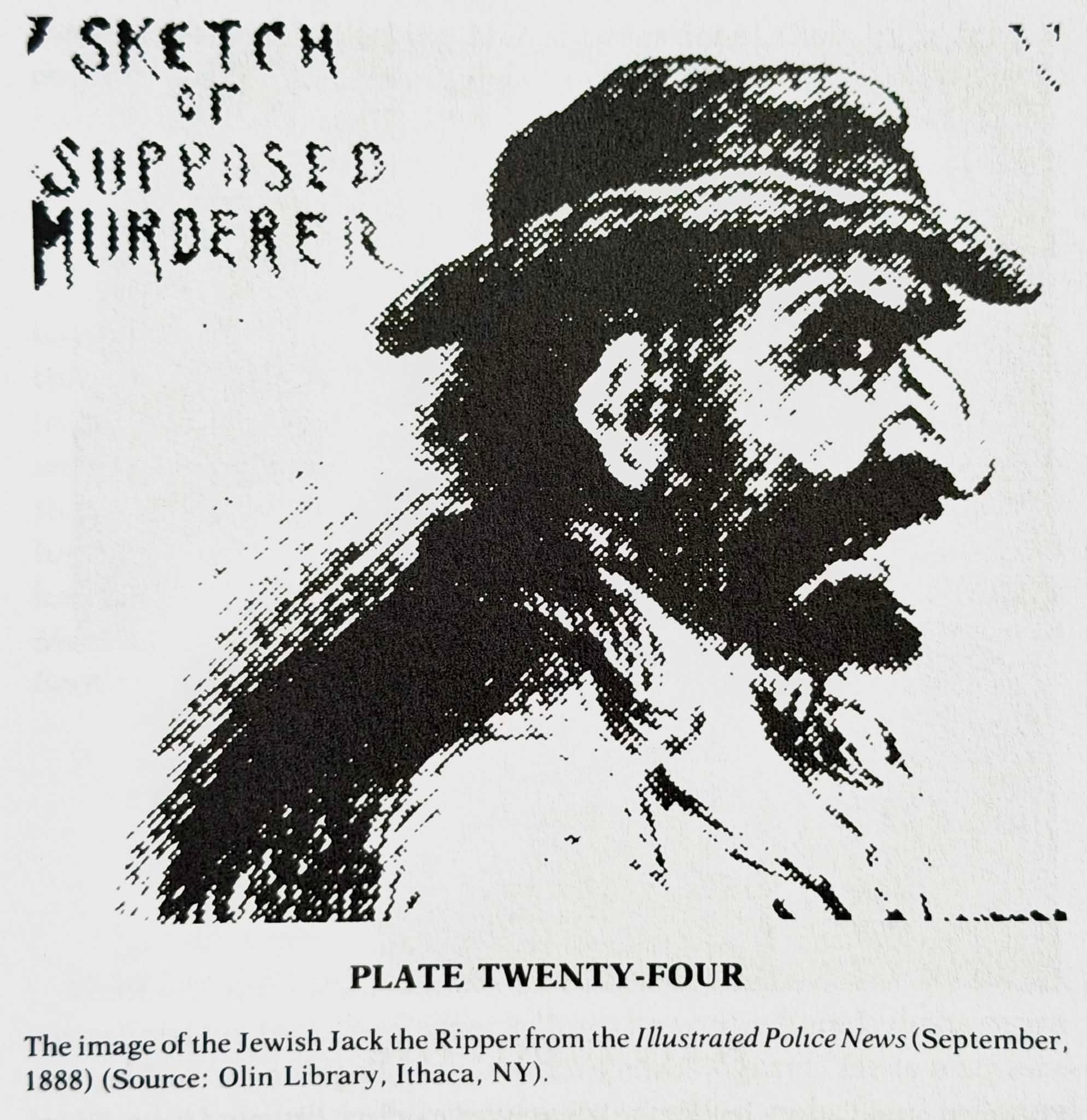
Photo from Sander Gilman’s book, The Jew’s Body (chosen for it depicts “the jew as monster”)
As Sam Kriss noted recently, in his excellent essay on non-white neo-Nazis, “It used to be possible for progressives to claim that there was some kind of clear ethno-political line running through the world. On one side, the politics of whiteness, which are regressive, exclusionary, resentful, the cold withered hand of a dying order, based in fear of the other and the desire to chop the world into neat little parcels surrounded by white picket fences. On the other side, the politics of the global majority, which are warm and joyful, open to everyone, and based on principles like community and laughter and using lots of interesting seasonings in your food.” This has clearly broken down. It really only ever worked in North America and maybe Britain. But now it has really broken down. Because politics has begun to strongly bifurcate along gendered lines, I can now pretty much guarantee that if I teach a class all the young women will want me to acknowledge my white privilege and say something mournful and a little guilty about the genocide in Gaza, while all the men will staring at me debating if they can withstand the disrespect of being taught by a tranny Jew. I know this, because I’ve gotten these comments from both ends. You wouldn’t believe how many men drop my courses after they realize what their instructor is. To quite Kriss again, “As far as I can tell, every single [male] child on the planet is spending twelve hours a day watching ethnically ambiguous streamers chatter away about Jews. When a group of teens encounters one of their online idols in the flesh, they all gather around him and spontaneously start chanting “Fuck the Jews!” over and over again. Youth culture is just anime and antisemitism now; it’s in the deep grammar of how these people experience the world.”
I’d say that the whites have decided that whiteness is too expansive, but really, it is not the whites so much as it is the right. As Kriss pointed out (seriously, read the essay), increasingly white supremacy is believed in very firmly by non-white people. I do not mean the Turkish or the Armenians or even Jewish people, although I’m sure its true for all of them too. I mean Kanye West, and Caleb Liam Vazquez and Shabana Mahmood. White Supremacy is for every man now.
Not In My Name
Among anti-Zionist Jews the slogan “not in my name” has emerged as a rally cry against Zionist violence. I first heard it when reading Naomi Scheman’s articles “Queering the Center” and “Not In My Name”, in which she explains her reason for calling herself Jewish despite being an atheist as such:
there are, and have always been, a wide range of ways to be Jewish; and nothing beyond what we (Jews) do will make it continue to be the case that one can be born a Jew and remain one no matter what one does or believes. But if that were to change—if Jewishness were absorbed into Judaism and Judaism were to become in that regard more like Christianity—I think something important would be lost—even as I cannot make coherent sense of what that “something important” is. Part of what it is, of course, is what I am, and my attachment to it is obviously self-interested. But that self-interest is not selfish: the self I am protecting is one for which I feel deeply responsible: it is a self in whose name many things are being done, many of which I am deeply at odds with, and my being able to say “not in my name” depends on its truly being my name.
This is a powerful reason to cling to an identity that could otherwise be rejected. Jewishness has a powerful cultural and religious history. Even my atheistic father made sure to imprint it on me. I grew up on books and movies about Jewish history. I was enmeshed in Jewish culture. I can practically make latkes with my eyes closed and can recite most Mel Brooks bits from memory. There’s something wonderful about Jewish culture in the exact same way as there is something wonderful about every historically rich culture. Virtually everyone on the planet loves the tradition they come from. We want to eat our ancestral food and drink our ancestral wine, while singing our ancestral songs. So of course, when Israel tries to justify its genocide and its apartheid as being “for the Jews” a lump forms in our throat. Of course, we scream back “Not in my name!” What is believed to be the largest arrest of Jewish people in American history occurred in October 2023, and they were Anti-Zionist ‘not in my name’ protestors. Previously, the largest number of Rabbis arrested in America was during a 1960s civil rights protest, where they were there as allies. I no longer associated with my synagogue, but I will never let Zionists determine my Jewishness, or proclaim themselves the only real Jews. Jewishness is too important not to defend from the Zionists and their genocide.
But what of whiteness? Fanon wrote in Black Skin, White Masks that Black people “should no longer have to be faced with the dilemma ‘whiten or perish’.” Jews are not Black, but nor have we historically been white. It seems to me that this dilemma is what was asked of 20th century Jews, and many chose to whiten. Others, perhaps the majority, had whiteness thrust upon them. There was the Manichean insistence by the whites that you, Jew, must identify yourself as white. That this insistence came during a moment of unprecedented solidarity between Black and Jewish people in the fight for civil rights seems hardly a coincidence. I’ve already quoted Ruth Frankenberg’s definition of it, as “a location of structural advantage, of race privilege. Second, it is a ‘standpoint,’ a place from which white people look at ourselves, at others, and at society. Third, ‘whiteness’ refers to a set of cultural practices that are usually unmarked and unnamed.” Ignatiev and John Garvey in their journal Race Traitor defined it thusly, “Whiteness is nothing but the expression of race and privilege”. Likewise, in The Wages of Whiteness David Roediger says that “whiteness is nothing but oppressive and false”. There seems to be a uniformed agreement that whiteness is hollow, pointless outside of its cruelty. Do I need to keep calling myself white? Do thirty years of whiteness render me white forever? If a non-white person tells me that I am white, I never disagree. They’re right that I’ve a lot of white privilege when I’m perceived as white. That perception dwindles daily. But also, it seems wrong to say that I am not white. Sure, my university had a quota maximum of how many Jews it would let in during my father’s lifetime but look at me. I am white. Most of my male students think of me as a dirty Jew, but come on, look at me. This is white skin.
I think the question is, do I get a say? And my honest answer is that I do not know. I am clearly ‘white passing’ and I clearly benefit from a white privilege that is either sometimes mistakenly attributed to me, or sometimes taken away. The academic term most apt is ‘situational whiteness’, which is a fairly apt description of how I go through life, but it isn’t one that attributes me any agency. It would also be boneheaded of me to claim that I never experience white privilege, which is too easily what could come across if I start insisting that I’m not white. Or at the very least, some bad actors might start claiming that they’ve decided they’re not white and therefore can’t be critiqued. I do not want that. And if you’re reading this and thinking of doing that, fuck you so much. Perhaps, however, there is some way to reject whiteness without rejecting the claim that I benefit from white privilege.
As I’ve already mentioned, I do my best to make it very visibly obvious that I am Jewish. I wear a necklace to identify me. I have prominent tattoos in Hebrew and with Jewish symbolism. To the best of my ability I have changed my body to ensure that I am never read any anything but Jewish. In doing so, I am rejecting blanket whiteness. To me, this feels required of any rejection of whiteness. If you’re white white I’m sorry, you’re stuck with that shit. If you start posting about being Nordic or Celtic you’re just doing more specific white supremacy. But as for my fellow Jewish people, and perhaps for others who are having whiteness stripped from them, or for those East Asians and Indigenous people who feel increasingly obligated to participate in Manicheanism and identify as white, I want to suggest something very simple. Let’s go nude. Let’s take whiteness off. It will feel so much better than having it stripped and ripped off our bodies. It won’t be perfect. Whiteness will try to cling to us. Whiteness is wet and sticky and clings. And insofar as it does, we have to acknowledge when it benefits us. We cannot use our attempt to rid ourselves of it as a shield from criticism. But we can try to stop participating in it. I think we should. If whiteness is an oppressive force, then we should not readily join up to be counted in its ranks. We should not let our bodies be used against Blackness. We should defect.
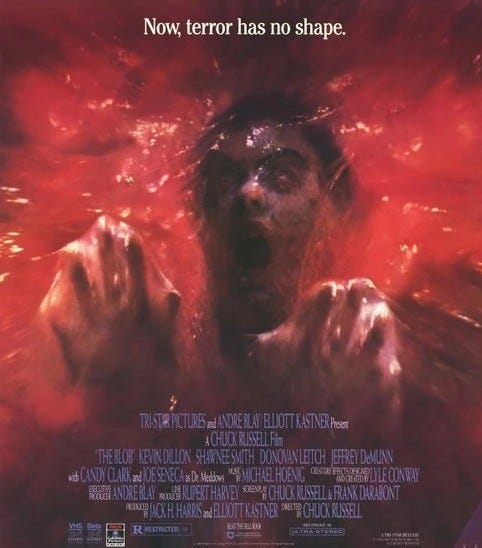
In helping me think through this article, Samer Cohen (whose work you should check out), said to me “I have often believed that the Jews’ racial identity is actually not self determined. It is put upon us, and it demands different things of us depending on where we are. I think we adapt to the identity rather than buy out of or into it, and in other cases, like historically in Europe, we are forced into it, and it can rapidly change depending on the political climate.” I agree with Samer that we cannot control what it is to be Jewish to the eyes of the goyim. I think the difference this time is that whiteness seems not so much a racial identity as the demand to give up specific ethnic identity for the protection and power of the blob-monster we call white. It subsumes you and all your uniqueness and uses your body for violence. As the tagline for the 1988 remake of the 1958 horror classic The Blob reads, “Now, terror has no shape.” Insofar as whiteness is a system, it should also be something you can subtract your support from. And insofar as it demands unspecificity, insofar as it demands the abdication of what you were known as before, I believe that we Jews cannot and should not allow ourselves to be subsumed into it. Afterall, isn’t that part of what is so awful about being American, that you become part of the ‘melting pot’, a chunk of fuck knows what in the sludgy soup, no longer identifiable not only as what you once were, beef or carrot, turnip or beet, but as anything distinct at all. And, if you refuse to melt together, if America can still tell what you are at the end of the day, then well, you’re not really fully American. You’re the kind of American with a hyphen attached. You’re not white. With thousands of years of culture, and thousands of years of diasporic living, how dare this little country of not yet three hundred years demand that we become indistinguishable. How dare it demand we perpetuate its racist system. How dare it demand that give up our distinctiveness and call ourselves white so that we can lord power alongside the white people who chant “Jews will not replace us!”
A Final Caveat
It is important to acknowledge that Judaism is essentially a tribal religion. It’s a bronze age real estate deal. Swaths of the Tanakh are basically rough plagiarisms of standard vassal contracts where the relationship between say the Kingdom of Judea and Egypt has been swapped out for the relationship between the Jewish people and G-d. Because of this, who counts as Jewish has largely depended historically on who was allowed into the tribe. It is not a convert religion like Christianity or Islam. But it also traditionally isn’t a race. It functions much closer to North American Indigenous tribal membership. You are Jewish if you sufficiently abide by the rules, if other Jewish people recognize you as one and invite you in in large enough numbers that you can form a community, and if you are willing to recognize yourself as Jewish for better or worse, the good times and the bad. It has been this way from the beginning. In one of the most lesbian passages in the whole of Judaism, Ruth (who was not born Jewish) says to her Jewish mother-in-law Naomi: “Do not entreat me to leave you, to return from following you, for wherever you go, I will go, and wherever you lodge, I will lodge; your people shall be my people and your God my God. Where you die, I will die, and there I will be buried. So may the Lord do to me and so may He continue, if anything but death separate me and you.” Of course, being born into the tribe works just as well, better really. Still, as much as this article is about where Jewish people fit into American racial relations, it is important to remember that those racial relations are a white supremacist and colonial imposition on Jewishness and Judaism.
This racial imposition flattens Jewish people to a racial conception that does not easily fit. Our features are wide and varied. The insistence that Jewish people are white erases Ethiopian Jews and the Black Jews of North America (we rarely acknowledge the Jewishness of people like Eric André, Rashida Jones, Lenny Kravitz, Drake, Sammy Davis Jr., and Maya Rudolph). It also fails to acknowledge the Mizrahim (although I try not to use this label since it itself is a racialization imposed by the State of Israel, although since they are among the most loudly Zionist groups, perhaps it is appropriate). Then, of course, there are the (woke) white people who love to insist on the brownness Sephardic Jews, in sloppy North American attempts to read onto them some sort of “good ones” narrative that allows them to further vilify the Ashkenazi as ‘the bad white ones’, ignoring much in the process, including that the Sephardi hail from Spain. And of course, Ashkenazi as a term has expanded so much in recent years. Seventy years ago, my friend A. Goldman’s parents would probably have spit at me and called me Ostjuden. Now they see me as Ashkenazi.
The point I am trying to make, is that I have presented a very Ashkenazi-centric view of Jewishness here, because North Americans imagine and flatten Jewishness to merely be the Ashkenazim. However, within Judaism, there is a myriad of different and overlapping self conceptions that war with each other on the basis of religious commitment, race, and heritage. Within the Orthodox world things become even more navel gazing and fractured. These realities, despite their importance within Judaism, and within Jewishness, unfortunately matter very little to how the average goy North American perceives Jewishness. That has always been the case. We became a race, not by our own choosing or because it made sense to us, but because the goyim decided that was what we were. If this essay is anything, it is the question: do we Jews get a say?
No posts
Comments
Nothing yet. Say the first thing.
Sign in to join the conversation.