
I no longer have any PhD funding. That means I’ve zero income from what is effectively my day job. A Pistachio Frappuccino® from Starbucks costs $7.35USD plus sales tax A subscription to my Substack costs $8USD. Because I’m a Canadian that’s $11CAD to me. If I get 120 paying subscribers I can make my previous PhD income off Substack alone and can stop doing SW. If I got 200 I could probably actually afford to like live comfortably (phd income levels are precarious at best)! Basically for the price of buying me a coffee a month you can be a shockingly large part of how I stop doing SW and get out of poverty. Please Consider subscribing!
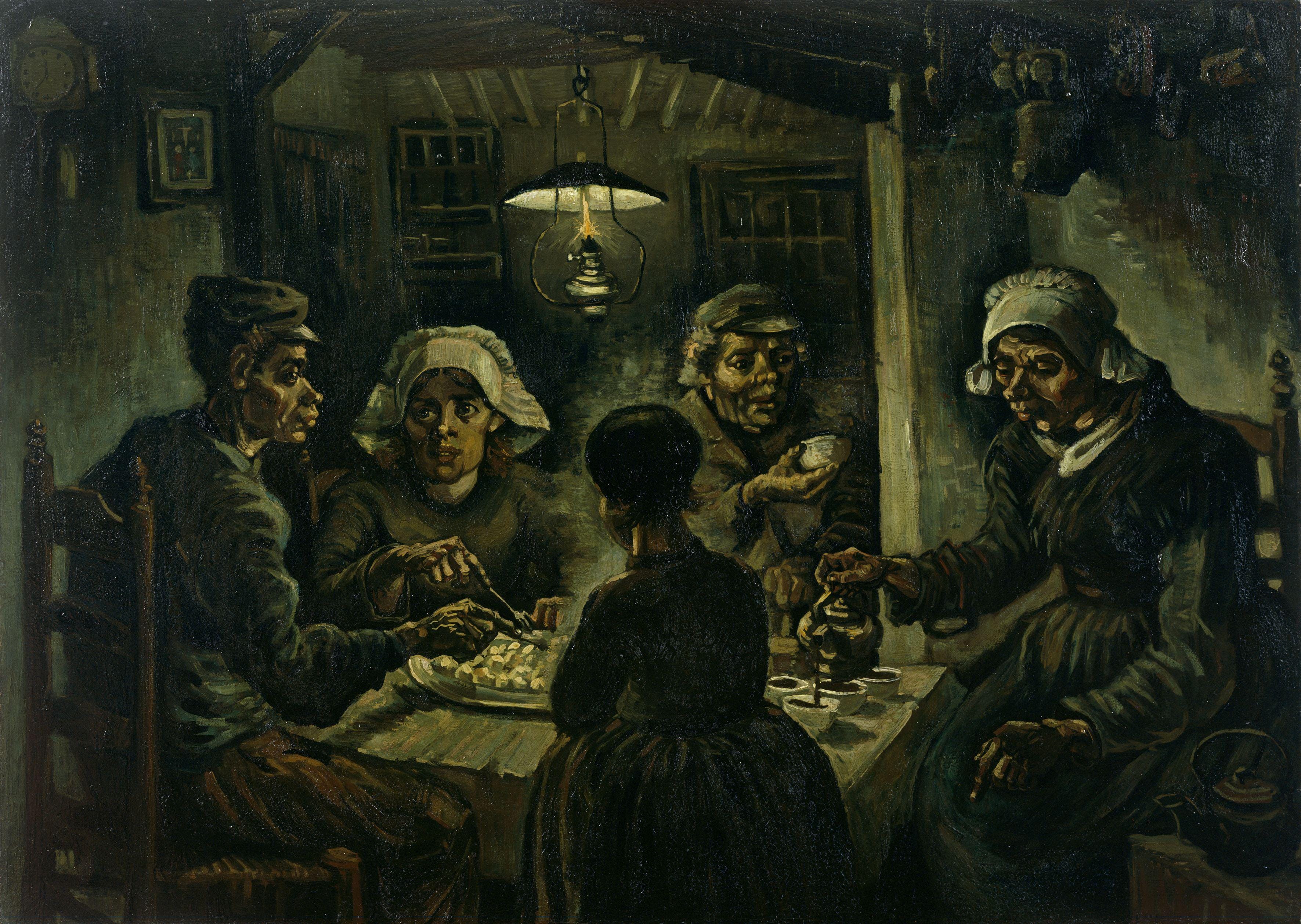
Vincent Van Gogh, The Potato Eaters (1885)
I’ve been writing a lot lately. I’ll be real with you, It is panic writing. I am trying desperately to bring my Substack paid subscriber count up. This is not an abstract goal. I am not some egomaniacal hedge fund manager who has gamified income into a twisted points system. I am just broke. I’ve been broke for a long time now. I am sick of it. It eats away at me and with the loss of my PhD funding, I am about to be more broke than ever. It is not the first time I’ve been broke. I spent much of my early childhood broke. My father slept on my grandmother’s sofa. When I came and visited him, he slept on the floor. One summer he slept in his wealthy’s friends stable. It was a beautiful stable, and his room was once that of a stable boy. Still, it was a century old stable. Things were a little better with my mother. She had an apartment in one of those big 60s blocks. It had faux parquet floors and in the summers your feet would stick to them. The old glue would give way, and a wood tile would lift out of its spot. I learned to notice that sensation quickly and could avoid the pain of stepping back down with it still stuck to my foot. Then, as you went to stick the wood tile back into its place you would notice the moldy blackness of the concrete underneath. You would see how the wood had separated from it. Then, more often than not, a cockroach would crawl out with great haste. That was okay because you, that is I, had learned to use the handy wood pile to crush it. They’re hard to kill, but a wood tile will do it. At least, it will if you really lean your whole child sized weight into it.
I was launched into poverty when I was five. It isn’t important why. Perhaps children who were born into it feel different, but I have lived my entire life afraid of returning to it. Poverty hangs like a guillotine blade. I look up and it is there waiting. I can see the string holding it, but not who will cut it. Poverty does not hang like the “Sword of Damocles”. Swords decapitate the rich and powerful. The guillotine was made to utilitarian. Maybe there’s some ancestral memory of fleeing from Cossacks through some long snowy Ukrainian night, bringing into the wagon only the Judaica that would sell well wherever we were going.[1] Either way, poverty has haunted my mind in a manner I’ve not witnessed among my friends with more affluent heritage. Perhaps that is why I’ve never been the type of Marxist who fetishized it, the type you meet who hunger to hunger. It all seems terribly romantic to them. They dream of looking gaunt with tuberculosis in some Parisian loft with exposed wood beams. Or they dream of living in some collapsing tenement on West 23rd St in 1977. They do not dream of being a Walmart employee. Still, whatever they dream of, I’ve never been one of them. Marxism is not my religion. To me it is merely a good and useful theory. My religion, to the extent I have one, is about survival. I will never waste away like Simone Weil. I will fight and panic. There will be nothing beautiful in it.
Susan Sontag recalled a decade later how she wrote her classic Illness as Metaphor during her own struggle with cancer. She produced it while she “wept, struggled, was comforted, [and] struggle[d]” some more. She “wrote it very quickly, spurred by evangelical zeal as well as anxiety about how much time I had left to do any living or writing”.[2] I wish that I was Sontag. I wish I was confident that I could produce something that groundbreaking while wracked with anxiety. I am doing my best to. But I also want to take a minute to think about what it is to write while in poverty panic. There are very few modern autodidacts from working class backgrounds. Heinrich Blücher and James Boggs are my two favourites. It is notable that these authors produced the majority of their work (and more importantly, read the majority of what they needed to read) during the high point of Keynesian prosperity and resultingly positive work-life balances for the working classes. Now even those of us fortunate enough to receive post-secondary education do so with severe economic precarity. The description of “Publish or perish” which when first coined in the mid-century was a figurative perish is now very literal. Or rather, it is “publish and starve”. In their discussion of my essay “Sex Working Through Your PhD,” Devon accounts for how it too relied on sex work (in the form of caming on Chaturbate” to get by in grad school. Devon also mentions how a “severe eating disorder” benefited budgeting during that period. In my essay I talk about fellow students who dumpster dive. While I’ve never done that, I was eating one meal (and no snacks) a day for most of the last three years. Just now, I allowed myself to get distracted while writing this article. I hoped Instagram and noticed I had a DM request. I’ve been getting a lot of those since the sex working article came out. This one turned out to be much like the others: “Hello, PhD candidate here, funding also expired. Read your article the other day before going to the strip club where I work. While getting ready in the back my coworker told me that she is in the second her of her PhD in neuroscience. We’ve worked together for half a year and didn’t realize we’re both in PhD programs”. The point I am trying to make here, is that during graduate school, and often even as adjunct (aka contract profs), we are underfed, sleep deprived, and full of anxiety.
According to Demosthenes, “Poverty forces the free to do many slavish and base things”.[3] In The Human Condition, Arendt paraphrased this as “Poverty forces the free man to act like a slave”.[4] She adds “Private wealth, therefore, became a condition for admission to public life not because its owner was engaged in accumulating it, but on the contrary, because it assured with reasonable certainty that its owner would not have to engage in providing for himself the means of use and consumption as was free for public activity”.[5] She additionally pointed out that in ancient Athens if “the property-owner chose to enlarge his property instead of using it up in leading a political life, it was as though he willingly sacrificed his freedom and became voluntarily what the slave was against his own will, a servant of necessity.”[6] The idea here then was not to class demarcate who has a voice politically (although all modern democracies did this into the twentieth century). Instead, the idea was that those who are desperately attempting to survive, or the wealthy who hustle so hard that they might as well be, have psyches that somehow do not produce good work. Or, more accurately, the idea is that political debate and decision-making capacity is negatively impacted by the headspace one gets into when they feel their life on the line.
In the sex working article I suggested this in the inverse. I talked about how people who are financially stable, who have the monthly financial support of parents, see the benefits in their work. I wrote: “If you’ve a professor parent or two who can teach you how to navigate the competitiveness, can teach you how to fill out grant applications (might even fill them out for you), and will fund your lifestyle through the financial insecurity of a PhD, then why wouldn’t you do it? It might not even matter to you how long it takes to finish. What matters is that your work is great! What matters is that you took your time. You got to pour over every line, consider every objection.” Under the “Publish or Perish” imperative even fifty years ago the work of academics was suffering. Arendt wrote that this “business of ‘publish or perish’ has been a catastrophe. People write things which should never have been written and which should never be printed.”[7] Under “Publish and Starve” it has gotten much worse, and it has gotten even outside of academia. Journalism now exists under this model. Screen writing is now under this model. I cannot tell you how often I hear of people taking “AI Training” gigs to make ends meet. They are training their own killer. Worse, many “writers” are desperately turning to AI to write for them. Some are glory seekers who don’t even care if they did the things that got them glory. These are the true dregs of society. Others are merely in professions where they’re being pressured into using it by timelines imposed on them by poverty, economic incentive, and AI loving bosses. I’ve more sympathy of them, though it remains minimal at best. But I’m getting sidetracked and I’ve already discussed AI detection.
My point is that the late capitalist economy (if it even is still that[10]) has proletarianized almost all truly thinking labour. The jobs which are not proletarianized mostly exist as a form of welfare[11] that preserves the class interests of the remaining middle class.[12] These jobs are explicitly “bullshit jobs” rather than “thinking” jobs. It is far more advantageous for capitalism to have jobs where you do nothing but collect a paycheque, answer emails, and consume advertising, than for you to have a job where you get to think or problem solve.[13] Thus, while the slave/master dynamic of the ancient world had ended, as had the lord/serf relationship of the middle ages, by the 19th century it was apparent that the relationship was now citizen/survival. It was proletariat/bourgeoisie too, but now it was also citizen/survival. According to Arendt, “Marx’s hope […] rose from the fact that the modern age had emancipated this subject class to the point where it might recover its ability to act […] it had liberated them from their masters only to but them under a stronger taskmaster, their daily needs and wants, the force, in other words with which necessity drives and compels men and which is more compelling than violence. Marx, whose general and often inexplicit outlook was still firmly rooted in the institutions and theories of the ancients, knew this very well”.[14] As work has increasingly become a gig economy, this phenomenon has only become more true. In my PhD work I am an unpaid worker with a boss (my supervisor). However, to financially support that relationship I engage in two things: sex work and substack writing. In both sex work and substack writing I am a gig employee if I am an employee at all. When I make money off pornography hosted on a website, I am a gig employee.[15] When I write for substack, my writing is hosted on substack and they take 10%, also making me a gig employee. In both of these instances, it honestly does not feel that different from when I biked for Uber Eats in terms of my relation to the company.
What I put into it is what I get out of it, kind of—sometimes an article I worked hard on flops. In my interview with the porn star Lili, she said something similar about Fansly. She got addicted to it, “I got exactly out of it as much as I put into it, and I’ve never had that happen before, and I mean, I don’t know if you know this about me, but I’m like a notoriously hard worker, like I am. […] By which I mean, I love to work when I feel like I am being validated and recognized for it […] give me praise […] and I will work endlessly for you.” That’s where I’ve felt I’ve been lately too, but with Substack.
Except. It is a little different. Lili does not describe the same panic I feel, the same panic I write this article with. She did not feel the guillotine of Damocles hanging over her head. Her journey into sex work was within the rare confines of a financial situation that assured her that she no longer needed to concern herself with economy. She, like graduate students with rich parents, got to focus on the quality of her work. And I, I am worried that I am not. I’m doing my best to. I’ve never written with AI, and I try to avoid writing anything that is rage bait (sometimes I fail because the topic I want to write on happens to inspire rage). Yet, I know I can write better than this. I am writing once a week. I am writing with limited editing. I am writing with limited time to research. I am writing because each article I write generates about five paying subscribers, and that’s $500 over the course of a year. That might not sound like a lot to you. But my gosh, it’s a game changer to me. Then, when an article flops. When no one new pays, I panic. I feel my poverty. I know that I am only halfway to a salary that would meet the poverty line in my city. I feel that at some point there will be no one left who cares about funding my writing. I wake up terrified that I’m already there. I cry into my pillow or the hair of a lover because I am only halfway there. Halfway to survival doesn’t mean you get to half live. Survival, unfortunately, is binary. You do or you do not. So, I start writing something new. And then I think, what if this doesn’t do anything either? So, I write faster. And then I write faster. Because I need to know that I will get by.
Hannah Arendt defined poverty thusly: “Poverty is more than deprivation, it is a state of constant want and acute misery whose ignominy consists in its dehumanizing force; poverty is abject because it puts men under the absolute dictate of their bodies, that is, under the absolute dictate of necessity as all men know it from their most intimate experience and outside all speculations.”[16] If you do not agree with this definition, you have not known full blown poverty. Poverty is when all of your actions are survival actions. Poverty is when even your elevated lofty thought and theory is about one thing, food and housing. This is why the Greeks didn’t trust it. How could they? I barely trust myself. Throughout human history, “the predicament of the poor after their self-preservation has been assured [has been] that their lives are without consequence, and that they remain excluded from the light of the public realm where excellence can shine; they stand in darkness wherever they go.”[17] The meritocratic aspect of the internet, the fact that I am no one except online, and am someone online completely detached from who I am in person, has meant that people in poverty can shine brightly.
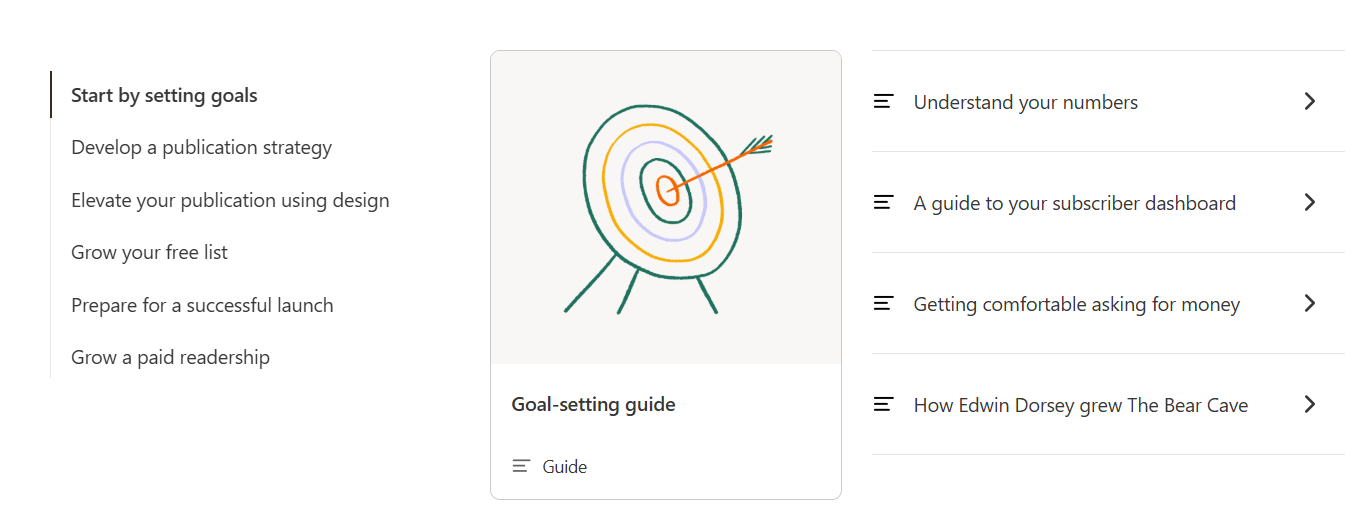
Begging has historically been confined to street corners, transit stations, and rushed trips with tin can in hand through diners and bars. Now, it is the voice of the impoverished on the internet. You cannot scroll through Tumblr without seeing the post of a known account begging for money. Instagram is awash in gofundme links. Substack is no different. The app itself actively encourages it. If you go and read the advice that Substack gives to its users on “going paid” they have an entire sub-article about getting “comfortable asking for money”. Most of us on the internet have gotten fairly numb to it. You have too. There’s so many people asking for it. You skim past the post. No matter what it says, it will not be different from anyone else’s equivalent post. Maybe you give to a friend, or an account you’ve followed for awhile and feel attached to. But that’s what the cause will be. It won’t be about how desperate the person is. Afterall, all the posts seem the same.
Even if you have made a name for yourself online, there’s something deeply debasing about asking for money. I’ve given nearly a decade to Auto_Anon now. Many of you have grown up with me. People tell me all the time that they read me at lunch during High School who are now fully blown adults established in the work force. Yet, every time I write some note on substack telling you that I am poor, asking you to consider paying for what you have read for free for seven years, I feel myself disappearing into that one same voice with which poverty speaks. Convinced that it was the shift from attempting to give the people democratic voice to trying to ensure that people were fed that brought on The Terror period of the French Revolution, Arendt wrote that, “Robespierre once compared the nation to the ocean; it was indeed the ocean of misery and the ocean-like sentiments it aroused that combined to drown the foundations of freedom.”[18] It is this online ocean into which I can feel my individuality be consumed when I ask you to pay me.
Friends assure me that it is not begging. They point out that I am a writer who is selling her work to people who should be paying for her labour. I am literally providing a service they say. I ensure that people with “email jobs” have something to read. My work is a baston against the boredom that capitalism encourages in the few people it allows relative prosperity. It is my job to make sure that people’s brains do not rot playing candy crush or listening to podcasts they half tune out. All of this is true. Except, I am still begging. I am doing what squeegee guys used to do at traffic lights (at least in Canada this practice is far less common then when I was a child). I am providing a service to make both of us feel less like it’s charity, less like its begging. But, until I have enough financial leeway to write what I want to write, at the pace I want to write it, with the detailed research that I long to put into it, it is begging. Speaking about the first time the impoverished were granted political voice in the French Revolution, Arendt writes that the impression that they were “driven by one will was an exact description of what they actually were, for what urged them on was the quest for bread, and the cry for bread will always be uttered with one voice. In so far as we all need bread, we are indeed all the same, and may as well unite into one body.”[19] I need bread. I need bread. I need bread. That is what my writing is saying. That is what I have said these past two months on here. I have said a lot else, and I am proud that I have not yet been reduced to solely saying “I need bread”, but every line of text contains implicit in it “I need bread”.
Worse, it is not even effective begging. I have written several articles thousands of words long that have earned me zero new income. Meanwhile if I write and post a one-hundred word “note” detailing my financial situation it usually brings in at least $150. Why do you respond better when I ask bluntly for money, when I remove my skills from the equation? Do you prefer when I am not a person but the role of beggar? “Oh this person is asking for money, I will give them money” seems a much easier thought for most people to have than “I enjoyed this article and would like to express my enjoyment of it by paying a fair market rate for it”. So, I keep writing little notes begging for money. And I write long essays because I love writing long essays. And I try and tell myself that people give money to the notes because they like my essays. But I’m not sure that’s true. I really want it to be true. But want is not sure.
I am not alone. We are a mass. We are the creative lifeblood of this world. We are your waiters, your strippers, your porn stars, your uber drivers, your babysitter, your dominatrix, and regrettably, your AI trainers. We are also your special effects team, your favourite comic creator, illustrator, screen writers, academics, journalists, teachers, copy editors, tutors, journal editors, painters, sculptors and substack authors. We supply you everything that you look forward to consuming in life. Yet increasingly we speak with one voice, “I need bread”. And when someone is saying “I need bread”, the other voice, the individual voice that they yearn to be heard over and above their poverty, is quieter, is worse. If you want a world where the things you enjoy are good, are not slop, it isn’t enough to not support people who use AI. You must also support the people AI is trying to replace. Its needs are so great that it is draining lakes. But I need water too.
[1] I’m evoking Stefan Zweig’s short story “Im Schnee” here. If you haven’t read it, I highly recommend it.
[2] Susan Sontag, Illness As Metaphor and AIDS and Its Metaphors p101
[3] Demosthenes, Orationes 57. 45 (cited in Arendt, The Human Condition, page 64)
[4] Hannah Arendt, The Human Condition p.64
[5] Hannah Arendt, The Human Condition p.64
[6] Hannah Arendt, The Human Condition p.65.

Samantha Rose Hill@Samantharhill
"[R]eally good teachers are not thought of highly by the academic society. This business of 'publish or perish' has been a catastrophe. People write things which should never have been written and which should never be printed. Nobody's interested." — Hannah Arendt

5:27 PM · Sep 4, 2024 · 68K Views
14 Replies · 288 Reposts · 1.06K Likes
[8] https://www.mayoclinic.org/diseases-conditions/narcissistic-personality-disorder/symptoms-causes/syc-20366662
[9] https://www.pangram.com/dashboard?pendingCheck=true&pendingType=text&step=pricing
[10] https://www.versobooks.com/en-ca/products/887-capital-is-dead?srsltid=AfmBOooYk0ielHN6w8WrzybthC8Upye6et4LCXBOJvKvkI5DGMcKHewC
[11] https://en.wikipedia.org/wiki/Bullshit_Jobs
[12] https://archive.org/details/affluentsociety0000unse_l6q9
[13] https://autoanon.substack.com/p/the-loneliness-economy
[14] Hannah Arendt, On Revolution p.53.
[15] When I sell things more physically or privately, I am outside of the employee status, but I am also a kind of product and the owner.
[16] Hannah Arendt, On Revolution p.50.
[17] Hannah Arendt, On Revolution p.59.
[18] Hannah Arendt, On Revolution p.85.
[19] Hannah Arendt, On Revolution p.84
No posts
Comments
Nothing yet. Say the first thing.
Sign in to join the conversation.